


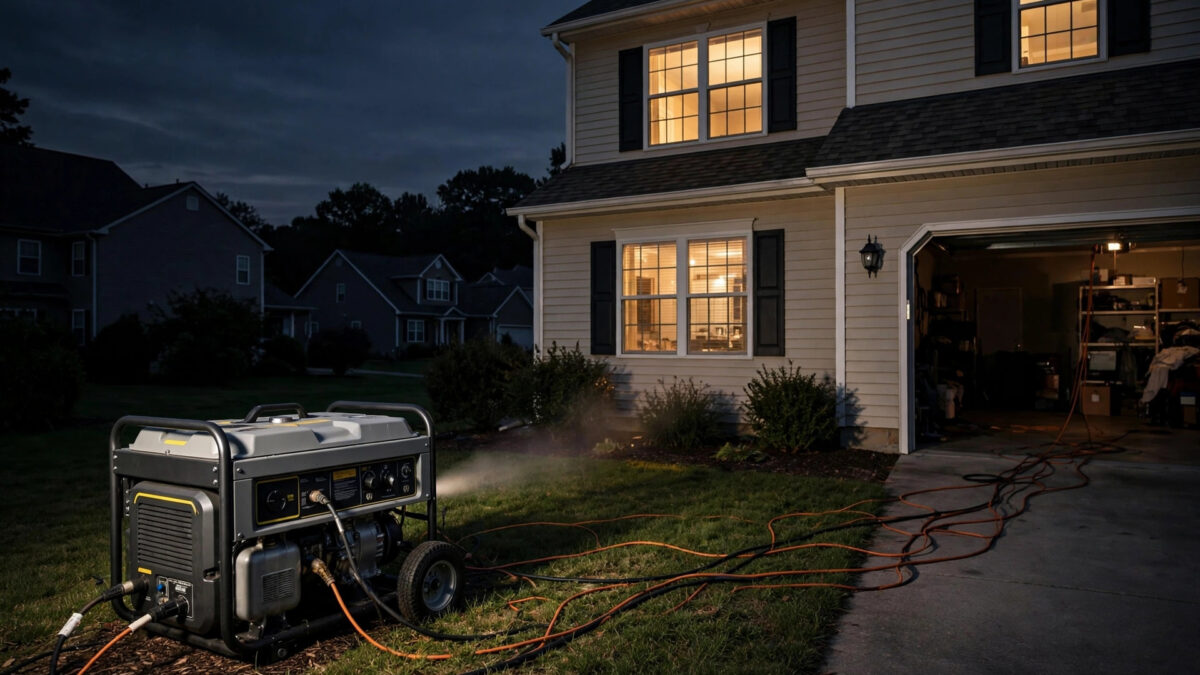
The 6,500-watt class is America’s home-backup sweet spot. It’s the smallest size that covers the true essentials — fridge, freezer, furnace blower, well pump, lights — without forcing you to play appliance triage in the dark. Go smaller and you’re choosing what stays on. Go bigger and you’re paying for watts you’ll rarely use.
For 2027, the class splits two ways: quiet inverter models led by the Briggs & Stratton Q6500 (6,500W at just 66 dB — unheard of in this size), and conventional workhorses like the Generac GP6500E that deliver the same watts for less money and more noise. Here’s how the five best stack up, with real specs and real listings.
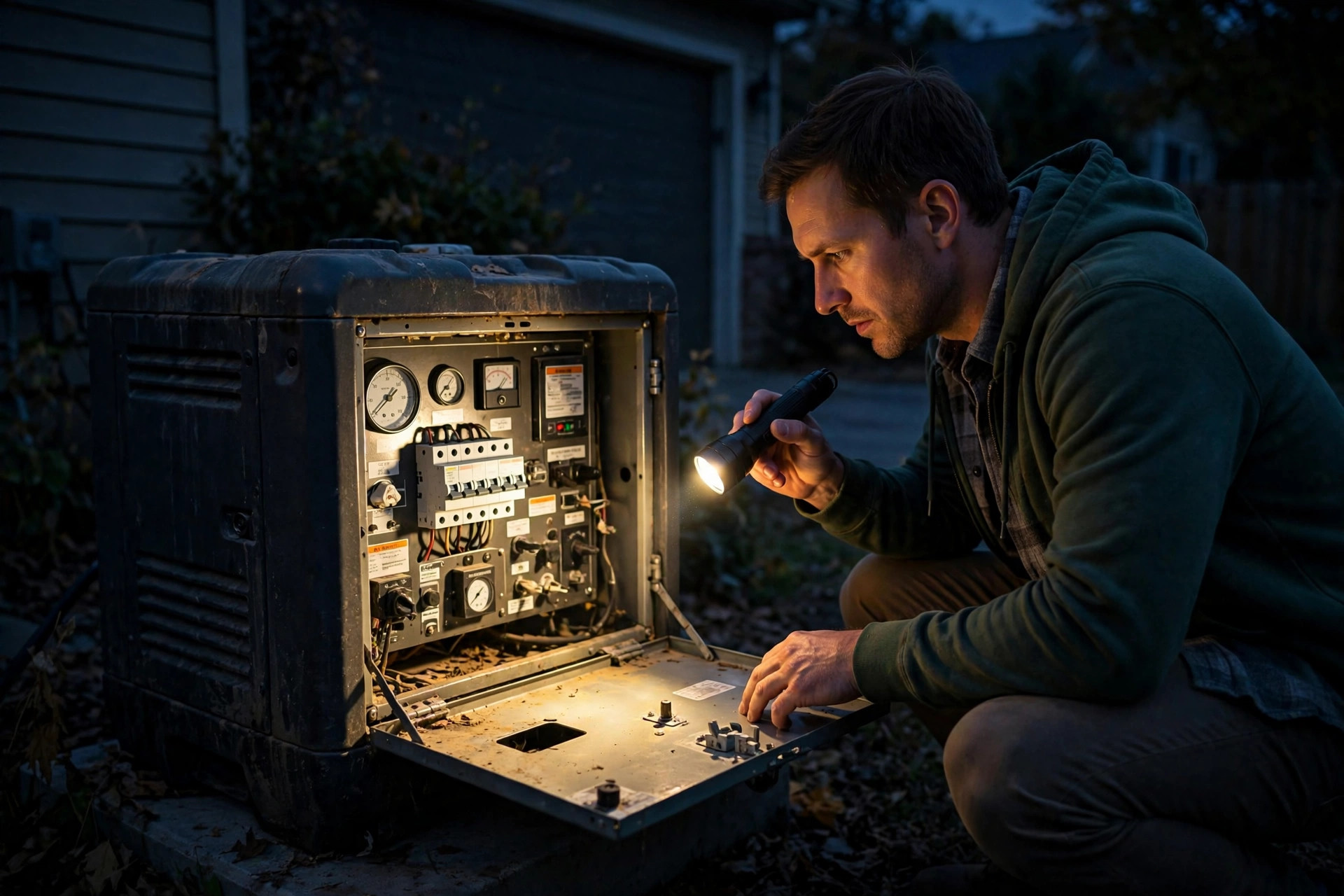
Key takeaways
- 6,500W covers the essential home backup list: fridge, freezer, furnace blower, well pump, lights, devices.
- The Briggs & Stratton Q6500 is the only genuinely quiet option in the class at 66 dB — an inverter.
- Conventional 6,500W generators (Generac, Westinghouse, Champion, DuroMax) cost less but run ~72 dB.
- Electric start is standard on most picks here — worth it when you’re starting up in a storm.
- None of these will run a central AC; that’s 10,000W+ territory.
Quick picks
- Best overall: Briggs & Stratton Q6500 — 6,500W inverter, 66 dB, the quiet pick.
- Best conventional: Generac GP6500E — 6,500W, electric start, COsense, great value.
- Best dual-fuel: Westinghouse 6600W Dual Fuel — 6,600W peak, propane-ready, budget-friendly.
- Best inverter value: Champion 6250W Open-Frame Inverter — 6,250W, 69 dB, 13.5-hour runtime.
- Best budget: DuroMax XP5500EH — 5,500W dual fuel, MX2, lowest price here.
Best overall
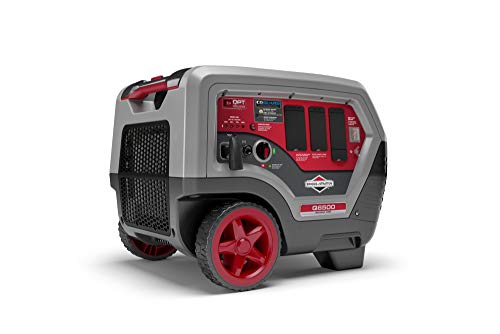
Briggs & Stratton Q6500 Inverter Generator
- Running Watts: 5,000 W
- Runtime: ~14 hrs @ 1/4 load
- Noise Level: 66 dB
- Weight: 139 lbs
As an Amazon Associate, we earn from qualifying purchases.
The Q6500 is the most interesting generator in this class, because it shouldn’t exist: 6,500 starting watts and 5,000 running watts of inverter power at just 66 dB. That’s roughly 8 dB quieter than every conventional 6,500W generator — a difference your neighbors will notice during a multi-day outage.
Being an inverter, it produces clean power for furnace control boards, computers, and modern appliances, and it throttles down at light loads to stretch the 5-gallon tank. The 306cc Briggs engine is a known quantity with deep parts support. CO Guard shutdown is included.
At 139 pounds it’s no lightweight, and typical pricing runs $1,300–$1,600 — a premium over conventional rivals. But based on spec comparison and owner feedback, it’s the only 6,500W-class generator I’d run in a suburb without dreading the neighbors. Quiet, clean power at this wattage is genuinely rare.
Pros
- Only 66 dB — quietest in class by far
- Clean inverter power for electronics
- CO Guard shutdown included
- Deep Briggs parts and service network
Cons
- Premium price ($1,300–$1,600)
- 5,000W running — less than conventional rivals
Best conventional
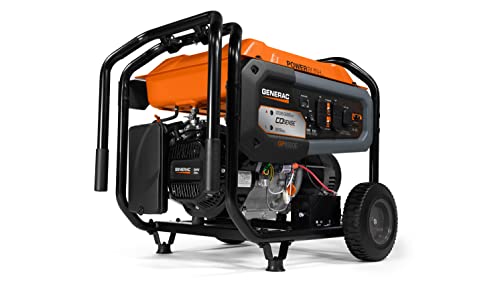
Generac GP6500E Portable Generator (7713)
- Running Watts: 6,500 W
- Runtime: ~10 hrs @ 1/2 load
- Noise Level: ~72 dB
- Weight: 182 lbs
As an Amazon Associate, we earn from qualifying purchases.
The GP6500E is the mainstream answer: 9,100 surge watts, 6,500 running watts, electric start, 6.9-gallon tank, typically $900–$1,100. Generac’s PowerRush technology delivers extra starting current for motors — well pumps and sump pumps start easier than the numbers suggest.
This is the generator for buyers who want proven, conventional, no-surprises backup. The 439cc engine is a workhorse, COsense shutdown is standard, and Generac’s dealer network is the largest in the industry. Runtime runs about 10 hours at half load — overnight coverage without a refill.
The trade-off versus the Q6500 is noise (~72 dB) and power quality (conventional AVR, not inverter-clean). For furnaces, fridges, pumps, and lights, that’s fine. For a house full of sensitive electronics, the inverter matters. Based on owner feedback, the GP6500E is a set-and-forget storm performer.
Pros
- Full 6,500W running for ~$1,000
- PowerRush motor starting
- COsense + electric start
- Huge service network
Cons
- Louder than the Q6500 inverter
- Gasoline only
Best dual-fuel
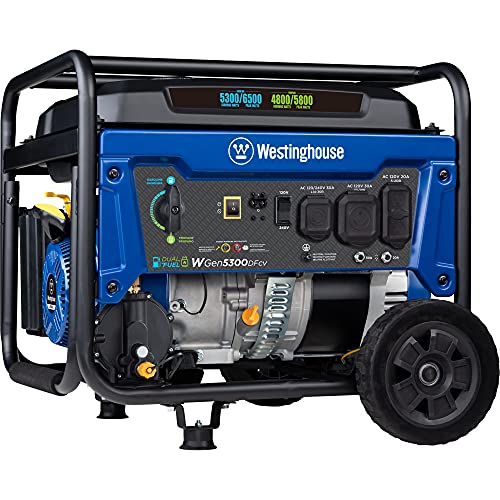
Westinghouse 6600W Dual-Fuel Portable Generator
- Running Watts: 5,300 W (gas)
- Runtime: 14.5 hrs @ 1/2 load
- Noise Level: ~72 dB
- Weight: ~150 lbs
As an Amazon Associate, we earn from qualifying purchases.
Westinghouse’s 6600-watt dual-fuel unit (6,600 peak / 5,300 running watts on gas) is the budget-friendly way into propane backup: typically $600–$800. The 274cc engine and 4.7-gallon tank deliver about 14.5 hours of runtime — the longest per tank in this roundup.
The dual-fuel angle is the whole pitch: propane stores indefinitely, so the generator is ready even after sitting for a year. For seasonal storm prep — hurricane coast, ice-storm country — that readiness matters more than a few hundred watts.
It’s a conventional generator at heart: ~72 dB, AVR power regulation, straightforward and proven. Based on spec comparison and owner feedback, it’s the value dual-fuel pick for buyers whose essentials fit under 5,000W continuous. If your load list is bigger, step up to the GP6500E.
Pros
- Dual fuel at a budget price ($600–$800)
- 14.5-hour runtime is class-leading
- Propane stores forever
Cons
- 5,300W running — smallest here
- Conventional noise and power quality
Best inverter value
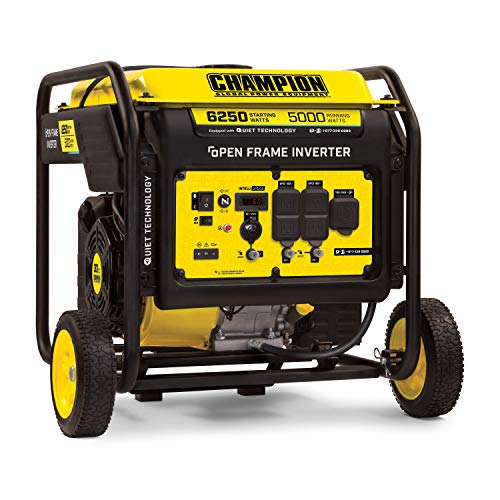
Champion 6250W Open-Frame Inverter Generator (100522)
- Running Watts: 5,000 W
- Runtime: 13.5 hrs
- Noise Level: 69 dBA
- Weight: 121 lbs
As an Amazon Associate, we earn from qualifying purchases.
Champion’s open-frame inverter is a clever compromise: 6,250 starting watts, 5,000 running watts of clean inverter power, but in an open frame that costs far less than enclosed inverters like the Q6500. Noise is 69 dBA — 3 dB quieter than conventional rivals, a noticeable difference.
The 301cc engine and 4.2-gallon tank deliver 13.5 hours of runtime. At 121 pounds it’s lighter than the enclosed Q6500. Typical pricing runs $900–$1,100 — inverter power quality at conventional prices.
The open frame means it’s not as quiet as the Q6500, and it lacks the fully enclosed look. But based on owner feedback, it’s a workhorse: clean power for electronics, good fuel economy, Champion support. If you want inverter benefits without the inverter premium, this is the one.
Pros
- Inverter-clean power at conventional prices
- 69 dB — quieter than open-frame rivals
- 13.5-hour runtime, only 121 lbs
Cons
- Not as quiet as enclosed inverters
- Gasoline only
Best budget
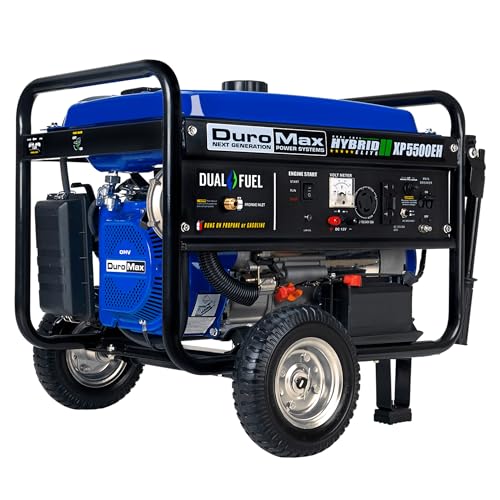
DuroMax XP5500EH Dual-Fuel Generator
- Running Watts: 4,500 W
- Runtime: 9 hrs @ 1/2 load
- Noise Level: ~72 dB
- Weight: ~140 lbs
As an Amazon Associate, we earn from qualifying purchases.
The XP5500EH is the cheapest way into the 6,500W conversation: 5,500 starting watts, 4,500 running watts, dual fuel, typically $600–$800. DuroMax’s MX2 technology switches between 120V and 240V to deliver full power from every outlet — a genuinely useful feature competitors charge more for.
Runtime is about 9 hours at half load on gasoline. The 224cc engine is proven across DuroMax’s line. Yes, 4,500 running watts is a step below the class nominal — but it still covers fridge, freezer, furnace blower, and lights, which is the actual emergency list for most families.
Based on owner feedback, the XP5500EH is a reliable budget performer. Buy it when the budget is fixed and the essentials list is honest. If you need the full 6,500W, the Generac above is worth the step up.
Pros
- Lowest price in the roundup
- Dual fuel with MX2 full-power outlets
- Covers the true essentials list
Cons
- 4,500W — below class nominal
- Basic feature set
Side-by-side comparison
| Product | Running W | Fuel | Noise | Best for |
|---|---|---|---|---|
| Briggs & Stratton Q6500 | 5,000 | Gas | 66 dB | Quiet overall pick |
| Generac GP6500E | 6,500 | Gas | 72 dB | Conventional value |
| Westinghouse 6600W DF | 5,300 | Dual | 72 dB | Budget dual-fuel |
| Champion 6250W Inverter | 5,000 | Gas | 69 dB | Inverter value |
| DuroMax XP5500EH | 4,500 | Dual | 72 dB | Budget pick |
How to choose a 6500-watt generator
The 6,500W class is about honest essentials. Here’s the decision framework.
Inverter vs. conventional: the class’s big fork
This is the only wattage class where the choice is genuinely hard. The Q6500 inverter gives you 66 dB quiet and clean power for ~$1,450. The GP6500E conventional gives you 1,500 more running watts for ~$1,000, at 72 dB with AVR-regulated (not inverter-clean) power. My rule: if your home has a modern variable-speed furnace, a well pump with electronic controls, or you just hate noise — buy the inverter. If your loads are dumb motors and resistive heat and your budget is fixed — buy the conventional and spend the savings on a transfer switch.
What 6,500W actually runs
The realistic emergency list: refrigerator (700W), freezer (700W), gas furnace blower (800W), well pump (2,000W running — the big one), sump pump (1,000W), lights + devices (500W). Total: ~5,700W running with everything on — inside a 6,500W unit’s comfort zone, with surge capacity for one motor starting at a time. What it won’t run: central AC (3,500–5,000W running alone), electric water heater (4,500W), electric range. If those matter, you’re shopping our 10,000-watt roundup instead.
One subtlety worth knowing: the 125% continuous-load rule from NEC guidance means you shouldn’t run a generator above 80% of its rated running watts for hours on end. On a 6,500W unit, that’s 5,200W continuous — so if your essentials total 5,700W with everything on, you’re technically overloading it in sustained use. In practice, not everything runs simultaneously (the fridge cycles, the pump runs minutes at a time), so real continuous draw is usually 30–50% below the worst-case total. But if your loads genuinely sit above 5,200W for hours — electric heat, I’m looking at you — step up a class rather than cooking a generator at its limit all winter.
Dual fuel: worth it here?
Two of the five picks are dual-fuel, and for storm prep I lean yes. Propane’s indefinite storage means the generator works after sitting for two years — gasoline won’t, without disciplined stabilizer use. The wattage penalty on propane (~10%) rarely matters at these loads. Our dual-fuel guide covers the fuel strategy in depth.
Starting systems and CO safety
Electric start is standard on the Generac and available across the class — at 2 a.m. in a storm, you’ll appreciate it. Every pick here has CO shutdown protection (COsense, CO Guard, or equivalent). Still: 20 feet from the house, exhaust away, never in a garage. For the full safety picture, see our emergency generator guide.
Transfer switch vs. extension cords
At 6,500W you’re firmly in transfer-switch territory if you want the furnace and well pump — both are hardwired. A manual transfer switch or interlock kit, installed by an electrician per NEC Article 702, runs $500–$1,500. Extension cords only reach plug-in loads. Decide before the storm: the electrician’s schedule fills up fast when the forecast turns. Our transfer switch guide walks through it.
Is 6500 watts enough to run a house?
Should I buy an inverter or conventional 6500W generator?
Can a 6500-watt generator run a well pump?
How long will a 6500W generator run on a tank of gas?
Do I need a transfer switch for a 6500W generator?
6500W vs. 7500W: should you step up?
The most common question I get about this class: “for a few hundred more, shouldn’t I just get 7,500 watts?” Sometimes yes. Here’s the decision math.
The real-world gap between a 6,500W and 7,500W generator is about 1,000 running watts — roughly one major appliance. In practice, 6,500W covers the essentials list (fridge, freezer, furnace, well pump, lights) with modest headroom. 7,500W covers the same list plus a microwave running simultaneously, or a well pump starting while everything else runs. If your load list has a 1HP+ well pump and you hate thinking about what’s on, the step up buys genuine peace of mind.
But the step up costs more than the price difference. 7,500W units are heavier (190–215 lbs vs. 140–185), thirstier (~0.9 gal/hr vs. ~0.7 at half load), and louder on average — there’s no 66 dB inverter option at 7,500W like the Q6500. You’re trading the quietest pick in this roundup for 1,000 watts you might never use.
My rule: if your honest load math (running watts + biggest starting surge) fits under 5,500W continuous, stay at 6,500W and enjoy the lighter, quieter, cheaper machine. If you’re at 5,500–6,500W or you have a deep well pump with a big starting surge, step up to our 7,500-watt roundup — the Westinghouse WGen7500DFc is the value king there. And if central AC is on the list, skip both and look at 10,000-watt generators.
Our verdict
The Briggs & Stratton Q6500 is the best 6,500-watt generator for 2027 — the only genuinely quiet option in the class, with clean inverter power. If you’d rather have maximum watts per dollar, the Generac GP6500E is the conventional champion. And the Champion 6250W open-frame inverter splits the difference brilliantly: inverter power quality near conventional prices. Add up your essential loads honestly, apply the 80% continuous-load rule, and buy once — a right-sized 6,500W generator you trust beats an oversized one you resent fueling. Measure twice, buy once, and test it under real load before the storm.
How we researched this: Inverter-vs-conventional spec comparison across the 6,500W class, running-watts verification (not marketing surge numbers), noise-rating analysis, emergency load-list math, and owner feedback on multi-day reliability. Every pick has a verified Amazon listing. We scored noise, power quality, and warranty length alongside raw watts, since backup generators live or die on livability.

Related Guides
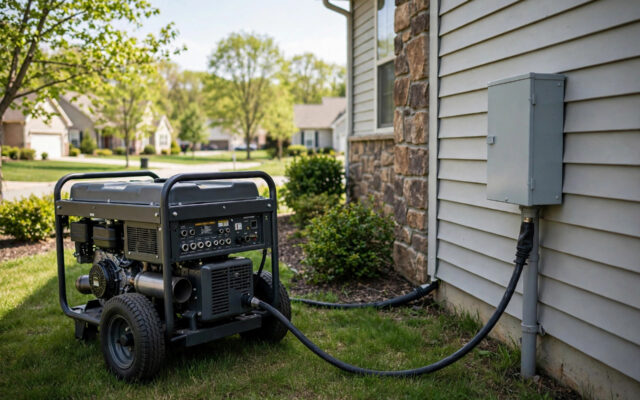
Best 12000 Watt Generators of 2027
Best 12000 watt generators of 2027: 6 whole-home portables compared — tri-fuel vs dual fuel, real specs, transfer switch guidance and fuel planning.

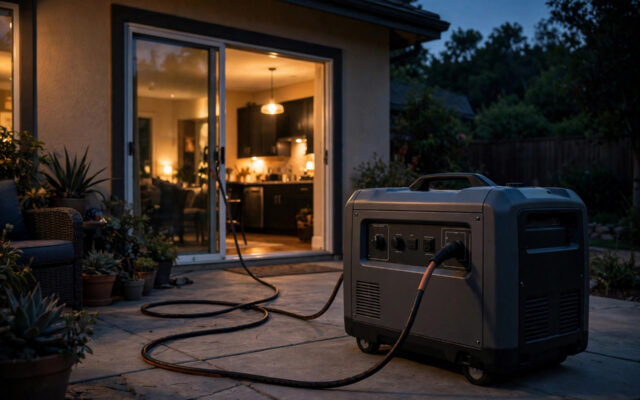
Best 3500 Watt Generators of 2027
Best 3500 watt generators of 2027: 5 top picks compared — inverter vs conventional, dual fuel options, real running-watt specs and buying guide.
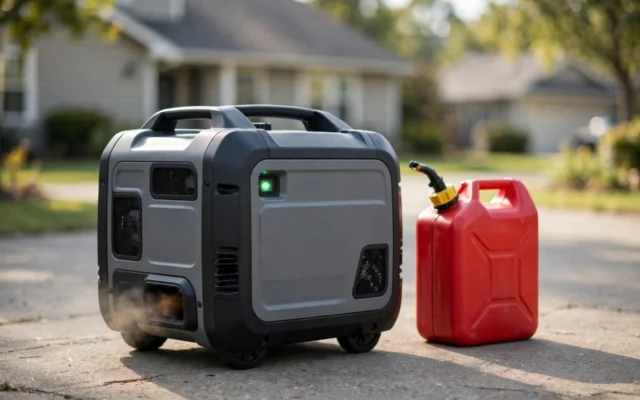
How Much Electricity Does a Generator Make Per Gallon of Gas?
A typical portable gas generator makes 4–7 kWh of electricity per gallon. We break down kWh per gallon by load, size, and fuel type so you can plan fuel for any outage.