


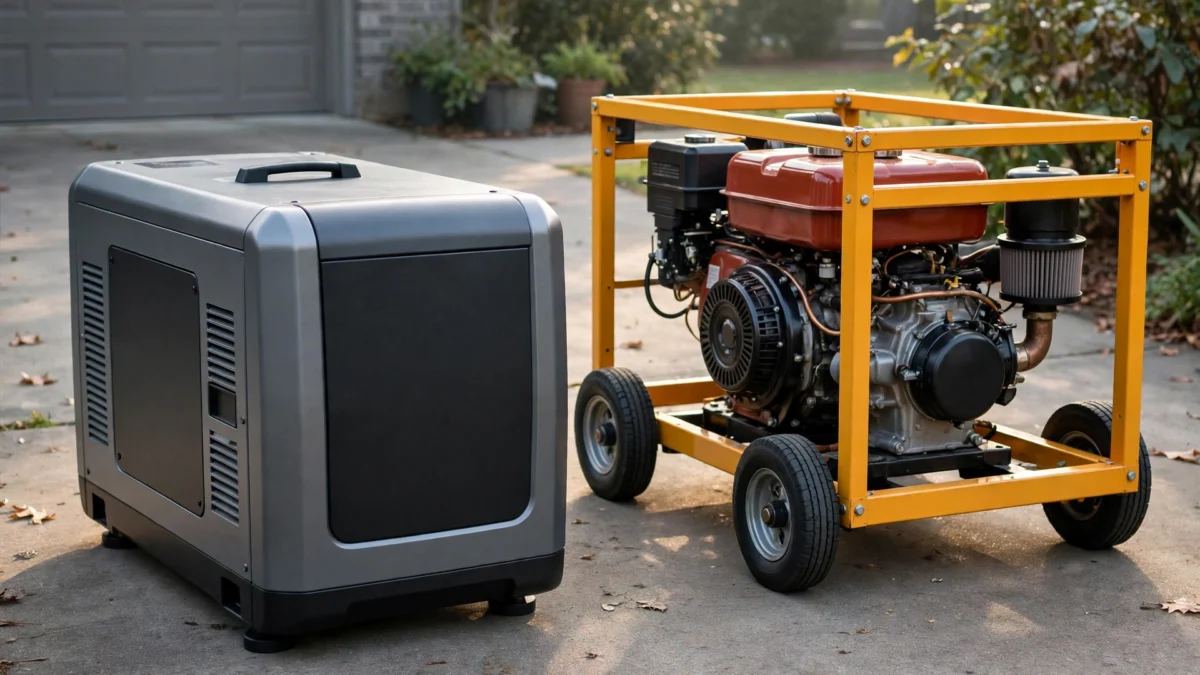
Walk into any generator aisle and you’ll see two kinds of machines that look like they do the same job: enclosed inverter generators (the quiet Honda-style boxes) and open-frame conventional generators (the loud steel-cage workhorses). They both make electricity. The difference is in what kind of electricity, how much noise they make doing it, and what they cost.
Here’s the direct answer: buy an inverter generator if you need to power electronics, value quiet operation, or want fuel efficiency — that’s most homeowners, campers, and RV owners. Buy a conventional generator if you need maximum watts per dollar for heavy loads like well pumps, job site tools, or whole-home backup. Neither is “better” in absolute terms; they’re built for different jobs.
I’ve owned and run both types for years. Below is the honest breakdown of how they differ on the six factors that actually matter — power quality, noise, fuel use, price, weight, and longevity — plus example models at each end so you can see the trade-offs in real products.
Key takeaways
- Inverter generators produce cleaner power (under 3% THD) — safe for laptops, phones, and modern appliances.
- Conventional generators deliver far more watts per dollar — a 13,000W conventional costs less than a 3,000W premium inverter.
- Inverters are dramatically quieter (48–62 dB vs. 68–78 dB) and burn less fuel at light loads.
- For whole-home backup with a transfer switch, conventional usually wins; for everything else, inverter usually wins.
Inverter vs conventional at a glance
| Factor | Inverter generator | Conventional generator | Winner |
|---|---|---|---|
| Power quality (THD) | Under 3% — safe for electronics | Up to 20%+ — risky for sensitive electronics | Inverter |
| Noise | 48–62 dB (conversation level) | 68–78 dB (lawnmower level) | Inverter |
| Fuel efficiency | Excellent — engine throttles to load | Fixed 3,600 RPM regardless of load | Inverter |
| Watts per dollar | Low — premium pricing | High — 2–3x the watts for the money | Conventional |
| Weight/portability | Light (47–106 lbs typical) | Heavy (150–400 lbs typical) | Inverter |
| Max power available | Up to ~9,000W (parallelable) | Up to 18,000W+ single unit | Conventional |
Power quality: the real difference
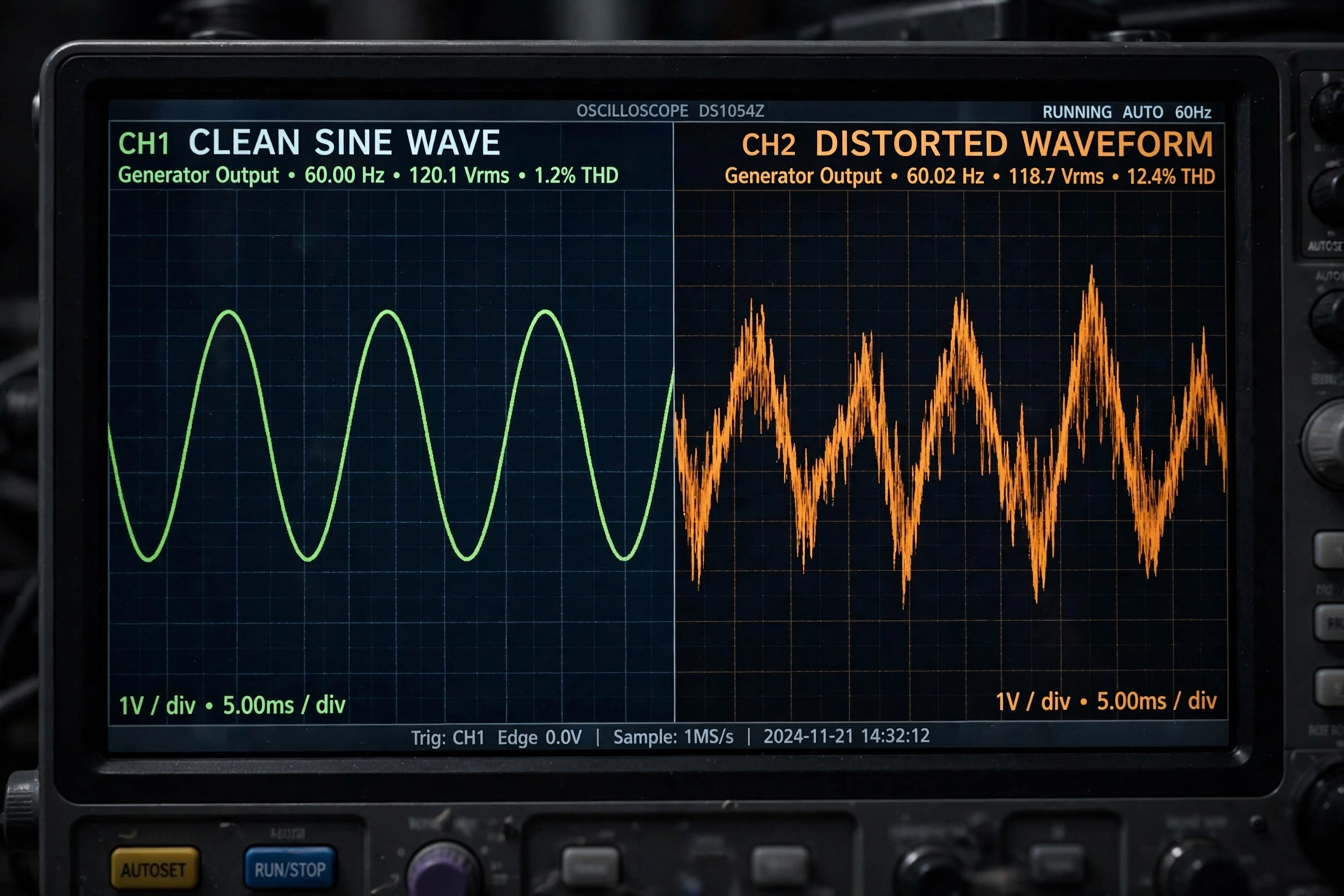
This is the technical heart of the debate, so let me explain it simply. A conventional generator spins its engine at a fixed 3,600 RPM and the alternator produces AC power directly. Engine speed wobbles under changing loads, and that wobble shows up as distortion in the power — measured as THD (total harmonic distortion). Conventional units can run 10–20% THD or more under load.
An inverter generator does it differently: the engine makes rough AC, converts it to DC, then the inverter rebuilds clean AC electronically. The result is under 3% THD — as clean as or cleaner than your wall outlet. Our THD explainer goes deeper, but the practical rule is simple.
What actually needs clean power? Anything with a microprocessor: laptops, phones, TVs, modern furnaces (their control boards are notoriously picky), CPAP machines, and variable-speed appliances. What doesn’t care? Power tools, incandescent lights, basic refrigerators, resistive heaters. If your outage plan includes the furnace control board or a home office, you need inverter power — or a conventional unit with verified low THD, which a few now offer.
Noise: no contest
An inverter generator at quarter load hums at 48–58 dB — quieter than normal conversation. You can stand next to one and talk. A conventional open-frame generator runs 68–78 dB — somewhere between a vacuum cleaner and a lawnmower. At night, in a neighborhood, that difference is the difference between sleeping and not.
The reasons are physical: inverter engines throttle down under light loads (less RPM, less noise), and the enclosed case muffles what’s left. Conventional engines run full-tilt 3,600 RPM whether they’re powering a phone charger or a table saw, and the open frame broadcasts every decibel.
If you’ll ever run the generator at night, at a campsite, or in a neighborhood with nearby houses, this factor alone decides it. Check local noise rules too — some areas limit nighttime generator noise to levels only inverters can meet.
Fuel efficiency: the throttle advantage
Here’s a number that surprised me when I first measured it: a 2,200-watt inverter running a 400-watt load (fridge + some lights) sips about 0.1 gallons per hour — roughly 8 hours on a single gallon. A 6,500-watt conventional running that same 400-watt load still burns its fixed-RPM ~0.5 gallons per hour, because the engine can’t slow down.
Over a three-day outage, that’s the difference between 8 gallons and 35 gallons. At today’s gas prices, the inverter pays for part of its price premium in a single long outage — and you don’t have to store or transport 35 gallons of gasoline.
The flip side: at full load, the efficiency gap narrows a lot. A conventional generator running at 80% capacity is reasonably efficient. Inverters win biggest at the light, variable loads that describe most real outage use.
Price: watts per dollar
This is where conventional generators punch back hard. A Honda EU2200i (2,200W inverter) costs around $1,200–$1,400. A DuroMax XP13000EH (13,000W conventional dual-fuel) costs roughly the same — for six times the watts. Per watt, conventional wins by a landslide.
The price gap has narrowed — budget inverter brands (Champion, Westinghouse, Predator) have brought 4,000–4,500W dual-fuel inverters down to the $700–$1,000 range — but it hasn’t closed. If your budget is fixed and your load is large, conventional gives you far more power for the money.
Weight and portability
Inverters are dramatically lighter: 47 pounds for a Honda EU2200i, ~106 for a Westinghouse iGen4500DFc. One person carries them. Conventional units start around 150 pounds and climb past 350 — they’re roll-it-into-place machines, not carry-it machines. For camping, tailgating, and RV use, this decides it before anything else.
Example models: see the trade-off in real products
These are verified current models that show each side at its best:
Inverter examples
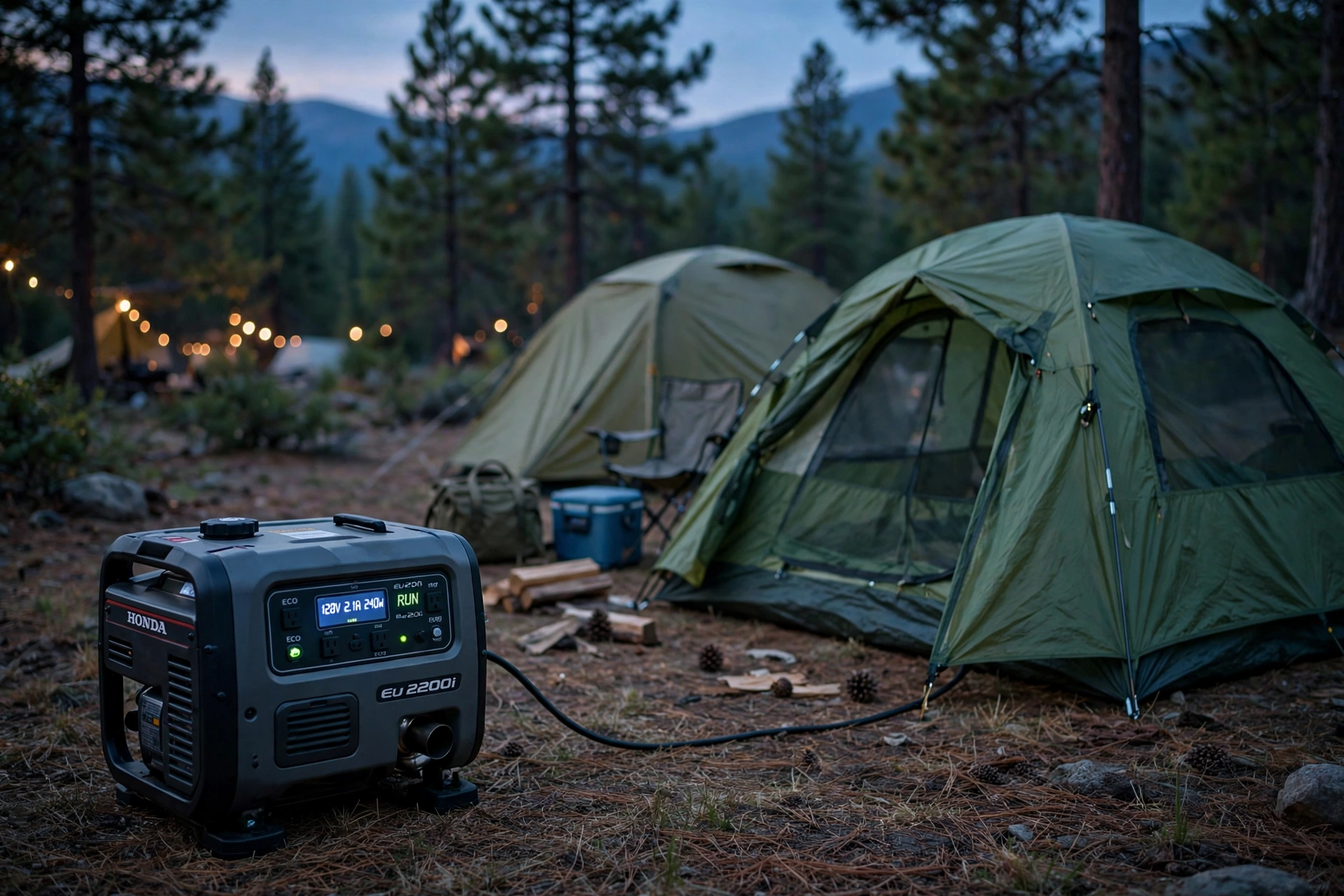
Honda EU2200i — 2,200W, 48–57 dB, 47 lbs, CO-MINDER. The gold standard small inverter. Premium price, unmatched refinement and resale.
Honda EU3200i — 3,200W, fuel-injected, 54–58 dB. Enough for a 13,500 BTU RV air conditioner. The nicest portable inverter you can buy.
Champion 4500W Dual Fuel Inverter — 4,500W, dual fuel, CO Shield, 61 dB. The value inverter: more watts per dollar than Honda, with safety tech included.
Conventional examples
Generac GP6500E — 8,125 starting / 6,500 running watts, COsense, electric start. The classic home-backup workhorse: well pump, fridge, furnace.
DuroMax XP13000EH — 13,000W dual fuel with a 50-amp outlet. Whole-home portable power for the price of a premium 3,000W inverter.
For a broader look at the inverter side, our best portable generators roundup covers the top picks in depth.
Runtime: tank size matters too
Inverters tend to have smaller tanks (1–3.4 gallons) but sip fuel, so real-world runtime is often 8–18 hours. Conventional units carry more fuel (5–8+ gallons) but burn it faster — typical runtime 8–12 hours at half load. For overnight outage duty, both get you through the night; the inverter just does it on half the fuel. One practical tip: whatever type you buy, a good fuel can setup matters more than tank size — refueling at 3 a.m. is nobody’s idea of fun, so size your spare fuel for the outage, not the tank.
Maintenance: what’s different
Day-to-day maintenance is nearly identical: oil changes every 50–100 hours, air filter checks, spark plug once a season, fuel stabilizer for storage. Two differences worth knowing: inverter generators have more electronics, so a lightning strike or power surge during a storm can theoretically damage the inverter module (a surge protector on the output is cheap insurance) — and conventional generators’ fixed-RPM design means the engine works harder at light loads, so oil gets dirtier faster relative to the power produced. Neither difference should decide your purchase, but the surge-protector tip has saved more than one inverter owner I know.
Total cost over five years
Let’s make the price debate concrete. Scenario: 100 outage hours per year, average 1,500W load, gas at $3.50/gallon.
Option A: a 4,500W dual-fuel inverter (~$900). At 1,500W it burns roughly 0.25 gal/hr → 25 gallons/year → $87.50/year in fuel. Five-year fuel: ~$440. Total: ~$1,340.
Option B: a 6,500W conventional (~$800). At the same load it burns roughly 0.5 gal/hr → 50 gallons/year → $175/year. Five-year fuel: ~$875. Total: ~$1,675.
The inverter costs $100 more up front and saves ~$335 over five years — and that’s before counting the propane option, which dodges stale-gas carburetor rebuilds entirely. At higher loads the gap shrinks; at lighter loads it grows. Run your own numbers, but for typical outage duty the inverter usually wins on total cost, not just purchase price.
Which should you buy?
Buy an inverter generator if: you’ll power electronics, run it at night or around neighbors, camp or RV, want the best fuel efficiency, or need something one person can carry. This describes most homeowners buying their first generator.
Buy a conventional generator if: you need maximum watts per dollar, you’re backing up a whole house through a transfer switch, you’re running job site tools or a well pump, or your loads are all motor-driven and non-electronic. This describes whole-home backup and construction use.
The hybrid answer: some buyers get both — a big conventional for the house panel and a small inverter for the RV, the campsite, and nighttime fridge duty. It’s more money up front, but each machine does what it’s best at.
Frequently asked questions
Is an inverter generator better than a regular generator?
Can a conventional generator damage electronics?
Do inverter generators last as long as conventional ones?
Can you parallel two inverter generators?
Why are inverter generators so expensive?
Our verdict
Most buyers should buy an inverter generator — the quiet operation, clean power, and fuel efficiency match how most people actually use a generator. Buy conventional when the job is raw power per dollar: whole-home transfer-switch backup, job sites, and big motor loads. If you can only buy one generator and you’re unsure, a 4,000–4,500W dual-fuel inverter is the most versatile single purchase in 2027.
How we researched this: We compared manufacturer spec sheets (THD, noise, fuel consumption, weight) across leading inverter and conventional models, reviewed owner fuel-use reports, and verified current Amazon availability for example models in October 2026. Efficiency figures are based on manufacturer ratings and owner-reported consumption.

Related Guides
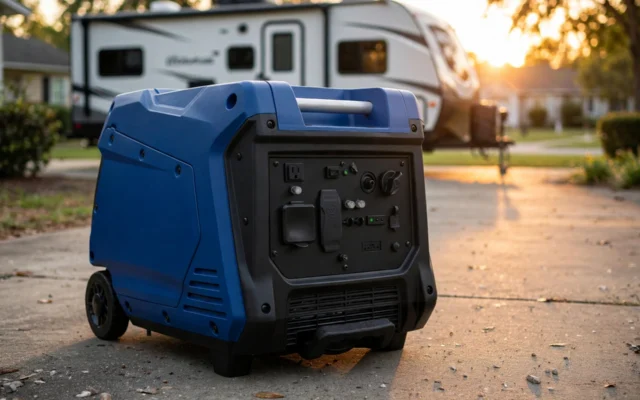
Westinghouse iGen4500DF Review: The Dual-Fuel Inverter to Beat in 2027
Westinghouse iGen4500DF review: 4,500W dual-fuel inverter, 52 dBA, remote start, RV-ready. We test the specs, noise, and value against Honda in 2027.

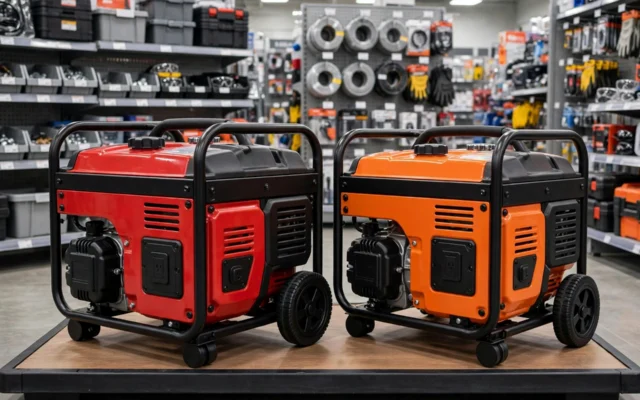
Champion vs Generac Generators: Which Brand Is Better in 2027?
Champion vs Generac: Champion wins portable value, Generac wins standby. We compare lineups, reliability, safety tech, and support to pick the right brand.
Best Generators With Carbon Monoxide Shutoff in 2027
The best generators with carbon monoxide shutoff stop themselves before CO turns deadly. We compare 7 models with Honda CO-MINDER, Champion CO Shield and more.