


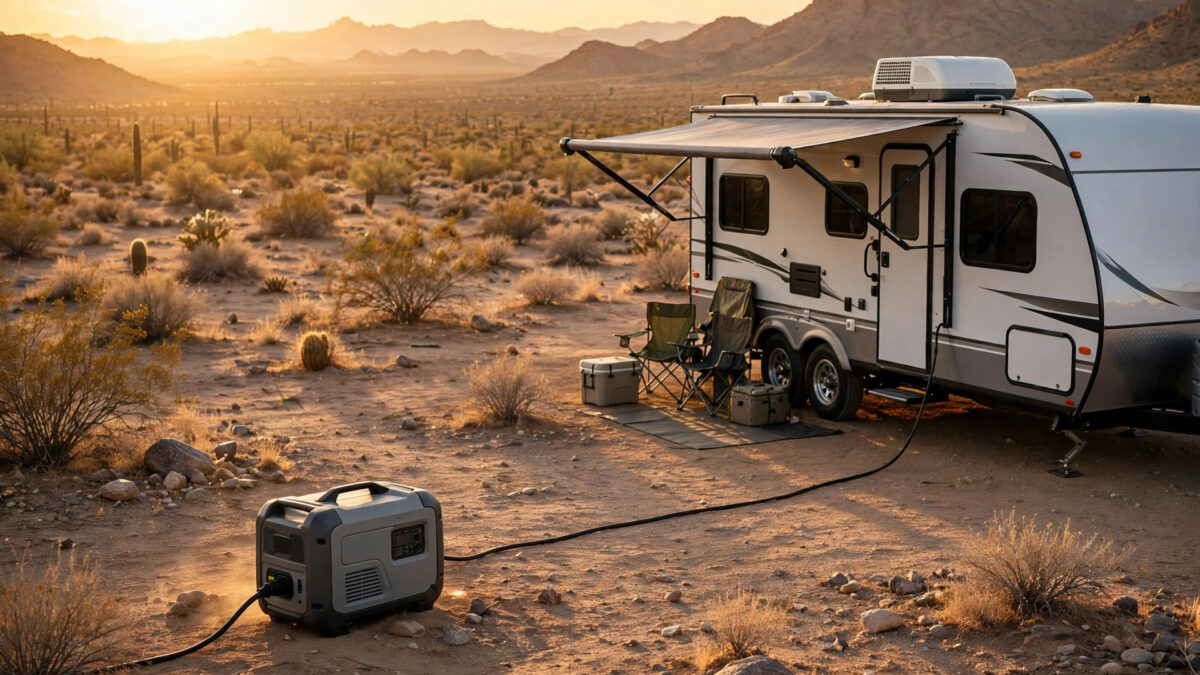
The 3,000-watt class is the RV and camping sweet spot — enough for a 13,500-BTU rooftop AC, a microwave, and battery charging, all in a package one person can lift into a truck bed. It’s also the most confusing class to shop, because “3,000 watts” on the box can mean 3,000 surge watts with only 2,300 you can actually use.
Here’s the honest headline for 2027: the true 3,000-watt inverter field is thin, led by the Honda EU3000iS (2,800 running watts, whisper-quiet, expensive) and the Generac GP3000i (2,300 running watts, a third of the price). If you can stretch a little on size, the WEN DF480iX and A-iPower SUA4300iD deliver 4,000+ watts of quiet dual-fuel inverter power for Honda-3000 money. I’ll show you exactly which fits your loads.
Key takeaways
- “3,000 watts” usually means surge — check the running watts, which is what you can actually use continuously.
- The Honda EU3000iS (2,800W running) is the class benchmark; the Generac GP3000i (2,300W) is the value alternative.
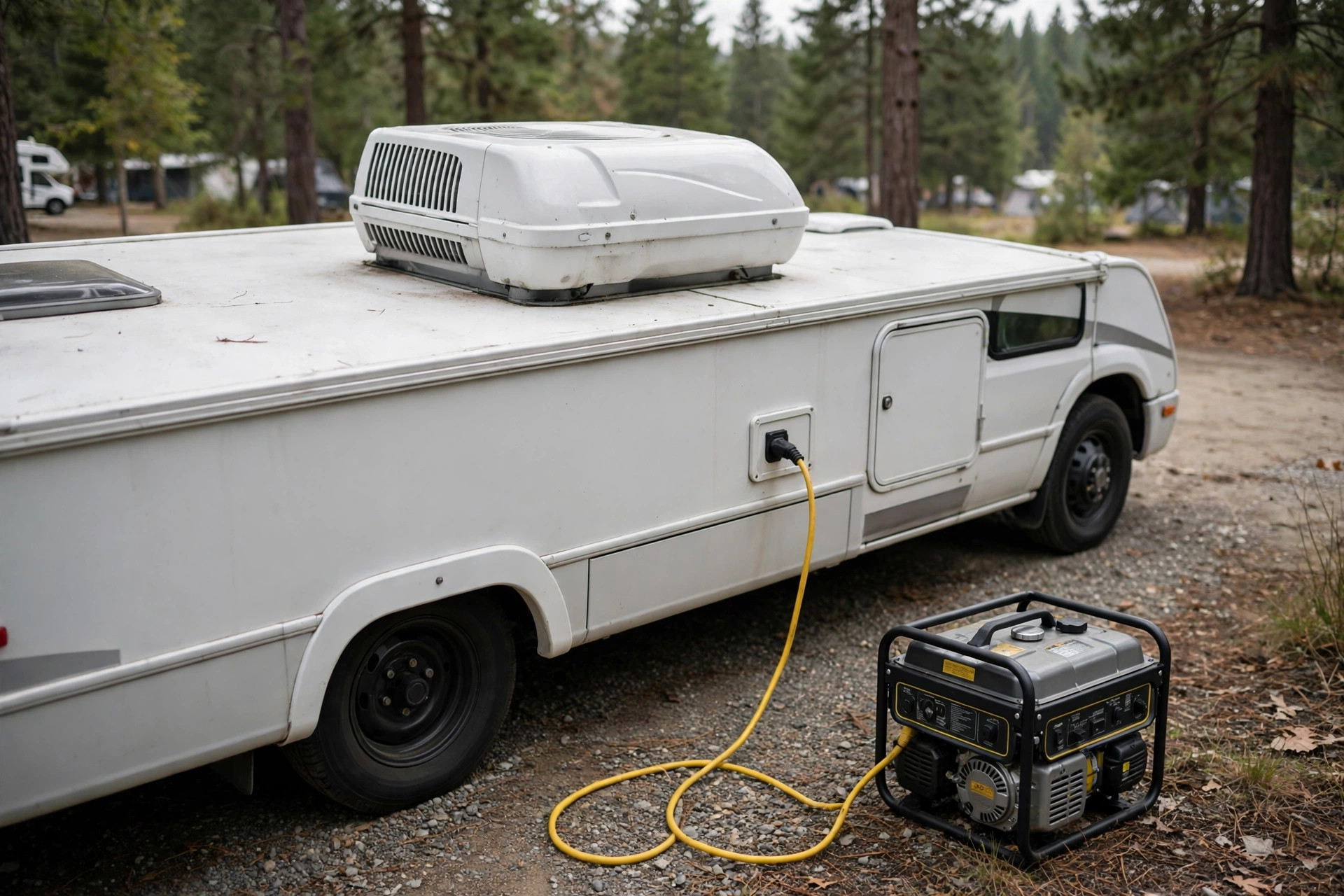
- A 13,500-BTU RV AC needs ~2,800W to start — right at the edge of this class. A soft-start kit changes everything.
- The WEN DF480iX and A-iPower SUA4300iD offer 4,000W+ of quiet inverter power for similar money — worth the step up.
- Inverter-only in this class: clean power for RV electronics, and half the noise of open-frame units.
Quick picks
- Best overall: Honda EU3000iS — 2,800 running watts, 50 dB, electric start, the benchmark.
- Best value: Generac GP3000i — 2,300 running watts, 59.5 lbs, roughly a third of the Honda’s price.
- Best step-up: WEN DF480iX — 4,800W dual-fuel inverter, 62 dB, TT-30R outlet.
- Best compact step-up: A-iPower SUA4300iD — 4,300W dual-fuel inverter, 63 dB.
Best overall
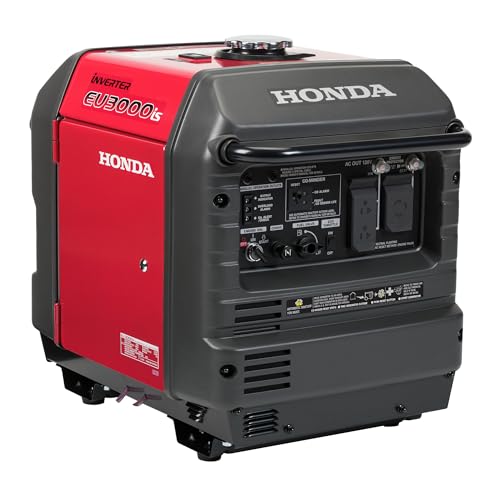
Honda EU3000iS Inverter Generator
- Running Watts: 2,800 W
- Runtime: 19.6 hrs @ 1/4 load
- Noise Level: 50–57 dB
- Weight: 131 lbs
As an Amazon Associate, we earn from qualifying purchases.
The EU3000iS has owned this class for years, and in 2027 nothing has dethroned it. True output: 3,000 surge watts, 2,800 running watts — the highest usable wattage of any generator most people call a “3000-watt” unit. Noise is 50–57 dB, which means it hums along in the background at a campsite instead of dominating it.
The RV credentials are impeccable: it’ll start and run a 13,500-BTU rooftop AC (the make-or-break test), plus the converter charger, with headroom. Electric start means no rope-pulling. The 3.4-gallon tank runs nearly 20 hours at quarter load — multiple nights of AC cycling without a refill.
The price is the perennial objection: typically $2,300–$2,600. At 131 pounds, it’s also the heaviest here — a ramp or a strong partner helps. But based on spec comparison and owner feedback, it’s the only 3,000-class generator I’d trust to run an RV AC all summer, every summer, for a decade. Resale value stays absurdly high, which softens the buy-in.
Pros
- Highest true running watts in the class
- Runs a 13.5k BTU RV AC reliably
- Nearly 20-hour runtime, electric start
- Legendary reliability and resale
Cons
- Expensive ($2,300–$2,600)
- 131 lbs — heaviest in class
Best value
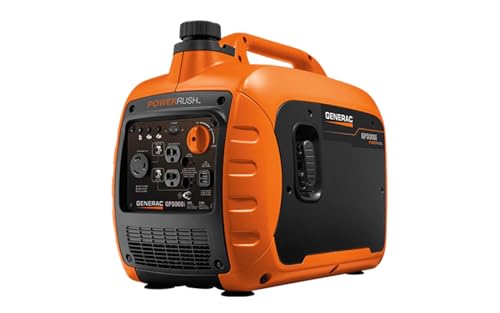
Generac GP3000i Inverter Generator
- Running Watts: 2,300 W
- Runtime: 4.5 hrs @ 1/2 load
- Noise Level: ~58 dB
- Weight: 59.5 lbs
As an Amazon Associate, we earn from qualifying purchases.
The GP3000i is the pragmatic choice: 3,000 surge watts, 2,300 running watts, 59.5 pounds, typically $700–$900. That’s roughly a third of the Honda’s price for about 80% of the usable power. For weekend campers and tailgaters, that math is compelling.
Be clear-eyed about the 2,300 running watts: it’ll run a 13,500-BTU RV AC only with a soft-start kit installed, and you won’t be microwaving at the same time. Without AC in the picture — lights, chargers, TV, small appliances — it’s plenty, and the USB ports on the panel are a nice touch for direct device charging.
Noise is rated in the high-50s dB — fine for campgrounds, not Honda-silent. Based on owner feedback, reliability is good for the price tier with normal maintenance. If your RV has a soft-start on the AC, or you camp without AC, pocket the $1,500 difference and don’t look back.
Pros
- Excellent value at $700–$900
- Light and portable at 59.5 lbs
- USB ports, parallel-ready
Cons
- 2,300W running — needs soft-start for RV AC
- Louder and thirstier than Honda
Best step-up pick
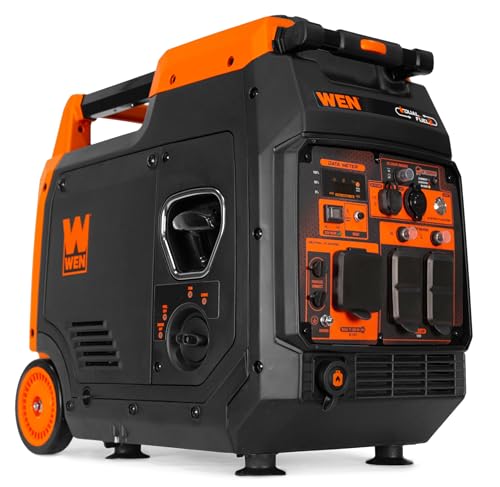
WEN DF480iX Dual-Fuel Inverter Generator
- Running Watts: 4,000 W (gas)
- Runtime: 7 hrs @ 1/2 load
- Noise Level: 62 dB @ 1/4 load
- Weight: ~95 lbs
As an Amazon Associate, we earn from qualifying purchases.
Here’s the move most buyers miss: for about the same money as a discounted Honda EU3000iS, the WEN DF480iX gives you 4,800 surge watts and 4,000 running watts of inverter power — dual-fuel, 62 dB at quarter load, typically $700–$900. That’s nearly double the Generac’s running watts, quieter than any open-frame, with propane in reserve.
The RV fit is excellent: TT-30R 30-amp outlet plugs straight into your shore cord, it starts a 13,500-BTU AC without breaking a sweat (no soft-start required), and runs the microwave simultaneously. The 224cc engine and 1.9-gallon tank deliver about 7 hours at half load — shorter than the Honda, the price of bigger power.
Based on spec comparison and owner feedback, the DF480iX is the “buy more generator than you need” answer done right: still quiet, still clean power, still portable-ish. If your budget is Honda-shaped but your loads are bigger than 2,800W, this is where I’d look first.
Pros
- 4,000W inverter power for ~$800
- Runs RV AC + microwave together
- Dual fuel, TT-30R outlet
- Quiet at 62 dB
Cons
- Heavier than 3kW-class units
- Shorter runtime per tank
Best compact step-up
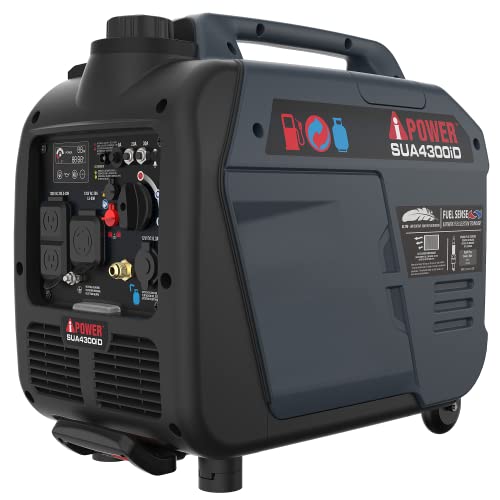
A-iPower SUA4300iD Dual-Fuel Inverter Generator
- Running Watts: 3,450 W (gas)
- Runtime: 7.5 hrs @ 1/4 load
- Noise Level: 63 dB
- Weight: ~80 lbs
As an Amazon Associate, we earn from qualifying purchases.
The SUA4300iD splits the difference beautifully: 4,300 surge watts, 3,450 running watts on gas, dual-fuel, 63 dB, from a compact 149cc package with a 1.6-gallon tank — typically $700–$900. It’s the smallest, lightest way to get solidly past the 3,000-watt ceiling.
That 3,450 running watts is the magic number: comfortably starts a 13,500-BTU RV AC without a soft-start kit, with margin left for the converter charger. Runtime is about 7.5 hours at quarter load. The compact size fits truck beds and RV storage bays that bigger 4,000W+ units won’t.
Based on owner feedback, A-iPower’s inverter line punches above its price. If the Honda’s 2,800W feels marginal and the WEN’s 4,000W feels like overkill, the SUA4300iD is the Goldilocks answer — and the dual-fuel propane option covers storage between camping seasons.
Pros
- 3,450W starts RV AC without soft-start
- Compact and lighter than 4kW+ rivals
- Dual fuel, quiet inverter
Cons
- Smaller tank needs more refills
- Less headroom than the WEN
Side-by-side comparison
| Product | Running W | Fuel | Noise | Best for |
|---|---|---|---|---|
| Honda EU3000iS | 2,800 | Gas | 50 dB | Class benchmark |
| Generac GP3000i | 2,300 | Gas | 58 dB | Value 3kW |
| WEN DF480iX | 4,000 | Dual | 62 dB | Step-up power |
| A-iPower SUA4300iD | 3,450 | Dual | 63 dB | Compact step-up |
How to choose a 3000-watt generator
The 3kW class rewards careful load math. Here’s how to get it right.
Running watts vs. surge watts: read the right number
The box shouts “3,000W!” but the running watts — 2,300 on the Generac, 2,800 on the Honda — are what you can actually draw continuously. Surge watts only cover motor startup spikes lasting seconds. When comparing models, line up the running watts column and ignore the marketing number. A “3,500-watt” conventional generator with 3,000 running watts genuinely out-powers a “3,000-watt” inverter with 2,300 running watts — but the inverter is quieter, cleaner, and more fuel-efficient. Pick your priority.
The RV air conditioner test
This is the question that decides everything: will it start my RV AC? A 13,500-BTU rooftop unit draws ~1,800W running but surges to ~2,800W+ on startup. The Honda EU3000iS handles it stock. The Generac GP3000i needs help — specifically a soft-start kit (MicroAir EasyStart is the standard), which cuts starting surge by up to 70% and costs around $300 installed. The WEN and A-iPower handle it without the kit. If AC is non-negotiable and you won’t install a soft-start, buy running watts with margin: the step-up picks exist for exactly this reason.
A quick way to remove the guesswork: measure your AC’s actual draw with a clamp meter or a plug-in watt meter before you buy the generator. Nameplate ratings are worst-case; real running watts are often 10–15% lower, but starting surge is where generators die — and it varies by unit age and capacitor health. An older AC with a weak start capacitor can surge 40% higher than spec. If you’re on the fence, the $300 soft-start kit is cheaper than the next generator size up, and it also lets you run the AC on a 2,000-watt inverter in a pinch. I’ve seen it turn a marginal setup into a reliable one more times than I can count.
Parallel: the escape hatch
Most inverter generators in this class can be paralleled — link two for double the power. Two Generac GP3000i units ($1,400–$1,800 total) give you 4,600 running watts: more than the Honda, for less money, and you can run just one when loads are light. The catch is buying the parallel kit and managing two engines (two oil changes, two fuel tanks). It’s a legitimate strategy, especially if you already own one unit.
Noise and campground rules
Many campgrounds enforce 60 dB limits at 50 feet, and some restrict generator hours to midday. All four picks here comply, but the Honda’s 50 dB gives you the most goodwill with neighbors. Quieter also matters at home — see our quiet generator roundup if backyard noise is the concern. For dedicated camping picks, our camping generator guide goes deeper.
Fuel, runtime, and weight trade-offs
Bigger watts mean bigger engines, more weight, and shorter runtime per gallon — physics doesn’t negotiate. The Honda’s 20-hour runtime comes from modest output; the WEN’s 7 hours comes from 4,000W. For RVing, weight matters every time you load up: 59.5 lbs (Generac) versus 131 lbs (Honda) is a real handling difference. Dual-fuel models add propane storage life for seasonal RVers — gas goes stale over winter, propane doesn’t. Our sizing guide helps nail the numbers.
Will a 3000-watt generator run an RV air conditioner?
What can I run on a 3000-watt generator?
What’s the difference between running watts and starting watts?
Can I connect two 3000-watt generators together?
Is the Honda EU3000iS worth twice the price of a Generac GP3000i?
What about 2000W or 4000W instead?
The 3,000-watt class sits between two popular alternatives, and it’s worth a minute to check you’re shopping the right shelf. The answer depends entirely on the air conditioner question.
Drop to 2,000W if you’ll never run AC. A 2,200-watt inverter (Honda EU2200i, Westinghouse iGen2200) runs lights, chargers, TV, fans, and even a microwave — everything except the rooftop AC — at half the weight and most of the quiet. For tent campers, tailgaters, and home fridge-backup, 2,000W is plenty and the units are genuinely one-hand portable. Our quiet generator roundup covers the best of them.
Jump to 4,000W+ if the AC is marginal on 3,000W or you run multiple big loads. Here’s the thing most shoppers don’t realize: the WEN DF480iX and A-iPower SUA4300iD in this very roundup are the 4,000W answer, priced like 3,000W units. The step up buys you the ability to run the AC and microwave simultaneously, or a 15,000-BTU AC instead of a 13,500. The penalty is weight (80–95 lbs vs. 60) and fuel burn — but for RVs, the extra headroom is usually worth it.
Stay at 3,000W if you want the sweet spot: enough for one RV AC with everything else managed, in the lightest package that can do it. The Honda EU3000iS defines this niche. But be honest — if you’re already considering the WEN at 4,000W for the same money, you’re not really a 3,000W buyer. Buy the watts you’ll use, not the number on the category label.
Our verdict
The Honda EU3000iS is still the best 3,000-watt generator in 2027 if your budget allows — nothing matches its combination of true 2,800W output, 50 dB quiet, and longevity. On a budget, the Generac GP3000i plus a soft-start kit is the clever play. And if you want maximum watts per dollar, the WEN DF480iX gives you 4,000W of quiet dual-fuel inverter power for Honda-3000 money. Whatever you choose, verify the running watts against your AC’s starting surge before buying — that’s the single number that decides whether your summer trips are comfortable or miserable. When in doubt, buy the step-up watts — an unstressed generator lasts longer and runs quieter every single time.
How we researched this: Running-watts-focused spec comparison across the 3,000W class and its step-up alternatives, RV AC starting-surge math, soft-start kit effectiveness data, campground noise-rule research, and owner feedback on real-world RV use. Every pick is an inverter generator with a verified Amazon listing. We weighted real running watts over marketing surge numbers and penalized any model without a published noise rating.

Related Guides
Best 12000 Watt Generators of 2027
Best 12000 watt generators of 2027: 6 whole-home portables compared — tri-fuel vs dual fuel, real specs, transfer switch guidance and fuel planning.

Best 3500 Watt Generators of 2027
Best 3500 watt generators of 2027: 5 top picks compared — inverter vs conventional, dual fuel options, real running-watt specs and buying guide.
How Much Electricity Does a Generator Make Per Gallon of Gas?
A typical portable gas generator makes 4–7 kWh of electricity per gallon. We break down kWh per gallon by load, size, and fuel type so you can plan fuel for any outage.