

Wondering what size generator for a refrigerator will keep your food cold through an outage? For most full-size fridges, a 2,000-watt generator is plenty — and many modern fridges run fine on even less. The key detail is the compressor’s startup surge: a fridge that draws only 150 to 250 watts while running can pull 800 to 1,200 watts for a split second when the compressor kicks on. In this expanded guide, we break down running and starting watts by refrigerator type, explain how to measure your own fridge, and show what else you can comfortably run alongside it.
Keeping a refrigerator powered is the single most common reason people buy a small generator. A full fridge stays cold for about 4 hours without power if you keep the door closed (about 24 hours for a full freezer), but after that, you are racing the clock on hundreds of dollars of groceries. The good news: a refrigerator is a light, easy load for almost any generator — you just need to understand the startup surge and the compressor’s on-off cycling.
Key Takeaways
- Most full-size refrigerators draw 100–250 running watts and 800–1,200 starting watts (approximate).
- A 2,000-watt generator comfortably runs a fridge with plenty of capacity left for lights, chargers, and a fan.
- Energy Star models and mini fridges draw noticeably less; older or very large fridges draw more — check the nameplate.
- The compressor cycles on and off, so average power use is much lower than the running watts suggest.
- Use clean, stable power: an inverter generator’s low-THD output is gentler on modern fridges with electronic controls.
- Never run a generator indoors or in a garage — carbon monoxide kills in minutes.
What Size Generator Do I Need to Run a Refrigerator?
A 2,000-watt generator will run virtually any standard household refrigerator, with room to spare for other small essentials. Most full-size fridges draw only 100 to 250 watts while the compressor is running, and their 800 to 1,200-watt startup surge fits easily inside a 2,000-watt generator’s surge rating. If you only need to power a mini fridge or a small Energy Star model, even a 1,000-watt inverter generator or a mid-size portable power station can do the job. These are approximate ranges — your fridge’s nameplate gives the exact numbers.
Refrigerator Wattage by Type: Running vs. Starting Watts
Refrigerator power draw varies mainly by size, age, and style. The table below shows commonly published approximate wattages. “Running watts” is what the fridge draws while the compressor is actively cooling; “starting watts” is the brief surge when the compressor kicks on.
| Refrigerator type | Typical running watts | Typical starting watts |
|---|---|---|
| Mini fridge / dorm fridge | 50–100 W | 300–500 W |
| Top-freezer, 18 cu. ft. (Energy Star) | 100–150 W | 600–900 W |
| Top-freezer, older model | 150–250 W | 900–1,200 W |
| Side-by-side | 200–300 W | 1,000–1,500 W |
| French door, large | 250–400 W | 1,200–1,800 W |
| Chest freezer | 100–200 W | 700–1,000 W |
| Upright freezer | 150–250 W | 900–1,200 W |
Two trends work in your favor in 2027: modern Energy Star refrigerators are significantly more efficient than models from a decade ago, and inverter-compressor fridges (common in newer models) ramp up gradually, producing a much smaller startup surge than old single-speed compressors.
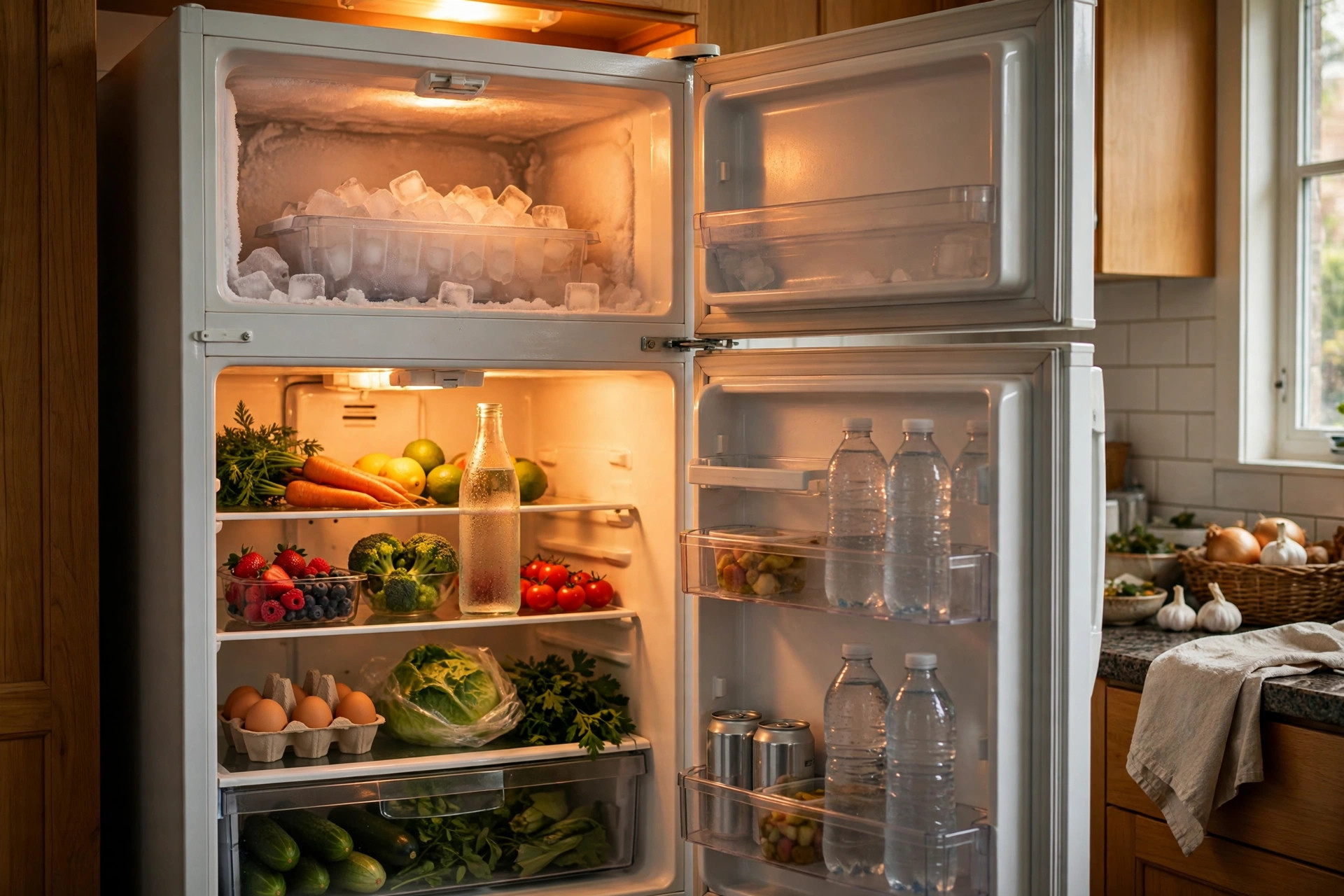
Understanding the Startup Surge (And Why It Rarely Causes Problems)
Like all motor-driven appliances, a refrigerator’s compressor draws a brief inrush current when it starts — typically 3 to 5 times its running watts for a fraction of a second. On a 200-watt fridge, that means a surge of roughly 800 to 1,000 watts. Generator surge ratings are designed exactly for this: a 2,000-watt generator typically offers 2,500 or more surge watts, comfortably above any standard fridge’s starting demand.
Surge only becomes an issue in edge cases: a very large French-door fridge on a tiny 1,000-watt generator, or several motor appliances starting at the exact same instant. The fix is simple — stagger your plug-ins by a minute or two rather than switching everything on at once.
How to Measure Your Own Fridge’s Power Draw
Charts give averages, but a $25 plug-in watt meter gives you the truth about your specific fridge — and it is genuinely useful for sizing a generator.
Use a plug-in watt meter
Plug the meter into the wall, plug the fridge into the meter, and let it run for 24 hours. You will see the running watts, the startup surge, and the total kilowatt-hours per day. Many owners are surprised to find their fridge averages well under 100 watts over a full day because the compressor only runs 30 to 40 percent of the time.
Read the nameplate
The sticker inside the fridge (or on the back) lists rated volts and amps. Multiply them for an approximate running wattage: a fridge rated 120 volts and 5 amps draws about 600 watts (120 × 5 = 600). Then allow two to three times that for the compressor’s startup surge — our 600-watt example needs roughly 1,200 to 1,800 surge watts for a few seconds when the compressor kicks on. Note that the nameplate shows maximum draw — real-world running watts are usually lower.
Account for the ice maker and dispenser
Through-the-door ice and water dispensers add small intermittent loads. They rarely change generator sizing, but if your fridge has them and you are sizing a very small power station, count an extra 50 to 100 watts of occasional draw.
What Else Can You Run Alongside a Refrigerator?
Once you know the fridge only draws a couple hundred watts, the question becomes what else fits. On a 2,000-watt generator, the answer is: quite a lot. The table below shows typical running watts for common outage essentials.
| Appliance | Typical running watts | Notes |
|---|---|---|
| Full-size refrigerator | 150–250 W | The anchor load |
| Chest freezer | 100–200 W | Easily added |
| LED lights (several rooms) | 30–60 W | Negligible |
| Phone and laptop chargers | 50–150 W | Negligible |
| Box fan | 50–100 W | Fine |
| Wi-Fi router + modem | 10–20 W | Negligible |
| TV (LED, 50-inch) | 60–150 W | Fine |
| Microwave | 1,000–1,500 W | Stagger with fridge startup |
| Space heater | 1,500 W | Pushes a 2,000 W generator hard — use sparingly |
A practical rule: keep the total running load under 80 percent of the generator’s running-watt rating. On a 2,000-watt generator, that is 1,600 watts — a fridge, freezer, lights, chargers, a fan, and a TV total well under 1,000 watts, leaving comfortable headroom.
How to Connect Your Refrigerator to a Generator Safely
Sizing is only half the job — hooking everything up correctly protects both you and the fridge. Follow these steps every time:
- Place the portable generator outdoors in an open, dry spot, well away from doors, windows, and vents. Never run it indoors or in a garage.
- Let the generator warm up for a few minutes after starting so voltage and frequency stabilize before you plug anything in.
- Use a heavy-duty, outdoor-rated extension cord with a wire gauge matched to the load — a thin indoor cord can overheat.
- Plug in the refrigerator first. Once it is running smoothly, add other small loads one at a time.
- Do not exceed the generator’s running-watt rating; overloading causes voltage sag that stresses the compressor.
- Turn the fridge to its coldest setting at the start of the outage, and open the door as little as possible.
- Refuel well before the tank runs dry — sputtering on fumes starves the compressor of steady power.
- Never plug a generator into a wall outlet (“backfeeding”). It can energize utility lines and endanger line workers, and it is illegal in most areas.
What Size Generator Is Best for a Refrigerator: Inverter vs. Conventional
Both types will run a refrigerator, but an inverter generator is the better match for three reasons. First, it produces clean sine-wave power with low total harmonic distortion (THD), which is gentler on the electronic control boards in modern fridges. Second, it adjusts engine speed to the load, so it sips fuel and runs quietly when the fridge is just idling between compressor cycles. Third, it is lighter and easier to store.
A conventional open-frame generator works fine for older fridges with simple mechanical thermostats, and it costs less per watt. But for a modern fridge with digital controls, an ice maker, or an inverter compressor, the clean power of an inverter generator is worth the premium.
A few features are worth prioritizing whichever type you choose: a cold-weather kit if you get freezing temperatures, a carbon-monoxide auto-shutoff sensor, quiet operation if the generator sits near living areas, and at least a 2–3 year warranty as a rough indicator of build quality.
What About a Standby Generator?
If outages are frequent or long where you live, a permanently installed standby generator removes the whole setup ritual: it connects to your home’s natural gas line or an LP tank and switches on automatically when the power drops. It is the most convenient and safest option for extended blackouts, but it costs far more than a portable — overkill if keeping the fridge cold a few times a year is the only goal.
Can a Portable Power Station Run a Refrigerator?
Yes — this is one of the most popular uses for portable power stations, because there is no fuel, no noise, and no carbon monoxide, so the station can sit right in the kitchen. The math: a fridge averaging 150 watts with a 35 percent duty cycle uses about 50 watt-hours per hour, or roughly 1,200 watt-hours per day. A 1,000Wh station therefore runs a full-size fridge for most of a day; a 2,000Wh station covers a day and a half or more.
For outages longer than a day, pair the station with solar panels to recharge during daylight. This fridge-plus-solar setup is one of the most practical emergency configurations for apartments and homes where running a gas generator is impractical.
Food Safety and Generator Tips
When power returns — or when you connect the generator — the fridge’s compressor will run continuously for a while to pull temperatures back down. This is normal and does not require a bigger generator. Also note: after an outage, discard perishable food that has been above 40°F for more than 2 hours, per USDA food safety guidance.
For longer outages, tuck block ice or freezer packs inside to stretch cold time, and consider moving essentials to an ice chest with ice packs if the power will stay out. Eat refrigerated perishables first while they are still safe — and remember the old rule: when in doubt, throw it out.
FAQs
What size generator do I need to run a refrigerator?
Will a 1000-watt generator run a full-size refrigerator?
How many watts does a refrigerator use per day?
Can I run a refrigerator and freezer on the same generator?
Is an inverter generator better for a refrigerator?
How long will a portable power station run a refrigerator?
Will a 2,200-watt generator run a full-size refrigerator?
Can a bad generator connection damage my refrigerator?
Conclusion
A refrigerator is one of the easiest loads to power in an outage: 2,000 watts of generator covers nearly any full-size fridge with capacity to spare. Know your fridge’s running and starting watts from the table above (or better, from its nameplate), favor an inverter generator for clean power, and you will keep food safe through outages of any length — with plenty of headroom for the rest of your essentials.
Our verdict
Most full-size refrigerators need only 800–1,200 starting watts, so a 2,000W inverter generator handles a fridge plus a few extras with room to spare. Size up to 3,500W+ if you want to run the freezer, lights, and devices at the same time.

Related Guides
Why Does My Generator Backfire? Causes and Fixes (2027)
Why does your generator backfire? An exhaust bang means unburned fuel in the muffler; a pop through the carb means lean mixture or valve trouble. Here are the fixes.


Generator Valve Adjustment: How to Set Valve Lash (2027 Guide)
Generator valve adjustment: 0.006" intake, 0.008" exhaust on Honda GX engines. Tools, TDC procedure, and symptoms of bad valve lash explained.

How to Clean and Replace a Generator Air Filter (2027 Guide)
How to clean a generator air filter: wash foam filters in soapy water and re-oil; tap out paper filters, never wash them. Full steps inside.