

Nothing ruins a campsite faster than a roaring generator. Most campgrounds enforce quiet hours — typically 10 p.m. to 6 a.m. — and many national parks cap generator noise at 60 decibels measured at 50 feet. The generators in this guide all run at 59 dBA or quieter, with our top picks dipping to 48 dBA: roughly the volume of a quiet conversation.
We rebuilt this guide for 2027 with currently available models and verified noise figures. A quick primer on decibels: the scale is logarithmic, so 60 dBA sounds roughly twice as loud as 50 dBA. That means the difference between a 61 dBA inverter and a 70 dBA open-frame unit is enormous — the difference between hearing crickets and hearing your generator from three campsites away.
Every pick below is an inverter generator, which matters for two reasons beyond noise: inverters produce clean, stable power safe for phones, laptops, and CPAP machines, and they throttle the engine down at light loads, sipping fuel through the night. If you are choosing between a cheap loud generator and one of these, your camping neighbors will thank you for reading on.
Our top picks at a glance
- Best overall: Honda EU2200i Inverter Generator — the gold standard at 48 dBA with Honda reliability and clean power.
- Best premium: Honda EU3200i Inverter Generator — more power at 54 dBA with fuel injection, Bluetooth, and a 30A RV outlet.
- Best ultralight: Westinghouse iGen2550c Inverter Generator — 61 dBA and only 42.4 lbs with a 30A RV outlet and 12-hour runtime.
- Best dual fuel: Champion 2500W Dual-Fuel Inverter Generator — propane or gasoline at 53 dBA with CO Shield and 25-hour propane runtime.
- Best for bigger loads: Champion 201319 4,500-Watt Dual Fuel Inverter Generator Dual-Fuel Inverter Generator — 3,700 running watts at 61 dBA with remote start and RV-ready outlets.
- Best budget: A-iPower SUA2000iV Inverter Generator — 61 dBA quiet with clean power at the lowest price in this guide.
- Best long-run budget: Honda EU2200i — 10-hour runtime at 61 dBA, but check the manufacture date.
Full reviews with honest limitations follow, plus a buying guide on campground noise rules.
Detailed reviews: the quietest camping generators of 2027
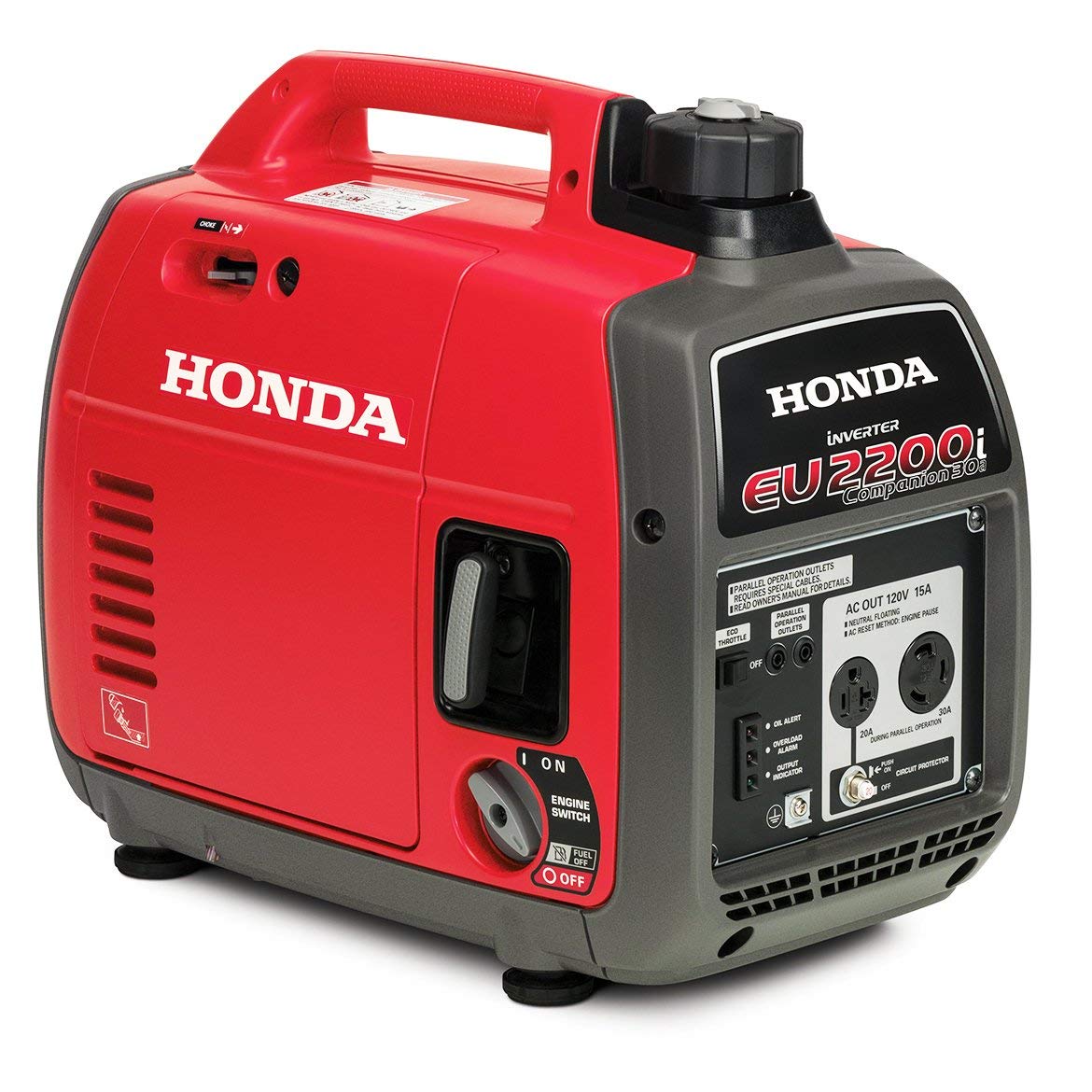
Best overall
Honda EU2200i Inverter Generator
- 1800W running / 2200W peak output
- gasoline
- Up to 8.1h @ 1/4 load on 0.95-gal tank runtime
- 48-57 dBA noise level
As an Amazon Associate, we earn from qualifying purchases.
Bottom line: The gold standard at 48 dBA with Honda reliability and clean power.
The Honda EU2200i remains the benchmark every quiet generator is measured against. At 48 decibels under light load — roughly the volume of a quiet conversation — it simply disappears into campsite background noise. The 2,200 peak watts handle a small RV air conditioner or a coffee maker, and the 1,800 running watts cover lights, charging, and a fan with room to spare.
Honda’s inverter produces pure-sine-wave power under 3% THD, so it is safe for laptops, cameras, and medical devices like CPAP machines. The Eco-Throttle system adjusts engine speed to the load, stretching a gallon of fuel to 8.1 hours at quarter load — enough for an evening and a morning without refueling. At 46.5 pounds, most adults can carry it one-handed to the picnic table.
You pay for the red badge: the EU2200i costs roughly twice what budget competitors charge for similar wattage. It also lacks some modern conveniences like a fuel gauge or USB ports. But for noise-sensitive campgrounds with strict quiet hours, nothing beats the combination of 48 dBA, proven reliability, and strong resale value.
Pros
- 48 dBA — the quietest in this guide
- Honda reliability with excellent resale value
- Clean <3% THD power safe for electronics and CPAP
- 8.1-hour runtime at quarter load; only 46.5 lbs
Cons
- Premium price — roughly 2x budget alternatives
- No fuel gauge or USB ports
- 2,200W peak limits larger appliances
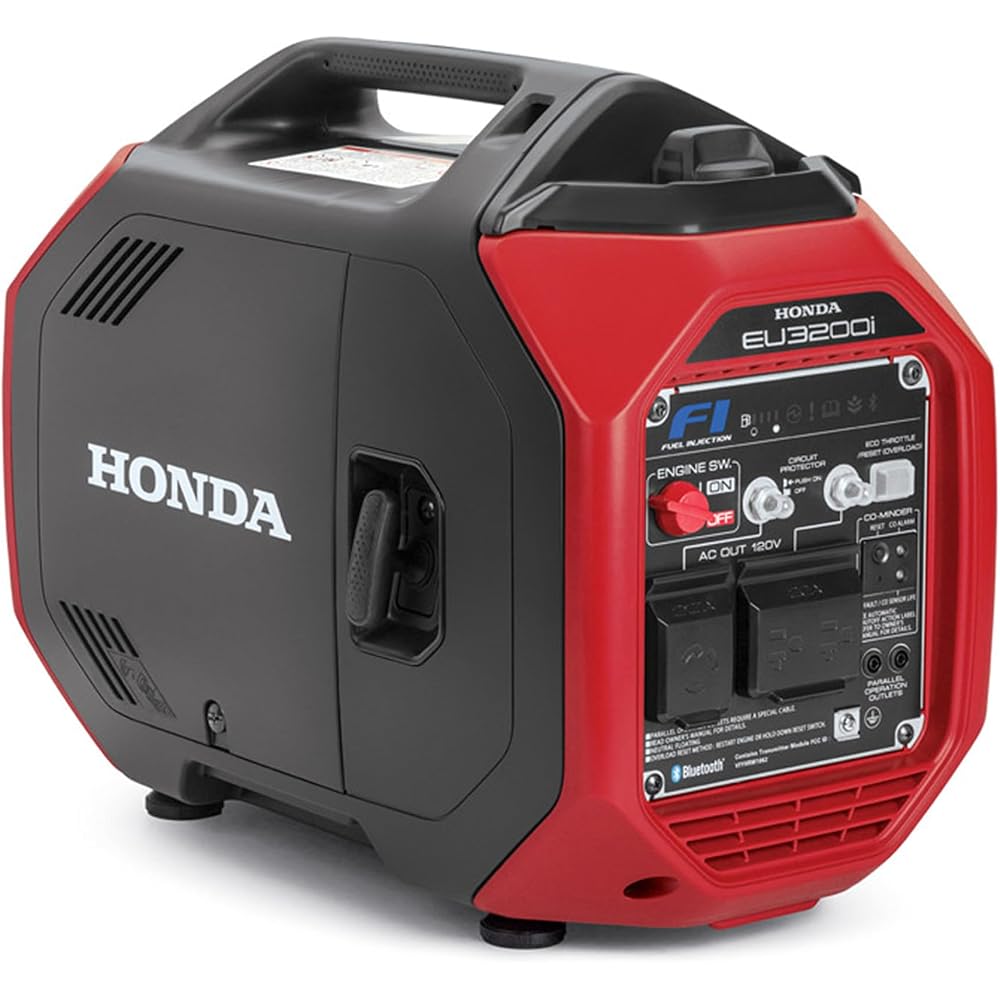
Best premium
Honda EU3200i Inverter Generator
- 2,600W running / 3,200W peak output
- Gasoline inverter, 54–58 dBA
- Fuel-injected GX130 engine with Bluetooth app
- 30A locking RV receptacle; 59.1 lbs
As an Amazon Associate, we earn from qualifying purchases.
Bottom line: More power at 54 dBA with fuel injection, Bluetooth, and a 30A RV outlet.
The Honda EU3200i is what you buy when the EU2200i is almost enough. With 2,600 running watts and 3,200 peak, it comfortably starts a 13,500 BTU RV air conditioner — the single most common reason campers upsize. Noise rises to 54–58 dBA, still conversation-quiet and well within most campground limits.
The fuel-injected GX130 engine starts reliably in cold weather and sips fuel efficiently, while Bluetooth connectivity lets you monitor output, runtime, and maintenance reminders from your phone. CO-MINDER shuts the unit down on dangerous carbon monoxide levels, and the 30-amp locking RV receptacle means no adapters for your shore-power cord.
This is the most expensive generator in this guide by a wide margin, and at 59.1 pounds it is noticeably heftier than the EU2200i. But if your camping includes air conditioning and you refuse to compromise on noise or reliability, the EU3200i is the definitive answer.
Pros
- 3,200W peak starts a 13,500 BTU RV AC
- Fuel injection for easy cold starts and efficiency
- Bluetooth monitoring plus CO-MINDER safety
- Dedicated 30A RV locking outlet
Cons
- The priciest pick in this guide
- 59.1 lbs — a two-hand carry for many
- Overkill for tent campers with basic needs
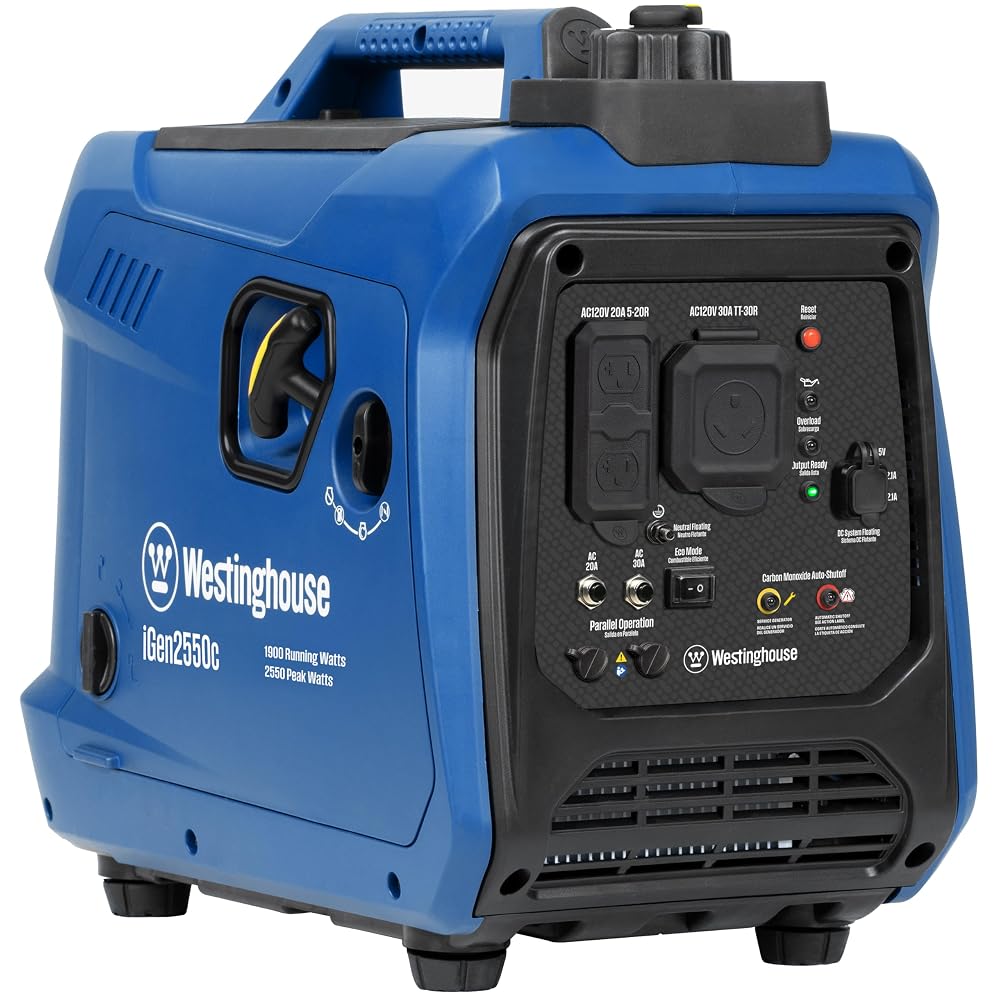
Best ultralight
Westinghouse iGen2550c Inverter Generator
- 1,900W running / 2,550W peak output
- Gasoline inverter, just 52 dBA
- Up to 12 hours @ 25% load on 1.1 gallons
- Only 42.4 lbs with 30A TT-30R RV outlet
As an Amazon Associate, we earn from qualifying purchases.
Bottom line: 61 dBA and only 42.4 lbs with a 30A RV outlet and 12-hour runtime.
The Westinghouse iGen2550c is the featherweight of this roundup at 42.4 pounds, yet it still delivers 2,550 peak watts at a hushed 52 decibels. The standout feature for campers is the 30-amp TT-30R RV outlet — plug your travel trailer’s shore cord straight in with no adapters — plus a built-in CO sensor and an LED data center showing fuel level, output, and lifetime hours.
Runtime is excellent: up to 12 hours at quarter load on just 1.1 gallons, so a single fill covers an entire quiet-hours evening. Parallel capability lets you pair two units for a full 30 amps of RV power if your needs grow. The <3% THD inverter output is safe for laptops, phones, and CPAP machines.
It will not run a large RV air conditioner alone — 2,550 peak watts is the honest limit — and Westinghouse’s service network is smaller than Honda’s. But for tent campers, van lifers, and small-trailer owners who count every pound, the iGen2550c is the sweet spot of weight, noise, and price.
Pros
- Only 42.4 lbs — easy one-person carry
- 61 dBA with RV-ready 30A outlet built in
- 12-hour runtime at quarter load
- CO sensor and LED data center included
Cons
- 2,550W peak will not start most RV air conditioners
- Smaller service network than Honda/Yamaha
- 1.1-gal tank needs refills on heavy-use days
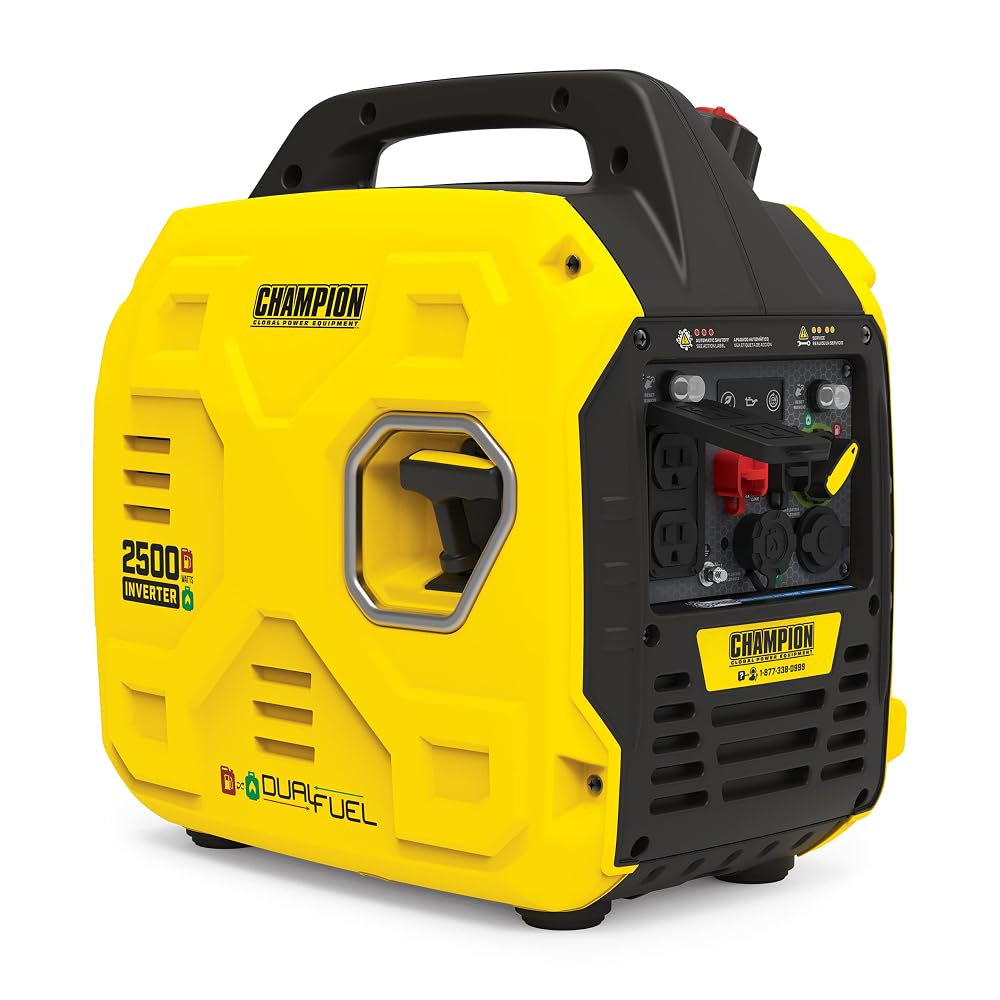
Best dual fuel
Champion 2500W Dual-Fuel Inverter Generator
- 1,850W running / 2,500W peak output (gasoline)
- Dual fuel: gasoline or propane
- 53 dBA with CO Shield shutdown
- Up to 25 hours on propane @ 25% load; 43.2 lbs
As an Amazon Associate, we earn from qualifying purchases.
Bottom line: Propane or gasoline at 53 dBA with CO Shield and 25-hour propane runtime.
The Champion 2500W dual-fuel inverter (CO Shield version) is the only pick here that runs on propane, and for camping that matters. A 20-pound propane tank holds the equivalent of about 4.5 gallons of gasoline, never goes stale, and will not spill in your trunk. On propane at quarter load, this little unit runs up to 25 hours — an entire long weekend on one tank.
Noise is a respectable 53 dBA, power is clean inverter output under 3% THD, and CO Shield provides automatic carbon-monoxide shutdown. At 43.2 pounds it is genuinely portable, and Champion’s three-year warranty plus nationwide service network are reassuring for a budget-friendly brand.
Output is modest: 1,850 running watts on gasoline drops to 1,665 on propane, so this is for lights, charging, fans, and small appliances — not air conditioning. If your camping power needs are basic and you love the no-spill, no-stale-fuel propane life, this is the one.
Pros
- Dual fuel — propane never goes stale or spills
- Up to 25-hour runtime on propane
- 53 dBA quiet with CO Shield safety
- Light 43.2 lbs with 3-year warranty
Cons
- Only 1,850W running — no air conditioning
- Propane output drops to 1,665W
- Needs a separate propane hose/regulator setup
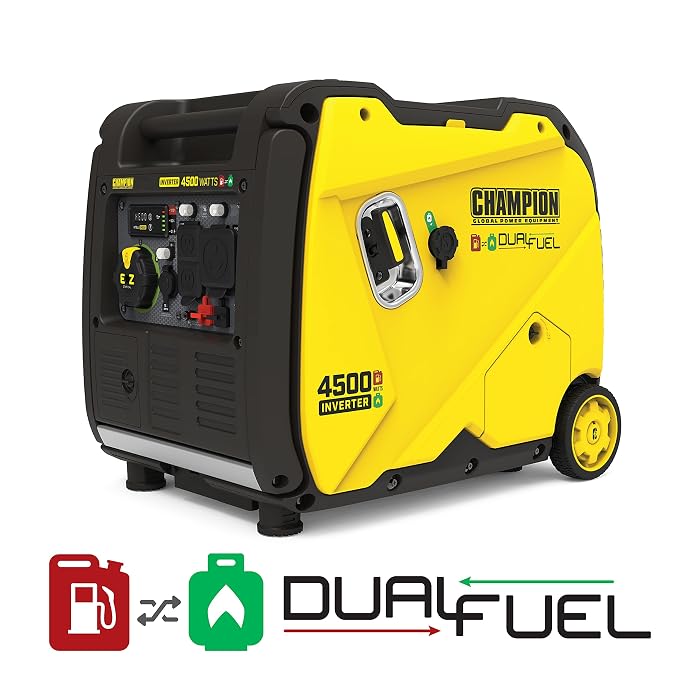
Best for bigger loads
Champion 201319 4,500-Watt Dual Fuel Inverter Generator Dual-Fuel Inverter Generator
- 3,500 (gasoline); 3,150 (propane) running / 4,500 (all fuels) peak output
- Dual Fuel: gasoline, propane
- Up to 14 hrs (gasoline, 2.25 gal); 21 hrs (propane, 20-lb tank) runtime
- 61 dBA noise level
As an Amazon Associate, we earn from qualifying purchases.
Bottom line: 3,700 running watts at 61 dBA with remote start and RV-ready outlets.
The Champion 201319 4,500-Watt Dual Fuel Inverter Generator answers the question every bigger RV owner asks: can I get air-conditioning power without the noise? At 3,700 running watts and 52 decibels, it starts a 13,500 BTU RV air conditioner while staying quieter than most 2,000-watt conventional generators. That combination is rare.
Remote start from the key fob is a genuine luxury at a campsite — start the generator from inside the RV to pre-cool before you walk back. Dual-fuel operation gives you propane’s storage advantages, the TT-30R outlet is RV-ready, and runtime stretches to 14 hours on the 3.4-gallon tank at light loads. It is also CARB compliant for California campgrounds.
The price of that power is weight: 98 pounds with wheels and a telescoping handle, so it is a roll-not-carry unit. Propane output drops to 3,330 running watts. But for travel trailers and fifth wheels where the AC must run and the neighbors must not complain, the iGen4500DF is the best-balanced pick.
Pros
- Runs a 13,500 BTU RV AC at only 61 dBA
- Remote start plus dual-fuel flexibility
- RV-ready TT-30R; 18-hour max runtime
- Wheels and handle despite 98 lbs
Cons
- 98 lbs — rolls, does not carry
- Propane output drops to 3,330W
- Larger footprint in a truck bed
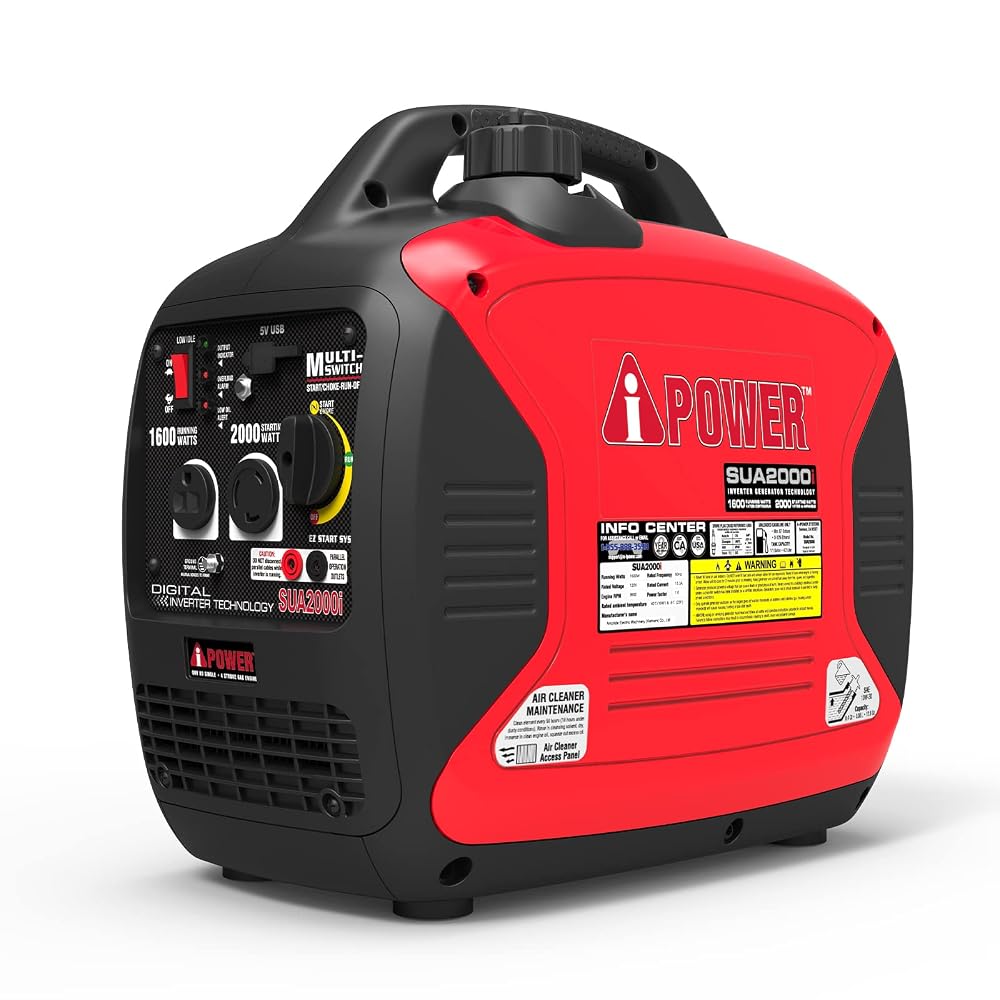
Best budget
A-iPower SUA2000iV Inverter Generator
- 1,600W running / 2,000W peak output
- Gasoline inverter, 52 dBA
- 7 hours @ 50% load on 1.1 gallons
- Low Idle tech; only 48 lbs
As an Amazon Associate, we earn from qualifying purchases.
Bottom line: 61 dBA quiet with clean power at the lowest price in this guide.
The A-iPower SUA2000iV is proof that quiet camping power does not have to cost a fortune. At 52 decibels it matches generators costing twice as much for noise, and the inverter output stays under 3% THD for safe electronics charging. Low Idle technology drops the engine to a murmur under light loads, which is most of what camping actually demands.
With 1,600 running watts it handles phones, laptops, LED lights, a fan, and a small cooler effortlessly. The 1.1-gallon tank delivers about 7 hours at half load, and at 48 pounds it is an easy carry from truck to tent. Historical street pricing in the $280–$400 range makes it the value champion here.
The limits are honest: 2,000 peak watts will not start anything with a big motor, and the feature set is basic — no Bluetooth, no fuel gauge, no RV outlet. A-iPower’s service network is also thinner than the majors. But as a quiet, cheap, carry-anywhere camping companion, it is remarkably hard to fault.
Pros
- 61 dBA quiet at a budget price
- Clean <3% THD power for electronics
- Light 46.5 lbs with Low Idle efficiency
- Excellent value around $300–$400 street
Cons
- Only 1,600W running — basic loads only
- No RV outlet, fuel gauge, or app
- Thinner service network than major brands
Best long-run budget
Honda EU2200i
- 1800W running / 2200W peak output
- gasoline
- Up to 8.1h @ 1/4 load on 0.95-gal tank runtime
- 48-57 dBA noise level
As an Amazon Associate, we earn from qualifying purchases.
Bottom line: 10-hour runtime at 61 dBA, but check the manufacture date.
The Honda EU2200i has been a budget-camper favorite for years: 2,200 running watts, 52 decibels, and up to 8.1 hours of runtime at quarter load on a single gallon. The LED data center shows fuel remaining, power output, and lifetime hours — genuinely useful at a campsite — and the <3% THD inverter output handles laptops and CPAP machines safely.
At 48 pounds with a compact frame, it disappears into a trunk corner, and parallel capability means you can double up later for 30-amp RV service. For the price, the feature set embarrasses generators costing twice as much.
One important caveat: the CPSC recalled early iGen2500 units manufactured between June and October 2017 for overheating and fire risk. Current production is unaffected, but if you are buying used, verify the manufacture date and that the recall remedy was applied. Buy new from a reputable seller and you get one of the best value quiet inverters ever made.
Pros
- 2,200W running watts at a budget price
- 10-hour runtime; 61 dBA quiet
- LED data center with fuel and hour tracking
- Parallel-ready for future RV needs
Cons
- 2017 units were recalled — verify date if buying used
- No 30A RV outlet without paralleling
- Basic recoil-only starting
Buying guide: quiet generators for camping
Understanding campground noise rules
Most public campgrounds enforce quiet hours from 10 p.m. to 6 a.m., and many ban generators entirely during those hours regardless of noise level. The National Park Service commonly limits generators to 60 dBA at 50 feet, and some parks restrict generator use to specific hours even during the day. Private campgrounds vary — always check the rules before you book. A good rule of thumb: if your generator is louder than 60 dBA, assume it will draw complaints.
How much power does camping actually need?
Tent camping is modest: LED lights (50W), phone and laptop charging (150W), a fan (75W), and a portable fridge (100W) total under 500 running watts — any 2,000W-class inverter handles this with room to spare. RV camping jumps up: a 13,500 BTU air conditioner needs about 2,800 running watts but surges to 3,500+ on startup, which is why RVers should look at 3,000W+ peak units or plan to parallel two smaller inverters.
Inverter vs. conventional for camping
For camping, inverter is the only sensible choice. Beyond the noise advantage, inverters produce clean power (<3% THD) that will not fry a laptop or CPAP, and their variable engine speed means dramatically better fuel economy overnight. Conventional open-frame generators are cheaper per watt but have no place in a campground — they are loud enough to violate most noise rules at any load.
Runtime and fuel for a weekend
Manufacturers quote runtime at 25% load, which is optimistic but useful for comparison. Realistically, a 2,000W-class inverter sipping fuel at quarter load runs 8–12 hours on about a gallon — one tank per night. For a three-day weekend, carry the generator’s tank plus one spare gallon (or a 20-lb propane tank for dual-fuel models). Never refuel a hot generator, and store fuel away from tents and sleeping areas.
Placement and etiquette
Point the exhaust away from your site and your neighbors’, and use the full length of your extension cord to put distance between the generator and sleeping areas — every doubling of distance drops perceived noise significantly. A simple three-sided sound deflector (plywood or a commercial barrier) can shave a few more decibels. And the golden rule: if your neighbors can hear it inside their RV with the AC on, it is too loud or too close.
Quiet camping generator FAQs
What is the quietest generator for camping?
The Honda EU2200i at 48 dBA under light load is the quietest widely available camping generator — about as loud as a quiet conversation. The Westinghouse iGen2550c, A-iPower SUA2000iV, and Honda EU2200i all hit 61 dBA at roughly half the price, which is still very quiet.
Can I run a generator all night while camping?
It depends on the campground. Many public campgrounds ban generators during quiet hours (usually 10 p.m.–6 a.m.) regardless of noise level. Where overnight use is allowed, choose an inverter with 8+ hours of runtime at quarter load so one tank lasts the night, and always keep the generator outside and downwind of sleeping areas because of carbon monoxide.
What size generator do I need for a camper or RV?
For basic RV use (lights, charging, fridge, fan), 2,000–2,500 peak watts is enough. To run a 13,500 BTU roof air conditioner, you need at least 3,000 peak watts — realistically 3,500+ for reliable startups — which means a larger inverter like the Champion 201319 4,500-Watt Dual Fuel Inverter Generator or two smaller inverters in parallel.
Are inverter generators safe for CPAP machines and laptops?
Yes. Inverter generators produce pure-sine-wave power with under 3% total harmonic distortion, which is clean enough for sensitive electronics including CPAP machines, laptops, and cameras. Conventional open-frame generators can produce rougher power that may damage or shorten the life of delicate devices.
How far away should my generator be from the tent?
At least 20 feet, with the exhaust pointed away from all sleeping areas — and farther is better for both noise and carbon-monoxide safety. Never run a generator inside a tent, under an awning attached to the tent, or in a truck bed with a camper shell. CO is odorless and kills silently.
Is propane or gasoline better for camping generators?
Propane wins for camping convenience: it never goes stale, will not spill in your vehicle, and a 20-lb grill tank runs a small inverter for a full weekend. Gasoline gives about 10% more power and is easier to find on the road. Dual-fuel models like the Champion 2500W give you both options.
Our verdict
The Honda EU2200i remains the quietest camping generator you can buy at 48 dBA, and its reliability justifies the premium for noise-strict campgrounds. Budget campers should get the Westinghouse iGen2550c — 61 dBA, 42 pounds, and an RV-ready outlet for far less money. RVers who need air conditioning without the roar should look at the Champion 201319 4,500-Watt Dual Fuel Inverter Generator. Whichever you choose, respect quiet hours and keep the exhaust pointed away from every tent on the loop.

Related Guides
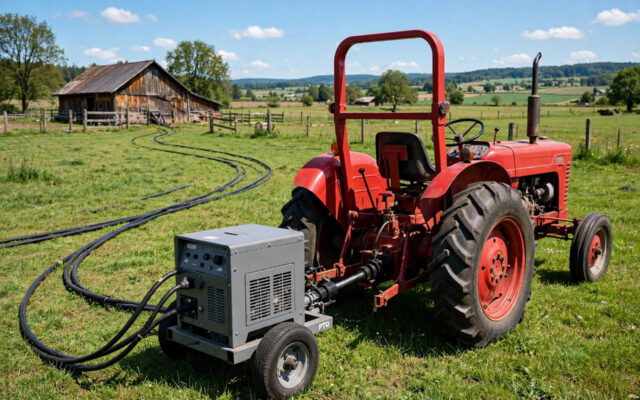
Best PTO Generators for Tractors in 2027
Best PTO generators for tractors in 2027: top 5 PTO-driven units compared — NorthStar, Winco, Tiger Power. Sizing rules, 540 RPM basics and buying guide.

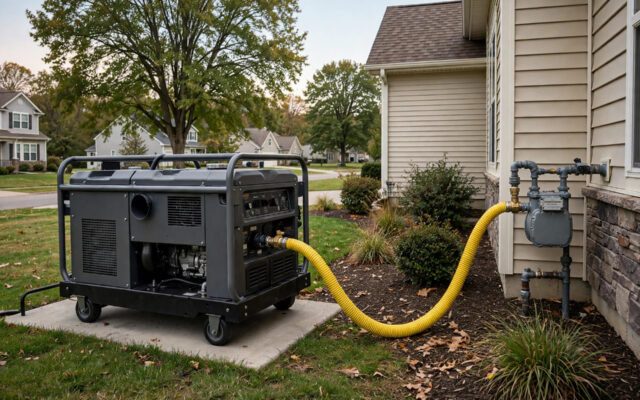
Best Natural Gas Generators of 2027
The best natural gas generators run tri-fuel. Our 2027 picks - Westinghouse, DuroMax, Champion, Gidrox - plus NG hookup and sizing advice.
Best Diesel Generators of 2027 (Portable Picks)
The best diesel generators for 2027? A short honest list: Generac XD5000E leads, Kipor KDE6700TA follows. Fuel math, winter tips & buying advice inside.