


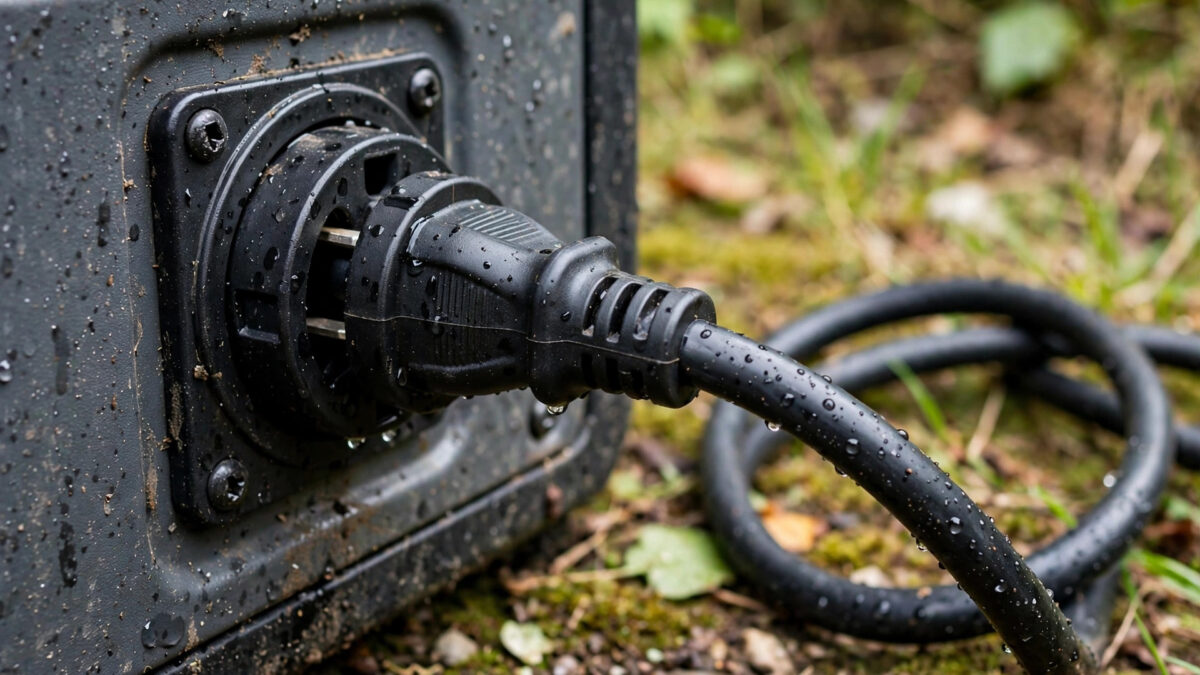
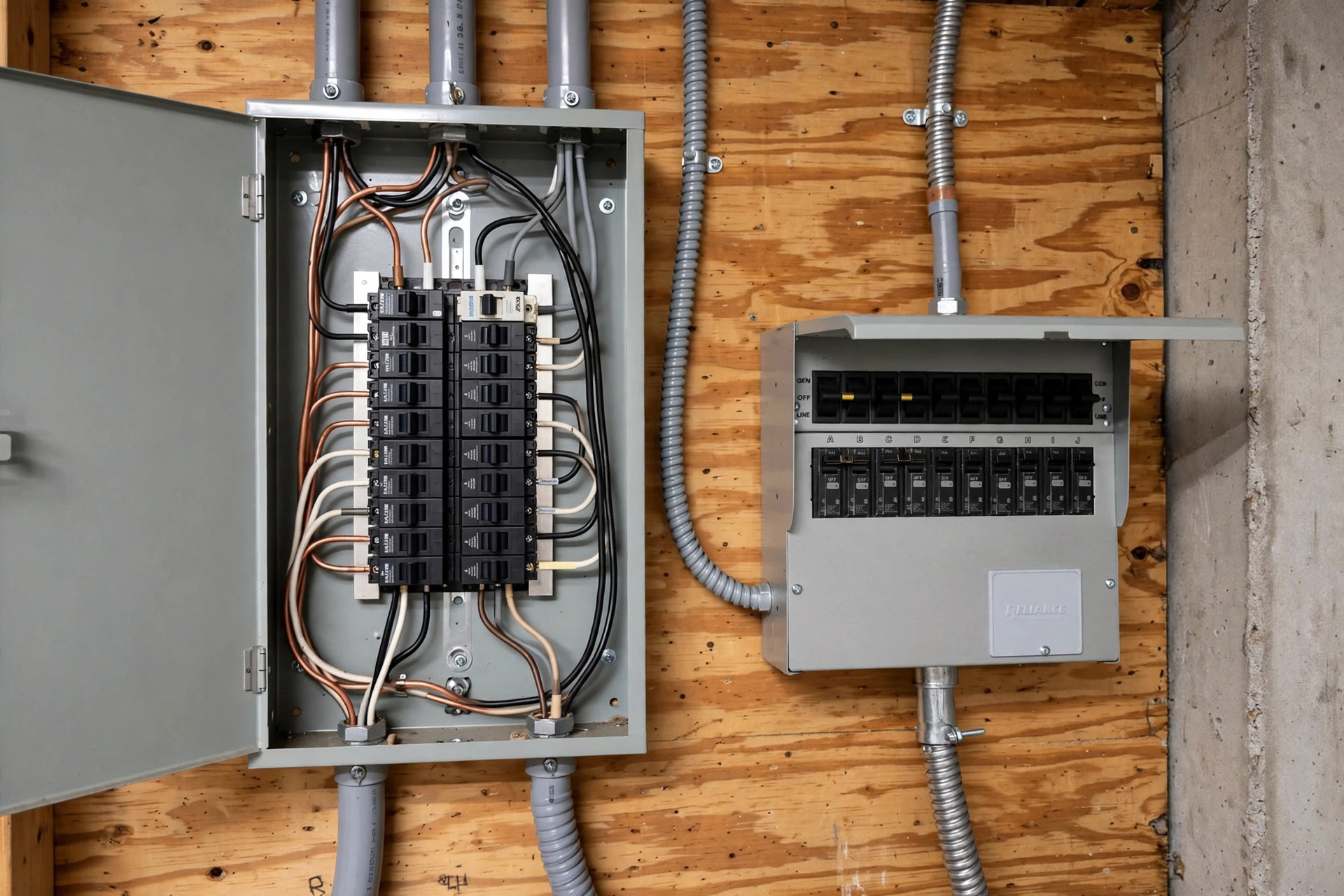
For a portable generator, match the transfer switch to the generator’s largest outlet: a 30-amp switch handles up to 7,200 watts (the L14-30 outlet on most portables), and a 50-amp switch handles up to 12,000 watts. For a standby generator with an automatic transfer switch, size the switch to your electrical service — 100A or 200A — and make sure the protected load doesn’t exceed the generator’s rating per NEC 702.4(B).
This is the step where I see the most confusion, because “match the amps” sounds simple and is almost right — but the details matter. A 30A outlet at 240V gives you 7,200 watts. Your 9,500W generator probably still has a 30A outlet. And the switch must handle your continuous loads at 125%. Let me walk through it properly.
Key takeaways
- 30A transfer switch = up to 7,200W (240V). 50A = up to 12,000W. These are the two sizes for portable generators.
- Match the switch to your generator’s largest outlet (usually L14-30), not the generator’s max wattage.
- Continuous loads (3+ hours) must be sized at 125% per NEC — a 24A continuous load needs a 30A switch minimum.
- For ATS/standby: 100A or 200A service-rated, and the connected load can’t exceed the generator’s rating.
- When in doubt, go one size up — a 50A switch on a 30A generator is fine; a 30A switch on a 50A generator is a bottleneck.
The 30A vs. 50A Decision (Portable Generators)
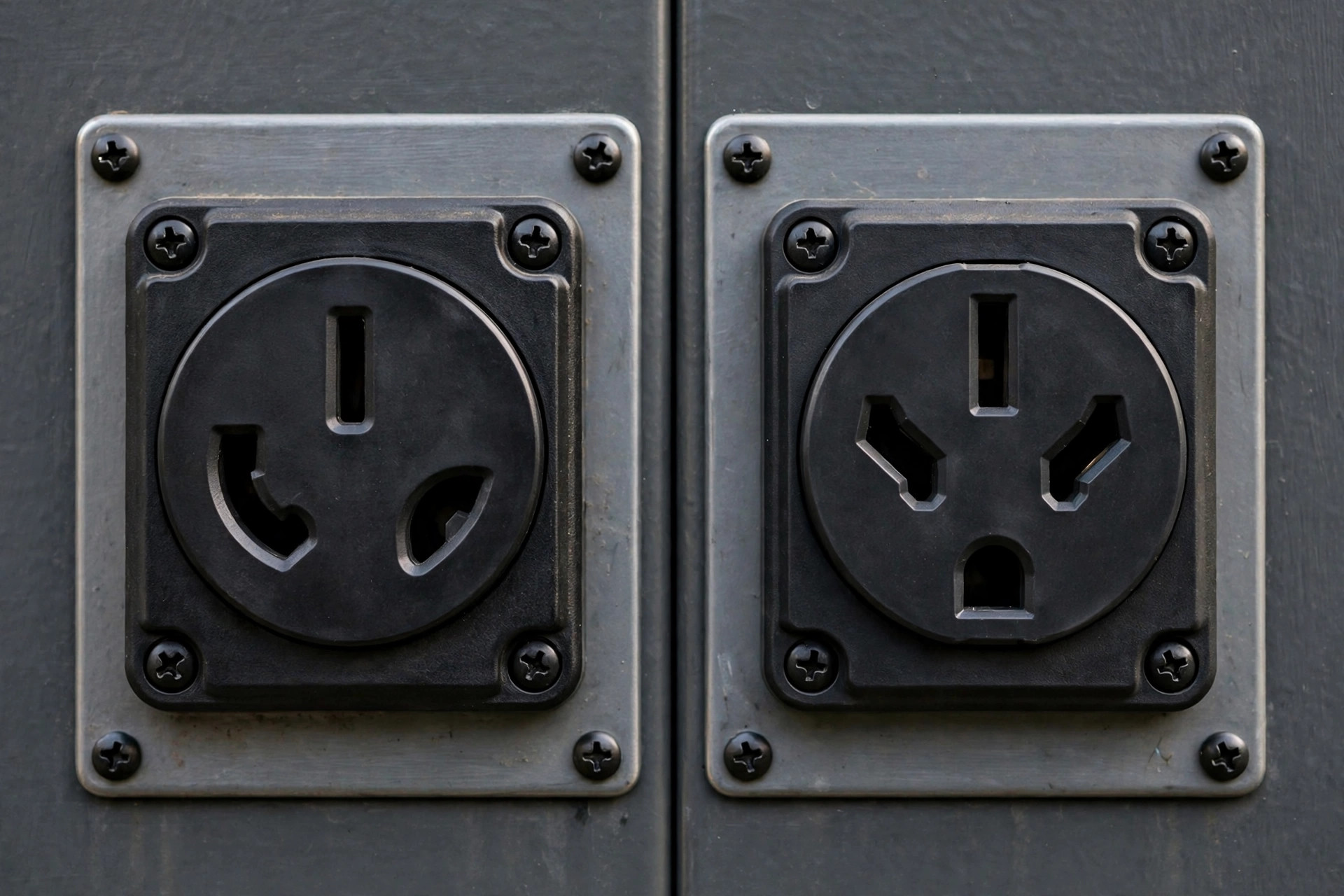
Almost every portable generator in the 5,000–12,000W range has a 30-amp twist-lock outlet (NEMA L14-30) — it’s the industry standard. Even a 9,500W portable usually ships with a 30A outlet, because 30A × 240V = 7,200W of continuous capacity through that receptacle.
| Switch size | Max watts (240V) | Typical generator pairing | Cord/outlet |
|---|---|---|---|
| 30A | 7,200W | 5,000–9,500W portables | L14-30 |
| 50A | 12,000W | 10,000–15,000W portables | 14-50 / CS6364 |
Wait — if my generator makes 9,500W but the outlet is 30A, do I lose 2,300W? Through that outlet, yes: the 30A breaker on the generator limits that receptacle to 7,200W. (The rest is available through the 120V household outlets.) This is normal and fine — but it’s exactly why you match the transfer switch to the outlet, not the headline wattage. A 30A transfer switch (like the popular Reliance 310A, rated to 7,500W) is the right call for nearly every portable with an L14-30.
Go 50A only if your generator actually has a 50A outlet — some 10,000W+ portables (Duromax XP12000EH class) ship with a 14-50. And remember: oversizing the switch is harmless. A 50A switch fed by a 30A generator works perfectly; the generator’s own breaker is the limiter. Undersizing is the mistake.
The 125% Rule for Continuous Loads
NEC requires continuous loads — anything running 3 hours or more — to be calculated at 125% of the actual current. This applies to your transfer switch sizing:
Amps = Watts ÷ Volts. A 5,760W continuous load at 240V = 24A × 1.25 = 30A. So that load exactly fills a 30A switch. A 6,000W continuous load needs 31.25A → you need the 50A switch.
In practice, residential backup loads are rarely all continuous — fridges cycle, pumps cycle, lights are intermittent. But electric heat, a well pump running irrigation, or a space heater grinding all night count as continuous. Add up your worst-case continuous loads and apply the 125% multiplier before choosing.
Sizing an Automatic Transfer Switch (Standby Generators)
Different game. An ATS is sized to your home’s electrical service, not the generator’s outlet:
- 100A ATS: For homes with 100A service, or 200A service with a sub-panel covering selected essential circuits.
- 200A service-rated ATS: For whole-house coverage on a 200A service — the most common standby setup.
Here’s the critical NEC rule (702.4(B)(2)): an automatic transfer switch must not transfer a load larger than the generator’s rating onto the generator. A 200A ATS on a 14 kW standby (58A) is fine only if the connected load is managed to what the generator can carry — through load-shed modules, smart management, or a sub-panel of selected circuits. This is why standby installers do a load calculation, not just a panel swap.
The practical upshot: don’t buy the ATS separately from the generator unless you know what you’re doing. Standby generators are sold as matched systems (generator + ATS + load management) precisely because the sizing interplay is tricky. The bundle is engineered; the à la carte approach is where mistakes happen.
Three Sizing Mistakes I See Constantly
Mistake 1: Sizing from surge watts. Covered above, but it bears repeating because marketing trains you wrong — the big number on the box is starting watts. Size from running watts. A “9,500W” portable with 7,500 running watts belongs on a 30A switch.
Mistake 2: Forgetting the neutral. On 120/240V systems, the neutral carries the imbalance between the two hot legs. If all your backup loads are 120V on one leg (common when people back up “convenience” circuits), the neutral can carry nearly the full load. This is why 50A transfer switches use heavier neutral wiring than 30A ones — and why balancing your backed-up circuits across both legs matters. Your electrician should check this; mention it if they don’t.
Mistake 3: Buying the switch before the generator. The generator’s outlet decides the switch size, not the other way around. Buy the generator first, read the outlet (it’s stamped on the panel), then buy the matching switch, inlet box, and cord. I’ve seen too many 50A switches gathering dust next to generators with 30A outlets.
Step-by-Step: Size Your Switch in 5 Minutes
1. Find your generator’s largest 240V outlet. L14-30 → 30A switch. 14-50 → 50A switch. Standby → 100A or 200A per your service.
2. List the circuits you’ll back up (see our essential circuits guide) and add their running watts.
3. Identify continuous loads (3+ hours) and multiply those by 1.25.
4. Total amps = total watts ÷ 240. Round UP to the next standard switch size.
5. Sanity check: the switch rating must be ≥ your generator outlet’s rating. Oversize if between sizes.
Example: fridge (700W) + freezer (500W) + furnace blower (800W) + well pump (1,000W) + lights (300W) + microwave (1,000W, intermittent) = 4,300W running. None are continuous except arguably the furnace blower in deep winter (800 × 1.25 = 1,000W). Total ≈ 4,500W ÷ 240V = 18.75A → 30A switch, comfortably. A 10-circuit 30A manual transfer switch is the answer for this very typical setup.
What size transfer switch do I need for a 7500 watt generator?
Can I use a 50 amp transfer switch with a 30 amp generator?
What size automatic transfer switch do I need for my house?
How many watts can a 30 amp transfer switch handle?
Do I need an electrician to install a transfer switch?
One last check before you buy: confirm your panel has space for the transfer switch’s breakers or the interlock’s generator breaker. A full panel with no room means adding a sub-panel or using tandem breakers — a $150–$300 wrinkle your electrician can spot in five minutes. Send them a photo of your open panel when getting the quote; it saves a return trip.
Right-sized switch in hand? The other half of the connection is the inlet box on the outside of your house — that’s what your generator cord actually plugs into, and its amperage must match the switch. Get both at the same rating and the whole chain is consistent.

Related Guides
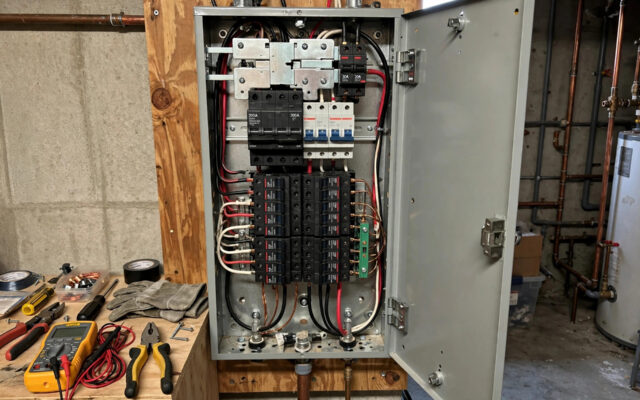
Do You Need a Panel Upgrade for a Generator? (2027 Guide)
Do you need a panel upgrade for a generator? Usually not — an interlock kit and two free breaker spaces handle a portable. Here is when an upgrade is truly required.

Transfer Switch vs Interlock Kit: Which Is Better in 2027?
Transfer switch vs interlock kit: both legally connect a generator to your house. Compare costs ($400–$1,300 vs $400–$850), flexibility, ease of use, and code rules.
How to Install a Generator Interlock Kit (Step-by-Step)
Install a generator interlock kit in 45-90 minutes: $50-$150 kit, 7 steps, panel safety warnings, and when to hire an electrician instead.