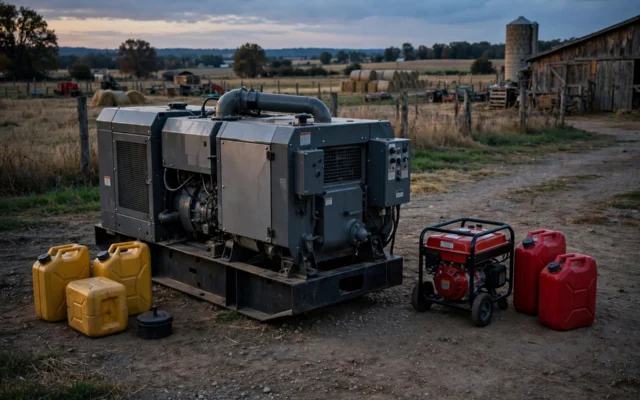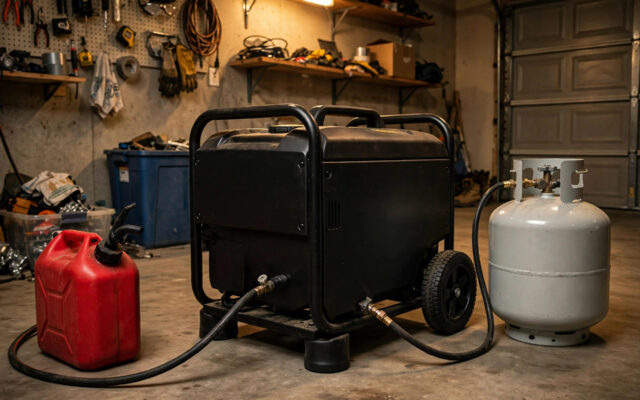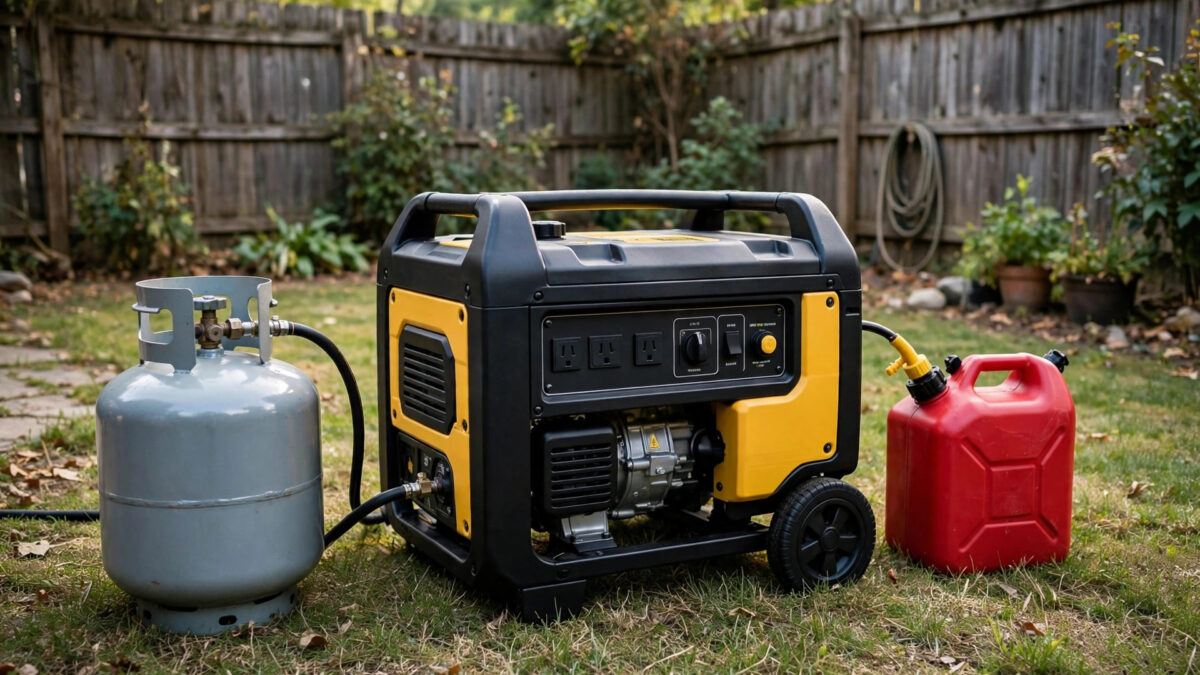
At October 2026 prices, propane is actually cheaper per kilowatt-hour than gasoline for most generator owners. With national average gas at $4.36/gal (AAA) and residential propane at $2.60/gal (EIA), a typical portable generator produces electricity for roughly $0.45–$0.50/kWh on propane vs. $0.60–$0.70/kWh on gasoline.
That surprises people — propane has less energy per gallon, so you’d expect it to cost more. But propane is priced like a heating commodity while gasoline is priced like a transportation fuel, and right now that pricing gap outweighs the energy-density gap. Let me show the math so you can rerun it with your local prices.
Key takeaways
- Gasoline: ~114,000 BTU/gal. Propane: ~91,500 BTU/gal — propane holds ~20% less energy per gallon.
- Small generators convert ~20% of fuel energy into electricity; the rest is lost as heat and exhaust.
- At Oct 2026 prices (gas $4.36, propane $2.60): gasoline ≈ $0.65/kWh, propane ≈ $0.48/kWh.
- Propane derates dual-fuel generators ~10% — a 9,500W gas machine makes ~8,550W on propane.
- Propane stores indefinitely without degrading; gasoline goes stale in 30–60 days without stabilizer.
The Math: How to Calculate Cost per kWh
You only need three numbers: the price per gallon, the fuel’s energy content, and your generator’s efficiency. Here’s the formula:
Cost per kWh = Price per gallon ÷ (BTU per gallon × efficiency ÷ 3,412)
3,412 is the number of BTUs in one kilowatt-hour. Generator efficiency for small air-cooled units at typical loads is roughly 18–22% — let’s use 20% for a clean example, since it’s well-supported by real owner measurements.
Worked example: 7,500W portable generator
On gasoline:
114,000 BTU/gal × 0.20 efficiency ÷ 3,412 = 6.7 kWh per gallon.
$4.36 ÷ 6.7 kWh = $0.65 per kWh.
On propane:
91,500 BTU/gal × 0.20 efficiency ÷ 3,412 = 5.4 kWh per gallon.
$2.60 ÷ 5.4 kWh = $0.48 per kWh.
So a gallon of propane produces about 20% less electricity — but it costs roughly 40% less than a gallon of gasoline at today’s prices. Net: propane wins by about 25% per kWh.
Cost Comparison Table (October 2026 prices)
| Gasoline | Propane | |
|---|---|---|
| Energy per gallon | ~114,000 BTU | ~91,500 BTU |
| Electricity per gallon (20% eff.) | ~6.7 kWh | ~5.4 kWh |
| National avg. price (Oct 2026) | $4.36/gal (AAA) | $2.60/gal (EIA) |
| Cost per kWh | ~$0.65 | ~$0.48 |
| Daily cost, 10 kWh/day use | ~$6.50 | ~$4.80 |
| 3-day outage cost | ~$19.50 | ~$14.40 |
| Power output (same machine) | Full rated watts | ~10% derate |
The Hidden Costs Nobody Mentions
Propane tank costs. A 20-lb grill tank holds about 4.7 gallons of propane and costs $15–$25 to exchange or refill — which can work out to $3.50–$5.00/gal, much worse than bulk pricing. Refilling at a propane dealer (not exchanging) is cheaper. For serious backup use, a 100-gallon or 250-gallon tank from a dealer gets you near bulk rates. Factor in tank rental ($50–$150/year) if you don’t own it.
The 10% power derate. Nearly every dual-fuel generator makes less power on propane — Champion, Westinghouse, Firman, Duromax all publish it. A 9,500W (gas) machine typically rates ~8,550W on propane. If your load plan was built around gasoline watts, you may need to shed a circuit on propane. Propane enters the engine as a vapor (displacing intake air) and lacks gasoline’s evaporative cooling effect — that’s physics, not a defect.
Gasoline storage losses. Propane never goes stale — a tank can sit for years. Gasoline degrades in 30–60 days without stabilizer, so every gallon you don’t burn during an outage is a gallon you may have to burn in your car or treat. That waste never shows up in the cost-per-kWh math, but your wallet feels it.
Cold weather. Below about -40°F propane won’t vaporize well, but that’s not a real-world concern for most. The practical issue is smaller: a 20-lb tank feeding a big generator in winter can ice up and lose pressure as the tank chills from rapid draw. Bigger tank = fewer problems.
What About Natural Gas?
Tri-fuel generators add a third option: natural gas from your home’s gas line. On cost per kWh, natural gas usually beats both — residential natural gas runs roughly $1.00–$1.50 per therm (100,000 BTU), which works out to about $0.35–$0.45/kWh at generator efficiencies, and there’s no tank to refill or exchange. The catch: you need a plumber to install a gas quick-connect, the generator must stay near the house connection (which fights the 20-foot CO rule — plan the hose run), and if an earthquake or utility shutoff kills your gas supply, you’re done. Our dual-fuel vs. tri-fuel comparison digs into whether the third fuel is worth it.
Efficiency Isn’t Constant: The Load Factor
One more wrinkle in the math: my 20% efficiency figure assumes the generator is running at a healthy 50–75% load. At light loads, efficiency collapses — a 7,500W generator loafing along at 1,000W might convert only 10–12% of fuel energy into electricity, nearly doubling your cost per kWh. Owner measurements on forums back this up: the same machine can cost $0.50/kWh at half load and over $1.00/kWh barely loaded.
The practical lesson: don’t oversize your generator and then run it nearly empty. A 3,500W inverter running at 70% load is cheaper per kWh than a 12,000W beast running at 20% — and quieter, too. This is another reason to size from your actual essential loads (see our essential circuits guide) rather than buying the biggest machine that fits the budget.
When Gasoline Still Wins
Propane’s cost-per-kWh edge depends on the price spread. If you’re in New England paying $3.80/gal for propane against $4.40 gasoline, rerun the numbers — gasoline likely wins. Propane also loses if you only have access to expensive 20-lb exchanges and no bulk refill option.
Gasoline also wins on pure portability. A 5-gallon can is easy to carry; a 100-lb propane cylinder is not. For camping, tailgating, and jobsites, gasoline is the practical fuel regardless of cost per kWh.
My Bottom Line
For home backup with a dual-fuel generator: run propane whenever it’s practical. It’s cheaper per kWh at current prices, it never goes stale, it burns cleaner (less oil contamination, less carbon buildup — engines last longer), and during extended outages, propane deliveries keep flowing when gas stations run dry. I keep my dual-fuel on propane year-round and only switch to gasoline when the propane tank runs out.
The honest exception: if propane costs you over ~$3.50/gal locally and gasoline is under $4.00, do the math — the answer may flip. And if you’re choosing between fuels for a generator you haven’t bought yet, read our dual-fuel vs. tri-fuel comparison before you decide.
Is propane cheaper than gasoline for generators?
How do you calculate generator cost per kWh?
Does propane produce less power than gasoline in a generator?
How long does a 20-lb propane tank last on a generator?
Does propane go bad like gasoline?
One last thought: cost per kWh matters, but availability during a real outage matters more. After major storms, I’ve seen gas stations with dead pumps and hour-long lines while the propane dealer was still delivering. The cheapest fuel is the fuel you can actually get — and propane’s storage life means you can stock it before storm season instead of hunting for it during one.