


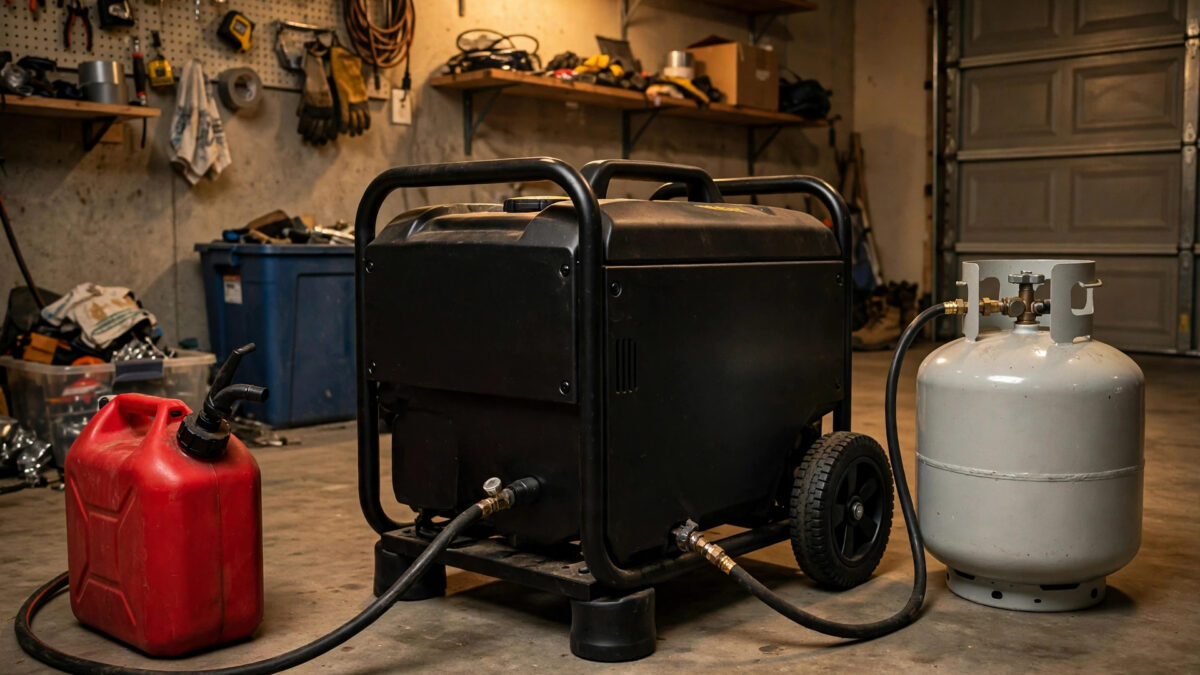
Ask ten generator owners which fuel is better and you’ll get eleven opinions. I’ve run both — gasoline for years, then propane after I got tired of gummed-up carburetors every spring. Here’s the honest summary: propane is the better fuel for standby and emergency use; gasoline is the better fuel for runtime per gallon and raw availability. And for most buyers in 2027, the right answer is a dual-fuel generator that lets you stop choosing.
Key takeaways
- Propane never goes stale; gasoline degrades in 3–6 months (faster with ethanol blends).
- Gasoline packs ~25% more energy per gallon — expect ~10% less power and shorter runtime on propane.
- Propane burns cleaner: less carbon buildup, longer oil life, easier maintenance.
- Gasoline is easier to find mid-outage at any gas station; propane depends on tank exchanges or refills.
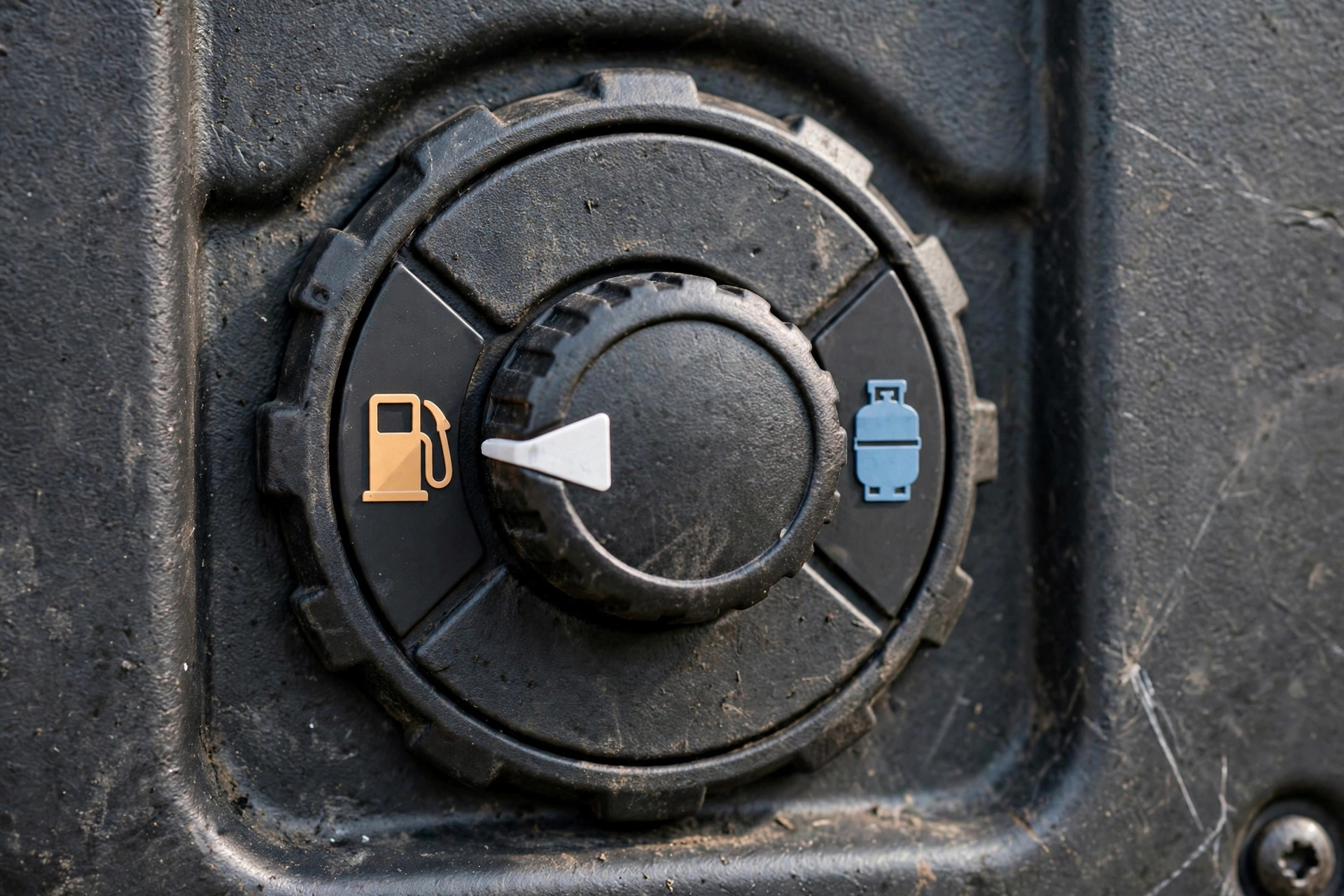
- Dual-fuel generators (like the Champion 201319) give you both options for a small premium — the best of both worlds.
Gasoline vs propane at a glance
| Factor | Gasoline | Propane | Winner |
|---|---|---|---|
| Energy per gallon | ~114,000 BTU | ~91,500 BTU | Gasoline |
| Shelf life | 3–6 months (with stabilizer) | Indefinite | Propane |
| Power output | Full rated watts | ~10% less | Gasoline |
| Engine cleanliness | Carbon buildup, ethanol issues | Burns clean | Propane |
| Cold weather | Starts harder; fuel stays liquid | Pressure drops in extreme cold | Gasoline (slight) |
| Refueling mid-outage | Any gas station | Exchange/refill locations | Gasoline |
| Storage safety | Flammable liquid, fumes | Sealed tanks, no spill risk | Propane |
The energy math: gasoline packs more punch
A gallon of gasoline contains about 114,000 BTU; a gallon of propane about 91,500. That’s roughly 25% more energy per gallon for gasoline, which is why dual-fuel generators are always rated lower on propane — typically around 10% fewer running watts. The Champion 201319, for example, makes 3,500 running watts on gasoline but 3,150 on propane.
In practical terms: a 20-pound propane tank holds about 4.6 gallons of propane. On the 201319, that tank runs up to 21 hours at light load — impressive, but the same generator goes up to 14 hours on just 2.25 gallons of gasoline. Per gallon, gasoline goes further. Per dollar, it depends on your local prices: propane refills often run $3–$4 per gallon equivalent versus $3–$3.50 for gasoline, but prices swing by region and season.
Shelf life: propane’s killer advantage
This is the argument that converted me. Gasoline starts degrading in as little as 30 days; with stabilizer you get 3–6 months, maybe a year if you’re lucky. Ethanol-blended gas (E10, which is nearly everything at the pump) absorbs moisture and gums up carburetors — the #1 reason generators won’t start when you need them. Every spring, small-engine shops fill up with generators that sat all winter on old gas.
Propane doesn’t degrade. Ever. A tank you filled three years ago burns exactly like a tank you filled yesterday. For a standby generator that might sit idle for 18 months between outages, that’s not a minor convenience — it’s the difference between starting and not starting. No stabilizer, no draining the carb, no spring ritual.
Maintenance and engine life
Propane burns cleaner than gasoline — less carbon buildup on valves and pistons, less oil contamination, longer intervals between oil changes. Dual-fuel owners consistently report that the propane side of their generator stays cleaner inside. Gasoline’s ethanol content is the villain here: it corrodes fuel system components and leaves varnish in carburetor jets. If you run gasoline, use ethanol-free fuel when you can find it and always add stabilizer — or better, run the carb dry after each use.
Cold weather performance
Both fuels have cold-weather quirks. Gasoline engines crank harder in the cold and need proper oil weight (5W-30 synthetic for winter), but the fuel itself doesn’t care about temperature. Propane’s weakness is pressure: as temperature drops, tank pressure drops, and below about -20°F a standard 20-pound tank may not deliver enough vapor to run a large generator at full load. For most of the US, this is a non-issue — but if you’re in the northern plains facing -30°F nights, gasoline (or a larger propane tank with more surface area) is the safer bet.
Availability during outages
When the power’s out for days, gasoline wins on availability — every gas station becomes a refueling point (as long as the station itself has power or a generator). Propane means tank exchanges at grocery and hardware stores, or refill stations, which can run dry in a regional emergency too. The smart play: keep both. A couple of full 20-pound propane tanks plus 10 gallons of stabilized gasoline covers nearly any outage scenario.
The dual-fuel answer
Here’s why this debate is increasingly academic: dual-fuel generators cost only slightly more than gasoline-only models and eliminate the tradeoff. Run propane for the clean, no-maintenance standby months; switch to gasoline when you need maximum watts or when the propane runs out mid-outage. My recommended picks:
- Champion 201319 — 4,500W dual-fuel inverter, 61 dBA, electric start. The best all-around dual-fuel value at $850–$950.
- Westinghouse WGen9500DF — 12,500W peak dual-fuel for whole-home backup, remote start, $1,100–$1,500.
- DuroMax XP13000EH — 13,000W peak dual-fuel workhorse, maximum watts per dollar.
If you go dual-fuel, our generator sizing guide will help you pick the right wattage class first.
The real cost per hour: a worked example
Let’s run the numbers on the Champion 201319, since we know its specs precisely. On gasoline: 2.25 gallons for up to 14 hours at light load = 0.16 gal/hr. At $3.25/gal, that’s about $0.52/hour. On propane: a 20-lb tank (~4.6 gal) for up to 21 hours = 0.22 gal/hr. At a $3.50/gal propane refill equivalent, that’s about $0.77/hour. Gasoline wins by roughly 50% on fuel cost alone at these prices.
But that’s light-load math. At half load, both fuels burn roughly twice as fast and the gap narrows in absolute dollars while staying similar in percentage. And the comparison ignores the hidden gasoline costs: stabilizer ($8–$12 a bottle), the fuel you throw away each spring when it goes stale, and the carburetor cleaning or rebuild ($75–$150 at a shop) that ethanol gas eventually demands. Over five years of standby use, propane’s maintenance savings can erase gasoline’s per-hour advantage entirely.
Storing fuel safely for years
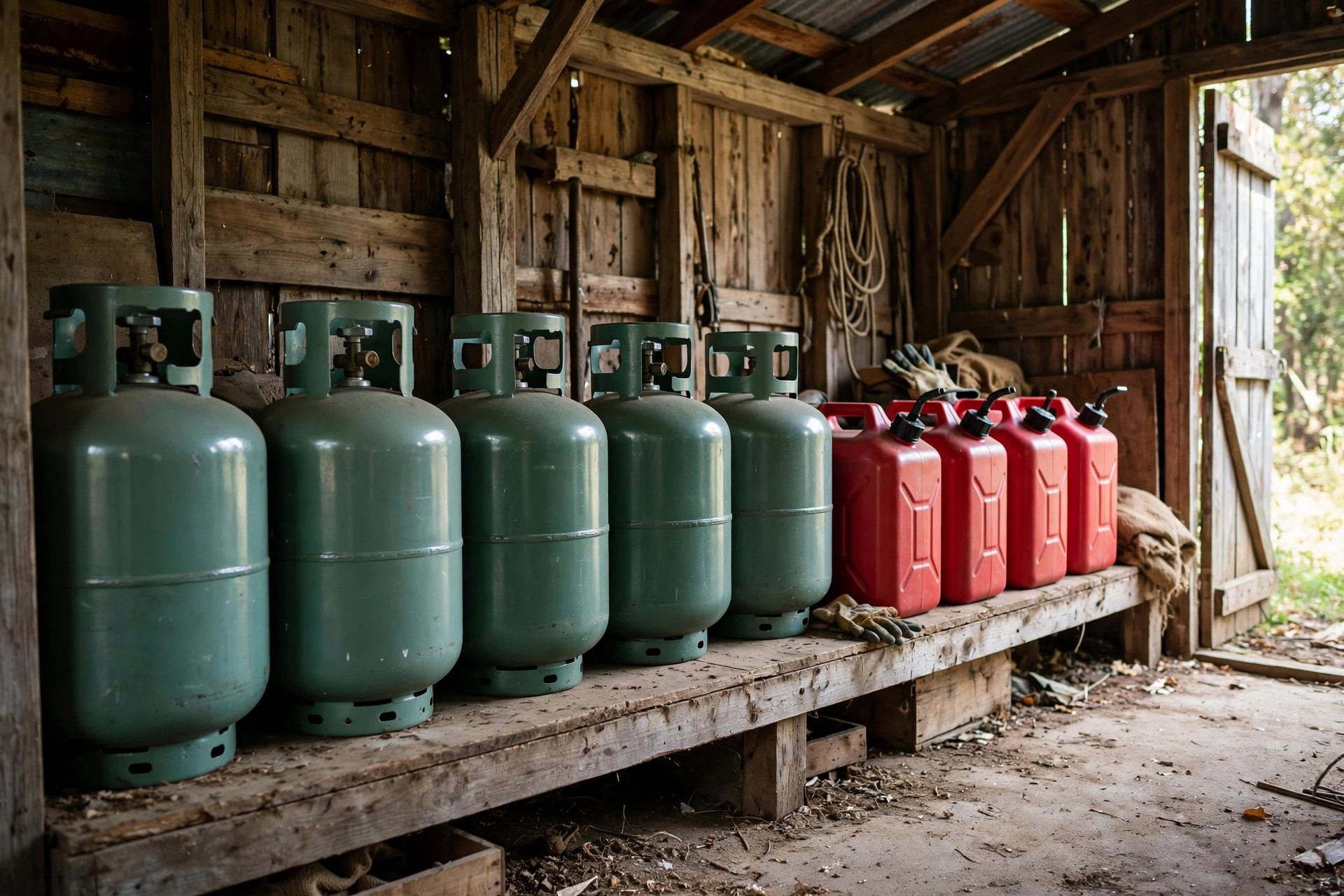
Propane storage is simple: keep tanks upright, outdoors or in a ventilated space, away from heat and ignition sources, and they’re good indefinitely. Most fire codes allow two 20-lb tanks at a residence; check your local rules. Inspect the tank collar date — tanks need recertification 12 years after manufacture, and exchange cages handle this automatically.
Gasoline storage is a system, not a container. Use approved cans, add stabilizer the day you buy the fuel (not months later), store in a cool ventilated spot away from the house, and rotate the stock every 6 months by pouring it into your car and refilling. Ethanol-free gas lasts longer and is worth the premium for generator duty if you can find it. Never store large quantities in an attached garage — gasoline fumes are heavier than air and travel to ignition sources.
What about natural gas and tri-fuel?
There’s a third option worth knowing about: natural gas. Tri-fuel generators (gasoline + propane + natural gas) like the Westinghouse iGen11000TFc add a plumbed gas connection to the mix. Natural gas means unlimited runtime — no refueling, no tank swaps, no storage — as long as the gas utility stays up (which it usually does during electrical outages, since gas infrastructure doesn’t depend on the grid the same way).
The tradeoffs: natural gas has the lowest energy density of the three, so wattage drops about 15–20% versus gasoline. Installation requires a plumber and a permit. And it’s only useful if your home already has gas service. But for whole-home backup buyers, the “never refuel” convenience is transformative — it’s the closest a portable gets to a standby generator. Our iGen11000TFc review covers the flagship tri-fuel option in detail.
My personal fuel setup
After years of both, here’s what actually sits in my garage: two full 20-pound propane tanks, one 5-gallon can of ethanol-free gasoline with stabilizer, and a dual-fuel generator. The propane covers the first 40 hours of any outage with zero maintenance and zero stale-fuel risk. The gasoline is the reserve — for the propane running out, or for the small single-fuel tools. Every six months the gas goes into my truck and the can gets refilled; the propane just sits there, ready, indefinitely.
Total investment: under $150 in fuel and containers. Total spring maintenance ritual: none. That’s the setup I’d recommend to anyone buying their first dual-fuel generator — stop debating the fuels and stock a little of both.
Frequently asked questions
Is propane cheaper than gasoline for generators?
How long does propane last in a generator tank?
Do dual-fuel generators lose power on propane?
Can I store propane tanks in my garage?
Which fuel is better for long-term generator storage?
Our verdict
Choose propane if your generator is primarily for emergency standby — the indefinite shelf life and clean burning outweigh the power penalty. Choose gasoline if you need maximum runtime per gallon, run the generator regularly, or face extreme cold. But honestly? Buy dual-fuel and stop worrying. The premium is small, and having both options during a multi-day outage is worth far more than the fuel debate. Pair it with a properly sized generator and you’ll be ready for whatever the grid throws at you.
How we researched this: We compared BTU content and fuel consumption figures from manufacturer spec sheets, reviewed fuel pricing data across regions, and analyzed long-term owner reports on maintenance, cold-weather performance, and fuel storage. Energy content figures (114,000 BTU/gal gasoline, 91,500 BTU/gal propane) are standard reference values.

Related Guides
Diesel vs Gasoline Generators: Which Is Better in 2027?
Diesel vs gasoline generators: diesel wins on efficiency, lifespan and fuel storage; gas wins on price, weight and choice. Here's which fuel fits your use case.

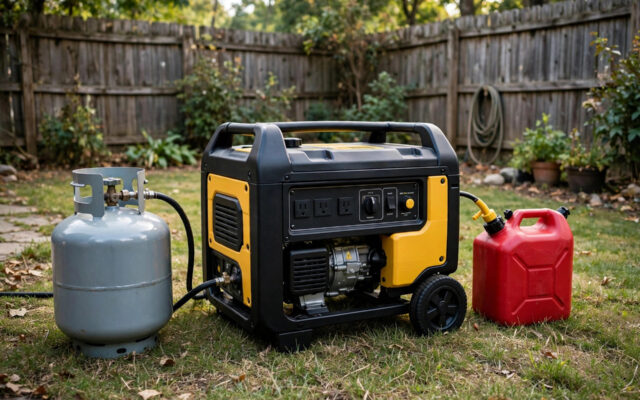
Propane vs Gasoline: Generator Fuel Cost per kWh Compared
At October 2026 prices, propane costs ~$0.48/kWh vs ~$0.65/kWh for gasoline in a generator. See the full math and when gasoline still wins.
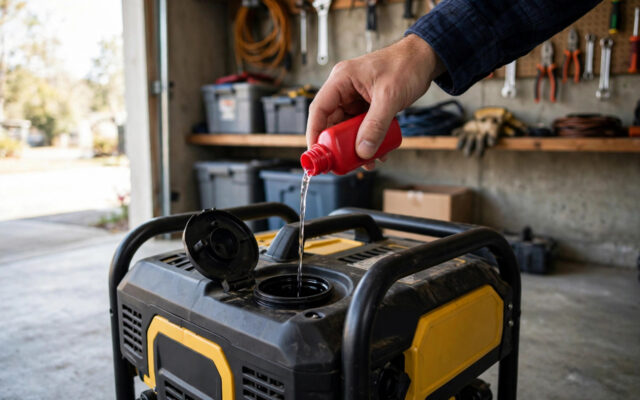
Fuel Stabilizer for Generators: How and When to Use It
Fuel stabilizer prevents the #1 generator no-start cause: gummed carburetors. Learn the 1 oz per 2.5 gallon dosing and the 5-minute rule.
2 Comments