


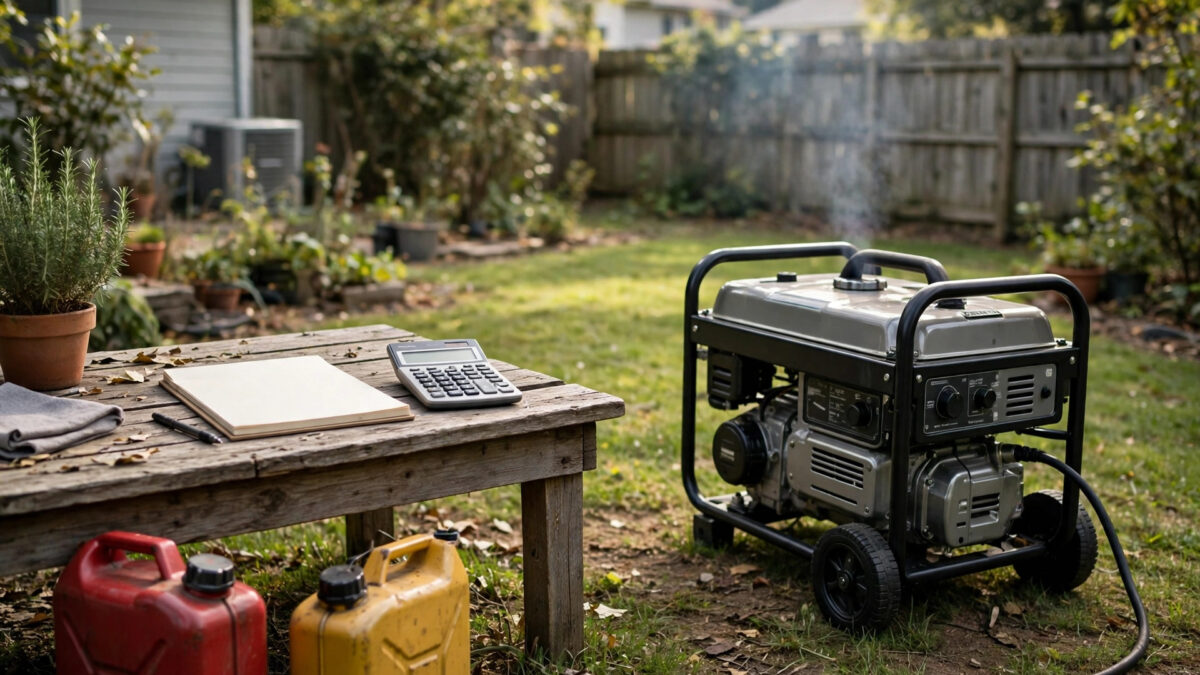
How much does a generator cost to run per hour? The short answer: a small inverter generator costs roughly $0.35-$0.70 per hour, a mid-size 5,000-7,500W portable costs about $1.50-$3.00 per hour on gasoline, and a 22kW whole-house standby costs around $3/hour on natural gas or $7+/hour on propane at half load. Your actual cost depends on three things: your generator’s fuel consumption at your load level, your local fuel price, and which fuel you are burning. Below you will find a simple calculator formula, fuel-by-fuel cost tables, and worked examples so you can estimate your own numbers — all based on published manufacturer fuel-consumption specs and typical 2027 U.S. fuel prices. Treat every figure as approximate, since fuel prices move and real-world loads vary.
Key Takeaways
- The formula: hourly cost = fuel burned per hour x price per gallon (or per therm).
- Small inverter (2,000W): ~$0.35-$0.70/hr on gasoline.
- Mid-size portable (5,000-7,500W): ~$1.50-$3.00/hr on gasoline at half load.
- 22kW standby: ~$3/hr on natural gas, ~$7+/hr on propane at half load.
- Cost per kWh is the fairest comparison: divide hourly cost by the kilowatts you are actually using.
- Propane from portable 20-lb tanks costs far more per gallon than bulk propane — factor that in.
Generator Fuel Cost Calculator: The Simple Formula
You do not need a special tool to calculate your generator’s running cost — two numbers from your owner’s manual and one from your local gas station are enough. The formula is: hourly cost = gallons burned per hour x price per gallon. For natural gas, substitute therms per hour x price per therm. The “gallons burned per hour” figure comes from your generator’s spec sheet, usually listed at 25% or 50% load; use the load level closest to how you actually run it.
Example: your portable generator burns 0.6 gallons of gasoline per hour at half load, and gas costs $3.50 per gallon. 0.6 x $3.50 = $2.10 per hour. That is the whole calculation. To compare generators fairly, take it one step further: cost per kWh = hourly cost / kilowatts of load. If that generator is carrying a 2.5kW load, $2.10 / 2.5 = $0.84 per kWh. That per-kWh figure lets you compare a small inverter against a big standby on equal terms, and against your utility rate (typically $0.15-$0.30/kWh) — generator power is always far more expensive than grid power, which is why sizing matters.
How Much Does It Cost to Run a Generator Per Hour? (By Fuel Type)
The table below shows approximate hourly running costs for common generator sizes and fuels, using typical 2027 U.S. fuel prices: gasoline ~$3.50/gallon, bulk propane ~$3.00/gallon (portable 20-lb tank exchanges cost far more per gallon — see below), natural gas ~$1.50/therm, and diesel ~$3.80/gallon. Fuel consumption figures are approximate, based on published manufacturer specs at the stated load. Your numbers will vary.
| Generator type | Load example | Fuel burn (approx.) | Hourly cost (approx.) |
|---|---|---|---|
| 2,000W inverter (gasoline) | 25% load | ~0.10 gal/hr | $0.35/hr |
| 3,500W inverter (gasoline) | 50% load | ~0.20 gal/hr | $0.70/hr |
| 5,000W portable (gasoline) | 50% load | ~0.60 gal/hr | $2.10/hr |
| 7,500W portable (gasoline) | 50% load | ~0.80 gal/hr | $2.80/hr |
| 7,500W portable (propane) | 50% load | ~0.90 gal/hr | $2.70/hr (bulk) / ~$4/hr (tank exchange) |
| 12,500W portable (gasoline) | 50% load | ~1.30 gal/hr | $4.55/hr |
| 22kW standby (natural gas) | 50% load | ~2.0 therms/hr | $3.00/hr |
| 22kW standby (propane) | 50% load | ~2.4 gal/hr | $7.20/hr |
| Diesel 10kW (diesel) | 50% load | ~0.50 gal/hr | $1.90/hr |
Two rows in that table deserve extra explanation. First, the propane row shows two prices because propane pricing is really two markets: bulk propane delivered to a large tank (~$2.50-$3.50/gallon) versus 20-lb tank exchanges at the hardware store (~$20-$25 for 4.6 gallons, or roughly $4.50-$5.50/gallon). A dual-fuel portable sipping from exchange tanks can cost nearly twice as much per hour as the same generator on bulk propane. Second, the standby propane figure surprises people: propane contains less energy per gallon than gasoline, so a big standby drinks it fast. A 500-gallon propane tank at 80% fill gives you roughly 160 hours at half load — about a week of continuous outage coverage.

Cost Per kWh: Comparing Generator Power to Grid Power
Hourly cost is useful for budgeting an outage; cost per kWh is useful for comparing options. Grid electricity in the U.S. averages roughly $0.15-$0.30 per kWh depending on your state. Generator power typically costs $0.50-$1.50 per kWh — three to five times more. Here is how common setups compare, using the table above and dividing by the actual kilowatt load.
| Setup | Load | Hourly cost | Cost per kWh (approx.) |
|---|---|---|---|
| 2,000W inverter, gasoline | 0.5 kW | $0.35 | $0.70 |
| 7,500W portable, gasoline | 3.75 kW | $2.80 | $0.75 |
| 22kW standby, natural gas | 11 kW | $3.00 | $0.27 |
| 22kW standby, propane | 11 kW | $7.20 | $0.65 |
| Grid power (reference) | — | — | $0.15-$0.30 |
Notice something interesting: the big standby on natural gas is the cheapest per kWh of the bunch, because natural gas is cheap energy and the generator is running near its efficiency sweet spot. The takeaway is not that standbys are “cheap” — they cost $9,000-$16,000 installed — but that fuel economics favor natural gas and right-sized loads. A small inverter sipping gas for a fridge and phones is the cheapest absolute hourly cost; a standby on natural gas is the cheapest per unit of energy delivered at scale.
What Does a Full Day of Outage Cost?
Hourly figures are abstract until you multiply them by a real outage. Here are three realistic scenarios for a 24-hour outage day, using the approximate figures above. These assume the generator runs continuously at roughly half load, which is typical for a home cycling a fridge, some lights, and intermittent larger loads.
| Scenario | Fuel per day | Daily cost (approx.) |
|---|---|---|
| 2,000W inverter, essentials only (gasoline) | ~2.4 gallons | ~$8-$17 |
| 7,500W portable, half the house (gasoline) | ~19 gallons | ~$67 |
| 22kW standby, whole house (natural gas) | ~48 therms | ~$72 |
| 22kW standby, whole house (propane) | ~58 gallons | ~$173 |
The portable-gasoline scenario hides a logistics problem: 19 gallons per day means refueling a typical 6-8 gallon tank three times daily, and gas stations may be closed or out of fuel during a widespread outage. This is the strongest practical argument for dual-fuel or tri-fuel generators — a dual-fuel portable like the Westinghouse WGen9500DF can switch to propane when gasoline runs dry, and a tri-fuel unit plumbed to natural gas never needs refueling at all. Our dual-fuel generator guide and tri-fuel generator guide compare the options.
5 Ways to Lower Your Generator’s Hourly Running Cost
1. Size the generator to the load
The most expensive generator to run is an oversized one loafing at 10% load. A 12,500W portable burning $4.55/hour to power a fridge and phone chargers is wasting money; a 2,000W inverter would do the same job for under $0.50/hour. Match the machine to the mission.
2. Use eco mode on inverter generators
Inverter generators like the Honda EU2200i throttle the engine down at light loads, cutting fuel burn dramatically versus a conventional generator running full speed regardless of load. Eco mode can halve fuel consumption at quarter load.
3. Choose the cheapest available fuel
Where natural gas is available, it is almost always the cheapest per-hour fuel for a big generator. For portables, bulk propane beats tank-exchange propane by a wide margin. Buy gasoline before storm season when prices are calmer, and store it properly with stabilizer.
4. Cycle heavy loads instead of running everything at once
You do not need the water heater, dryer, and AC running simultaneously. Staggering heavy loads keeps the generator in its efficient 50-75% band instead of spiking to full load (where fuel burn per kWh is worst) or idling at 10%.
5. Maintain the generator
A dirty air filter, old spark plug, or stale fuel makes any engine burn more fuel for the same output. Annual maintenance — oil change, filter, plug, fresh fuel — keeps consumption at spec. It also keeps the generator starting when you need it, which is worth more than the fuel savings.
Power Stations: The Zero-Fuel-Per-Hour Option
For completeness: battery power stations like the Jackery Explorer 1000 v2 or EcoFlow DELTA 3 Plus cost nothing per hour to run once charged — there is no fuel burn, just the pennies of grid electricity (or free sunlight) used to recharge them. Their “fuel cost” is really the amortized cost of the battery over its cycle life. For short outages and light loads, they are the cheapest per-outage option; for multi-day whole-home backup, fuel generators still win on total energy delivered. Our portable power station guide covers the math.
Our verdict
Most homeowners will spend $0.35-$3.00 per hour running a portable generator, depending on size and load, and $3-$7+ per hour running a whole-house standby — with natural gas dramatically cheaper than propane. Use the formula (fuel per hour x fuel price) with your manual’s consumption specs and your local fuel prices for an accurate estimate, and remember that generator power costs 3-5x more per kWh than grid power. The cheapest outage is the one powered by a right-sized generator running in its efficiency sweet spot.
How we researched this
We based fuel-consumption figures on published manufacturer specifications (typically rated at 25% or 50% load) and fuel prices on typical 2027 U.S. averages: gasoline ~$3.50/gal, bulk propane ~$3.00/gal, natural gas ~$1.50/therm, diesel ~$3.80/gal. We did not measure fuel consumption ourselves. All figures are approximate — real-world consumption varies with load profile, altitude, temperature, maintenance, and local fuel prices. Use your owner’s manual specs and current local prices for planning.
How much does it cost to run a generator per hour?
How do I calculate my generator’s fuel cost per hour?
Is it cheaper to run a generator on propane or gasoline?
How much does a whole house generator cost to run per day?
What is the cheapest generator to run?
Does a generator use more fuel at full load?
Knowing your generator’s hourly running cost turns outage planning from guesswork into arithmetic. Pull your manual’s fuel-consumption specs, plug in your local fuel prices, and you will know exactly what a day — or a week — without grid power costs you. And if the math stings, remember the levers: right-size the generator, use eco mode, stagger heavy loads, and pick the cheapest fuel available to you. For help choosing the machine in the first place, start with our inverter generator picks or our portable generators for home backup.

Related Guides
Bonded vs Floating Neutral on Generators: What’s the Difference?
Bonded vs floating neutral generator explained: what each means, the one-bond rule, which setup your transfer switch needs, and how to check your own unit.


Generator THD Explained: What It Means for Electronics & Appliances
Generator THD explained: what total harmonic distortion means, the under-3% vs over-6% tiers, which appliances need clean power, and how to check the spec.
Generator Noise Laws by Location: Are Generators Legal in Residential Areas?
Generator noise laws vary by city: typical residential decibel limits, quiet hours, HOA rules, and how a quiet inverter generator keeps you compliant.