


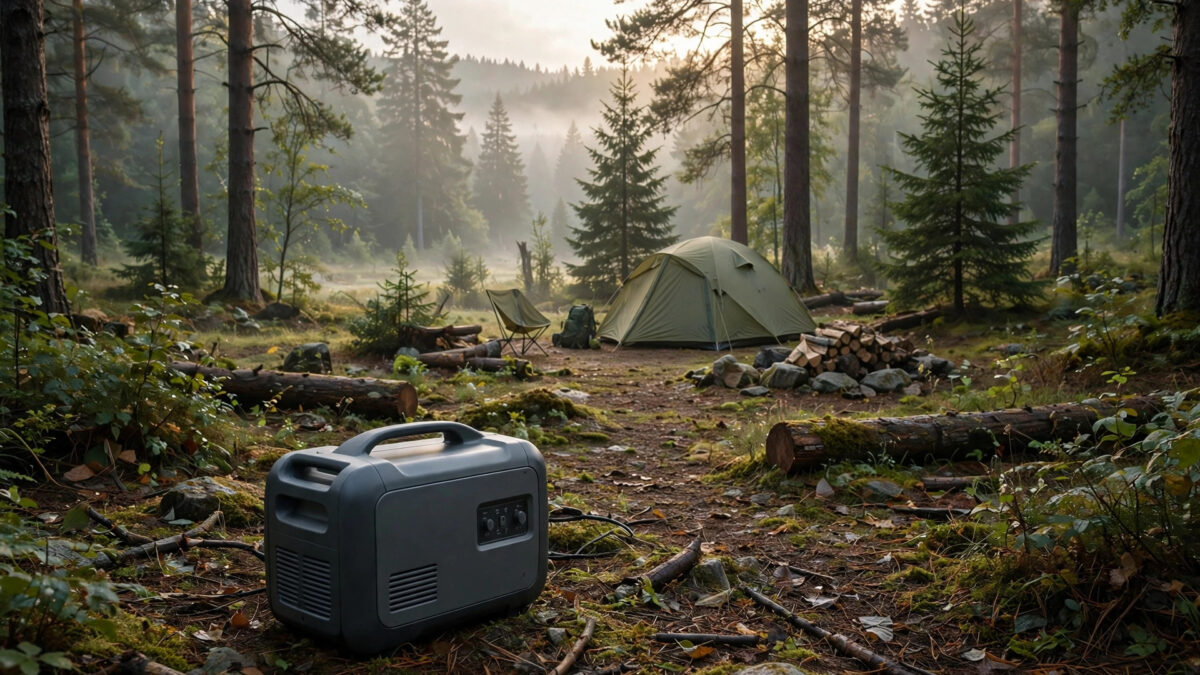
The best inverter generators of 2027 do three things conventional generators cannot: run quietly enough for a campground, sip fuel by throttling down at light loads, and produce clean, stable electricity that is safe for laptops, phones, and modern electronics. We researched and compared eight inverter models — from the legendary Honda EU2200i to budget-friendly dual fuel options — to find the best for camping, RVs, tailgating, and quiet home backup.
How does an inverter generator work? Instead of running the engine at a fixed 3,600 RPM like a conventional generator, an inverter generator produces raw AC, converts it to DC, then inverts it back to clean 120V AC — typically with under 3% total harmonic distortion. The engine speed varies with the load, which is why a 2,200W inverter can idle along quietly while a conventional unit roars at full tilt powering the same phone charger.
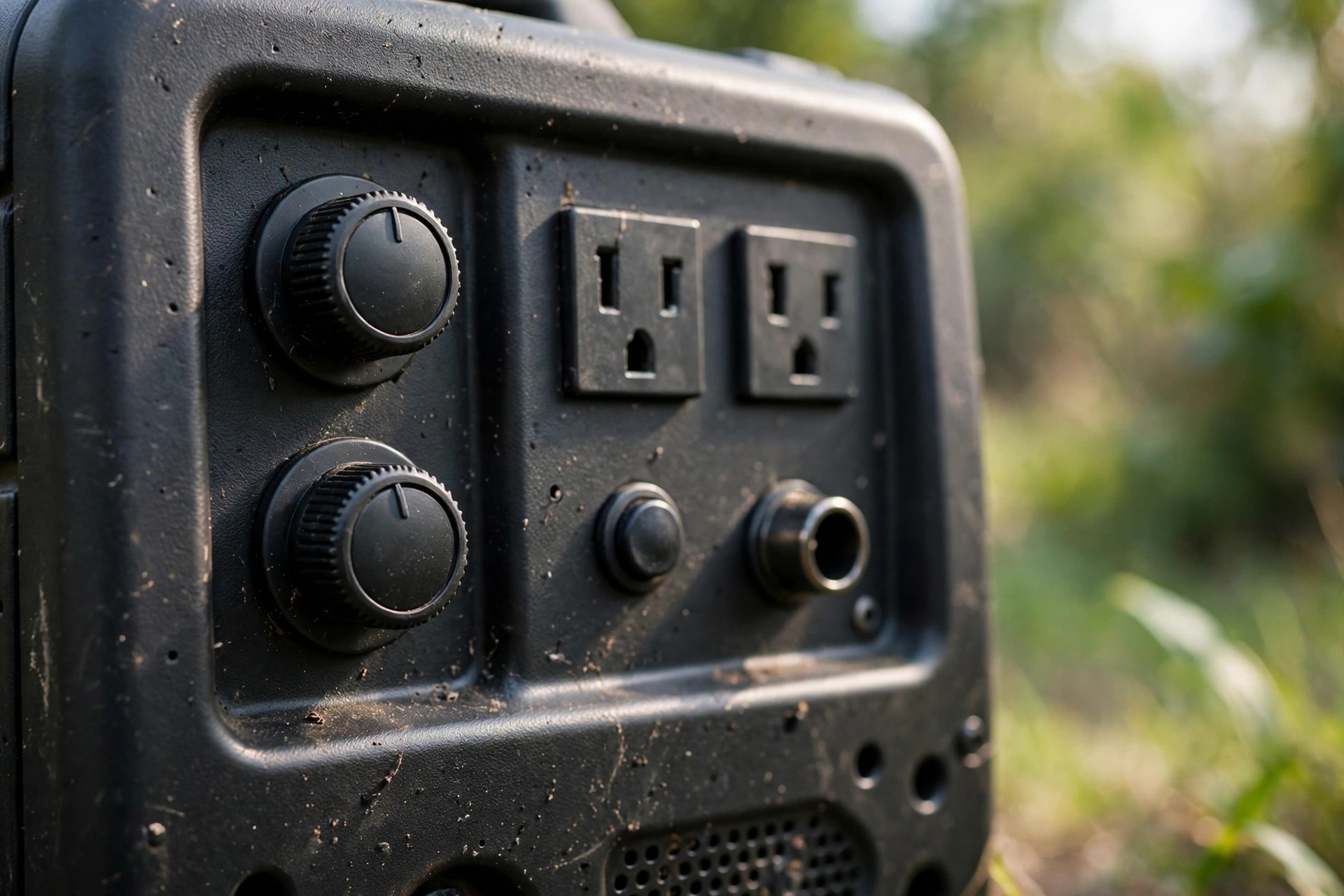
This roundup focuses on portable inverter generators from 2,000 to 4,500 watts. If you need whole-home power, see our home backup roundup; for RV-specific picks, see best RV generators.
Key takeaways
- Honda EU2200i remains the benchmark — the quietest, most reliable 2,200W inverter you can buy.
- Honda EU3200i is the premium step-up: fuel-injected, Bluetooth app control, and 30A output.
- Champion 201319 4,500-Watt Dual Fuel Inverter Generator is the best dual fuel inverter — 4,500W of quiet, propane-capable power.
- WEN 56225i is the budget sweet spot with clean <1.2% THD power and a fuel shutoff.
- Inverter generators produce <3% THD power — safe for sensitive electronics — and run 50–60% quieter than conventional models.
Our top picks at a glance
- Honda EU2200i — Best overall — the benchmark quiet inverter, 48–57 dBA
- Honda EU3200i — Best premium — fuel-injected with Bluetooth and CO-MINDER
- Champion 201319 4,500-Watt Dual Fuel Inverter Generator — Best dual fuel inverter — 4,500W, RV-ready, remote start
- WEN 56225i — Best budget — clean power and fuel shutoff at a low price
- Pulsar PGD40iSCO — Best high-power value — 4,000W at ~47 lbs (gasoline-only)
Best overall
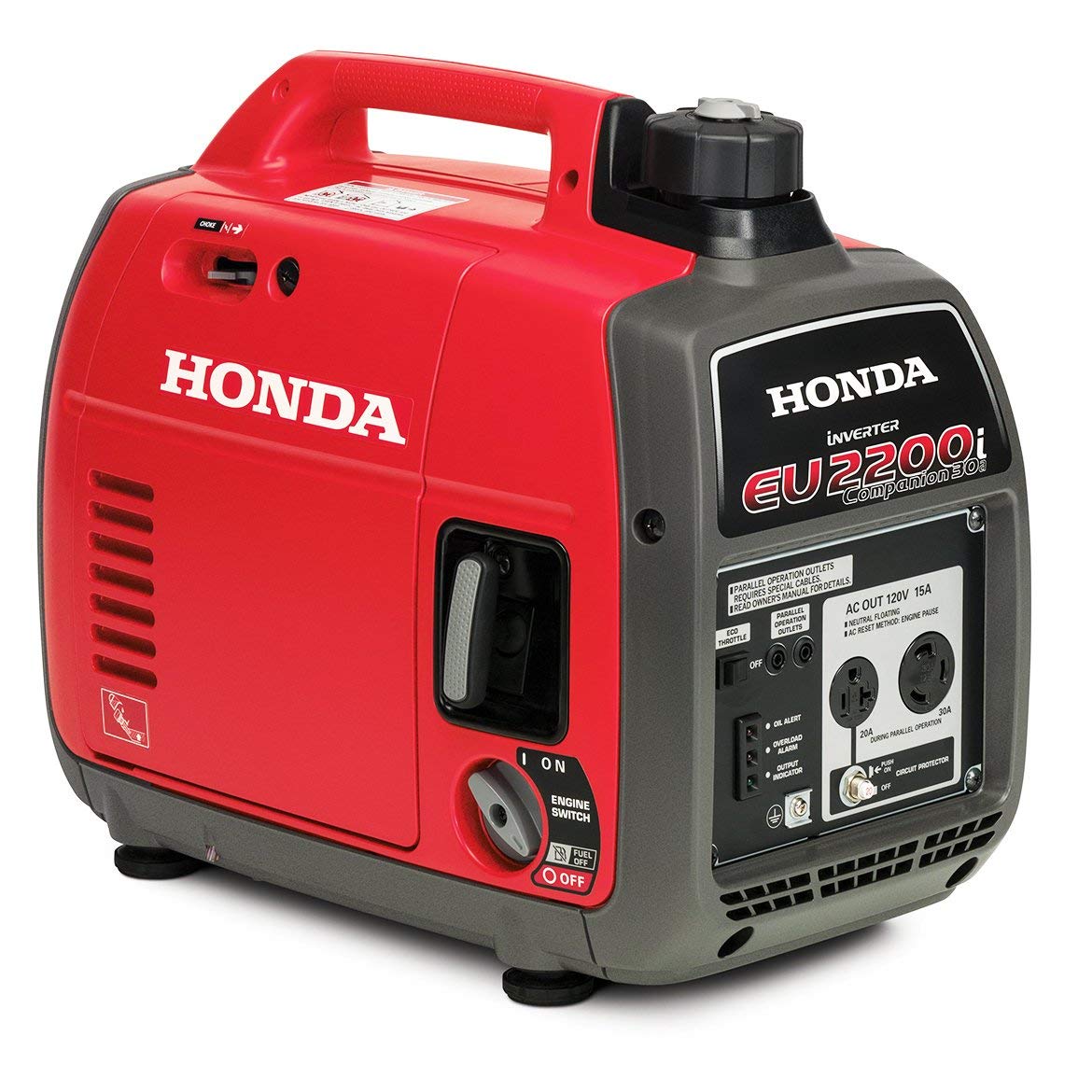
Honda EU2200i Inverter Generator
- 1800W running / 2200W peak output
- gasoline
- Up to 3.2h @ rated load / 8.1h @ 1/4 load runtime
- Pure-sine-wave Honda inverter (<3% THD) ideal for Level 1 EVSE use
- 2200W starting watts / 1800W running watts
- gasoline
- Noise: 48-57 dBA
- 3.2h @ rated load / 8.1h @ 1/4 load
As an Amazon Associate, we earn from qualifying purchases.
The Honda EU2200i is the inverter generator everything else is judged against. With 2,200 starting watts and 1,800 running watts, it powers the camping and tailgating essentials — and at 48–57 dBA, it is quieter than normal conversation at light loads. Honda’s Eco-Throttle lets the engine idle down when demand drops, stretching the 0.95-gallon tank to about 8.1 hours at quarter load.
Reliability is the real story. Owner feedback spanning well over a decade describes EU-series Hondas starting on the first or second pull after years of seasonal storage. It is parallel-capable (pair two for 4,400W), and Honda’s dealer network means parts and service anywhere. Multiple legitimate ASIN variants exist (standard, Companion with 30A outlet, camo); the canonical listing is used here.
It costs more per watt than any competitor here. But for buyers who want the quietest, most dependable portable inverter made, the EU2200i remains the answer in 2027.
| Running watts | 1,800 |
|---|---|
| Starting watts | 2,200 |
| Fuel type | Gasoline |
| Noise level | 48–57 dBA |
| Runtime | Approx. 8.1h at 1/4 load (0.95-gal tank) |
| Weight | Approx. 46.5 lbs |
Pros
- Quietest in class (48–57 dBA)
- Legendary Honda reliability
- Parallel-capable to 4,400W
- Excellent fuel economy with Eco-Throttle
Cons
- Premium price per watt
- 2,200W won’t run large RV air conditioners alone
- No electric start
Best premium
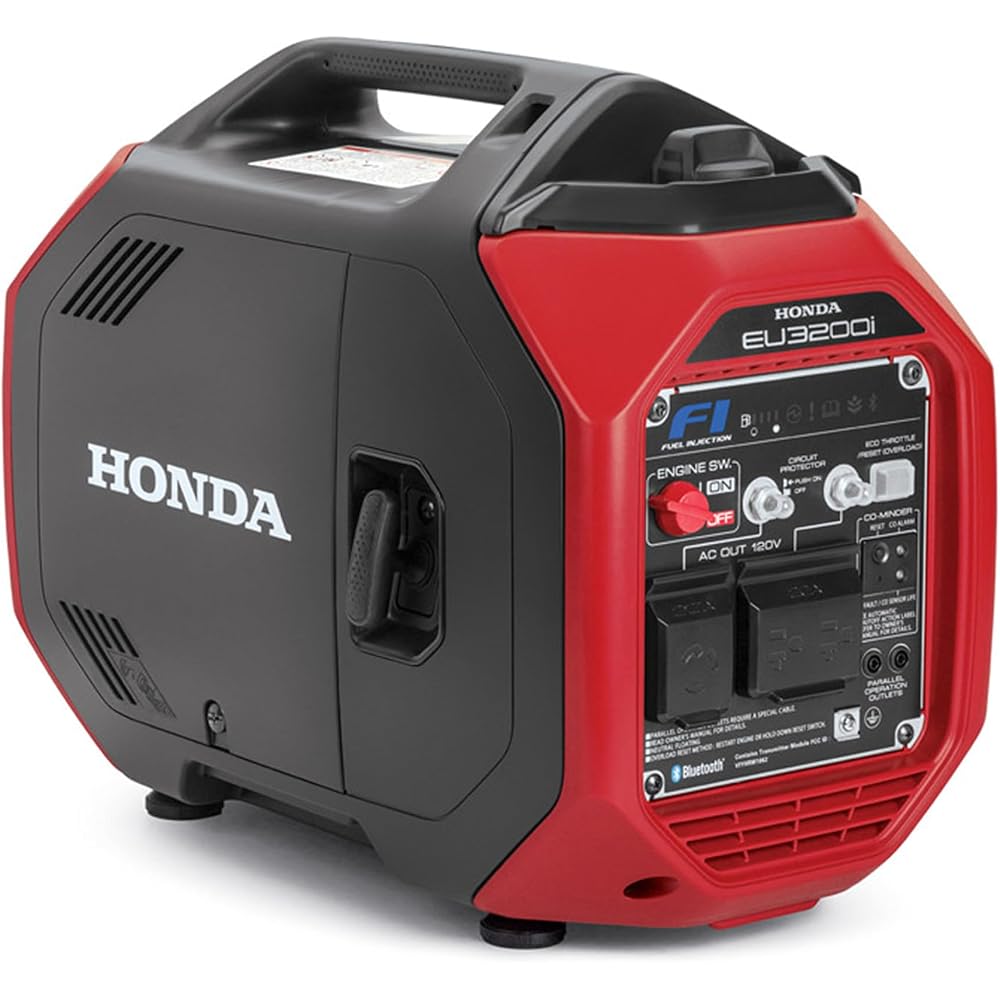
Honda EU3200i Inverter Generator (Bluetooth, 49-State)
- 2600W running / 3200W peak output
- gasoline
- Up to 3.3h @ rated load / 8.6h @ 1/4 load runtime
- Honda’s flagship premium RV inverter
- 3200W starting watts / 2600W running watts
- gasoline
- Noise: 54-58 dBA
- 3.3h @ rated load / 8.6h @ 1/4 load
As an Amazon Associate, we earn from qualifying purchases.
The Honda EU3200i is the premium step up: 3,200 starting watts and 2,600 running watts from a fuel-injected GX130 engine. Fuel injection means easier starting, better altitude performance, and no carburetor gum-up during storage — the most common small-engine problem, eliminated by design.
It adds genuinely useful tech: Bluetooth smartphone app control and monitoring, a 30A locking outlet, and CO-MINDER carbon-monoxide shutdown. Noise is rated 54 dBA at quarter load and 58 dBA at rated load — remarkably quiet for 3,200W. Runtime runs about 8.6 hours at quarter load.
At 65 pounds it is heavier than the EU2200i but still one-person portable. For buyers who want the best inverter generator money can buy, with enough power for a 13,500 BTU RV air conditioner, the EU3200i is it.
| Running watts | 2,600 |
|---|---|
| Starting watts | 3,200 |
| Fuel type | Gasoline |
| Noise level | 54 dBA at 1/4 load / 58 dBA at rated |
| Runtime | Approx. 8.6h at 1/4 load |
| Weight | Approx. 65 lbs |
Pros
- Fuel-injected — no carburetor issues
- Bluetooth app monitoring + CO-MINDER
- 30A locking outlet
- Runs a 13,500 BTU RV A/C
Cons
- Highest price in this roundup
- 65 lbs is a heavy carry
- 49-state (not CARB) version listed
Best premium alternative
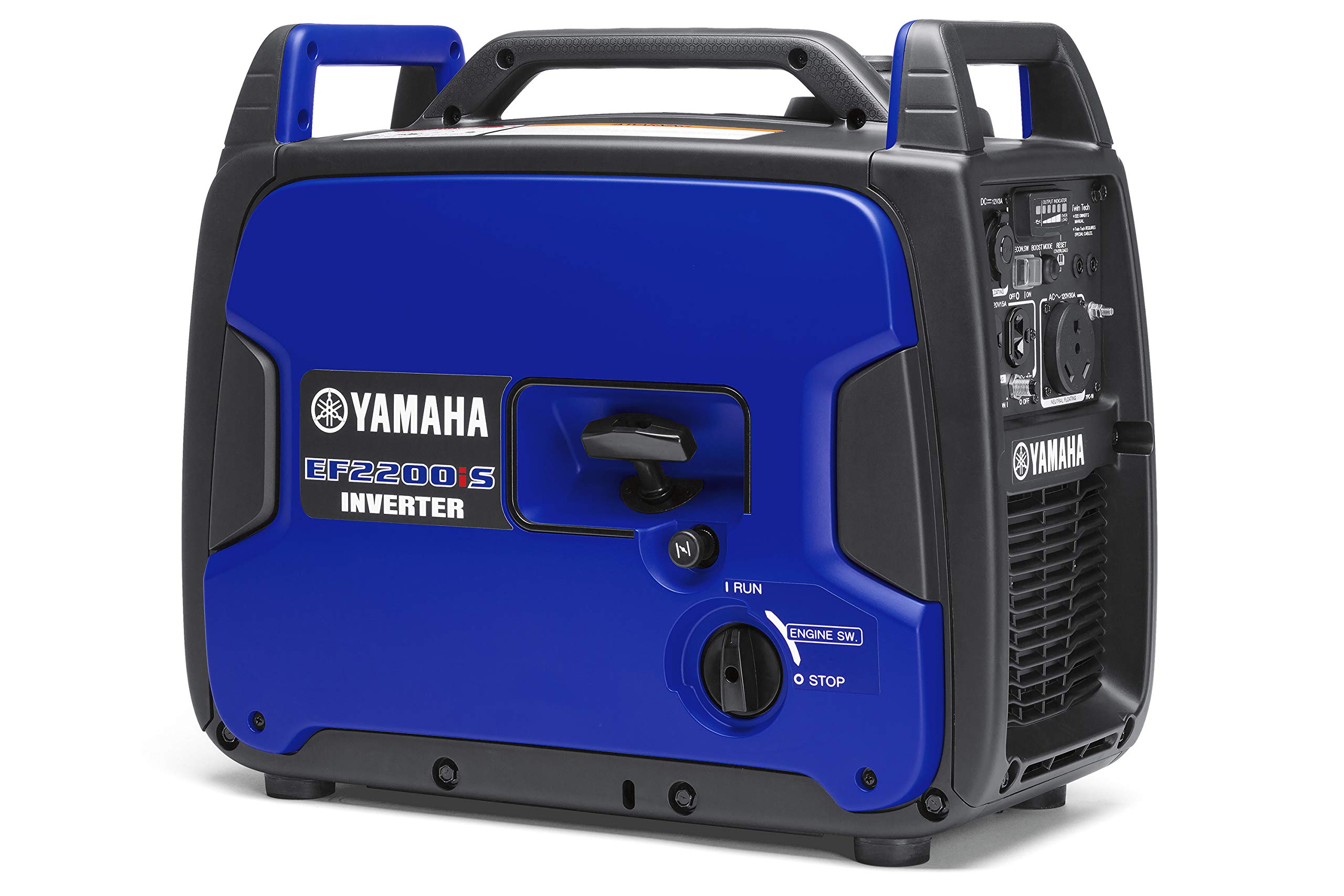
Yamaha EF2200iS Inverter Generator
- 1800W running / 2200W peak output
- gasoline
- Yamaha reliability rival to the EU2200i with 3-year warranty and 1
- 2200W starting watts / 1800W running watts
- gasoline
- 55.2 lbs
As an Amazon Associate, we earn from qualifying purchases.
The Yamaha EF2200iS is the Honda EU2200i’s great rival: 2,200 starting watts and 1,800 running watts of famously reliable Yamaha inverter power. Yamaha matches Honda on build quality and backs it with a 3-year warranty — a year longer than Honda’s standard coverage.
The 1.24-gallon tank is larger than the Honda’s, giving longer runtime between refills. It is parallel-capable, fuel-gauge equipped, and famously quiet. Owner feedback describes the same first-pull starting reputation as the Honda, with some owners preferring Yamaha’s dealer experience.
At 55.2 pounds it is a few pounds heavier than the EU2200i. Choose the Yamaha if you prefer the brand, want the longer warranty, or find it at a better price — you will not go wrong either way.
| Running watts | 1,800 |
|---|---|
| Starting watts | 2,200 |
| Fuel type | Gasoline |
| Noise level | Not published in manufacturer specs we reviewed |
| Runtime | Not published in manufacturer specs we reviewed |
| Weight | Approx. 55.2 lbs |
Pros
- Honda-rival reliability
- 3-year warranty
- Larger 1.24-gal fuel tank
- Parallel-capable with fuel gauge
Cons
- Premium price like the Honda
- Heavier than the EU2200i
- Fewer third-party accessories
Best dual fuel inverter
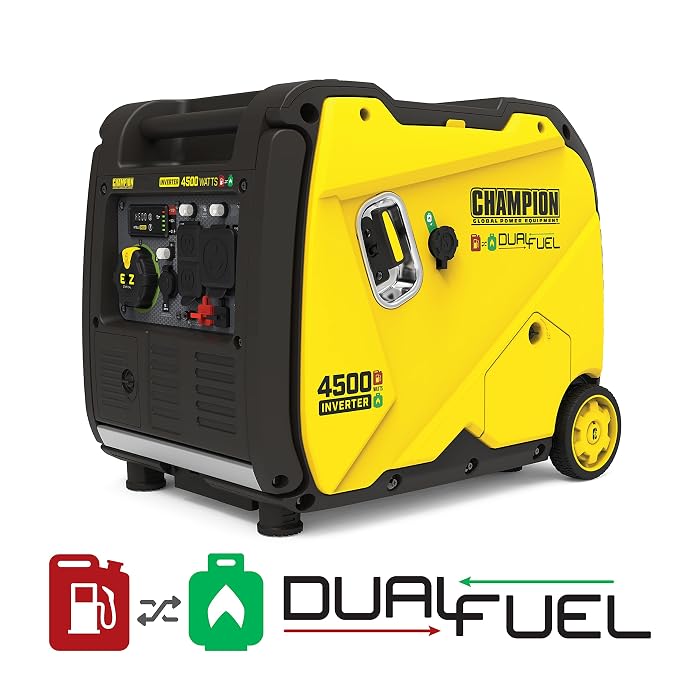
Champion 201319 4,500-Watt Dual Fuel Inverter Generator
- 3,500 (gasoline); 3,150 (propane) running / 4,500 (all fuels) peak output
- Dual Fuel: gasoline, propane
- Up to 14 hrs (gasoline, 2.25 gal); 21 hrs (propane, 20-lb tank) runtime
- 61 dBA noise level
- 4,500 (all fuels) starting watts / 3,500 (gasoline); 3,150 (propane) running watts
- Dual Fuel: gasoline, propane
- Noise: 61 dBA
- 14 hrs (gasoline, 2.25 gal); 21 hrs (propane, 20-lb tank) runtime
- Weight: 99.2 lbs
As an Amazon Associate, we earn from qualifying purchases.
The Champion 201319 4,500-Watt Dual Fuel Inverter Generator is the best dual fuel inverter you can buy: 4,500 starting watts and 3,500 running watts on gasoline, with propane capability for fuel flexibility. At 61 dBA it is genuinely quiet — conversation-level — while delivering enough power for an RV air conditioner, a home’s essential circuits, or a job site.
Starting options are generous: remote, push-button electric, and recoil backup. The TT-30R RV outlet plugs straight into a camper, and it is CARB compliant for 50-state use. Runtime stretches to about 14 hours at quarter load on the 3.4-gallon tank — outstanding for the output.
At about 98 pounds it is not a one-hand carry, but the wheel kit and telescoping handle help. For buyers who want inverter-quiet power with propane flexibility and serious wattage, this is the standout value.
| Running watts | 3,700 (gasoline) |
|---|---|
| Starting watts | 4,500 (gasoline) |
| Fuel type | Dual fuel: gasoline / propane |
| Noise level | 61 dBA |
| Runtime | Up to ~14h at 25% on 3.4-gal tank |
| Weight | Approx. 98 lbs |
Pros
- 4,500W of quiet dual fuel power
- 61 dBA — genuinely quiet
- Remote + push-button + recoil start
- TT-30R RV-ready, CARB compliant
Cons
- 98 lbs needs the wheel kit
- Propane output lower than gasoline
- Larger than 2kW-class inverters
Best lightweight dual fuel
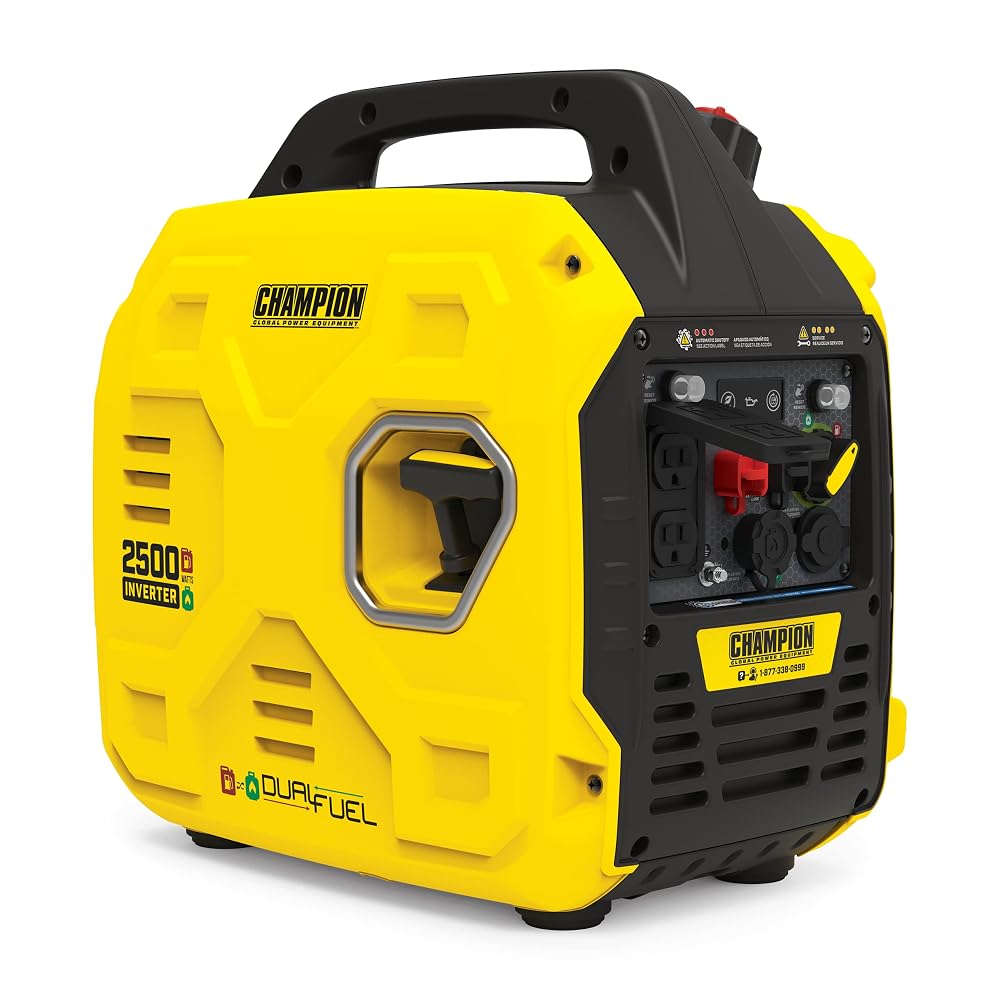
Champion 2500W Dual Fuel Inverter Generator (CO Shield)
- 1850W (gasoline), 1665W (propane) running / 2500W peak output
- dual fuel (gasoline/propane)
- Up to up to 11.5h gasoline / 25h propane (@25% load) runtime
- Dual-fuel inverter producing <3% THD pure-sine power
- 2500W starting watts / 1850W, 1665W running watts
- dual fuel (gasoline/propane)
- Noise: 53 dBA
- up to 11.5h gasoline / 25h propane (@25% load)
As an Amazon Associate, we earn from qualifying purchases.
The Champion 2500W dual fuel inverter (current CO Shield version) is the ultralight dual fuel pick: 2,500 starting watts and 1,850 running watts on gasoline (1,665 on propane), quiet at 53 dBA, and light enough to carry with one hand. It is the easiest dual fuel generator to live with.
CO Shield protection is built in, power is clean at under 3% THD for electronics, and it is parallel-capable — pair two with the parallel kit for double power and a 30A RV outlet. Runtime is excellent: about 11.5 hours on gasoline or up to 25 hours on a 20-pound propane tank at light load.
It will not run an RV air conditioner alone, but for everything else in camp or as a quiet essentials backup, it is the best lightweight dual fuel inverter value.
| Running watts | 1,850 (gasoline); 1,665 (propane) |
|---|---|
| Starting watts | 2,500 |
| Fuel type | Dual fuel: gasoline / propane |
| Noise level | 53 dBA |
| Runtime | Approx. 11.5h gas / 25h propane (20-lb tank) |
| Weight | Not published in manufacturer specs we reviewed |
Pros
- Ultralight and easy to carry
- Dual fuel with CO Shield
- Up to 25h runtime on propane
- Parallel-capable
Cons
- Won’t run an RV A/C alone
- Weight not published — confirm before buying
- Small fuel tank needs refills on long gas runs
Best budget
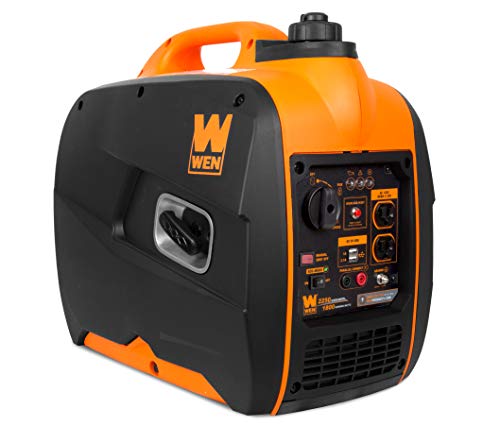
WEN 56225i Inverter Generator
- 1800W running / 2250W peak output
- gasoline
- Up to 6h @ half load (1 gal) runtime
- Classic budget pick
- 2250W starting watts / 1800W running watts
- gasoline
- Noise: 53 dBA
- 6h @ half load (1 gal)
As an Amazon Associate, we earn from qualifying purchases.
The WEN 56225i is the budget inverter sweet spot: 2,250 starting watts and 1,800 running watts — Honda EU2200i-class power — at a fraction of the price. It produces clean sine-wave power under 1.2% THD, runs at 53 dBA at quarter load, and includes a fuel shutoff that lets the carburetor run dry for storage.
That fuel shutoff deserves emphasis: most small-generator carburetor problems come from stale fuel gumming up during storage, and the shutoff largely prevents it. It is CARB compliant with a 2-year warranty, and at 48.5 pounds it is easy to carry.
Owner feedback praises its reliability for the price, though long-term durability will not match a Honda. For buyers who want clean, quiet inverter power on a budget, the 56225i is the value king.
| Running watts | 1,800 |
|---|---|
| Starting watts | 2,250 |
| Fuel type | Gasoline |
| Noise level | 53 dBA at 1/4 load |
| Runtime | Approx. 6h at 1/2 load (1-gal tank) |
| Weight | Approx. 48.5 lbs |
Pros
- Honda-class power at a budget price
- <1.2% THD clean power
- Fuel shutoff prevents carburetor gum-up
- CARB compliant, 2-year warranty
Cons
- 6h runtime at half load is modest
- Long-term durability below Honda/Yamaha
- No electric start
Best compact Generac
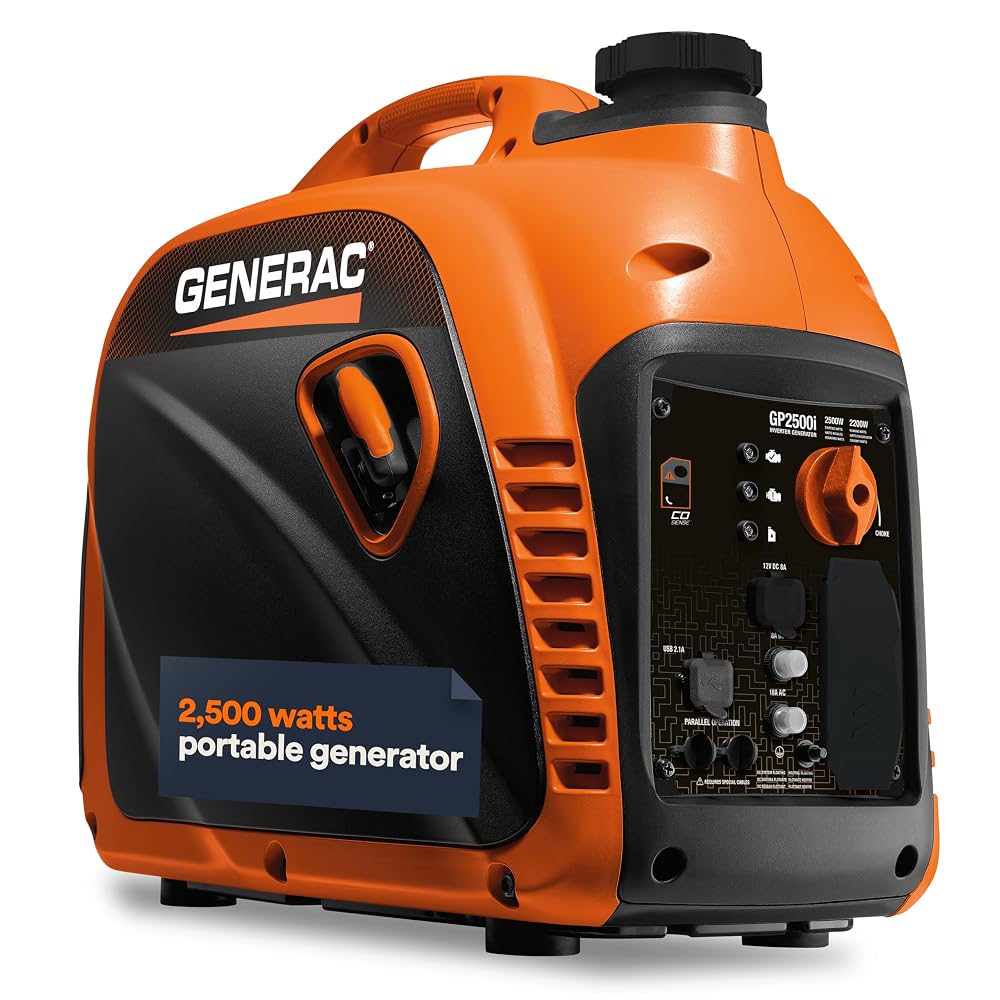
Generac GP2500i Inverter Generator (Model 8251, COsense)
- 2200W running / 2500W peak output
- gasoline
- Up to 8h on 1 gal tank runtime
- Generac TruePower clean, stable inverter output suitable for Level 1 EV charging
- 2500W starting watts / 2200W running watts
- gasoline
- 8h on 1 gal tank
- 56 lbs
As an Amazon Associate, we earn from qualifying purchases.
The Generac GP2500i brings the biggest generator brand into the compact inverter class: 2,500 starting watts and 2,200 running watts with Generac’s TruePower clean, stable output. COsense carbon-monoxide shutdown is built in, and it is parallel-ready for double power.
It includes USB charging ports — handy for phones and tablets without an adapter — and it is CARB compliant. At about 48 pounds it is a true one-hand carry for camping and tailgating.
Runtime figures were not fully published at research time, so check the listing. For buyers who want a mainstream-brand compact inverter with modern safety tech, the GP2500i is a solid mainstream choice.
| Running watts | 2,200 |
|---|---|
| Starting watts | 2,500 |
| Fuel type | Gasoline |
| Noise level | Not published in manufacturer specs we reviewed |
| Runtime | Not published in manufacturer specs we reviewed |
| Weight | Approx. 48 lbs |
Pros
- TruePower clean power from Generac
- COsense protection built in
- USB ports and parallel-ready
- Light at ~48 lbs, CARB compliant
Cons
- Runtime not published at research time
- No published noise rating
- 2,500W won’t run an RV A/C alone
Best high-power value
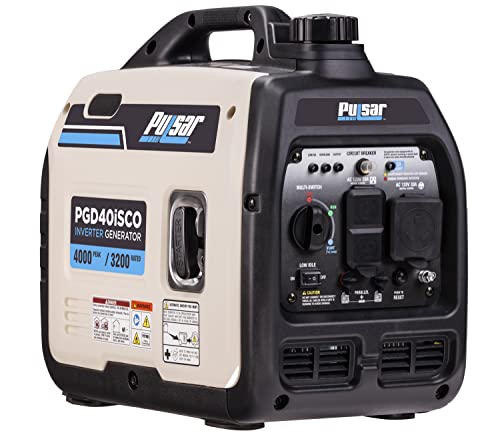
Pulsar PGD40iSCO 4000W Inverter Generator
- 3200W running / 4000W peak output
- gasoline
- Up to 4h @ half load (1 gal) runtime
- Budget pick for buyers who want maximum watts per dollar
- 4000W starting watts / 3200W running watts
- gasoline
- Noise: 59 dB
- 4h @ half load (1 gal)
As an Amazon Associate, we earn from qualifying purchases.
The Pulsar PGD40iSCO delivers 4,000 starting watts and 3,200 running watts at only about 47.3 pounds — remarkable power density for an inverter generator. It includes a TT-30R RV outlet, CO Sentry shutdown, and clean power under 3% THD, with a 3-year warranty.
One critical clarification: the Amazon listing for the PGD40iSCO is gasoline-only — it is NOT a dual fuel model, despite the confusingly similar model names in Pulsar’s lineup. (Pulsar’s dual fuel sibling is the PGD40BiSRCO, a different model.) We verified this during research and state it plainly so nobody buys expecting propane capability.
Taken as a gasoline inverter, it is an outstanding value — the closest thing to the Harbor Freight-exclusive Predator 3500 that you can buy on Amazon. Noise is 59 dBA, louder than the 2kW-class inverters but reasonable for 4,000W.
| Running watts | 3,200 |
|---|---|
| Starting watts | 4,000 |
| Fuel type | Gasoline only (NOT dual fuel) |
| Noise level | 59 dBA |
| Runtime | Approx. 4h at 1/2 load (1-gal tank) |
| Weight | Approx. 47.3 lbs |
Pros
- 4,000W at only ~47 lbs — excellent power density
- TT-30R RV outlet and CO Sentry
- <3% THD clean power, 3-year warranty
- Strong value vs premium brands
Cons
- Gasoline only — not dual fuel despite confusing naming
- 59 dBA is louder than 2kW inverters
- 4h runtime at half load is short
Inverter generators compared
All models produce inverter-clean power (under ~3% THD) safe for sensitive electronics. Noise ratings are manufacturer figures at stated loads.
| Product | Running watts | Fuel | Noise | Best for | |
|---|---|---|---|---|---|
| Honda EU2200i Inverter Generator | 1,800 | Gasoline | 48–57 dBA | Benchmark quiet | Check price |
| Honda EU3200i Inverter Generator (Bluetooth, 49-State) | 2,600 | Gasoline | 54–58 dBA | Premium pick | Check price |
| Yamaha EF2200iS Inverter Generator | 1,800 | Gasoline | Quiet (inverter) | Honda alternative | Check price |
| Champion 201319 4,500-Watt Dual Fuel Inverter Generator | 3,700 | Gas / propane | 61 dBA | Dual fuel inverter | Check price |
| Champion 2500W Dual Fuel Inverter Generator (CO Shield) | 1,850 | Gas / propane | 53 dBA | Ultralight dual fuel | Check price |
| WEN 56225i Inverter Generator | 1,800 | Gasoline | 53 dBA | Budget inverter | Check price |
| Generac GP2500i Inverter Generator (Model 8251, COsense) | 2,200 | Gasoline | Not published | Compact mainstream | Check price |
| Pulsar PGD40iSCO 4000W Inverter Generator | 3,200 | Gasoline | 59 dBA | High-power value | Check price |
How do you choose the best inverter generator in 2027?
Inverter generators compete on quietness, clean power, and fuel efficiency rather than raw watts. Here is what matters.
How quiet is quiet enough?
Decibels are logarithmic: 48 dBA (Honda EU2200i at light load) is dramatically quieter than 59 dBA (Pulsar at half load). For campgrounds with quiet hours, stay under 60 dBA; for close-quarters camping, the 48–53 dBA class (Honda, WEN, Champion) is worth the premium. Check whether the rating is at quarter load or rated load — the same generator can differ by 10 dB.
Clean power: what THD means for your gear
Total harmonic distortion (THD) measures how clean the electricity is. Under 3% THD is safe for laptops, phones, TVs, and modern electronics; under 1.2% (WEN 56225i) is excellent. Conventional generators often run 6–9%+ THD, which can damage sensitive electronics over time. If you are powering anything with a microprocessor, inverter is the safe choice.
Sizing: the RV air conditioner test
The classic inverter sizing question is the RV air conditioner. A 13,500 BTU RV A/C needs roughly 2,800–3,000 starting watts — beyond a single 2,200W inverter, but within reach of the Honda EU3200i, the Champion 201319 4,500-Watt Dual Fuel Inverter Generator, or two paralleled 2,500W units. Size to your largest motor load’s starting watts, not its running watts.
Fuel type and runtime
Most inverters here are gasoline-only; the Champion 201319 4,500-Watt Dual Fuel Inverter Generator and Champion 2500W add propane flexibility. Propane burns cleaner and stores indefinitely — a real advantage for a generator that sits unused for months. Compare runtime at the load you will actually run: inverter generators shine at light loads where the engine throttles down.
Parallel capability doubles your options
Many inverters can be paired with a parallel kit for double the power — two Champion 2500W units give you 5,000W with a 30A RV outlet, for example. This is the smart way to buy: start with one unit for light use, add a second if you buy a bigger RV. Confirm the specific parallel kit for your model before buying.
Weight, warranty, and the long game
A generator you cannot lift is a generator you will not use — be honest about the 98-pound Westinghouse versus the 46-pound Honda. Warranty matters too: Yamaha’s 3 years and Pulsar’s 3 years beat the typical 2. And remember that premium brands (Honda, Yamaha) hold resale value remarkably well; budget brands depreciate faster.
Inverter generator FAQs
What is an inverter generator?
An inverter generator produces AC power, converts it to DC, then inverts it back to clean, stable 120V AC — typically under 3% total harmonic distortion. The engine speed varies with load instead of running at fixed RPM, which makes it quieter and more fuel-efficient than a conventional generator, especially at light loads.
Are inverter generators safe for electronics?
Yes. Their clean, stable power (under ~3% THD) is safe for laptops, phones, TVs, and other sensitive electronics. This is the main reason to choose an inverter over a conventional generator for anything with a microprocessor. Conventional generators (often 6–9%+ THD) can damage sensitive gear over time.
How quiet are inverter generators really?
The quietest models (Honda EU2200i) run 48–57 dBA — quieter than normal conversation at light loads. Most quality inverters run 52–59 dBA. For comparison, conventional portable generators typically run 68–76 dBA, which is roughly 4–8 times louder as perceived by the human ear (decibels are logarithmic).
Can I parallel two inverter generators?
Many models support it — including the Honda EU2200i, Yamaha EF2200iS, Champion 2500W, and Generac GP2500i — using a brand-specific parallel kit. Paralleling doubles your available power (two 2,500W units ≈ 5,000W) and often adds a 30A RV outlet. Always use the kit designed for your exact model.
Is the Pulsar PGD40iSCO dual fuel?
No. Despite confusingly similar model names in Pulsar’s lineup, the PGD40iSCO sold on Amazon is gasoline-only. Pulsar’s dual fuel sibling is the PGD40BiSRCO — a different model with a different listing. Always verify the fuel type on the exact listing before buying.
Do inverter generators need special maintenance?
Maintenance is the same as any small engine: oil changes (first after 20–30 hours, then per the manual), air filter checks, and fresh fuel. The fuel shutoff on models like the WEN 56225i is genuinely useful — run the carburetor dry before storage to prevent gum-up. Fuel-injected models (Honda EU3200i) avoid carburetor issues entirely.
Our verdict
The Honda EU2200i remains the best inverter generator of 2027 — the quietest, most reliable portable inverter made. If you want more power and the latest tech, the Honda EU3200i is worth every penny. For dual fuel flexibility with serious wattage, get the Champion 201319 4,500-Watt Dual Fuel Inverter Generator. On a budget, the WEN 56225i delivers clean, quiet power for far less. And for maximum watts per pound, the Pulsar PGD40iSCO is unmatched — just remember it is gasoline-only.
How we researched: We did not perform hands-on testing. We compared manufacturer specifications for eight inverter generators verified on Amazon in October 2026, cross-checked fuel types against brand listings (which confirmed the Pulsar PGD40iSCO is gasoline-only, not dual fuel), and reviewed aggregated owner feedback on noise, reliability, and real-world fuel economy. Where manufacturers had not published a figure, we said so. Prices and availability change frequently — verify the live listing before buying.

Related Guides
Best Time to Buy a Generator: 2027 Price & Sales Calendar
The best time to buy a generator is Black Friday, with 10-30% off typical. 2027 price and sales calendar: clearance windows, pre-season deals, and timing tips.

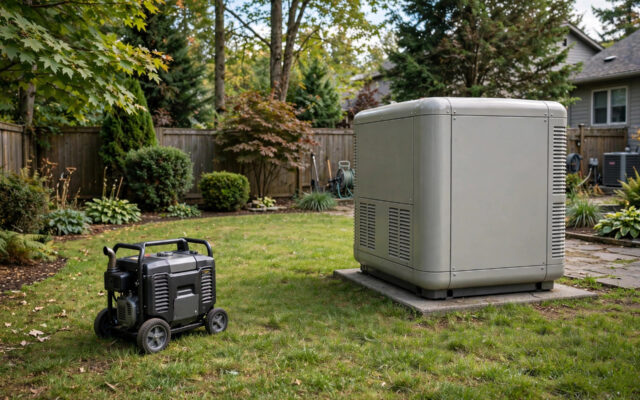
Portable vs Standby Generator: Cost, Runtime, Maintenance & Pros/Cons
Portable vs standby generator: $1,100-$5,000 vs $9,000-$20,000+ installed. Compare costs, runtime, maintenance, pros and cons, and which type wins for you.
Jackery vs EcoFlow vs Bluetti vs Anker: Which Power Station Brand Is Best?
Jackery vs EcoFlow vs Bluetti vs Anker power stations compared on battery chemistry, charging speed, cycle life, and value. Includes the NMC vs LiFePO4 warning.
2 Comments