


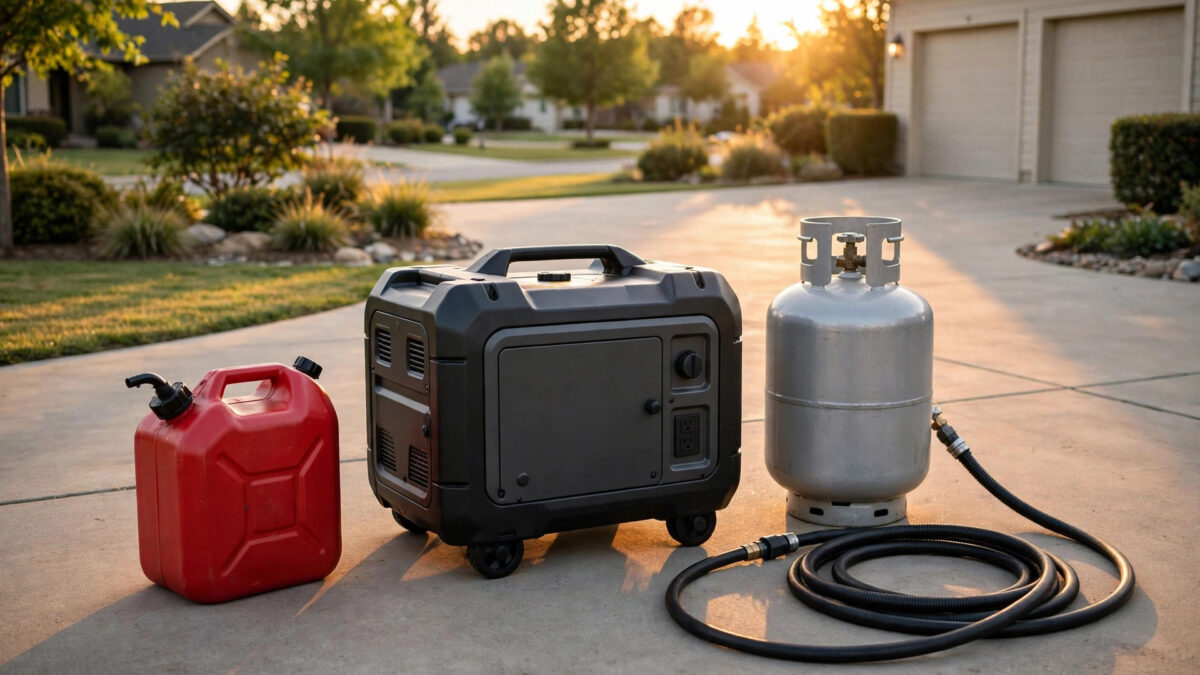
The best tri-fuel generators of 2027 give you something no single-fuel generator can: choice. When the gas station runs dry during a long outage, you can switch to propane from the grill tank. When propane gets expensive, you can plug into your home’s natural gas line and run for days. We researched and compared the specifications, owner feedback, and safety features of eight tri-fuel models to find the ones worth buying.
A tri-fuel generator burns three fuels: gasoline, liquid propane (LPG), and natural gas (NG). Output drops a little on propane and a little more on natural gas — that is normal physics, since gasoline packs more energy per gallon than propane, and propane packs more than natural gas. A good tri-fuel model makes the fuel switch easy, usually with quick-connect hoses and a simple selector switch.
Who should buy one? Homeowners who want the longest possible backup runtime without storing dozens of gasoline cans. If your house already has a natural gas line, a tri-fuel generator paired with a transfer switch can keep essentials running for a week or more. This guide is for whole-home and large-portable buyers; if you need something smaller for camping, see our inverter generator roundup instead.
Key takeaways
- DuroMax XP13000HXT is our overall pick — the largest tri-fuel portable in its class with remote start and CO Alert.
- Westinghouse WGen14500TFc delivers the most power: 14,500 running watts on gasoline, with transfer-switch-ready 14-50R outlet.
- WEN TF-1450X is the best value, publishing full per-fuel wattage ratings and including CO Watchdog protection.
- Expect about 10% less power on propane and 20% less on natural gas compared to gasoline — this is normal for all tri-fuel models.
- Always run a generator outdoors, at least 20 feet from the house, and pair any whole-home setup with a transfer switch installed by a licensed electrician.
Our top picks at a glance
- DuroMax XP13000HXT — Best overall — 13,000 starting watts, remote start, CO Alert, 5-year warranty
- Westinghouse WGen14500TFc — Most powerful — 18,000 peak watts and a 713cc V-Twin engine
- WEN TF-1450X — Best value — full per-fuel ratings with CO Watchdog at a mid-tier price
- Champion 201176 — Quietest open-frame pick — inverter design with CO Shield
- GENMAX GM10500iETC — Best inverter for home backup — 50A outlet and ATS support (check live availability)
The DuroMax XP13000HXT is the largest tri-fuel portable generator on the market, and it earns the top spot by combining serious power with genuinely convenient features. With 13,000 starting watts and 10,500 running watts on gasoline, it can carry a whole-house load — central air, well pump, refrigerator, and lights — through an outage. Push-button electric start and a wireless remote start mean you can fire it up from inside the house instead of fumbling in the dark.
What stood out in our research is how complete the package feels. The XP13000HXT includes CO Alert carbon-monoxide shutdown, an MX2 power-boost feature that lets you get the full rated wattage from each 120V receptacle, and a 50A 14-50R outlet that connects directly to a transfer switch. DuroMax backs it with a 5-year residential warranty, which is longer than most competitors offer. Owner feedback we reviewed consistently praises the remote start and the fuel flexibility during long outages.
At around 240 pounds, this is not a generator you will carry to a tailgate. Plan on a wheel kit and a permanent outdoor spot. But for whole-home backup with fuel choice, it is the most complete tri-fuel package we found.
| Running watts | 10,500 (gasoline) |
|---|---|
| Starting watts | 13,000 (gasoline) |
| Fuel type | Tri-fuel: gasoline, propane, natural gas |
| Noise level | Not published in manufacturer specs we reviewed |
| Runtime | Approx. 8.5 hours at 50% load (gasoline) |
| Weight | Approx. 240 lbs |
Pros
- Highest-output tri-fuel portable in its class
- Push-button + wireless remote start
- CO Alert automatic shutoff included
- 50A transfer-switch-ready outlet and 5-year warranty
Cons
- Heavy — needs a permanent outdoor setup
- No published noise rating from the manufacturer
- Premium price for the category
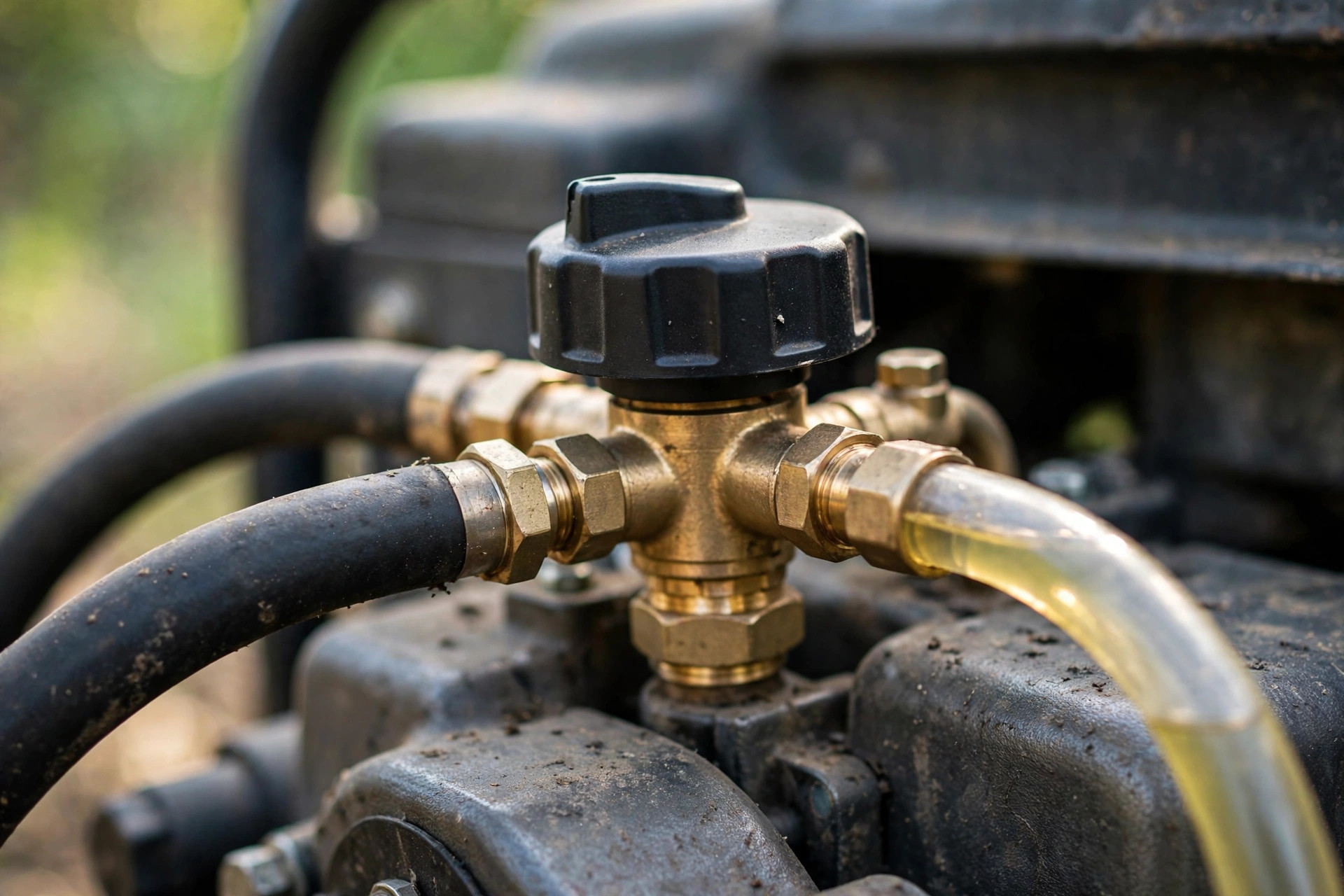
Westinghouse WGen14500TFc 18,000 Peak Watt Tri-Fuel Generator
If raw output is what you need, the Westinghouse WGen14500TFc is the strongest tri-fuel portable in Westinghouse’s lineup: 18,000 peak watts and 14,500 running watts on gasoline. The big 713cc V-Twin engine delivers smooth, steady power with less than 5% total harmonic distortion, so it is safe for computers, TVs, and other sensitive electronics — not always a given on high-output conventional generators.
It is also built for whole-home use. The 14-50R 50-amp receptacle connects straight to a transfer switch, and the 10.5-gallon fuel tank stretches runtime to about 16 hours at 25% load on gasoline. Remote electric start is included, and the steel frame with never-flat wheels helps you move its roughly 348 pounds around. Owner feedback points to strong reliability during multi-day outages, especially on natural gas where the fuel supply never runs out.
The tradeoff is size and noise. This is a big, loud conventional generator — fine for a rural property or a home with a dedicated outdoor pad, less ideal for a small suburban lot. For maximum power on any of three fuels, though, nothing in this roundup beats it.
| Running watts | 14,500 (gasoline) |
|---|---|
| Starting watts | 18,000 (gasoline) |
| Fuel type | Tri-fuel: gasoline, propane (LPG), natural gas |
| Noise level | 74 dBA |
| Runtime | Approx. 16 hours at 25% load (gasoline, 10.5 gal tank) |
| Weight | Approx. 348 lbs |
Pros
- Most powerful tri-fuel portable we found
- Clean power (<5% THD) for sensitive electronics
- Transfer-switch-ready 14-50R outlet
- Long runtime from the 10.5-gallon tank
Cons
- Very heavy at about 348 lbs
- Loud conventional generator — 74 dBA
- Needs a large outdoor space
The WEN TF-1450X is the best-selling value pick in the tri-fuel class, and its biggest strength is honesty: WEN publishes the full wattage rating for each fuel — 11,500 running watts on gasoline, 10,300 on LPG, and 8,750 on natural gas. Many brands only advertise the gasoline number, so WEN’s transparency makes it much easier to plan your loads.
You get CO Watchdog, WEN’s carbon-monoxide shutdown system, plus electric start and a transfer-switch-ready design. The 8.2-gallon tank gives about 12 hours of runtime at half load on gasoline. Owner feedback we reviewed highlights how well it starts and how complete the natural-gas and propane hose kit feels for the price.
WEN backs it with a 2-year warranty, which is shorter than DuroMax’s 5 years, but the price gap usually more than makes up for it. For buyers who want big tri-fuel power without the flagship price, this is the one to beat.
| Running watts | 11,500 (gasoline); 10,300 (LPG); 8,750 (NG) |
|---|---|
| Starting watts | 14,500 (gasoline); 12,500 (LPG); 10,500 (NG) |
| Fuel type | Tri-fuel: gasoline, propane, natural gas |
| Noise level | Not published in manufacturer specs we reviewed |
| Runtime | Approx. 12 hours at 50% load (gasoline, 8.2 gal tank) |
| Weight | Approx. 245 lbs |
Pros
- Excellent value for 14,500 starting watts
- Full per-fuel wattage ratings published
- CO Watchdog carbon-monoxide protection
- Electric start and transfer-switch ready
Cons
- 2-year warranty vs 5 years on some rivals
- No published noise rating
- Heavy to move at 245 lbs
Champion 201176 9,000-Watt Tri-Fuel Open Frame Inverter Generator
The Champion 201176 is unusual: an open-frame generator with true inverter technology. That means it delivers clean, stable power with low harmonic distortion for sensitive electronics, while running at about 72 dBA — Champion says roughly half the noise of a traditional open-frame unit of the same size. For a neighborhood where a screaming conventional generator would cause problems, this design is a smart compromise.
It produces 9,000 starting watts and 7,250 running watts on gasoline, with lower but still useful output on propane (6,525) and natural gas (5,875). CO Shield carbon-monoxide shutoff is built in, and Champion includes both the propane and natural-gas hoses in the box, so there is no extra kit to buy. At about 165.8 pounds it is also the lightest high-output tri-fuel here.
Nine thousand starting watts will not run a whole large house the way the 13–18kW models do, but it comfortably covers essential circuits — fridge, furnace fan, sump pump, lights, and a window AC or two. For buyers who want tri-fuel flexibility with inverter-clean power and lower noise, this is the standout.
| Running watts | 7,250 (gasoline); 6,525 (propane); 5,875 (NG) |
|---|---|
| Starting watts | 9,000 (all fuels) |
| Fuel type | Tri-fuel: gasoline, propane, natural gas |
| Noise level | 72 dBA |
| Runtime | Approx. 14 hrs at 25% load (gasoline, 4.3 gal); 12 hrs at 25% load (propane) |
| Weight | Approx. 165.8 lbs |
Pros
- Inverter-clean power in an open-frame design
- Quieter than conventional open-frame models (72 dBA)
- CO Shield protection and both gas hoses included
- Lightest high-output tri-fuel in this roundup
Cons
- Less total power than the big conventional models
- Still louder than an enclosed inverter
- Won’t power a whole large house
GENMAX GM10500iETC 10,500-Watt Tri-Fuel Inverter Generator
The GENMAX GM10500iETC is the largest single-cylinder inverter tri-fuel generator we found, and it brings inverter advantages — clean power under 3% THD, quieter operation, better fuel efficiency — to the whole-home backup class. With 10,500 starting watts and 8,500 running watts on gasoline, it has the muscle for a transfer-switch-fed panel while staying safe for computers and home electronics.
The feature list is unusually generous: a 50A outlet, automatic transfer switch (ATS) support, remote start, and CO detection. Owner feedback highlights the smooth power delivery and the convenience of ATS compatibility, which lets the generator start automatically when the grid fails — a rare feature at this price point.
One important honesty note: during our research, the Amazon listing showed “No featured offers available,” which means there was no active buy box at that moment. That does not mean it is discontinued — listings come back — but we recommend verifying live availability and the current price before buying. If it is in stock, it is one of the strongest inverter-based home backup options available.
| Running watts | 8,500 (gasoline); 8,000 (LPG); 6,800 (NG) |
|---|---|
| Starting watts | 10,500 (gasoline); 9,500 (LPG); 8,400 (NG) |
| Fuel type | Tri-fuel: gasoline, propane, natural gas |
| Noise level | Not published in manufacturer specs we reviewed |
| Runtime | Not published in manufacturer specs we reviewed |
| Weight | Approx. 298 lbs |
Pros
- Inverter-clean power (<3% THD) at home-backup wattage
- 50A outlet and ATS support for automatic backup
- Remote start and CO detection
- Strong per-fuel ratings
Cons
- Availability was uncertain at research time — verify before buying
- Heavy at about 298 lbs
- Runtime not published by the manufacturer
Champion 100416 10,000-Watt Tri-Fuel Generator with CO Shield
The Champion 100416 is the workhorse mid-size pick: 10,000 starting watts and 8,000 running watts on gasoline, dropping to 7,200 on propane and 7,000 on natural gas. It is EPA and CARB compliant, so it can be sold and used in all 50 states, and the box includes a 25-foot natural-gas hose kit — longer than most competitors include, which matters when the gas meter is not right next to your generator pad.
CO Shield carbon-monoxide shutoff is standard, and the Intelligauge display shows voltage, frequency, and run-time hours so you can track maintenance. Electric start plus a battery-included setup keeps startup simple. Owner feedback we reviewed praises its easy natural-gas hookup and steady performance during multi-day outages.
At about 207 pounds it is manageable on its wheel kit but still a two-person lift. If you want a proven mid-size tri-fuel with the natural-gas plumbing already in the box, this is the safest mainstream choice.
| Running watts | 8,000 (gasoline); 7,200 (propane); 7,000 (NG) |
|---|---|
| Starting watts | 10,000 (gasoline); 9,000 (propane); 8,750 (NG) |
| Fuel type | Tri-fuel: gasoline, propane, natural gas |
| Noise level | 74 dBA |
| Runtime | Approx. 12.5 hrs at 50% load (gasoline, 8.5 gal) |
| Weight | Approx. 207 lbs |
Pros
- 25-ft natural-gas hose kit included
- EPA and CARB compliant — 50-state legal
- CO Shield protection and Intelligauge display
- Proven mainstream brand with wide service network
Cons
- 74 dBA is loud for close neighbors
- Mid-size power won’t run a whole large home
- Heavy despite the wheel kit
Westinghouse WGen11500TFc 14,500 Peak Watt Tri-Fuel Generator
The Westinghouse WGen11500TFc gives you nearly the same tri-fuel flexibility as its bigger 18kW brother at about 118 pounds less weight. With 14,500 peak watts and 11,500 running watts on gasoline — plus 10,500 on propane and 9,500 on natural gas — it sits in the sweet spot for a medium-to-large home running essential and comfort loads together.
Like the bigger model, it includes the transfer-switch-ready 14-50R outlet, electric start, and Westinghouse’s VFT data center that displays voltage, frequency, and lifetime hours. The 9.5-gallon tank delivers up to about 19 hours of runtime at 25% load on gasoline, one of the longest tank ranges in this roundup.
The tradeoff is the same as the flagship: 74 dBA of conventional-generator noise and a still-hefty 230 pounds. But dollar for dollar, this is one of the strongest power-per-pound values among tri-fuel portables.
| Running watts | 11,500 (gasoline); 10,500 (propane); 9,500 (NG) |
|---|---|
| Starting watts | 14,500 (gasoline); 13,500 (propane); 12,000 (NG) |
| Fuel type | Tri-fuel: gasoline, propane, natural gas |
| Noise level | 74 dBA |
| Runtime | Approx. 19 hrs at 25% load (gasoline, 9.5 gal) |
| Weight | Approx. 230 lbs |
Pros
- 14,500 peak watts at a midsize price
- Up to ~19 hours runtime at light load
- Transfer-switch-ready 14-50R outlet
- 118 lbs lighter than the 18kW flagship
Cons
- 74 dBA — loud for tight neighborhoods
- Still heavy at 230 lbs
- Natural gas output drops to 9,500W
Champion 201161 12,500-Watt Tri-Fuel Generator with CO Shield
The Champion 201161 fills the gap between the 10kW mid-size models and the 13–14.5kW flagships: 12,500 starting watts and 10,000 running watts on gasoline, with full published ratings for propane (9,000 running) and natural gas (8,000 running). If your load calculation lands just above what a 10kW unit handles, this is the natural step up.
It carries the full Champion feature set — CO Shield shutoff, electric start, and the Intelligauge monitoring display — and it is tri-fuel out of the box with quick-connect hoses. As one of Champion’s newer tri-fuel listings, it also benefits from the brand’s broad dealer and service network for parts and support.
Runtime and noise figures were not fully published at the time of our research, so check the listing for the latest specs before buying. For buyers who need a bit more than 10kW but do not want the biggest and heaviest units, the 201161 is a well-balanced middle ground.
| Running watts | 10,000 (gasoline); 9,000 (propane); 8,000 (NG) |
|---|---|
| Starting watts | 12,500 (gasoline); 11,250 (propane); 10,000 (NG) |
| Fuel type | Tri-fuel: gasoline, propane, natural gas |
| Noise level | Not published in manufacturer specs we reviewed |
| Runtime | Not published in manufacturer specs we reviewed |
| Weight | Not published in manufacturer specs we reviewed |
Pros
- Full per-fuel wattage ratings published
- CO Shield and Intelligauge included
- Good step up from 10kW models
- Broad Champion service network
Cons
- Some specs not published at research time
- Newer model with less long-term owner history
- Check live availability before buying
Tri-fuel generators compared
Wattage figures below are running watts on gasoline unless noted. Always plan your loads against the propane or natural-gas rating if that is the fuel you will actually use.
How do you choose the best tri-fuel generator in 2027?
Tri-fuel generators look similar on a spec sheet, but the right choice depends on your home, your fuel access, and how you plan to connect it. Here is what we compared when ranking these eight models.
How many watts do you actually need?
Add up the running watts of everything you want to power at once, then add the highest starting-watt requirement among your motor-driven appliances (well pump, AC compressor, sump pump). Most whole-home backup setups need 10,000–14,000 starting watts. A common mistake is sizing to the gasoline rating while planning to run on natural gas — remember the NG output is usually 15–25% lower.
If you are unsure how to tally your loads, our guide on sizing a generator for your home walks through the math with real appliance examples.
Which fuel will you use most?
Gasoline is the most powerful and widely available day to day, but it goes stale in 3–6 months and gas stations can run dry in a long outage. Propane stores indefinitely and burns cleaner, but a 20-pound grill tank only holds about 4.6 gallons — plan on larger tanks or frequent swaps for multi-day runs. Natural gas is the king of long outages if you have a utility line: the supply effectively never runs out, though output is lowest of the three.
For honest numbers, we favored models that publish the running watts for each fuel, like the WEN TF-1450X and Champion 201161. If a manufacturer only advertises the gasoline rating, assume propane gives roughly 90% and natural gas roughly 80%.
Transfer switch or extension cords?
A manual transfer switch, installed by a licensed electrician, lets you feed selected house circuits through your breaker panel — no extension cords snaking through windows, and no risk of backfeeding the grid (which can kill utility workers). Any generator with a 14-50R 50A or L14-30 30A outlet is transfer-switch ready.
Electrical work for a transfer switch must meet your local electrical code — most areas require a permit and inspection, and the current NEC (2026 edition) has specific rules for generator connections. This is not a DIY job for most homeowners. See our generator transfer switch guide for the full picture.
Inverter vs conventional: does it matter?
Conventional generators are cheaper per watt and great for resistive loads (heaters, incandescent lights) and most motor loads. Inverter generators produce cleaner power with under 3–5% total harmonic distortion, which is safer for computers, modern HVAC controls, and anything with a microprocessor. They are also quieter and more fuel-efficient at light loads because the engine throttles down.
In this roundup, the Champion 201176 and GENMAX GM10500iETC are the inverter options. Choose one if you run a lot of sensitive electronics or have noise-sensitive neighbors; choose a conventional model if you want maximum watts per dollar.
Noise and where you will put it
Conventional tri-fuel generators run 72–76 dBA — about as loud as a vacuum cleaner, and noticeable to neighbors. Enclosed inverter models are much quieter. Local noise ordinances may restrict nighttime operation, so check your city’s rules before buying.
Placement matters for safety too: at least 20 feet from the house, on a dry level surface, with the exhaust pointed away from doors and windows. Never refuel a hot generator, and let it cool before adding gasoline.
Warranty and parts support
Generators are long-term equipment — expect 10–20 years of service with maintenance. DuroMax’s 5-year residential warranty is the best in this roundup; most competitors offer 2–3 years. Also consider parts availability: mainstream brands like Champion, Westinghouse, and DuroMax have broad dealer networks, which matters when you need an air filter or a carburetor kit five years from now.
Tri-fuel generator FAQs
What is a tri-fuel generator?
A tri-fuel generator is a portable generator that can run on three fuels: gasoline, liquid propane (LPG), and natural gas (NG). It ships with the hoses and regulator needed to connect a propane tank or a natural gas line, plus the standard gasoline tank. Switching fuels usually takes a minute or two with a selector switch and quick-connect fittings.
Do tri-fuel generators produce less power on propane and natural gas?
Yes. Expect roughly 10% less running power on propane and 15–25% less on natural gas compared to gasoline. This is normal physics — gasoline contains more energy per unit than propane, and propane contains more than natural gas. Always size your generator using the wattage rating of the fuel you plan to run most often, not the gasoline headline number.
Can I connect a tri-fuel generator to my home's natural gas line?
Usually yes, and it is one of the biggest advantages of a tri-fuel model. Most include a natural-gas hose kit with a quick-connect fitting. The gas connection itself should be installed or verified by a licensed plumber or gas fitter to meet local code, and you will need adequate gas pressure — check with your utility if you are unsure.
Is it safe to run a tri-fuel generator during a power outage?
Yes, if you follow basic safety rules. Always operate it outdoors at least 20 feet from your home with the exhaust pointed away. Never run it in a garage, basement, or enclosed space. Install battery-powered carbon-monoxide detectors in your home. Connect to house circuits only through a transfer switch installed by a licensed electrician — never plug a generator directly into a wall outlet (backfeeding), which is illegal and can kill utility workers.
How long can a tri-fuel generator run on natural gas?
As long as your utility gas supply holds out — there is no tank to refill. That is why natural gas is the preferred fuel for multi-day outages. Just keep up with oil changes (most manufacturers recommend the first change after 20–30 hours, then every 100 hours), and let the unit cool before any maintenance.
Are tri-fuel generators worth it over dual-fuel models?
They are if you have access to natural gas. A dual-fuel (gasoline + propane) generator is simpler and often cheaper, and propane stores forever. But only tri-fuel gives you the third option of piped natural gas — effectively unlimited runtime during long outages. If you do not have a natural gas line, save your money and buy dual-fuel.
Our verdict
For most homeowners, the DuroMax XP13000HXT is the best tri-fuel generator of 2027: the most power in its class, remote start, CO Alert, and a 5-year warranty. If you need the absolute maximum output, step up to the Westinghouse WGen14500TFc. On a budget, the WEN TF-1450X delivers honest per-fuel ratings and CO Watchdog protection for much less. And if inverter-clean power and lower noise matter most, the Champion 201176 and GENMAX GM10500iETC are the picks — just verify the GENMAX is actually in stock before you buy.
How we researched: We did not perform hands-on testing for this roundup. We compared manufacturer specifications for eight tri-fuel generators verified on Amazon in October 2026, cross-checked model numbers against brand listings, and reviewed aggregated owner feedback for reliability and real-world fuel-switching experience. We favored models that publish wattage ratings for all three fuels and include carbon-monoxide safety shutoff. Prices and availability change frequently, so always check the live listing before buying.

Related Guides
Best Time to Buy a Generator: 2027 Price & Sales Calendar
The best time to buy a generator is Black Friday, with 10-30% off typical. 2027 price and sales calendar: clearance windows, pre-season deals, and timing tips.

Portable vs Standby Generator: Cost, Runtime, Maintenance & Pros/Cons
Portable vs standby generator: $1,100-$5,000 vs $9,000-$20,000+ installed. Compare costs, runtime, maintenance, pros and cons, and which type wins for you.
Jackery vs EcoFlow vs Bluetti vs Anker: Which Power Station Brand Is Best?
Jackery vs EcoFlow vs Bluetti vs Anker power stations compared on battery chemistry, charging speed, cycle life, and value. Includes the NMC vs LiFePO4 warning.
1 Comment