


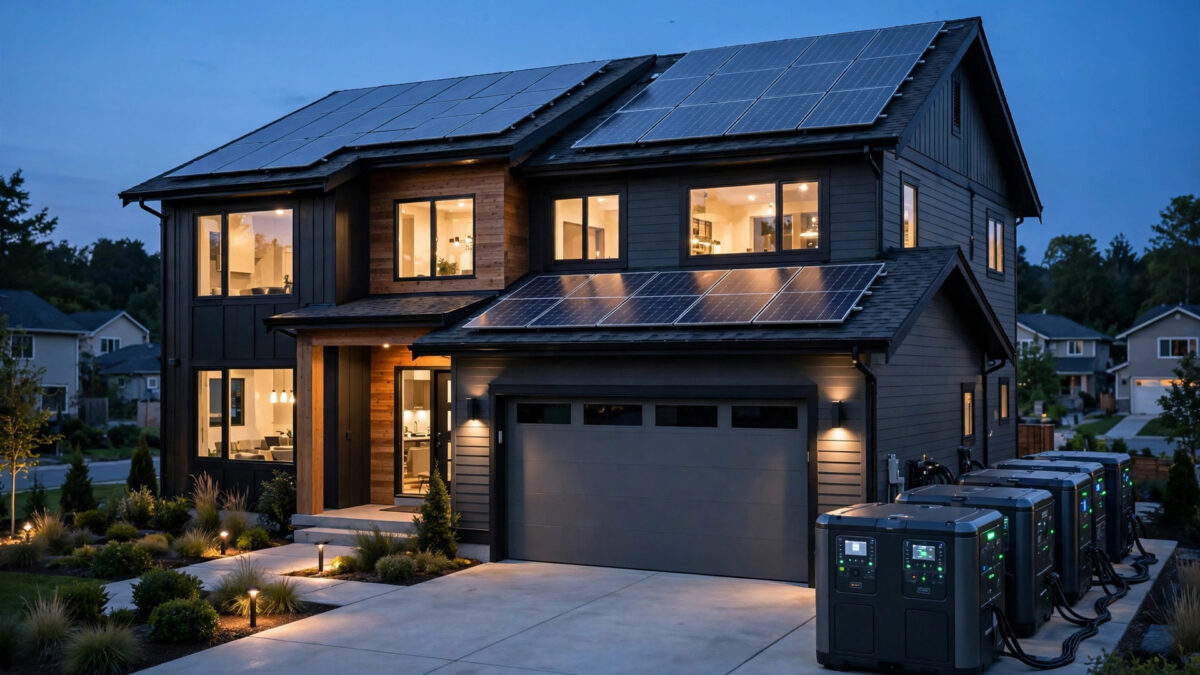
When the grid goes down for hours — or days — a small power station won’t cut it. Whole-home backup means running your fridge, freezer, well pump or sump pump, lights, Wi-Fi, and maybe even a window AC or electric cooktop, all at once. That takes a large solar generator: 2kWh or more of capacity, 2400W+ of output, and ideally 240V support for the heavy loads.
In 2027, large solar generators have matured into genuine alternatives to gas generators and even partial home battery systems. The best units now offer 240V split-phase output, expandable capacity into the tens of kilowatt-hours, sub-hour fast charging, and manual transfer switch integration so they can feed your home’s circuits directly. We’ve compared the five best large solar generators for whole-home backup below, ranked by what actually matters when the lights go out: usable capacity, sustained output, expansion headroom, and recharge speed.
Our five picks at a glance:
- EcoFlow DELTA Pro 3 — best overall large solar generator
- Jackery HomePower 3600 Plus — best new platform with transfer-switch integration
- BLUETTI AC200PL — best mid-large value
- Anker SOLIX F2600 — best 2.5kWh value
- BLUETTI Elite 200 V2 — quietest large solar generator
Our Top 5 Large Solar Generators for Whole-Home Backup
Best overall
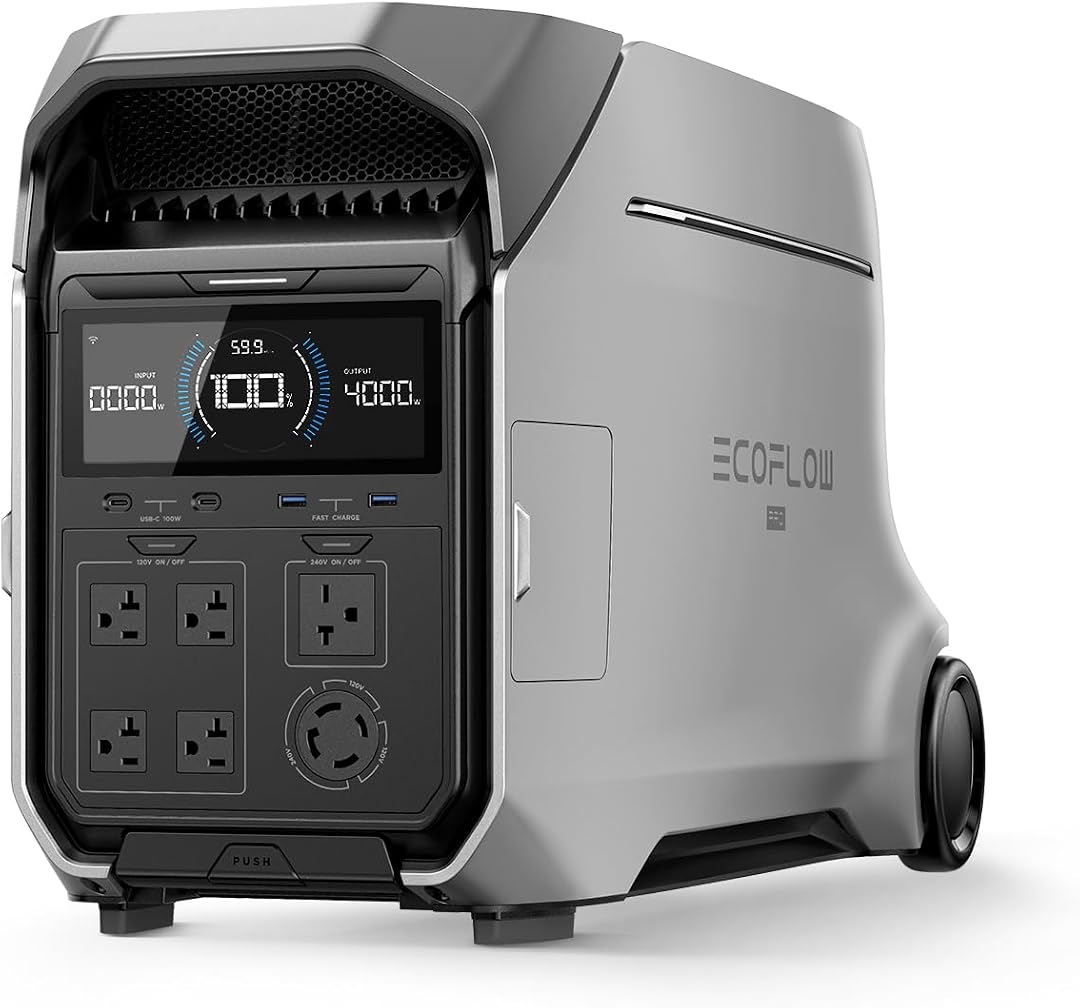
EcoFlow DELTA Pro 3
- 4096Wh capacity / 4000W output (120V/240V)
- Expands to a massive 48kWh
- LiFePO4 — 0-80% in ~50 minutes
- IP65 dust and water resistance
- Capacity: 4096Wh (expandable to 48kWh)
- Output: 4000W (6000W X-Boost), 120V/240V
- Battery: LiFePO4
- Recharge: 0-80% in ~50 min (AC)
- Weight: 115 lbs
As an Amazon Associate, we earn from qualifying purchases.
EcoFlow DELTA Pro 3 Review: The Whole-Home Benchmark
The EcoFlow DELTA Pro 3 is the large solar generator everything else is measured against. With 4096Wh of built-in LiFePO4 capacity, 4000W of continuous output (6000W with X-Boost), and true 120V/240V split-phase power, a single unit can run a 3-ton central air conditioner, an electric dryer, or a well pump — loads that smaller stations can’t touch. Two units in parallel double that to 8000W.
Expansion is where the DELTA Pro 3 pulls away. Add extra batteries and it scales all the way to 48kWh — that’s roughly three to four days of essential-load backup for an average home, or a serious foundation for daily solar self-consumption. Charging keeps pace with the capacity: 0-80% in about 50 minutes from AC, up to 2600W of solar input, and even EV-station charging support for roadside top-ups. The IP65 rating means dust and rain won’t kill it if it’s staged in a garage or under an awning during an outage.
It’s heavy at 115 lbs — this is a two-person lift or a hand-truck job, not something you’ll carry to a campsite. And it’s the priciest single unit on this list. But for whole-home backup, that money buys the deepest capability: 240V output, the largest expansion ceiling in its class, and an ecosystem (transfer switches, smart panels, extra batteries) that turns a portable station into a permanent home energy setup. If you want one unit that can genuinely replace a gas generator for home backup, this is it.
Pros
- 4000W output with true 240V — runs central AC and well pumps
- Expands to 48kWh, the largest ceiling here
- 50-minute fast charging and huge solar input
- IP65 weather resistance and deep home-integration ecosystem
Cons
- 115 lbs — not portable without a hand truck
- Highest single-unit price on this list
- Extra batteries add significant cost
Best new platform
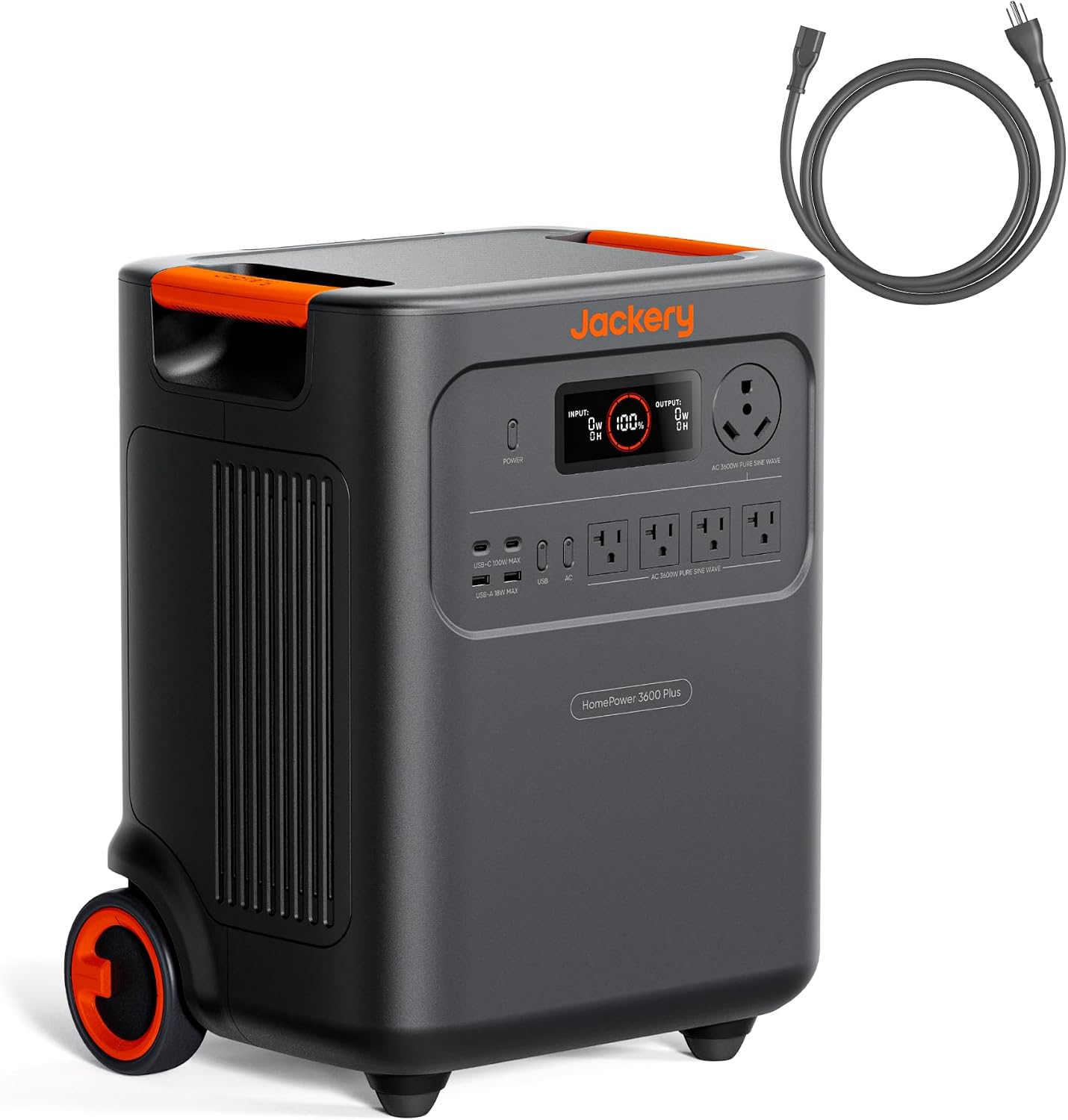
Jackery HomePower 3600 Plus
- 3584Wh capacity / 3600W output (120V/240V)
- Expands to 43kWh with extra batteries
- LiFePO4 — 6000 cycles
- Manual transfer switch (MTS) integration
- Capacity: 3584Wh (expandable to 43kWh)
- Output: 3600W (7200W surge), 120V/240V
- Battery: LiFePO4, 6000 cycles
- Recharge: 0-100% in 2.5h (AC)
- Weight: 77.2 lbs
As an Amazon Associate, we earn from qualifying purchases.
Jackery HomePower 3600 Plus Review: Built for the Breaker Panel
Jackery’s HomePower 3600 Plus represents a strategic shift: instead of just selling bigger portable stations, Jackery built a unit designed from the ground up to integrate with your home’s electrical panel. The headline feature is manual transfer switch (MTS) integration — wire it in through a transfer switch and it can feed your home’s essential circuits directly, the way a standby generator would, without extension cords snaking through windows.
The specs back up the ambition. 3584Wh of LiFePO4 rated for an exceptional 6,000 cycles, 3600W of continuous output with 7200W surge, and true 120V/240V output for heavy loads. Expansion reaches 43kWh with additional battery packs — within striking distance of the DELTA Pro 3’s ceiling. At 77.2 lbs it’s notably lighter than the DELTA Pro 3, which matters if you’ll ever move it. Full AC recharge takes 2.5 hours, slower than EcoFlow’s 50-minute sprint but perfectly reasonable for a unit this size.
The trade-offs: Jackery’s home-integration ecosystem is newer than EcoFlow’s, so there are fewer third-party accessories and less long-term field data. 3600W output is a step below the DELTA Pro 3’s 4000W, which matters for the very largest loads. But if your vision is a clean, panel-integrated backup setup rather than a portable powerhouse, the HomePower 3600 Plus is the most thoughtfully designed option — and the 6,000-cycle battery rating is the best longevity figure on this list.
Pros
- Designed for MTS/panel integration — cleanest home setup
- 6,000-cycle LiFePO4 — best longevity rating here
- 43kWh expansion ceiling
- Lighter than the DELTA Pro 3 at 77.2 lbs
Cons
- 3600W output trails the DELTA Pro 3
- Newer platform with less long-term field data
- Slower AC recharge (2.5h) than EcoFlow
Best mid-large value
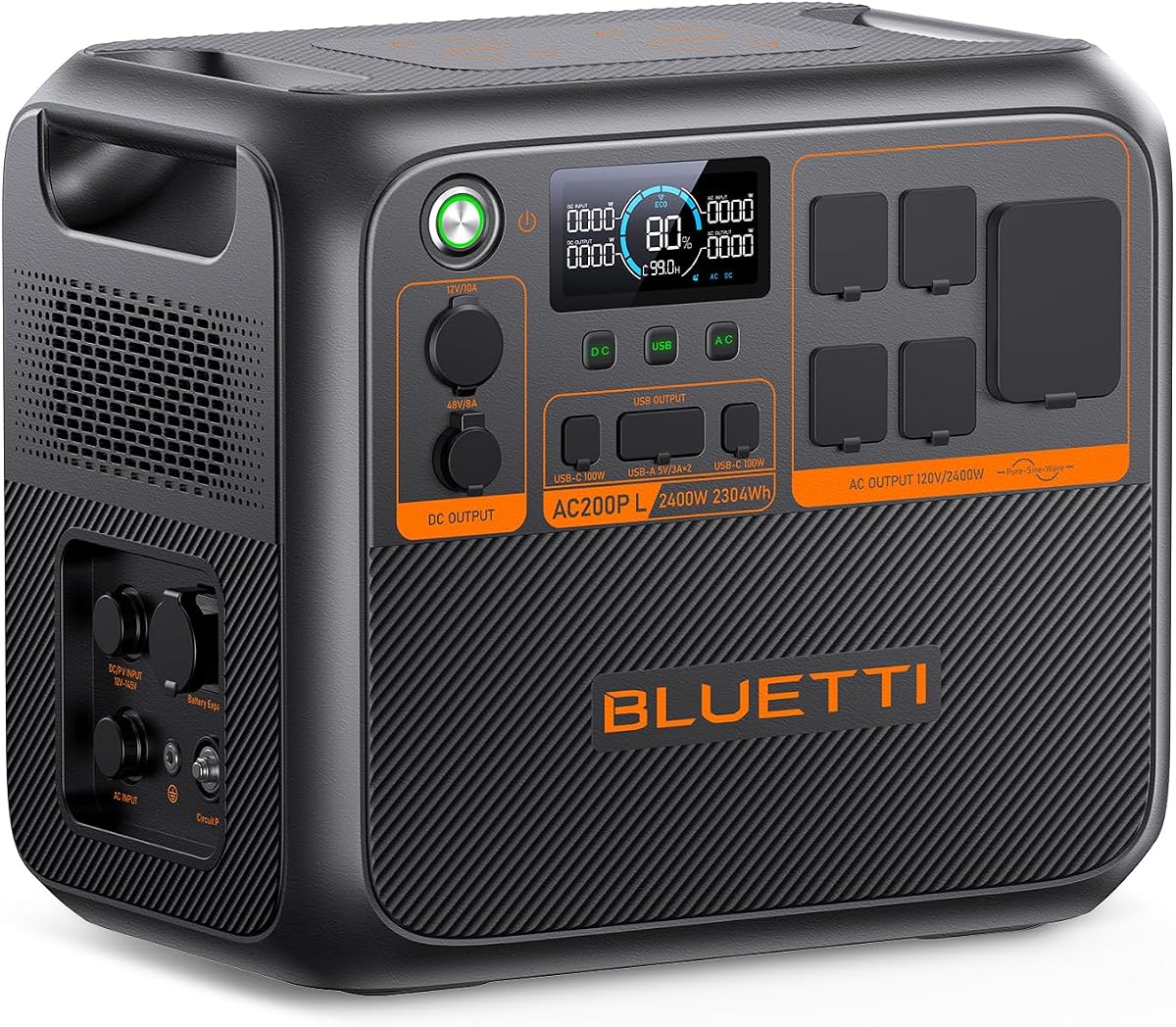
BLUETTI AC200PL
- 2304Wh capacity / 2400W output
- Expands to 8448Wh
- LiFePO4 — 3000+ cycles
- 0-80% in ~1 hour
- Capacity: 2304Wh (expandable to 8448Wh)
- Output: 2400W (3600W Power Lifting)
- Battery: LiFePO4, 3000+ cycles
- Recharge: 0-80% in ~1h (AC)
- Weight: 72 lbs
As an Amazon Associate, we earn from qualifying purchases.
BLUETTI AC200PL Review: The Sweet Spot
Not everyone needs 4kWh and 240V. The BLUETTI AC200PL hits the sweet spot for whole-home backup on a saner budget: 2304Wh of LiFePO4, 2400W of continuous output (3600W in Power Lifting mode for resistive loads), and expansion to 8448Wh — enough to run a fridge, freezer, lights, Wi-Fi, and devices for a full day or more.
The AC200PL is a refined evolution of BLUETTI’s legendary AC200 line, which has one of the largest owner communities in solar. The 2400W inverter handles nearly all 120V household loads; the main things it can’t do are 240V appliances like central AC, electric dryers, and well pumps. For homes on city water with gas heat, that’s often everything that matters. One-hour fast charging to 80% means it recovers quickly between outages, and at 72 lbs it’s manageable with the built-in handles.
Value is the real story. The AC200PL typically costs far less than the DELTA Pro 3 or HomePower 3600 Plus while covering the most common backup scenarios. If your outage plan is “keep the food cold, the lights on, and the phones charged for 24-48 hours,” this is the most cost-effective way to do it from a top-tier brand. Pair it with 400-800W of solar panels and you have a self-sustaining setup for extended outages.
Pros
- Best price-per-watt-hour from a major brand
- 2400W handles nearly all 120V household loads
- Expands to 8448Wh for multi-day backup
- Huge owner community and proven platform
Cons
- No 240V output — can’t run central AC or well pumps
- 72 lbs is heavy for one person
- Smaller expansion ceiling than flagship rivals
Best 2.5kWh value
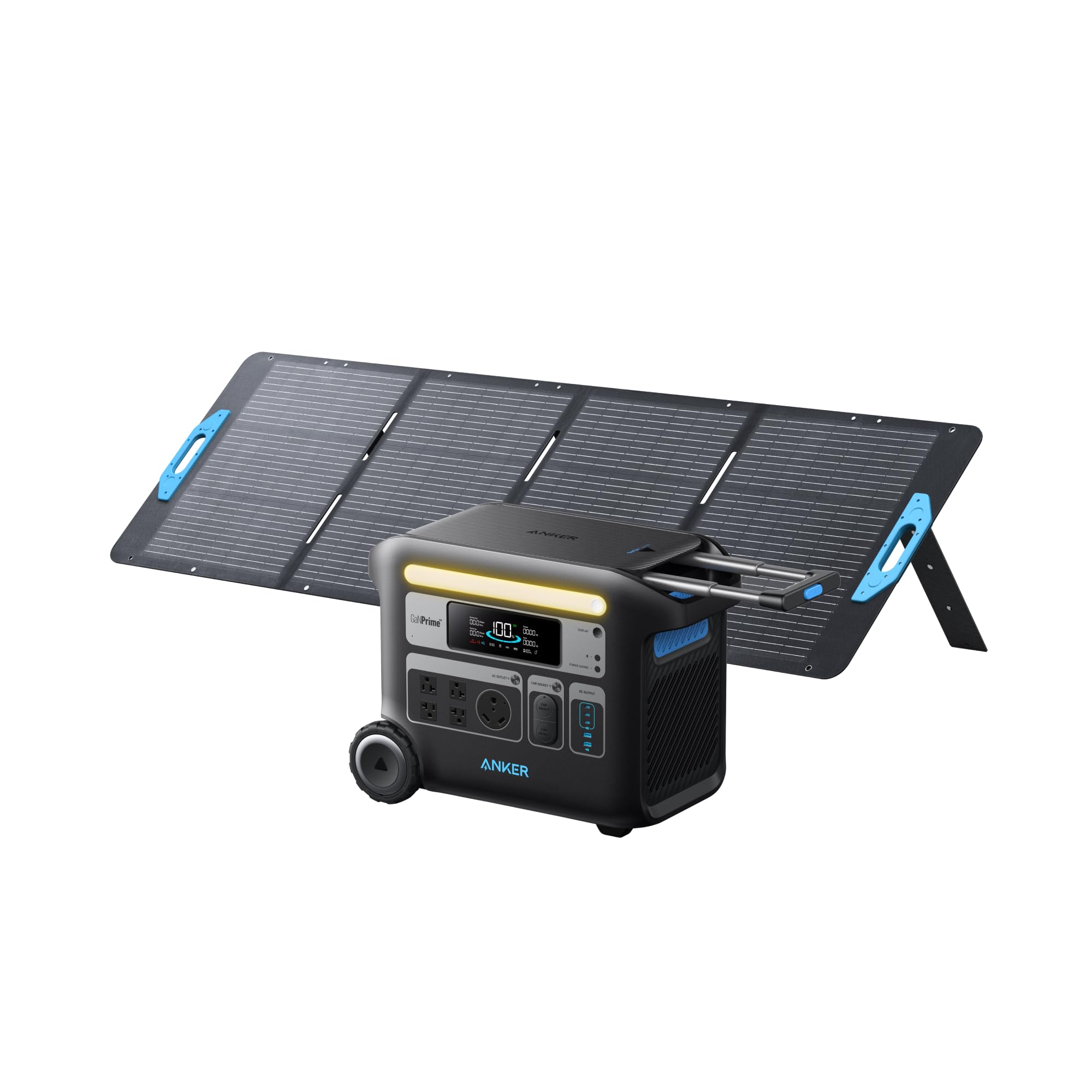
Anker SOLIX F2600
- 2560Wh capacity / 2400W output
- LiFePO4 — 3000+ cycles
- 0-80% in 1 hour
- Anker’s 5-year warranty
- Capacity: 2560Wh
- Output: 2400W (3600W peak)
- Battery: LiFePO4, 3000+ cycles
- Recharge: 0-80% in 1h
- Weight: 67.2 lbs
As an Amazon Associate, we earn from qualifying purchases.
Anker SOLIX F2600 Review: The Warranty Play
Anker built its name on reliable charging gear, and the SOLIX F2600 brings that reputation to large solar generators. With 2560Wh of LiFePO4 and 2400W of output, it slots between the AC200PL and the flagships — more capacity than the BLUETTI, less than the EcoFlow and Jackery flagships, at a price that often undercuts both per watt-hour.
The standout is Anker’s 5-year warranty, among the longest standard warranties in the category. Combined with 3,000+ cycle LiFePO4 cells, that’s a decade-scale ownership proposition with real manufacturer backing. Performance is solid across the board: 1-hour fast charging to 80%, 3600W peak output for motor startups, and a well-designed app. At 67.2 lbs it’s the lightest unit in this 2.4kWh+ class, with a suitcase-style design that’s genuinely movable.
The main limitation is expansion: unlike the EcoFlow, Jackery, and BLUETTI flagships, the F2600’s expansion options are more limited, so what you buy is closer to what you get. It’s also 120V-only, so 240V loads are out. But if you want 2.5kWh of dependable capacity with the best warranty in the business and no plans to build a 40kWh home battery, the F2600 is a smart, low-risk buy.
Pros
- 5-year warranty — best standard coverage here
- 2560Wh at a competitive price per watt-hour
- Lightest in its class at 67.2 lbs
- Fast 1-hour recharge and reliable app
Cons
- Limited expansion compared to rivals
- No 240V output
- Smaller accessory ecosystem than EcoFlow/BLUETTI
Quietest large
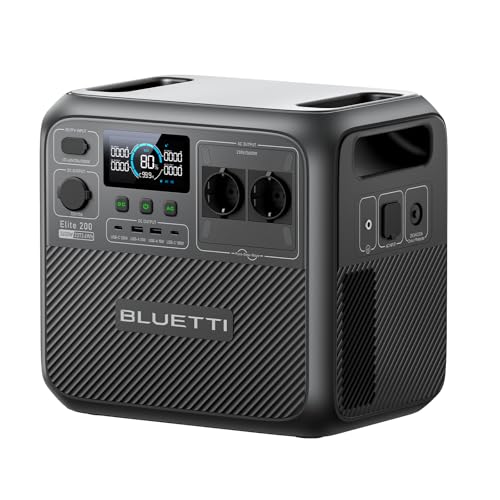
BLUETTI Elite 200 V2
- 2073.6Wh capacity / 2600W output
- LiFePO4 — 6000+ cycles
- 0-80% in ~50 minutes
- Whisper-quiet 30dB operation
- Capacity: 2073.6Wh
- Output: 2600W (3900W Power Lifting)
- Battery: LiFePO4, 6000+ cycles
- Recharge: 0-80% in ~50 min
- Weight: 53.4 lbs
As an Amazon Associate, we earn from qualifying purchases.
BLUETTI Elite 200 V2 Review: Power Without the Roar
Large solar generators have an open secret: under heavy load, their cooling fans can be loud enough to hear through walls. The BLUETTI Elite 200 V2 is the exception. BLUETTI engineered it to run at just 30dB under typical loads — quieter than a whisper — while still delivering 2073.6Wh of capacity and 2600W of output (3900W in Power Lifting mode). If your backup unit will sit in a living room, bedroom hallway, or apartment during an outage, this matters enormously.
Quiet doesn’t mean weak. The 2600W inverter out-muscles the 2400W units on this list, and the 6,000+ cycle LiFePO4 rating matches the Jackery flagship for longevity. At 53.4 lbs it’s dramatically lighter than the other large units here — one strong person can move it. Fifty-minute fast charging to 80% keeps it ready. For apartments, condos, and noise-sensitive households, it’s the only large unit that truly disappears into the background.
The trade-off is capacity: 2073.6Wh is the smallest on this list, so runtime for heavy loads is shorter. There’s no 240V output, and expansion is modest compared to the flagships. But as a quiet, long-lived 2kWh workhorse that you can actually live next to during a multi-day outage, the Elite 200 V2 has no equal. It’s also the most affordable entry into true large-generator territory.
Pros
- 30dB operation — dramatically quieter than rivals
- 6,000+ cycle LiFePO4 — exceptional longevity
- 2600W output beats other 2kWh-class units
- Lightest large unit at 53.4 lbs
Cons
- Smallest capacity on this list (2073.6Wh)
- No 240V output
- Limited expansion options
Whole-Home Backup Buying Guide
How Much Capacity Does a Home Need?
Start with an energy audit, not a product page. Essential loads — fridge (150W), freezer (100W), lights (50W), Wi-Fi and devices (50W), sump pump (800W intermittent) — total roughly 300-500W continuous, or about 7-12kWh per day. A 2kWh unit covers 4-6 hours of essentials; 4kWh covers most of a day; expanded 10kWh+ systems ride through multi-day outages, especially with solar refilling during the day. Size for your realistic outage history, not the apocalypse.
120V vs 240V: Know Before You Buy
Most household circuits are 120V, but heavy appliances — central AC, electric dryers, well pumps, EV chargers — need 240V. Only the EcoFlow DELTA Pro 3 and Jackery HomePower 3600 Plus on this list provide 240V. If any must-run load in your home is 240V, those are your only options here. Everyone else should verify their critical loads are all 120V before choosing a 120V-only unit.
Transfer Switches and Home Integration
The cleanest setups wire the generator into your home through a manual transfer switch (MTS) or a smart panel, letting it power hardwired circuits without extension cords. This requires an electrician and must follow local code — never backfeed through a dryer outlet, which endangers utility workers. The Jackery HomePower 3600 Plus is designed with MTS integration in mind; EcoFlow offers transfer switch accessories for the DELTA Pro 3. Budget $500-1,500 for professional transfer switch installation.
Solar Panels for Large Systems
Large units accept serious solar input — up to 2600W on the DELTA Pro 3. For meaningful outage refills, plan 800-1600W of panels: four 400W rigid panels on a ground mount or roof will refill a 2-4kWh unit on a sunny day. Portable folding panels work but cost more per watt; for a permanent backup setup, rigid residential-style panels are the economical choice. Match panel voltage to your unit’s MPPT input range.
What About Running Costs vs a Gas Generator?
A 7500W gas generator costs less upfront than any unit on this list — but the math flips over time. Gas generators burn roughly 0.75 gallons per hour at half load; a 3-day outage can easily consume 40+ gallons of fuel, plus oil changes, spark plugs, and carburetor cleanings. At current fuel prices, each multi-day outage costs $150-250 in gasoline alone, and that’s if you can buy fuel during the emergency.
A large solar generator’s “fuel” is free sunlight after the panel investment, and LiFePO4 batteries need zero maintenance for a decade. Over 10 years with just two multi-day outages per year, a solar setup typically breaks even against a gas generator — while running silently, producing no fumes, and working safely indoors. The remaining case for gas is continuous multi-day, high-wattage loads (like running central AC around the clock) where battery capacity gets expensive. For everything else, solar has won.
Portability Reality Check
Don’t buy a 115-lb unit expecting to toss it in the car for camping. The DELTA Pro 3 and HomePower 3600 Plus are home-backup appliances that happen to be movable; the AC200PL, F2600, and Elite 200 V2 are the practical limit of what one person can reasonably relocate. If you need both home backup and camping portability, the honest answer is two units: a large one for the house and a 1kWh-class unit for the road. Trying to make one unit do both jobs usually means it’s bad at one of them.
Frequently Asked Questions
What size solar generator do I need to power my whole house?
For essential loads (fridge, freezer, lights, Wi-Fi, devices), a 2-4kWh unit like the BLUETTI AC200PL or EcoFlow DELTA Pro 3 covers 6-24 hours. For true whole-home backup including 240V appliances like central AC or a well pump, you need a 240V-capable unit (DELTA Pro 3 or HomePower 3600 Plus), ideally expanded to 8kWh+.
Can a solar generator run central air conditioning?
Yes, but only 240V-capable units like the EcoFlow DELTA Pro 3 (4000W) or Jackery HomePower 3600 Plus (3600W) can handle a central AC’s 240V requirement and 3,000-5,000W draw. You’ll also need substantial capacity — plan on at least 8kWh of battery for meaningful AC runtime, plus solar to refill during the day.
How long will a large solar generator power a refrigerator?
A standard fridge draws about 100-200W while running (cycling on and off). A 2kWh unit like the BLUETTI Elite 200 V2 will keep it cold for roughly 15-20 hours; a 4kWh DELTA Pro 3 stretches that to 30-40 hours. Adding solar panels extends runtime indefinitely in sunny weather.
Are large solar generators better than gas generators?
For most homeowners, yes: no fuel storage, no fumes, no maintenance, silent operation, and they work indoors. Gas still wins on raw runtime per dollar for multi-day, high-load scenarios. The sweet spot in 2027 is a large solar generator for essentials plus solar panels — quiet, clean, and self-refilling.
Do I need an electrician to connect a solar generator to my house?
For extension-cord use, no. But to power hardwired home circuits, you need a manual transfer switch installed by a licensed electrician (typically $500-1,500). Never plug a generator into a wall outlet to backfeed your panel — it’s illegal in most areas and can kill utility workers.
Our verdict
The EcoFlow DELTA Pro 3 is the best large solar generator for whole-home backup: 240V output, 4000W of power, and expansion to 48kWh make it the closest thing to a gas-generator replacement. Want panel-integrated backup with the longest-lasting battery? The Jackery HomePower 3600 Plus is purpose-built for it. On a tighter budget, the BLUETTI AC200PL covers the essential 120V loads for far less, while the BLUETTI Elite 200 V2 is the pick for quiet, apartment-friendly backup.

Related Guides
Best Solar Generator Bundles with Panels for 2027
Save money with the best solar generator bundles of 2027 — power station plus solar panel kits ready to use out of the box.

Best Solar Generators for RVs in 2027
Power your RV adventures with the best solar generators for RVs in 2027, featuring TT-30 outlets and fast solar charging.
Best Solar Generators for Camping in 2027
The best solar generators for camping in 2027: lightweight, quiet power stations that keep your gear charged off-grid.
1 Comment