


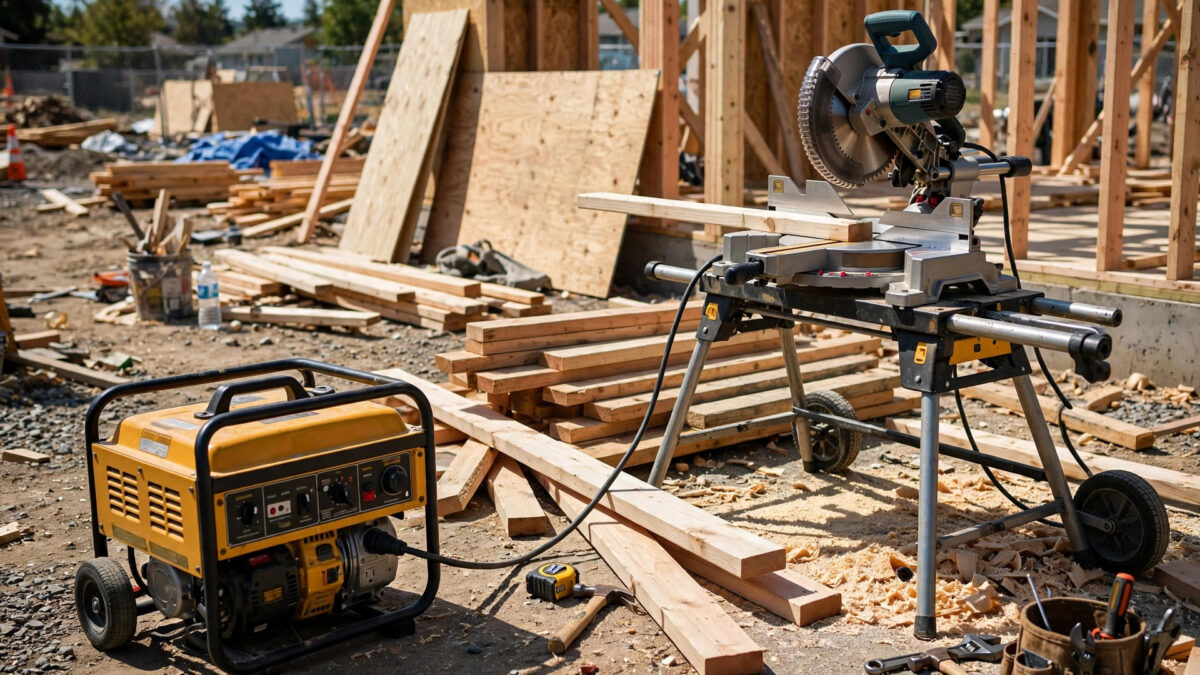
Power tools are the hardest loads most generators ever see. A circular saw doesn’t sip power like a refrigerator — it slams the generator with a 2,000+ watt starting surge every time you pull the trigger, then drops off, then slams it again. An air compressor is worse: high surge, then hours of cycling. And a welder just sits there drinking 5,000–7,000 watts like it’s nothing.
I’ve sized generators for workshop and job-site use for years, and the mistake I see most often is buying by running watts alone. Tools live and die by surge capacity and voltage stability under sudden load. A generator that technically covers your running watts will still trip, stall, or brown-out your tools if it can’t handle the surges — and repeated brown-outs are what kill tool motors.
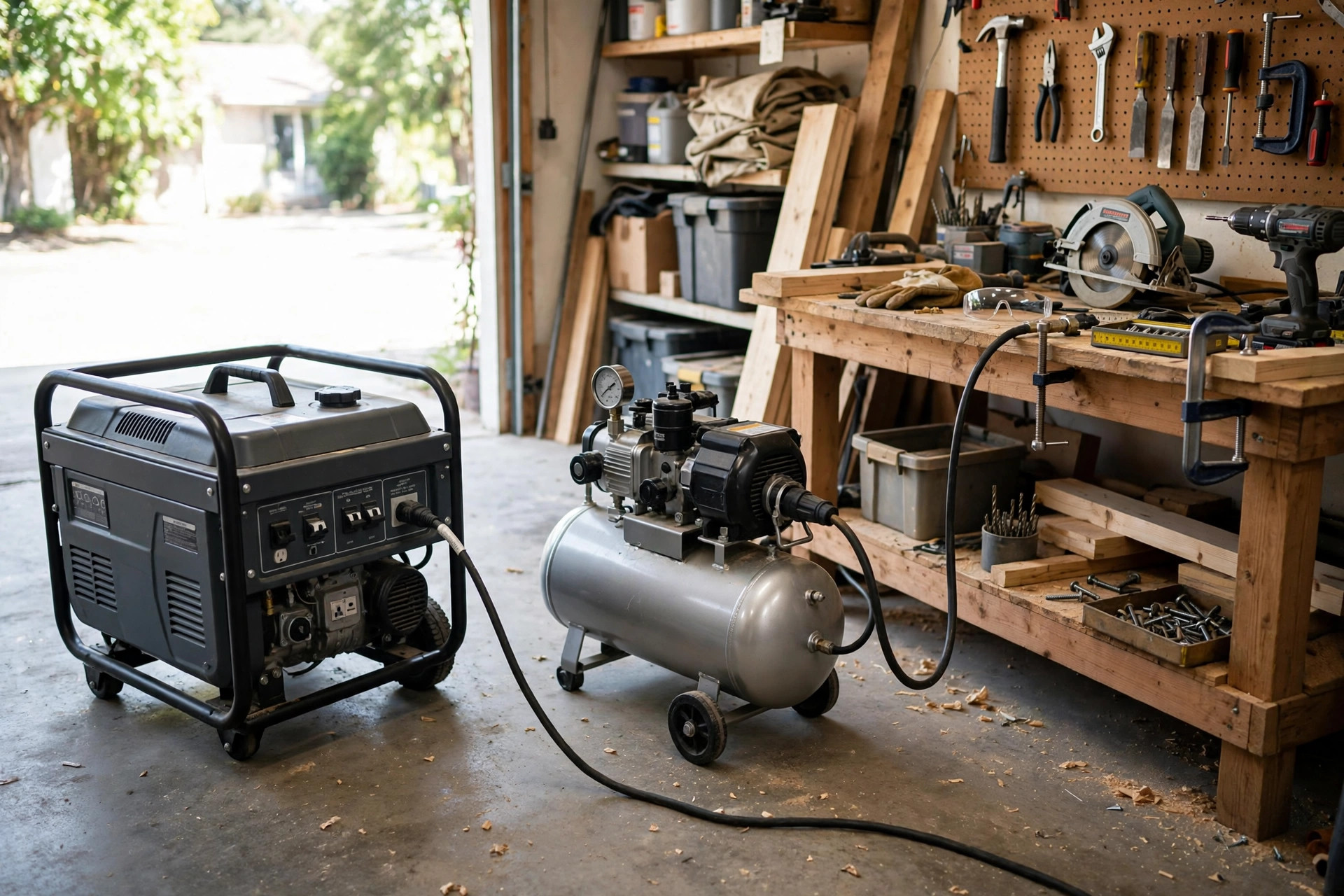
Here’s what actually works for tools in 2027, from job-site portables to full shop power.
Key takeaways
- Size for starting surge, not running watts — tools surge 1.5–3× their running draw. A 1,800W table saw needs ~3,000W of surge capacity.
- The Generac GP8000E (10,000 surge / 8,000 running watts) is the best all-around tool generator: proven, available everywhere, and priced fairly.
- Welders and big compressors need 10,000+ watts — step up to a 12kW-class unit like the DuroMax XP12000EH or Pulsar G12KBN.
- For tools with electronic controls (soft-start saws, inverter welders), cleaner power matters — consider an inverter or a line conditioner.
Quick picks: Best all-around — Generac GP8000E. Best 12kW workhorse — DuroMax XP12000EH. Best for welders — Champion 15,000W Tri-Fuel. Best value 12kW — Pulsar G12KBN. Best budget — A-iPower SUA12000E.
What your tools actually draw
Before the picks, the numbers that drive every recommendation below. These are typical draws — check your tool’s nameplate for exact figures:
| Tool | Running W | Starting surge | Notes |
|---|---|---|---|
| Circular saw | 1,400 | 2,300 | Repeated surges per cut |
| Miter saw | 1,800 | 2,400 | Big inrush on trigger pull |
| Table saw | 1,800 | 3,000 | Hardest common saw to start |
| Air compressor (2 HP) | 1,500 | 4,500 | Cycles all day — brutal |
| Angle grinder | 1,500 | 2,000 | Steady once running |
| MIG welder (140A) | 5,000 | 7,000 | Needs 240V, long duty |
Best all-around
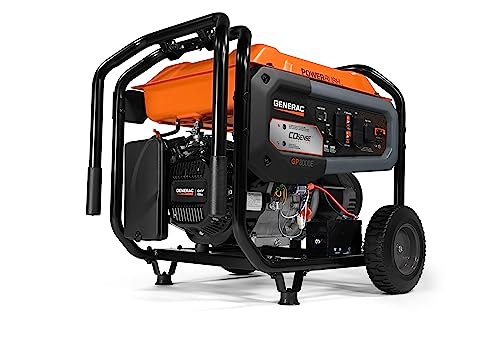
Generac GP8000E Portable Generator
- Running Watts: 8,000
- Runtime: Up to 11 hours at 50% load
- Noise Level: ~72 dB
- Weight: 214 lbs
As an Amazon Associate, we earn from qualifying purchases.
The GP8000E is the default job-site generator for a reason: 10,000 surge / 8,000 running watts from a 439cc Generac engine, electric start, and a frame that’s survived a million truck beds. It’ll run a table saw and a miter saw simultaneously, handle a 2 HP compressor’s 4,500-watt starting surge without drama, and the 7.9-gallon tank gives you a full workday at moderate load.
Generac’s current GP8000E includes COsense carbon monoxide shutdown, and parts availability is excellent — every Generac dealer stocks filters and common parts. At roughly $1,000–$1,300, it’s the price-performance anchor of this category.
Pros
- 10,000W surge handles the hardest tool starts
- Proven job-site durability
- Excellent parts and dealer support
- COsense safety shutdown
Cons
- Gasoline only
- Loud — it’s a job-site machine
- Conventional power (fine for tools, not for sensitive electronics)
Best 12kW workhorse
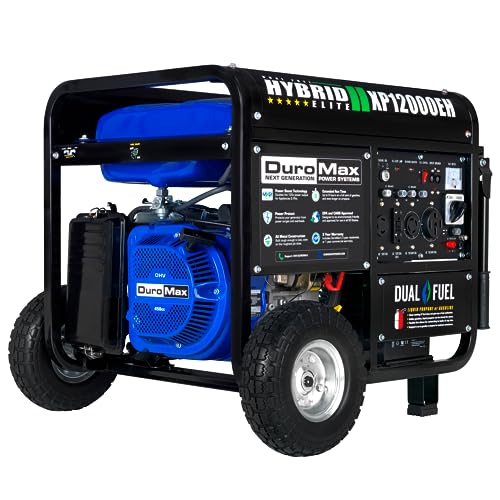
DuroMax XP12000EH Dual Fuel Generator
- Running Watts: 9,500
- Runtime: 8 hours at 50% load (gasoline, 8.3-gal tank)
- Noise Level: 74 dB
- Weight: 224 lbs
As an Amazon Associate, we earn from qualifying purchases.
When 8,000 watts isn’t enough — you’re running a welder, or three tools plus a compressor — the XP12000EH steps up with 12,000 surge / 9,500 running watts. The dual-fuel capability is genuinely useful on a job site: propane cylinders don’t spill in the truck, don’t go stale between jobs, and the generator sips from them cleanly. The MX2 switch is a nice touch — it lets you pull full power through the 120V outlets when you’re not using 240V, which is exactly the workshop scenario.
At 74 dB and 224 pounds it’s a loud, heavy machine. But for a shop or a serious job site, it’s the most watts per dollar with a real warranty (3 years).
Pros
- 12,000W surge for welders and big compressors
- Dual fuel — propane is ideal for job sites
- MX2 switch maximizes 120V power
Cons
- Loud and heavy
- Overkill (and thirsty) for light tool use
Best for welders
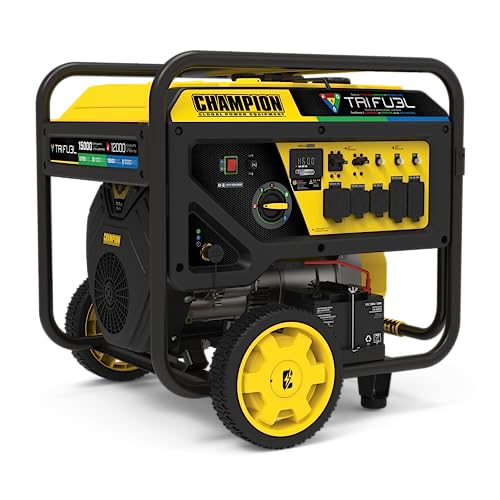
Champion 15,000-Watt Tri-Fuel Generator with CO Shield
- Running Watts: 12,000
- Runtime: Up to 9 hours at 50% load (gasoline)
- Noise Level: 78 dB
- Weight: 347 lbs
As an Amazon Associate, we earn from qualifying purchases.
Welding is the toughest common generator load: a 140-amp MIG pulls 5,000+ watts continuously with spiky demand, and it needs clean-ish 240V. The Champion’s 717cc V-twin delivers 15,000 surge / 12,000 running watts — enough to weld and run a grinder at the same time. The tri-fuel setup means you can plumb shop propane or natural gas and never haul fuel again.
This is a shop machine, not a portable one, at 347 pounds and 78 dB. But if welding is the job, nothing smaller does it comfortably.
Pros
- 12,000 running watts — welds comfortably
- V-twin runs smoother under sustained load
- Tri-fuel for shop use
Cons
- 347 lbs — not really portable
- 78 dB
- More generator than most need
Best value 12kW
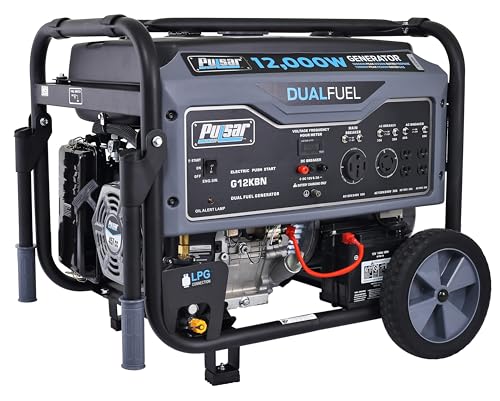
Pulsar G12KBN Dual Fuel Generator
- Running Watts: 9,500
- Runtime: Up to 12 hours at 50% load (8-gal tank)
- Noise Level: ~74 dB
- Weight: 214 lbs
As an Amazon Associate, we earn from qualifying purchases.
The Pulsar G12KBN is the budget way into 12kW-class power: 12,000 surge / 9,500 running watts, dual fuel, electric start, and a full outlet panel including a 50-amp receptacle — typically several hundred dollars less than the DuroMax equivalent. The 8-gallon tank stretches to 12 hours at half load, which is a genuine advantage for long workdays.
Pulsar doesn’t have DuroMax’s dealer network or warranty reputation, so this is the pick for buyers who maintain their own equipment and want maximum watts per dollar. For a detailed comparison of the 12kW class, see our best 12,000-watt generators roundup.
Pros
- Best price in the 12kW class
- 12-hour runtime at half load
- Full outlet panel with 50A receptacle
Cons
- Thinner dealer/support network
- Loud, like all conventionals this size
Best budget
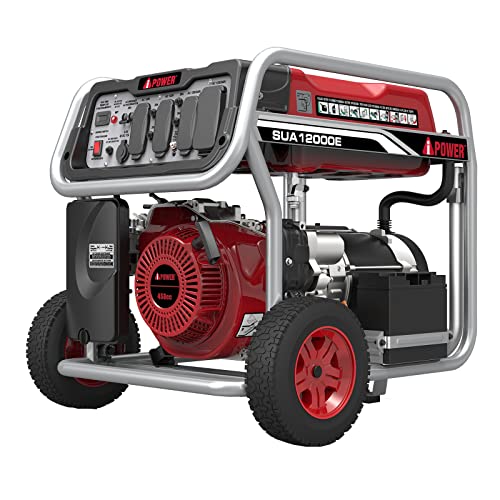
A-iPower SUA12000E Portable Generator
- Running Watts: 9,000
- Runtime: ~9 hours at 50% load (7-gal tank)
- Noise Level: ~76 dB
- Weight: ~210 lbs
As an Amazon Associate, we earn from qualifying purchases.
A-iPower’s SUA12000E is the cheapest path to serious tool power: 12,000 surge / 9,000 running watts from a 459cc engine, electric start, and a 7-gallon tank good for about 9 hours at half load. It won’t win refinement awards, but for a workshop or barn where the generator lives in the corner and just works, the value is hard to argue with.
Pros
- Lowest price for 12kW-class surge
- Electric start
- Decent runtime
Cons
- Gasoline only
- Basic feature set, limited support network
| Generator | Running W | Fuel | Noise | Best for |
|---|---|---|---|---|
| Generac GP8000E | 8,000 | Gas | ~72 dB | Best all-around |
| DuroMax XP12000EH | 9,500 | Dual fuel | 74 dB | 12kW workhorse |
| Champion 15kW tri-fuel | 12,000 | Tri-fuel | 78 dB | Welders |
| Pulsar G12KBN | 9,500 | Dual fuel | ~74 dB | Value 12kW |
| A-iPower SUA12000E | 9,000 | Gas | ~76 dB | Budget |
How to choose a generator for power tools
Size for surge, then add 20%
Add up the running watts of everything you’ll use simultaneously, then add the largest single starting surge on top. Example: table saw (1,800W running) + shop vac (1,200W) + work light (200W) = 3,200W running, plus the table saw’s 3,000W starting surge. You need a generator with at least 6,200W of surge capacity — and I’d buy 7,500+ for headroom. Undersized generators don’t just trip breakers; they sag voltage, and low voltage is what burns up tool motors.
Get 240V if you weld or run big motors
Welders, 5 HP compressors, and large table saws often need 240V. Every generator on this list delivers 120/240V. Smaller inverters usually don’t — check before you buy if 240V tools are in your future.
THD matters for electronic tools
Old-school brushed-motor tools don’t care about power quality. But soft-start circular saws, variable-speed tools with electronic controls, inverter welders, and battery chargers do — they want clean power under ~5% THD. Conventional generators run 6–9% THD or worse under load. If your tools have circuit boards, either buy an inverter generator or run them through a line conditioner. Our inverter generator roundup covers the clean-power options.
GFCI protection on job sites
OSHA requires GFCI protection for construction site power. Many modern generators include GFCI outlets — the DuroMax and Champion units here do. If yours doesn’t, use an inline GFCI adapter. It’s a $30 part that prevents the accident.
Runtime math for workdays
Tools cycle — a saw runs seconds at a time, a compressor cycles minutes on and off. Real-world “50% load” on a job site usually means 6–10 hours from a 7–8 gallon tank. For all-day remote work without refueling, prioritize tank size: the Pulsar’s 8 gallons and 12-hour rating is the standout here.
What size generator do I need for power tools?
Can I run a welder off a portable generator?
Will a regular generator damage my power tools?
Is dual fuel worth it for a job-site generator?
How long will a generator run power tools on a tank?
Our verdict
For most tool users, the Generac GP8000E hits the sweet spot — 10,000 watts of surge, proven reliability, fair price. Step up to the DuroMax XP12000EH or Pulsar G12KBN when welders and big compressors enter the picture. And whatever you buy, size for the surge, not the running watts — that’s the mistake that costs people a second generator.
Three real setups: from weekend warrior to welding rig
The weekend DIYer: circular saw (1,400/2,300W), drill chargers, work light, radio. Peak simultaneous draw is really one saw plus incidentals — under 3,000W surge. Honestly, a 3,500-watt-class generator covers this; our 3,500-watt roundup has quieter, cheaper options. Buy the GP8000E here only if you’re growing into bigger tools.
The serious workshop: table saw (1,800/3,000W) + dust collector (1,200/2,000W) + shop lights (300W) + occasional air compressor cycling (1,500/4,500W). Running total with the saw and dust collector: 3,300W; add the compressor’s 4,500W starting surge on top and you need ~7,800W of surge capacity. The Generac GP8000E (10,000W surge) handles this with comfortable headroom — this is exactly the use case it was built for.
The welding and fabrication setup: 140A MIG welder (5,000W+ continuous, spiky) + angle grinder (1,500W) + lights (300W). The welder alone wants a 9,500W+ continuous rating for comfortable all-day use, and 240V is mandatory. This is DuroMax XP12000EH or Champion 15kW territory. Undersize the generator and the welder’s arc goes unstable every time the grinder kicks on — maddening and bad for weld quality. When in doubt, the bigger generator welds better.
Extension cords: the overlooked bottleneck
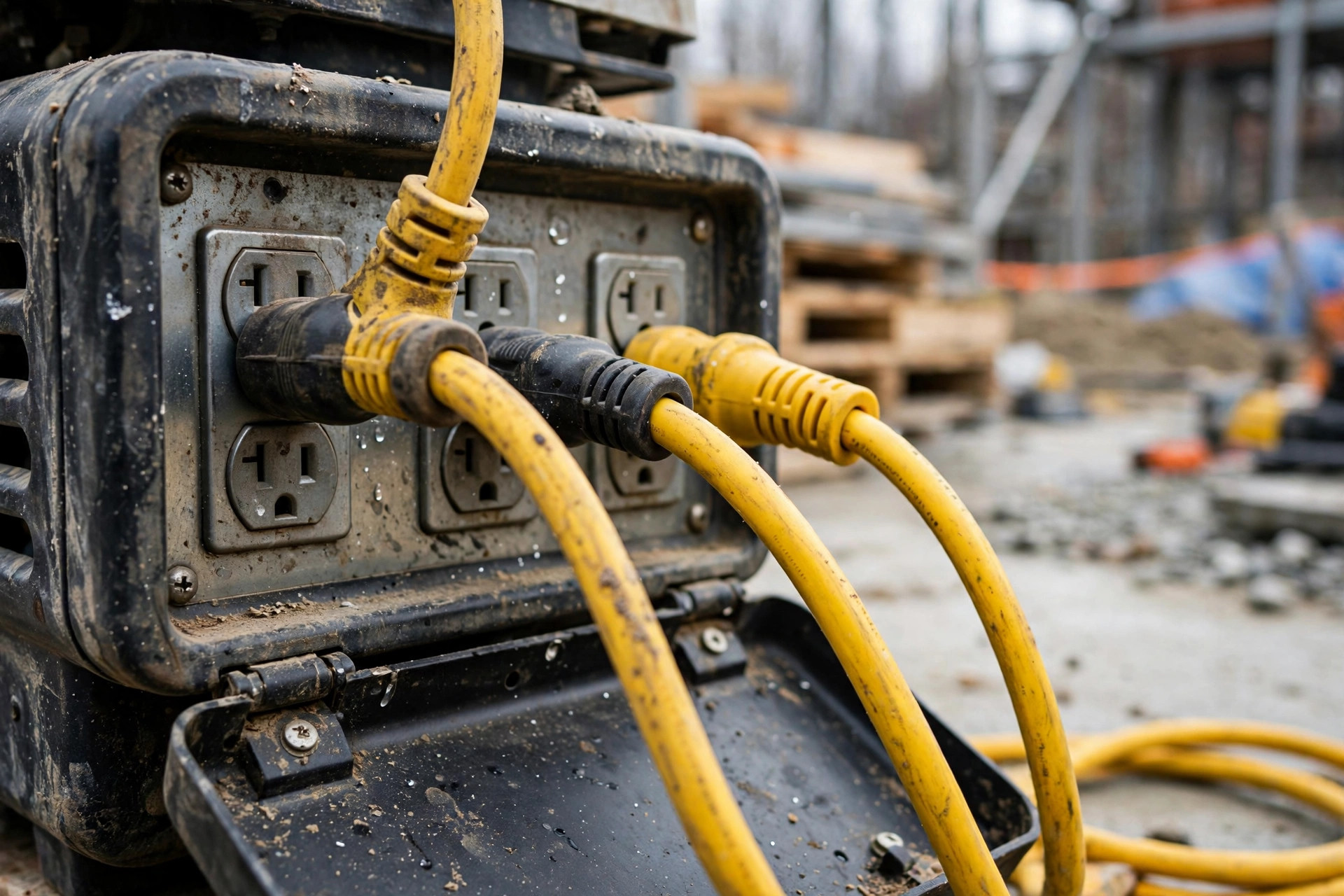
Here’s the failure I see constantly: a properly sized generator, quality tools, and a $25 orange extension cord strangling the whole setup. Voltage drop over a long, thin cord is real — a 100-foot 16-gauge cord running a 15-amp saw drops 6+ volts, which means the motor runs hot, the saw bogs down, and you blame the generator. The fix is simple: for tools, use 12-gauge cords up to 100 feet, 10-gauge beyond that, and keep runs as short as possible. A 50-foot 12-gauge cord costs $40–$60 and eliminates the problem entirely.
Also, plug the biggest tool directly into the generator’s 20-amp or 30-amp outlet — not into a power strip, not daisy-chained through two cords. Generator outlets are individually breaker-protected for a reason. And if you’re running 240V tools, you need a proper 240V cord (L14-30 or 14-50 ends) — adapting down to 120V cords with cheater adapters defeats the grounding and the breaker’s protection. The cord is part of the power system; size it like one.
Bonded vs. floating neutral: the job-site grounding question
One more thing that trips up tool users: most portable generators ship with a floating neutral, which is correct for connecting to a house through a transfer switch (the house provides the ground bond). But OSHA job-site rules generally want a bonded neutral with a ground rod when the generator is the standalone power source for tools. Some generators have a simple bonding plug or switch to convert between the two — check your manual. Running a floating-neutral generator as a standalone job-site source without proper grounding won’t trip a breaker on a ground fault the way it should. It’s an easy detail to get wrong and a genuinely important one: a ground fault through a worker is the accident this rule exists to prevent. When in doubt, drive a ground rod and bond it — $20 of copper-clad steel and ten minutes.
Dust, rain, and real job-site conditions
Job sites are brutal on generators in ways spec sheets ignore. Dust clogs air filters fast — on a dry construction site, check the filter weekly, not monthly, and keep a spare on hand. Rain is the other killer: generators and water don’t mix, but work doesn’t stop for drizzle. A simple generator tent or a plywood lean-to keeps rain off while maintaining airflow — never enclose it tightly, and never run it where exhaust can pool. And secure it: job-site generator theft is rampant. Chain it to the trailer or a ground anchor every night, and consider a model with an hour meter so you can spot unauthorized use. The generators on this list are tools, not jewelry — but they’re expensive tools, and they walk away.
How we researched this: Manufacturer specifications, tool manufacturer wattage data, and NEC motor-load sizing principles. Surge figures are typical values — always check your specific tool’s nameplate. We did not bench-test these units.

Related Guides
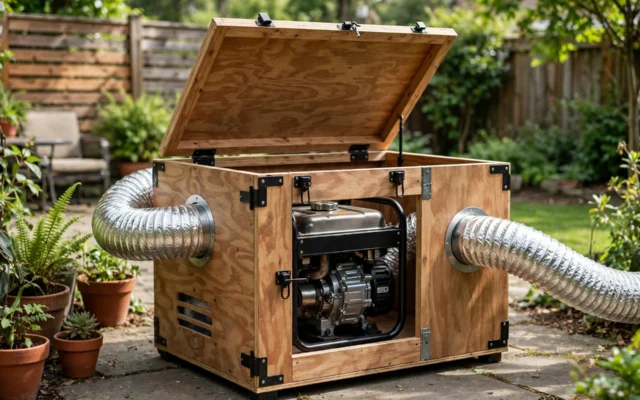
DIY Generator Quiet Box: How to Build a Noise-Reduction Enclosure
A DIY generator quiet box can cut noise 10–20 dB — but ventilation and CO safety are the whole project. Materials, baffle design, fan sizing, and the mistakes to avoid.

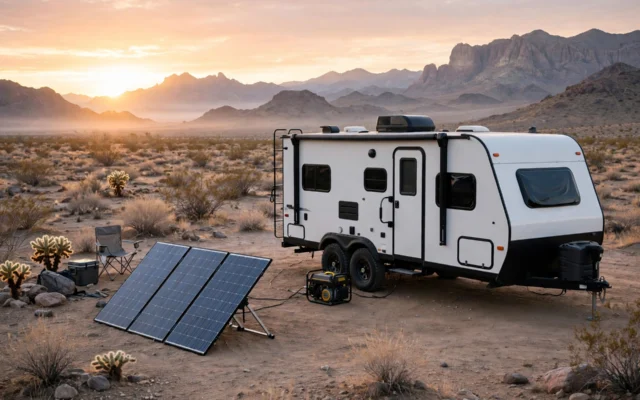
Boondocking Power Setup: Generator + Solar for Off-Grid Camping
The ideal boondocking power setup pairs solar with a generator and battery bank. Real daily load math, sizing tiers, and the generator run strategy that sips fuel.
RV Generator Quiet Hours & Campground Etiquette Guide
RV generator quiet hours are usually 10pm–8am, with limited daytime generator windows in national parks. The rules, the unwritten etiquette, and how to stay neighborly.
1 Comment