


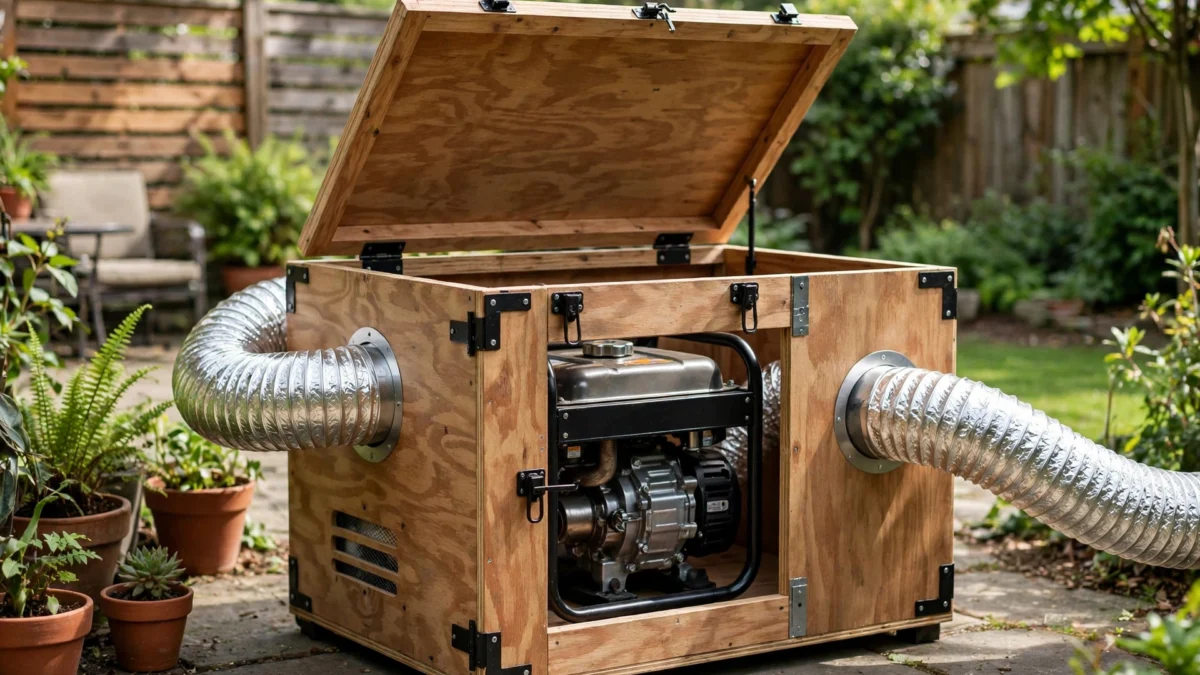
A well-built DIY generator quiet box cuts noise by roughly 10–20 decibels — the difference between “lawnmower next door” and “distant hum.” But here’s the truth most YouTube builds gloss over: the box is the easy part. Ventilation and carbon monoxide safety are the actual project, and getting them wrong can destroy your generator — or worse.
I’ve studied dozens of owner builds, from clever plywood doghouses to over-engineered enclosures with thermostatic kill switches. Here’s what actually works, what to buy, and the safety rules that are non-negotiable.
Key takeaways
- Expect 10–20 dB of reduction — a 65 dB generator becomes a 45–55 dB murmur. It won’t make it silent.
- Heat kills generators: you need dedicated intake AND exhaust airflow, ideally with a powered fan.
- CO kills people: never seal the box, always pipe exhaust outside and away, keep the box 20+ feet from occupied spaces.
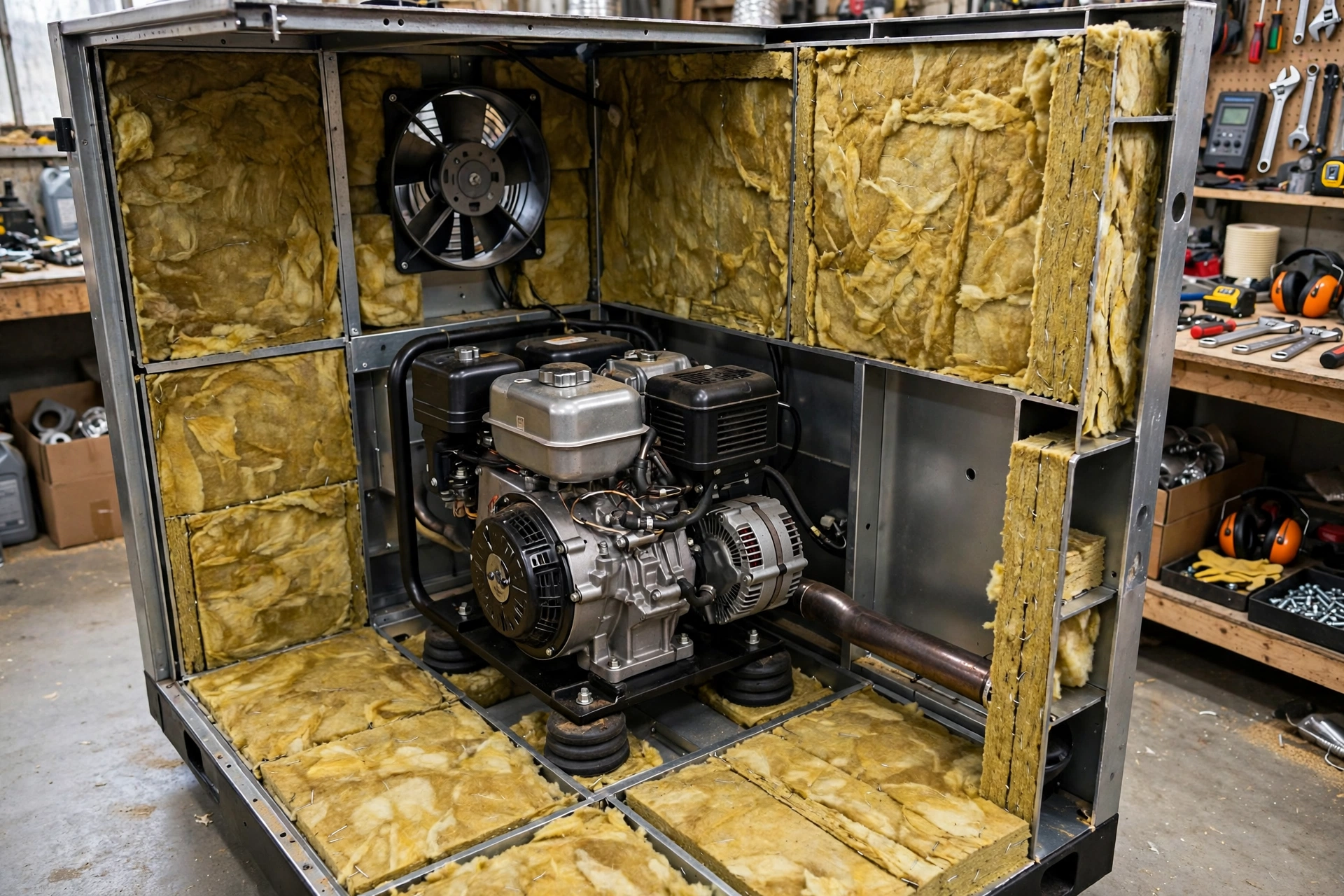
- Best materials: 3/4″ plywood shell + rockwool (fire-rated) or mass-loaded vinyl. Avoid plain foam as the only liner.
- Most noise comes from the engine block and cooling fan, not the muffler — the box must enclose everything.
Set Expectations First: What a Box Can and Can’t Do
Decibels are logarithmic: a 10 dB drop sounds roughly half as loud to human ears, and 20 dB is about one-quarter. So a typical 68 dB open-frame generator in a good box reads ~50 dB at the same distance — genuinely transformative for a campsite or a neighborhood during an outage.
What it won’t do: make a generator silent, or make it quieter than a purpose-built inverter generator. If you’re starting from scratch and noise is the priority, buying a quiet inverter (48–59 dB out of the box) beats building an enclosure around a loud one. The quiet box is for people who already own a louder unit and need it tamed.
One more reality check from experienced builders: most of the noise isn’t the exhaust. The engine’s mechanical clatter, the cooling fan, and panel vibration contribute as much as the muffler. That’s why the whole generator goes inside the box — half-measures like muffler extensions alone disappoint.
Materials: What to Buy
| Material | Purpose | Notes |
|---|---|---|
| 3/4″ plywood or OSB | Shell / mass barrier | Mass blocks sound; heavier is better. Avoid thin paneling. |
| Rockwool (mineral wool) batts | Interior absorption | Fire-rated to 2000°F+, absorbs sound far better than fiberglass. The top pick. |
| Mass-loaded vinyl (MLV) | Extra barrier layer | Optional; 1 lb/sq ft vinyl between plywood layers adds serious blocking. |
| HVAC duct liner | Alternative absorber | Dense fiberglass board from HVAC suppliers; good absorption, handle with gloves/mask. |
| 4″ inline duct fan (AC Infinity style) | Forced ventilation | The single most important purchase. Size for strong airflow. |
| Flexible dryer duct, 4″ | Intake/exhaust routing | Metal preferred near the exhaust; keep runs short. |
| Steel exhaust extension pipe | Exhaust outlet | Route engine exhaust fully outside the box — never vent exhaust into the enclosure. |
| Hinges, latches, weatherstripping | Access lid | You need tool-free access for fuel, oil, and the pull cord. |
What not to use: egg-crate foam or packing foam as the primary liner (it’s a fire accelerant next to a hot engine), thin luan paneling (no mass = no blocking), and anything that off-gasses when hot.
The Build: Step by Step
Step 1: Size the box generously
Measure your generator, then add at least 6 inches of clearance on every side — 8–12 inches is better. Cramped boxes overheat; airspace is insulation and cooling volume. For a typical 3,500W portable, you’re building roughly a 3×2.5×2.5 ft box. Bigger than you think. That’s fine.
Step 2: Build the shell double-layer
Frame with 2×2s, skin with 3/4″ plywood. If you want maximum blocking, add a layer of mass-loaded vinyl or a second plywood skin with Green Glue between. Seal every seam with acoustic caulk — sound leaks through gaps like water. The lid should be hinged and gasketed with weatherstripping, latching tight.
Step 3: Line the interior (but not airtight)
Cover interior walls with rockwool batts or duct liner, held in place with wire mesh or perforated hardboard so fibers stay put. Leave the floor unlined or use a thin rubber mat — you want the generator’s own vibration isolated, and a solid floor makes fuel spills manageable. Set the generator on rubber isolation pads to kill structure-borne vibration.
Step 4: Ventilation — the critical engineering
This is where builds succeed or fail. You need two separate air paths:
- Cooling air intake: low on one end of the box, sized generously (a 4″ duct minimum; bigger for larger generators). Route it through a 90° baffle elbow — an L-shaped duct section lined with rockwool. Sound travels line-of-sight; the elbow forces it to bounce through absorption instead of escaping straight out.
- Hot air exhaust: high on the opposite end (heat rises), pulled by the inline duct fan blowing outward. Also routed through a baffled elbow. The fan should move serious air — builders who started with small computer fans invariably upgraded to 100+ CFM inline fans after temperature testing.
- Engine exhaust: a separate path. Extend the generator’s exhaust with steel pipe straight out through the box wall, sealed with a high-temp grommet, discharging outside and away from the intake. Never let engine exhaust mix with cooling air inside the box — it recirculates CO into the intake and chokes combustion.
Test with a thermometer: run the generator at your typical load for an hour and check the air temperature inside the box. If it’s climbing past ~140°F (60°C) at the hottest point, you need more airflow. Several serious builders add a thermostatic kill switch wired to the generator’s ignition — if the fan fails and temps spike, it shuts the engine down automatically. Cheap insurance.
Step 5: Access and usability
You’ll open this box constantly — fuel, oil checks, choke, pull start. Design a large hinged lid or removable panel before you seal everything up. Route the power cord out through a grommeted hole. If your generator has electric start, even better: add a remote start switch on the outside.
Placement and CO Safety (Non-Negotiable)
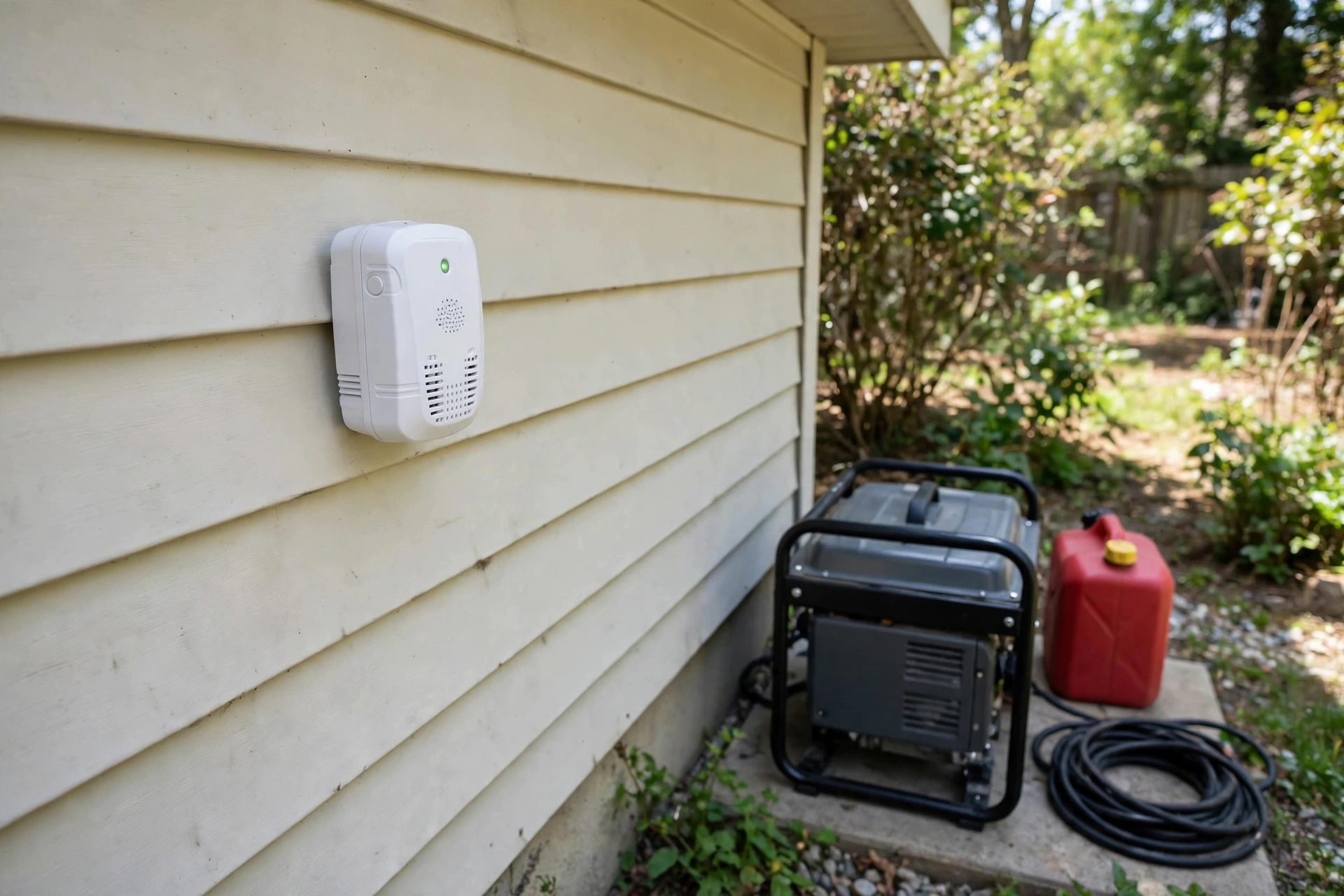
- 20+ feet from any occupied structure, per CPSC guidance — the box doesn’t change this. Exhaust pointed away from the house, windows, doors, and the air intake of the box itself.
- Never in a garage, basement, shed, or under a deck — even with the “box.” An enclosure is not a ventilated room.
- Put a battery CO detector on the house wall nearest the generator and one inside the home. They’re $25 and they save lives.
- Never run it while sleeping unless the setup is professionally designed with automatic CO shutdown. The skoolie/bus converters who do this seriously wire redundant fans, temperature kill switches, and CO-triggered shutdowns — and still treat it with deep respect.
- Keep it away from the neighbor’s windows too. Your quiet box doesn’t give you the right to park exhaust 10 feet from their bedroom.
Our generator size calculator can also help you check whether a smaller, inherently quieter generator would eliminate the need for a box entirely — sometimes the right answer is a different machine, not a carpentry project.
Common Mistakes That Ruin Builds
- Sealing it too tight. The #1 killer — of generators. If there’s no powered exhaust fan and generous intake, you’re building an oven.
- Undersized vents. Small holes whistle (new noise!) and starve the engine. When in doubt, go bigger and baffle it.
- Foam-only lining. Closed-cell foam reflects low-frequency rumble instead of absorbing it, and it’s a fire risk. Rockwool or duct liner.
- Forgetting the intake air. Builders obsess over the exhaust fan and forget the engine needs combustion air too. Both paths matter.
- No temperature testing. “Feels fine” isn’t data. A $15 thermometer probe inside the box during a full-load hour-long run is the difference between confidence and hope.
- Blocking service access. If checking the oil requires disassembly, you’ll skip it — and the generator will die young.
Frequently Asked Questions
How much quieter will a DIY generator box make it?
Can I just put my generator in a box without ventilation holes?
What’s the best soundproofing material for a generator box?
Is it safe to run a generator in a quiet box overnight?
Should I build a quiet box or just buy a quieter generator?
Bottom Line
A DIY quiet box is a genuinely effective project — 10–20 dB quieter for a weekend of carpentry and ~$150–300 in materials. But the box is only 30% of the job. Ventilation engineering and CO discipline are the other 70%: powered exhaust, baffled intake, a separate exhaust outlet, temperature testing, and the 20-foot rule. Build all of it, or buy the quiet inverter instead. For more ways to tame generator noise without construction, see our generator guides and calculators.

Related Guides
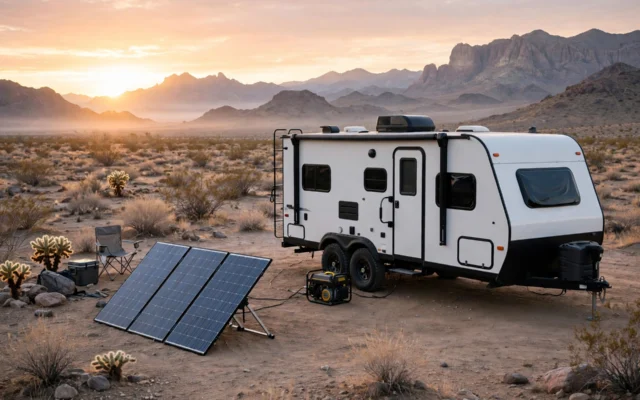
Boondocking Power Setup: Generator + Solar for Off-Grid Camping
The ideal boondocking power setup pairs solar with a generator and battery bank. Real daily load math, sizing tiers, and the generator run strategy that sips fuel.

RV Generator Quiet Hours & Campground Etiquette Guide
RV generator quiet hours are usually 10pm–8am, with limited daytime generator windows in national parks. The rules, the unwritten etiquette, and how to stay neighborly.

Best Generators for Power Tools & Workshops in 2027
Best generators for power tools in 2027: 5 workhorses compared with real surge specs. Sizing for saws, compressors, welders — surge watts matter most.