


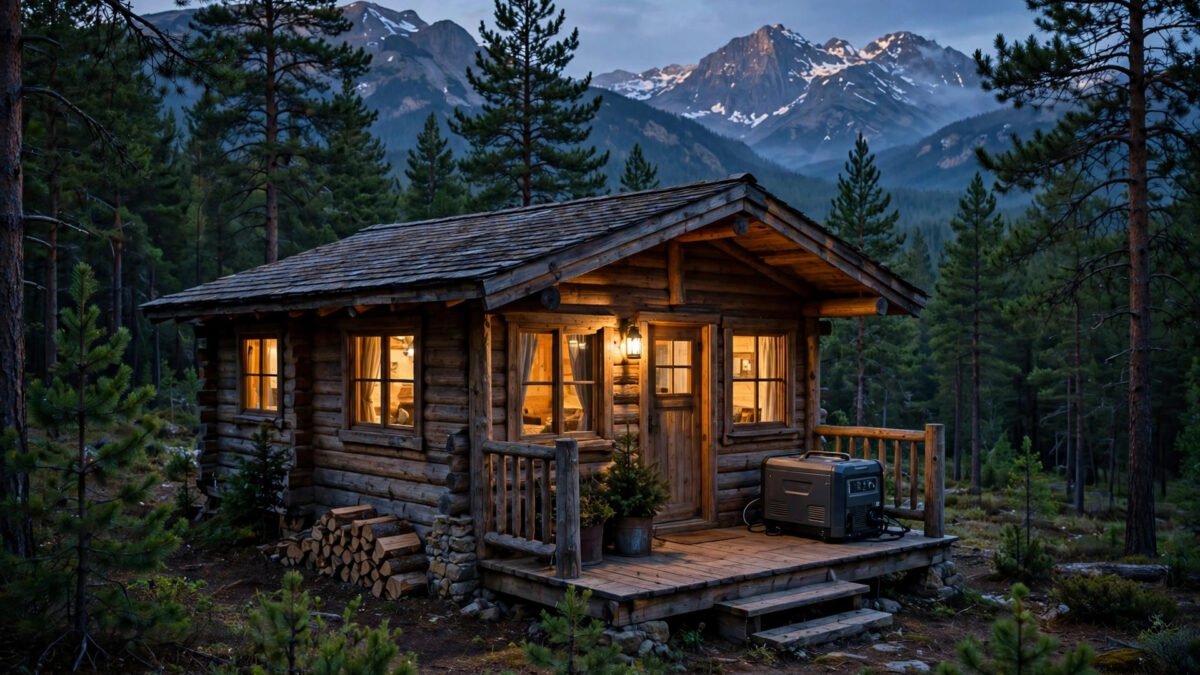
An off-grid cabin has different power needs than a suburban house, and most generator roundups get this wrong. You’re not backing up a grid connection — the generator is the grid, or at least the backup for your solar. It might sit unused for three months, then run 10 hours a day for a week. Fuel has to survive storage. Noise carries across a quiet lake. And whatever you buy has to survive being hauled down a dirt road.
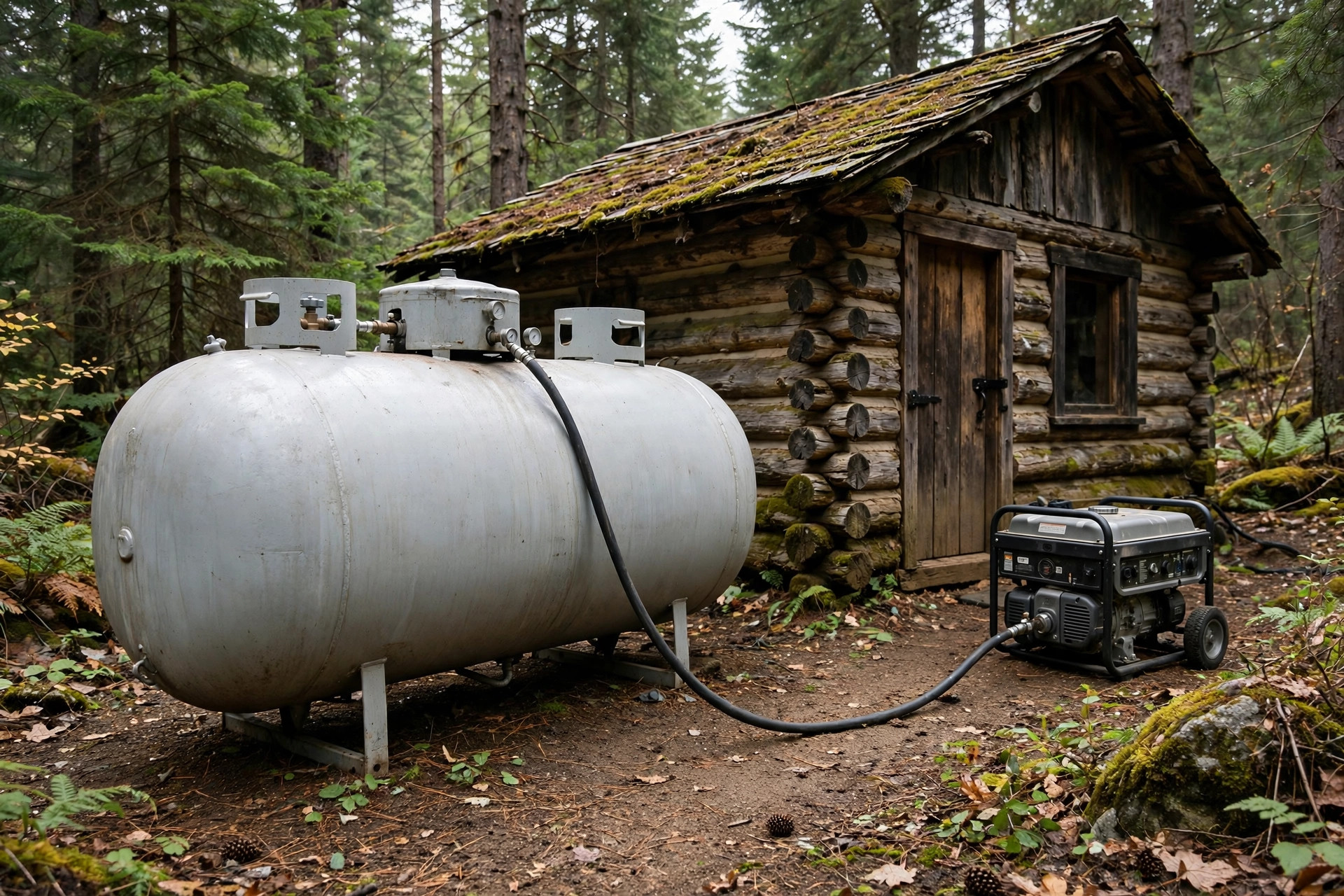
I’ve spent a lot of time thinking about this use case because it punishes the wrong choice harder than any other. A gasoline-only generator with a carburetor is the worst possible pick for a cabin you visit monthly — the fuel goes stale, the carb gums up, and it won’t start when you arrive on a Friday night in January. The right answer, for most cabins, is propane: it never goes stale, it burns clean, and a big tank means months of autonomy.
Here’s my shortlist for 2027, built around that reality.
Key takeaways
- For cabins, propane or tri-fuel beats gasoline-only — propane stores indefinitely and won’t gum up a carburetor between visits.
- The Honda EU7000iS is the best premium cabin generator: quiet, fuel-injected, sips fuel, and runs everything including a small A/C or well pump.
- On a budget, a tri-fuel conventional generator (DuroMax XP13000HXT or Champion 15kW) on a big propane tank is the most practical whole-cabin solution.
- The smartest setup is hybrid: solar + batteries for daily loads, generator as backup that runs a few hours to recharge — a generator alone gets expensive fast.
Quick picks: Best overall — Honda EU7000iS. Best whole-cabin tri-fuel — Champion 15,000W Tri-Fuel. Best tri-fuel value — DuroMax XP13000HXT. Best small and quiet — Honda EU3200i. Best budget — Generac iQ3500.
Best overall
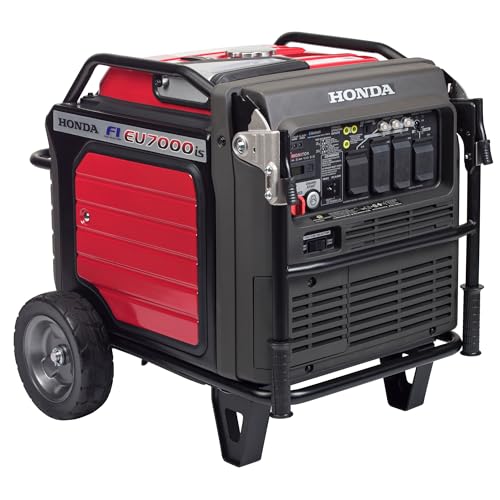
Honda EU7000iS Inverter Generator
- Running Watts: 5,500
- Runtime: Up to 16 hours (light load)
- Noise Level: 52–58 dB
- Weight: ~270 lbs
As an Amazon Associate, we earn from qualifying purchases.
For a cabin you actually live in part-time, the EU7000iS is worth the ~$5,000. Here’s why it fits this use case so well: fuel injection means it starts after sitting for two months without carburetor drama — the number-one cabin generator failure. At 52–58 dB it won’t ruin the reason you bought a cabin in the woods. And 5,500 running watts with 240V output handles a well pump, a small mini-split, the fridge, lights, and Starlink without breaking a sweat.
The fuel economy matters more at a cabin than anywhere else, because every gallon has to be hauled in. Up to 16 hours per 5.1-gallon tank at light load means a weekend of normal use on a single fill. Read our full Honda EU7000iS review for the deep dive.
Pros
- Fuel injection — reliable starts after long storage
- Whisper-quiet; won’t disturb the woods
- 240V output for well pumps
- Excellent fuel economy — fewer fuel hauls
Cons
- ~$5,000 is steep
- Gasoline only — haul fuel in, stabilize it
- 270 lbs to get down the dirt road
Best whole-cabin tri-fuel
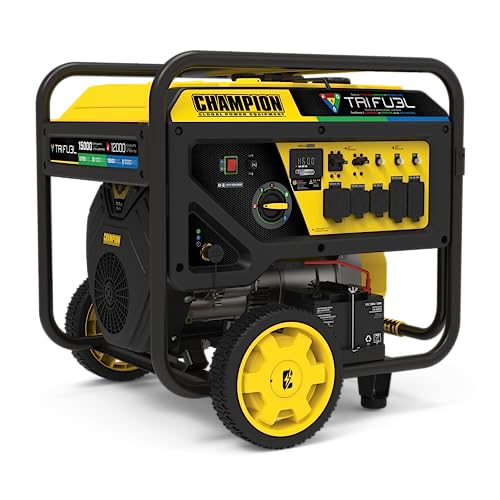
Champion 15,000-Watt Tri-Fuel Generator with CO Shield
- Running Watts: 12,000
- Runtime: Up to 9 hours at 50% load (gasoline); days on a large propane tank
- Noise Level: 78 dB
- Weight: 347 lbs
As an Amazon Associate, we earn from qualifying purchases.
If your cabin is really a second home — full kitchen, well, maybe a small A/C — and you have propane delivered, this is the practical answer. 15,000 peak / 12,000 running watts on a 717cc V-twin, running on gasoline, propane, or natural gas. Park a 250-gallon propane tank next to the cabin and you have weeks of runtime with zero fuel hauling and zero stale-fuel issues. Propane doesn’t degrade, ever.
The downsides are honest: 78 dB is loud, 347 pounds is a forklift job, and it’s conventional power — fine for the cabin’s appliances, but run sensitive electronics through a UPS or a small inverter. For a detailed breakdown of the tri-fuel approach, see our 12,000-watt generator roundup.
Pros
- Massive power — runs everything in a full-size cabin
- Tri-fuel; propane stores forever
- CO Shield safety shutdown
Cons
- Loud — needs distance from the cabin
- 347 lbs; delivery and placement is a project
- Thirsty on gasoline
Best tri-fuel value
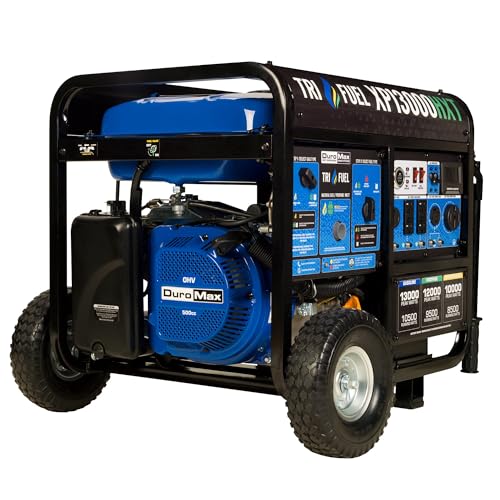
DuroMax XP13000HXT Tri-Fuel Generator
- Running Watts: 10,500
- Runtime: 8.5 hours at 50% load (gasoline)
- Noise Level: 74 dB
- Weight: 240 lbs
As an Amazon Associate, we earn from qualifying purchases.
The Champion above is the max-power answer; the DuroMax XP13000HXT is the value answer to the same question. 13,000 peak / 10,500 running watts, tri-fuel out of the box, CO Alert, remote start, and a 5-year warranty — typically several hundred dollars less than the Champion. For most cabins, 10,500 running watts is plenty; the Champion’s extra 1,500 watts only matters if you’re running a 5-ton A/C or a big shop.
Same cabin logic applies: put it on propane, and fuel storage stops being a chore. Our full XP13000HXT review covers the load math in detail.
Pros
- Tri-fuel flexibility at a value price
- 5-year warranty
- Remote start — great in bad weather
Cons
- 74 dB — loud for a quiet setting
- Conventional power, not inverter-clean
Best small and quiet
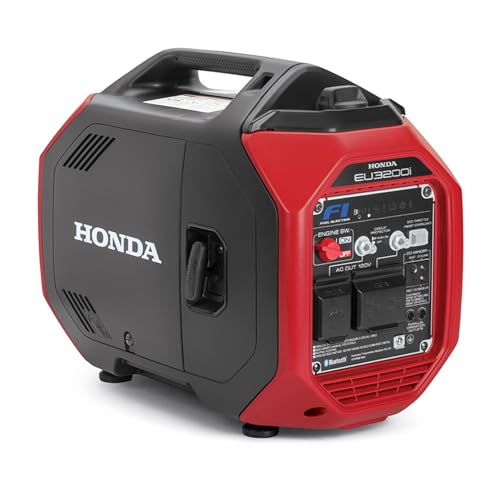
Honda EU3200i Inverter Generator
- Running Watts: 2,600
- Runtime: Up to 8.6 hours at quarter load
- Noise Level: 54–58 dB
- Weight: ~60 lbs
As an Amazon Associate, we earn from qualifying purchases.
Not every cabin needs 10,000 watts. If your cabin is a simple setup — lights, phone charging, a small fridge, Starlink, maybe a microwave — the EU3200i’s 2,600 running watts covers it at 54–58 dB, sipping fuel (up to 8.6 hours on a tank at quarter load). It’s fuel-injected like its big brother, so it starts reliably after sitting, and at ~60 pounds one person can carry it.
This is also the perfect companion generator: pair it with a big tri-fuel unit, run the big one for the well pump and heavy loads, and let the little Honda handle evenings. Your fuel budget will thank you.
Pros
- Quiet, light, fuel-injected
- Sips fuel — great for light cabin loads
- Clean inverter power for electronics
Cons
- 2,600 watts won’t run a well pump + more
- 120V only
- Premium price for the size
Best budget
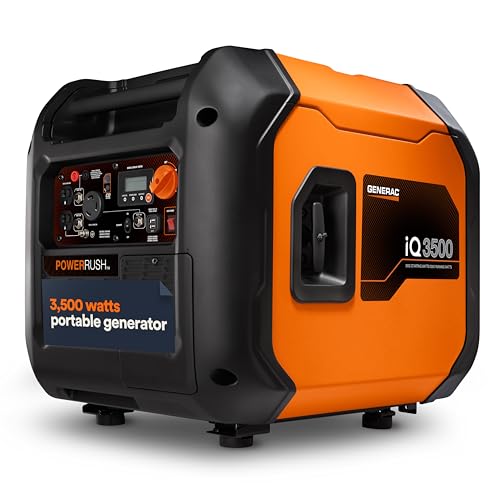
Generac iQ3500 Inverter Generator
- Running Watts: 3,000
- Runtime: Up to ~7 hours at 50% load
- Noise Level: ~50 dB (light load)
- Weight: 109 lbs
As an Amazon Associate, we earn from qualifying purchases.
The iQ3500 is the budget cabin pick: 3,000 running watts of quiet inverter power for roughly $1,300–$1,600. It’ll run the fridge, lights, chargers, and a small microwave — the core of simple cabin life — at noise levels that won’t carry across the lake. The catch for cabin use: it’s carbureted and gasoline-only, so you must stabilize the fuel and run it dry before leaving, or you’ll be rebuilding the carburetor in spring. Our fuel stabilizer guide is required reading if you go this route.
Pros
- Great price for quiet inverter power
- Electric start
- Light enough to move easily
Cons
- Carbureted — fuel maintenance is mandatory
- Gasoline only
- 120V only, no well pump
| Generator | Running W | Fuel | Noise | Best for |
|---|---|---|---|---|
| Honda EU7000iS | 5,500 | Gas (EFI) | 52–58 dB | Best overall |
| Champion 15kW tri-fuel | 12,000 | Tri-fuel | 78 dB | Big cabin on propane |
| DuroMax XP13000HXT | 10,500 | Tri-fuel | 74 dB | Tri-fuel value |
| Honda EU3200i | 2,600 | Gas (EFI) | 54–58 dB | Small/quiet |
| Generac iQ3500 | 3,000 | Gas | ~50 dB | Budget |
How to choose a cabin generator
Start with fuel: propane wins for cabins
Gasoline goes stale in 3–6 months and gums up carburetors — the exact failure mode of a cabin generator that sits between visits. Propane never degrades, burns cleaner (less maintenance), and a 100–250 gallon tank gives you weeks of autonomy. If propane delivery reaches your cabin, a tri-fuel or dual-fuel generator on propane is the single best decision you can make. If you’re stuck with gasoline, use fuel stabilizer religiously and consider a fuel-injected model (Honda’s EU series) that has no carburetor to gum up.
Size for your real loads, then add headroom
Walk through a typical cabin day and list the big loads: well pump (2,000W running, 4,000W surge), fridge (200W), freezer (150W), microwave (1,000W), mini-split (1,500W), Starlink + lights + chargers (300W). Most simple cabins land at 3,000–5,000 watts of realistic simultaneous load; full second-homes with A/C land at 8,000–12,000. Size to your 125% continuous-load number per NEC Article 702 thinking, and remember motor starting surges — the well pump’s 4,000W surge is what trips undersized generators.
Consider the hybrid setup: solar + generator
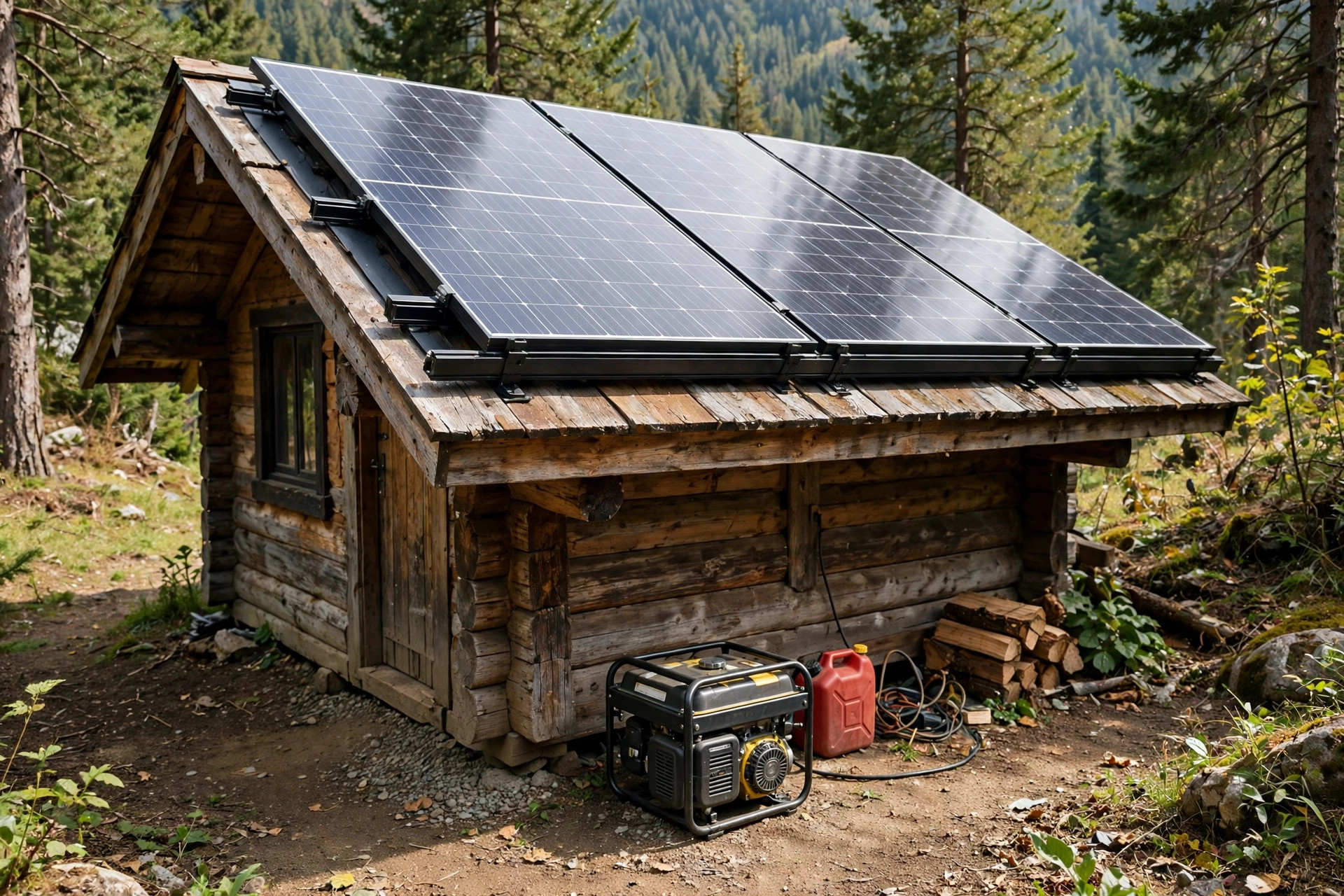
The cheapest kilowatt-hour at an off-grid cabin comes from solar panels, not a generator. A modest solar + battery setup handles lights, fridge, and electronics silently all day; the generator runs 2–3 hours in the evening to bulk-charge batteries and cover heavy loads. This cuts generator runtime (and fuel hauling) by 70–80%. Our solar generator guide covers the battery side. Even if you start generator-only, buy one with clean enough power to charge batteries later — any inverter model qualifies.
Noise and placement matter more in the woods
Sound carries over water and through quiet forest. A 74 dB conventional generator 50 feet from the cabin will be the soundtrack of your trip. If quiet matters — and at a cabin, it usually does — the premium for an inverter (50–58 dB) pays for itself in enjoyment. Whatever you buy, place it downwind, 20+ feet from sleeping areas, exhaust pointed away, and never in an enclosed shed without proper ventilation.
Plan for winter
Cold is hard on generators: batteries lose cranking power, oil thickens, and propane pressure drops in extreme cold (below -20°F, propane vaporization struggles — keep tanks reasonably full and consider a larger tank for surface area). A battery tender on electric-start models, 5W-30 synthetic oil, and a tested cold start before the season are cheap insurance.
What size generator do I need for an off-grid cabin?
Is propane or gasoline better for a cabin generator?
Can I run my cabin on a generator full-time?
How do I keep my cabin generator from being stolen?
Do I need an inverter generator for a cabin?
Our verdict
For most off-grid cabins in 2027: if you can swing it, the Honda EU7000iS on gasoline (fuel-injected, quiet, efficient) or a tri-fuel DuroMax/Champion on a big propane tank (no fuel worries, whole-cabin power). Pair either with solar down the road and you’ll have a power system that just works, visit after visit.
Sizing worksheet: a real cabin, two scenarios
Let me make this concrete with two cabins I see all the time.
Scenario A: the simple getaway. A one-room cabin with LED lights (100W), a mini fridge (150W running, 600W surge), phone/laptop charging and Starlink (150W), and a microwave used occasionally (1,000W). Realistic simultaneous load: about 1,400W. Any 3,000-watt-class generator handles this with huge headroom — the Generac iQ3500 or Honda EU3200i are perfect, sipping fuel at maybe 0.25 gallons per hour. A weekend runs on 5–8 gallons.
Scenario B: the second home. Full kitchen with fridge (200W) and freezer (150W), a well pump (2,000W running, 4,000W surge), a mini-split for heating/cooling (1,500W running, 2,500W surge), lights and electronics (500W), and a microwave (1,000W). Add the running watts: 200 + 150 + 2,000 + 1,500 + 500 = 4,350W running — but the well pump and mini-split surges mean you need 7,000–8,000W of surge capacity and enough continuous headroom that the pump starting doesn’t dim everything. This is Honda EU7000iS territory (5,500 running / 7,000 surge), or a 10–12kW tri-fuel unit if you want zero load management. The common mistake is buying Scenario A’s generator for Scenario B’s cabin and discovering the well pump trips it every time.
Do this worksheet with your actual appliances before buying. Check nameplates, add 25% headroom to the running total, and make sure the surge rating covers your biggest motor’s starting draw. An hour with a notepad beats a return shipment.
Cabin winterization checklist
If you close the cabin for winter, the generator needs 20 minutes of attention before you lock up. First, stabilize the fuel (or switch to propane — this is the strongest argument for tri-fuel at a seasonal cabin). Second, run the carburetor dry if it’s a carbureted model: shut the fuel valve and let the engine stall. Third, disconnect the battery or put it on a solar battery tender — a dead battery in spring is the second most common cabin generator failure after stale fuel. Fourth, change the oil if it’s due; old oil holds acids that etch bearings during storage. Fifth, cover the unit with a breathable cover (not a plastic tarp, which traps moisture) and stuff a rag in the exhaust outlet to keep mice out — rodents nesting in the air intake is absurdly common and chews up foam filters. Do this every fall and your generator will start every spring. Skip it and you’re gambling.
Theft: the cabin problem nobody warns you about
Generators get stolen from cabins — it’s one of the most commonly stolen items at remote properties, because they’re valuable, portable, and the thief knows nobody’s watching. The basics: chain it to something immovable with a hardened security chain (not a cable — cables cut in seconds), use a lockable ventilated enclosure bolted to a concrete pad, and don’t leave it visible from the road. For permanent installs, some owners pour a pad with anchor bolts and use tamper-resistant fasteners. A $40 trail camera pointed at the generator won’t stop a determined thief, but it’s cheap evidence and a decent deterrent. And record the serial number — without it, recovery is essentially impossible.
How we researched this: Spec comparison across manufacturers, off-grid forum discussions (solar and homesteading communities), and load-math modeling for typical cabin scenarios. We did not bench-test these units; runtime and suitability claims derive from published specs and aggregated owner reports.

Related Guides
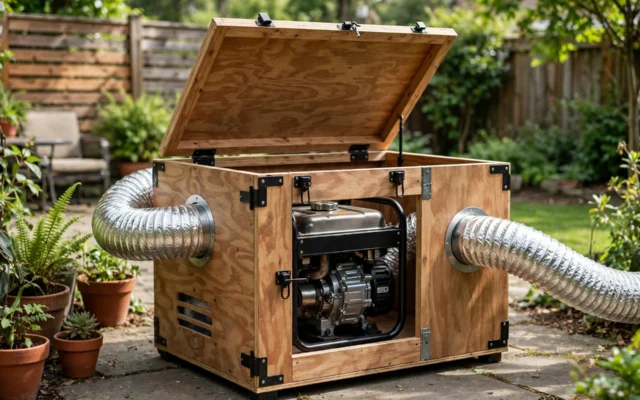
DIY Generator Quiet Box: How to Build a Noise-Reduction Enclosure
A DIY generator quiet box can cut noise 10–20 dB — but ventilation and CO safety are the whole project. Materials, baffle design, fan sizing, and the mistakes to avoid.

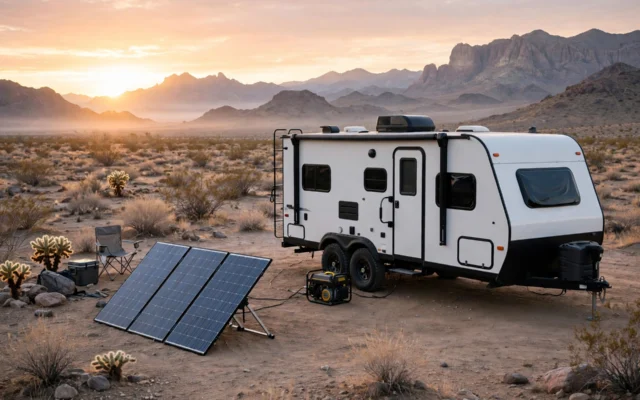
Boondocking Power Setup: Generator + Solar for Off-Grid Camping
The ideal boondocking power setup pairs solar with a generator and battery bank. Real daily load math, sizing tiers, and the generator run strategy that sips fuel.
RV Generator Quiet Hours & Campground Etiquette Guide
RV generator quiet hours are usually 10pm–8am, with limited daytime generator windows in national parks. The rules, the unwritten etiquette, and how to stay neighborly.