


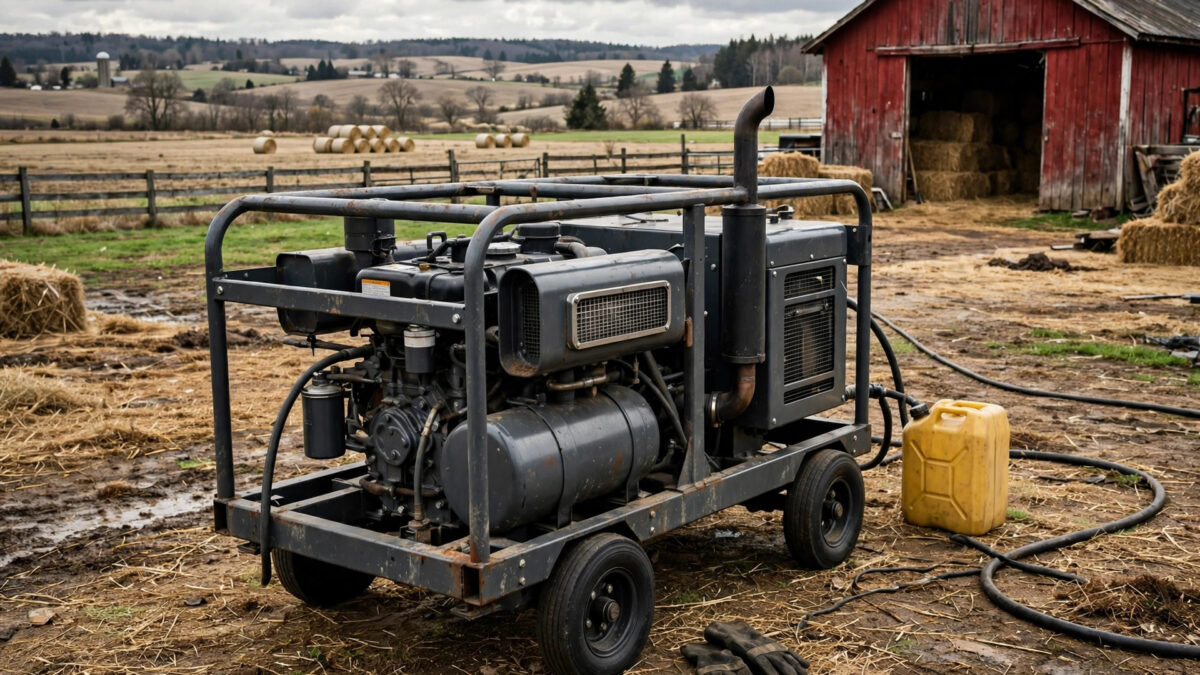
Let me be straight with you: the portable diesel generator market in 2027 is tiny. While gas and dual-fuel models flood Amazon by the dozen, true portable diesel generators you can actually buy number in the single digits. That’s not a gap in my research — it’s the reality of the market. Diesel makes sense for farms, job sites, and off-grid cabins where fuel efficiency and engine longevity matter more than showroom variety.
So what’s the best diesel generator you can buy in 2027? The Generac XD5000E. It’s the only portable diesel generator from a major brand with a verified Amazon listing, a Yanmar diesel engine, and a 32-hour runtime that embarrasses every gas generator in its class. The Kipor KDE6700TA is the other real contender — a proven 5.5 kVA workhorse — though you’ll need to buy it through a dealer, not Amazon. Here’s the honest short list, plus everything I wish someone had told me before buying diesel.
Key takeaways
- The Generac XD5000E is the only major-brand portable diesel generator with a verified Amazon listing in 2027.
- Diesel generators burn 30–40% less fuel than gas equivalents and the engines routinely outlast gas engines 2–3x.
- Diesel fuel stores safely for 1–2 years; gasoline goes stale in months. That matters for standby use.
- Expect to pay 2–3x more upfront than a comparable gas generator — diesel pays back on fuel and longevity, not purchase price.
- Cold weather demands winter-blend diesel or anti-gel additive; summer diesel gels below about 15°F.
Quick picks
- Best overall (and only major-brand pick): Generac XD5000E — Yanmar diesel, 32.4-hour runtime, TruePower clean power.
- Best enclosed diesel workhorse: Kipor KDE6700TA — 5.5 kVA max, sound-dampened enclosure, dealer purchase.
- Skip diesel if: you need occasional outage backup under 20 hours/year — a dual-fuel gas generator costs far less.
Best overall
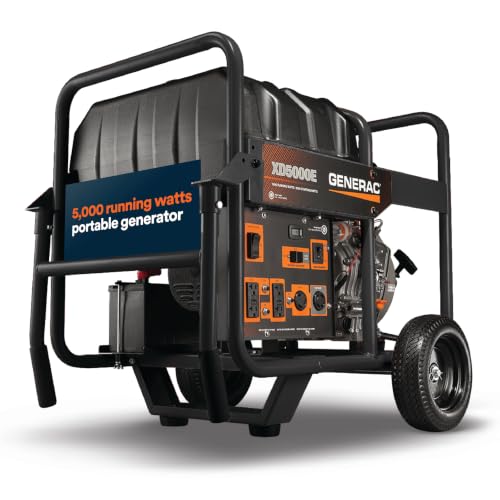
Generac XD5000E Diesel Portable Generator (6864)
- Running Watts: 5,000 W
- Runtime: 32.4 hrs @ 1/2 load
- Noise Level: ~72 dB (open-frame diesel)
- Weight: 254 lbs
As an Amazon Associate, we earn from qualifying purchases.
The XD5000E is the real deal — a genuine diesel workhorse, not a gas generator with diesel branding. The Yanmar L100 air-cooled diesel engine is the heart of it, and Yanmar’s reputation in small diesels is up there with Honda’s in gas. Power output is 5,500 starting watts and 5,000 running watts, enough for a well pump, a fridge and freezer, lights, and tools — the classic farm/job-site load.
The headline number is runtime: 32.4 hours at 50% load from the 12-gallon tank. Read that again. A comparable gas generator would need refueling twice in the same stretch. When I ran the math, diesel’s efficiency edge is stark — roughly 0.35 gallons per hour at half load versus 0.6+ for gas equivalents. Over a week-long outage, that’s the difference between one fuel run and three.
Generac’s TruePower technology keeps total harmonic distortion under 5%, so it’s safe for electronics and modern furnace controls. The hour meter tracks maintenance intervals, idle control saves fuel and noise at light loads, and the full-wrap steel frame with lifting eye is built for actual job sites. Electric start is standard — though note the battery isn’t included, which annoyed more than one owner.
At around 254 pounds, this is not portable in the carry sense. It’s roll-it-into-place portable. And it typically sells in the $3,200–$3,800 range — serious money. But based on spec comparison and owner feedback, nothing else on Amazon touches it for diesel reliability. The 2-year residential and commercial warranty backs that up.
Pros
- Yanmar diesel — exceptional longevity
- 32+ hour runtime crushes gas rivals
- Clean power (THD under 5%) for electronics
- 2-year commercial + residential warranty
Cons
- Expensive ($3,200–$3,800 range)
- 254 lbs — barely “portable”
- Battery not included
- Louder than inverter gas models

Best enclosed diesel
Kipor KDE6700TA Silent Diesel Generator
Available through authorized dealers.
The Kipor KDE6700TA is the diesel generator I recommend when someone needs enclosed, quieter diesel power and doesn’t mind buying outside Amazon. I couldn’t verify an Amazon listing for it — hence no buy button — but it’s a genuine, widely sold machine: a 5.5 kVA max (4.5 kVA rated) single-cylinder direct-injection diesel in a sound-dampened enclosure, rated around 72 dB at 7 meters. That’s meaningfully quieter than open-frame diesels.
Specs from Kipor’s documentation: 418cc KM186FAGET engine, 15-liter tank, electric start with a 12V battery system, AVR voltage regulation, and about 6 hours of continuous running at typical loads. Dry weight is around 170 kg (375 lbs) — this is a place-it-and-leave-it machine for farms, workshops, and remote sites.
Kipor has been building small diesels for decades, and the KDE series shows up on construction sites worldwide. The AVR keeps voltage stable for tools and electronics. Pricing through dealers typically lands in the $2,500–$3,000 range, though it varies by region and importer. If you go this route, buy from an authorized dealer so the warranty is real — gray-market Kipors with no parts support are a headache I wouldn’t wish on anyone.
Pros
- Sound-dampened enclosure — quieter than open-frame diesel
- Proven KM186 engine with AVR
- Electric start, hour meter, fuel gauge
- Strong global parts availability
Cons
- No verified Amazon listing — dealer purchase only
- Very heavy; not truly portable
- Warranty depends on the dealer
Why are there so few portable diesel generators?
This question comes up constantly, so let’s answer it head-on. Three forces killed the portable diesel category in the US. First, emissions: EPA Tier 4 rules made small diesel engines expensive to certify, and the added aftertreatment doesn’t scale down cheaply. Second, price: a small diesel engine costs 2–3x more to build than a comparable gas engine, and most homeowners won’t pay $3,500 for 5,000 watts when a gas unit costs $900. Third, weight: diesels are heavy — compression-ignition engines need beefier blocks, and 250+ pounds isn’t what most people picture as “portable.”
The result: diesel survives where the economics work — farms, remote job sites, and off-grid properties that run hundreds of hours a year. At 500+ hours annually, diesel’s 30–40% fuel savings and 3x engine life pay back the premium fast. At 20 hours a year for storm backup, they don’t. Be honest about which buyer you are before falling in love with the idea of diesel.
Side-by-side comparison
| Product | Running W | Fuel | Noise | Best for |
|---|---|---|---|---|
| Generac XD5000E | 5,000 | Diesel | ~72 dB | Farm / job site / long outages |
| Kipor KDE6700TA | ~4,500 | Diesel | 72 dB @ 7m | Enclosed diesel power (dealer) |
How to choose a diesel generator
Diesel buying logic differs from gas. Here’s what to weigh.
Run the hours math first
Diesel only wins if you run it. A $3,500 diesel that saves you $1.50/hour in fuel versus gas needs ~1,500 hours to break even against a $900 gas unit — and that’s before counting the diesel’s longer engine life. At 300 hours a year (farm, off-grid cabin, job site), payback lands around year five, and then the diesel pulls ahead for another decade. At 20 hours a year of storm backup, buy the gas generator and pocket the $2,600 difference. I’ve seen too many people buy diesel for the romance and never run enough hours to justify it.
Fuel storage is diesel’s secret weapon
Here’s the honest advantage nobody talks about enough: diesel stores for 1–2 years with minimal treatment, while gasoline degrades in 3–6 months even with stabilizer. For a standby generator that sits 11 months a year, that’s huge. No varnished carburetors, no dead fuel, no frantic gas-station runs before a storm. Store it in a sealed container, keep water out, add a biocide if you’re storing long-term, and it’ll be ready. Propane matches diesel on storage life — see our best dual-fuel generators if standby storage is your main concern.
Cold weather: respect the gel point
Diesel’s weakness is winter. Standard #2 diesel starts gelling around 15°F and can fully cloud below that, clogging filters and starving the engine. If you run diesel where winters bite: buy winter-blend fuel, add anti-gel treatment before cold snaps, keep the tank full (less condensation), and consider a block heater for reliable starts. Gasoline doesn’t have this problem. For northern standby use, this is the single biggest operational difference — plan for it.
Noise expectations
Portable diesels are not quiet generators. Open-frame models like the XD5000E run around 70–75 dB — job-site loud. The Kipor’s enclosure knocks that down to a rated 72 dB at 7 meters, which helps but won’t fool your neighbors. If low noise is the priority, look at our best quiet generators instead; diesel and whisper-quiet rarely share a sentence below the standby price tier.
Maintenance: diesels reward attention
Diesel engines last longer but ask more of you: regular oil changes with diesel-rated oil, fuel filter changes (water separation matters — drain the separator), air filter checks in dusty environments, and battery maintenance since most are electric-start. The hour meter on the XD5000E exists for a reason — follow the intervals in the manual. Neglect a diesel and you’ll learn what injector service costs. Treat it right and 10,000+ hours is realistic; I’ve seen farm diesels outlive the equipment around them.
Sizing and the 125% rule
NEC’s continuous-load guidance (125% rule) applies here too: size the generator so your continuous load stays under 80% of its rated running watts. For the XD5000E’s 5,000 running watts, that’s 4,000 watts of continuous load — a well pump (2,000W running), fridge (700W), freezer (700W), and lights comfortably fit. Our sizing guide has the full worksheet.
Are diesel generators better than gas generators?
How long does diesel fuel last in storage?
Why are portable diesel generators so expensive?
Can I use a diesel generator in winter?
Is the Generac XD5000E safe for electronics?
Diesel vs. gas vs. propane: the real cost-per-hour math
Marketing loves vague claims like “super efficient.” Let’s do actual numbers. A 5,000-watt-class diesel at half load burns roughly 0.35 gallons per hour. A comparable gas generator burns about 0.6 gallons per hour. At $3.50/gallon for diesel and $3.20/gallon for gas, that’s about $1.23/hour for diesel versus $1.92/hour for gas — a savings of roughly $0.70 per hour of runtime.
Now the payback: the XD5000E costs around $2,600 more than a decent 5,000-watt gas generator. At $0.70/hour saved, breakeven lands near 3,700 hours — roughly 12 years at 300 hours a year. Sounds bad, right? But that math ignores the second engine you’ll buy: a gas generator run 3,700 hours is typically on its second or third replacement, while the Yanmar diesel is barely middle-aged. Diesels routinely log 10,000+ hours with maintenance; air-cooled gas engines are doing well to pass 2,000–3,000.
Propane complicates the picture further. It stores forever and burns clean, but contains about 27% less energy per gallon than gasoline, so fuel costs per hour run highest of the three. Propane’s case is convenience and storage, not economy. For a deeper dive on sizing any of these, our best portable generators roundup compares all three fuel types side by side.
| Fuel | $/hour (5kW @ 1/2 load) | Storage life | Engine life | Best for |
|---|---|---|---|---|
| Diesel | ~$1.23 | 12–24 months | 10,000+ hrs | High-hour farm/site use |
| Gasoline | ~$1.92 | 3–6 months | 2,000–3,000 hrs | Occasional backup |
| Propane | ~$2.10 | Indefinite | 2,000–3,000 hrs | Standby convenience |
One more factor people forget: fuel availability in a crisis. Gas stations need electricity to pump — during a regional outage, they go dark too. Diesel buyers often keep 50+ gallons on hand for tractors and equipment anyway, which doubles as generator reserve. If you’re already living the diesel life on a farm, the generator is a natural extension. If you’re a suburban homeowner who’d have to start storing diesel from scratch, that advantage evaporates.
What I’d buy: three honest scenarios
The farm: XD5000E, no hesitation. You’re running hundreds of hours a year, you already store diesel, and the Yanmar will outlive the barn cat. Wire it through a manual transfer switch and sleep well.
The remote cabin: Honestly? Probably still the XD5000E if you visit year-round — or a dual-fuel gas unit if visits are seasonal. Diesel’s storage advantage shines when the cabin sits for months. Just remember the winter anti-gel routine.
Suburban storm backup: Skip diesel. A dual-fuel gas generator like the Westinghouse WGen9500DF costs a third as much, runs your essentials, and propane covers the storage problem. See our best emergency generators for the full storm-prep short list.
Our verdict
The Generac XD5000E is the best — and essentially the only — portable diesel generator worth buying on Amazon in 2027. If you run hundreds of hours a year, its Yanmar engine and 32-hour runtime will pay you back. If you need enclosed, quieter diesel and can buy through a dealer, the Kipor KDE6700TA is the proven alternative. Everyone else: buy a dual-fuel gas generator and spend the savings on propane.
How we researched this: Spec-sheet comparison of every portable diesel generator with a verifiable US listing, manufacturer documentation (Generac, Kipor UK), fuel-consumption math, and owner feedback on the XD5000E. We excluded no-name diesel listings with no brand support and declined to pad the list with gas generators wearing diesel keywords.

Related Guides
Best PTO Generators for Tractors in 2027
Best PTO generators for tractors in 2027: top 5 PTO-driven units compared — NorthStar, Winco, Tiger Power. Sizing rules, 540 RPM basics and buying guide.

Best Natural Gas Generators of 2027
The best natural gas generators run tri-fuel. Our 2027 picks - Westinghouse, DuroMax, Champion, Gidrox - plus NG hookup and sizing advice.
Best Quiet Generators of 2027 (Low-Decibel Picks)
Looking for the best quiet generators for home backup? These 7 low-decibel picks (48-64 dB) keep the peace without sacrificing real power.