


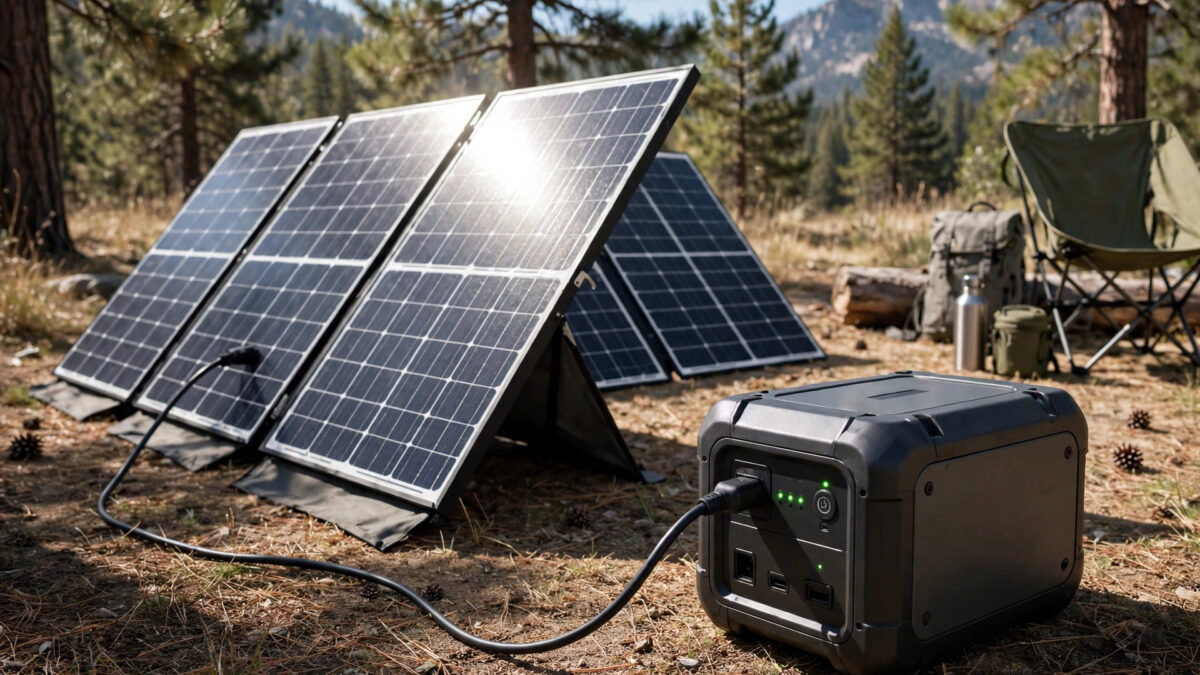
MPPT and PWM are the two types of solar charge controllers — the electronics that manage power flowing from your solar panels into your battery. MPPT (Maximum Power Point Tracking) is the better technology: it harvests 15-30% more energy from the same panels by converting excess panel voltage into extra charging current, while PWM (Pulse Width Modulation) simply throws that excess voltage away. In a portable solar generator, MPPT is the standard in 2027 — PWM survives only in the smallest, cheapest units.
If you’re shopping for a solar generator and the specs list the solar input type, this is one of the few specs that genuinely matters. It directly determines how fast your unit recharges from the same panels, in the same sun.
Key takeaways
- MPPT controllers operate at 95-99% efficiency; PWM controllers manage only 70-80% — the gap widens in cold weather and low light.
- MPPT converts excess panel voltage into additional charging amps; PWM clips the voltage down to battery level and wastes the difference as heat.
- Most quality portable solar generators in 2027 use MPPT. PWM appears mainly in small, budget units under ~300Wh.
- MPPT’s advantage is biggest with higher-voltage panels, cold mornings (panels produce extra voltage when cold), and partial shade.
- When comparing two solar generators, check the max solar input watts and voltage range — a bigger MPPT input window means faster, more flexible solar charging.
What a charge controller actually does
A solar panel’s output voltage swings around all day — with temperature, sunlight intensity, and shading. A battery, meanwhile, wants a steady, controlled charging voltage. The charge controller sits between them, translating panel output into battery-friendly charging power. How well it does that translation is the entire MPPT-vs-PWM story.
PWM: the simple switch
A PWM controller is essentially a rapid on/off switch between the panel and the battery. It connects the panel directly to the battery and pulses the connection to regulate charging as the battery fills.
The problem: the panel is forced to operate at battery voltage, which is almost always well below the panel’s ideal operating voltage. A typical “12V” solar panel actually produces around 18V at its maximum power point. Connected through a PWM controller to a 12V battery, the panel gets dragged down to ~13V — and the ~5V difference, roughly a quarter of the panel’s potential power, is simply lost.
PWM efficiency lands around 70-80% in good conditions and drops to 60-65% when panels run hot (voltage sags further from ideal) or in weak light.
MPPT: the smart converter
An MPPT controller continuously hunts for the panel’s maximum power point — the exact voltage-and-current combination delivering the most watts at that moment — then uses a DC-DC converter to step that power down to battery voltage while boosting the current proportionally. Power is conserved; nothing is thrown away.
That same 18V panel on an MPPT controller delivers its full wattage: the controller takes 18V × panel current and converts it to ~13V × proportionally higher current. Efficiency runs 95-99%, and it stays above 85% even in poor light.
The U.S. Department of Energy puts MPPT’s real-world harvest advantage at 15-30% over PWM. On a 400W array, that’s the difference between ~300W and ~380W of actual charging power — over a six-hour solar day, roughly 480 extra watt-hours. That’s a laptop charged, or a portable fridge run for several more hours.
Side-by-side comparison
| Feature | PWM | MPPT |
|---|---|---|
| Efficiency | 70-80% | 95-99% |
| Extra harvest vs PWM | — | 15-30% more |
| Panel voltage | Must match battery voltage | Can be much higher than battery |
| Cold weather | Wastes the cold-voltage bonus | Captures it as extra current |
| Low light / shade | Drops off sharply | Holds up much better |
| Cost | Cheap | More expensive |
| Best for | Small panels (<200W), tight budgets | Everything 200W and up |
What this means inside a solar generator
In a portable solar generator (EcoFlow, Jackery, Bluetti, Anker, and the rest), the charge controller is built in — you don’t choose it separately. But the spec sheet tells you what you’re getting:
- “MPPT” in the specs — the norm for quality units. Check the max solar input (watts) and the input voltage range. A wider voltage range (say 11-60V vs 11-30V) means you can use more panel types, including higher-voltage residential panels wired in series.
- No mention / PWM — a red flag on anything above ~300Wh. It usually signals a cost-cut unit that will recharge noticeably slower from the same panels.
- Max solar input watts — just as important as the controller type. A 1,000Wh unit with 200W max solar input takes 5+ hours of perfect sun to fill; the same unit with 800W input can do it in under two.
One practical consequence: with MPPT’s flexible voltage handling, you can often use cheaper, higher-voltage panels (even used residential panels) with your solar generator, as long as you stay within the unit’s max input voltage. With PWM, panel voltage must stay close to battery voltage, which limits your options and wastes the advantage of bigger panels.
When PWM is actually fine
I’ll defend PWM in exactly one scenario: tiny systems where the absolute power loss is trivial. A 50W panel losing 10W to PWM inefficiency isn’t a crisis, and the cheaper controller keeps a $150 gadget affordable. If you’re topping off phones on a weekend camping trip with a small panel, PWM gets the job done.
The moment the system matters — emergency backup, RV power, anything over ~200W of panels — MPPT pays for itself in harvested energy many times over. In 2027 there’s no serious mid-size or large solar generator shipping with PWM, and I’d treat one that does as a sign to keep shopping.
Pairing panels to your unit? Our sizing calculator helps with the power side, and check the solar input specs carefully — max watts, voltage range, and connector type — before buying panels for any solar generator.
A real-world example: same panels, different controllers
Let me make this concrete. Say you have a 400W solar array feeding a 12V battery bank in a solar generator — a common setup. The panels put out around 36V at their maximum power point on a cool morning.
Through a PWM controller, the panel gets dragged down to battery voltage (~13V). You get 13V times the panel current — roughly 280-310W of usable charging power. The rest is gone.
Through an MPPT controller, the full 400W gets converted down: ~13V at proportionally higher current, minus 2-4% conversion loss — roughly 380-390W of usable charging power.
Over a six-hour solar day, that gap compounds to 400-500 extra watt-hours with MPPT. On a 1,000Wh power station, that’s nearly half a charge conjured from nothing but better electronics. This is why two solar generators with the same battery size and same panels can have wildly different recharge times — the charge controller is doing quiet work in the background.
Is MPPT better than PWM for solar generators?
What does MPPT mean on a solar generator?
Can I use any solar panel with an MPPT solar generator?
Why do cheap solar generators charge slower from solar?
Does MPPT work better in winter?
Bottom line: MPPT isn’t a premium feature anymore — it’s the baseline for any solar generator worth buying. When you compare units, look past the battery size and check the solar input specs: MPPT controller, max input watts, and voltage range. Those three numbers determine how fast the sun actually refills your battery. And once it is charged, make sure it stays that way — our guide on solar generator self-discharge in storage covers the right storage charge level.

Related Guides
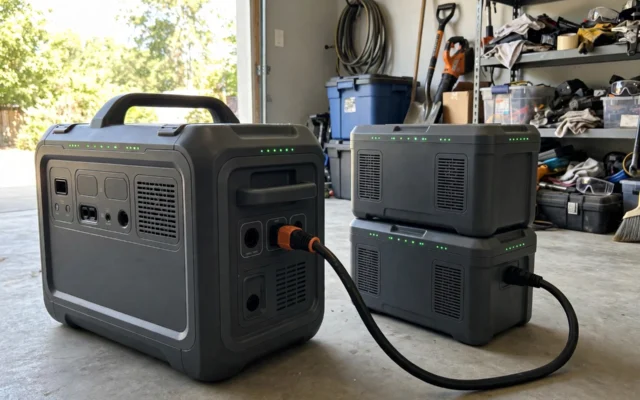
Solar Generator Expansion Batteries: How They Work & Are They Worth It?
Expansion batteries can double or triple your solar generator's capacity. How they connect, what they cost per kWh, and when they're worth it — vs. just buying bigger.

Can You Leave a Solar Generator Plugged In All the Time?
Can you leave a solar generator plugged in 24/7? Yes — the BMS prevents overcharging. But sitting at 100% shortens battery life. Here's the 80% rule and the right settings.
Can a Solar Generator Work as a UPS for Home Backup?
A solar generator can work like a UPS for most home backup — but it's technically EPS, not a true UPS. Switchover times, what stays on, and what doesn't.
1 Comment