


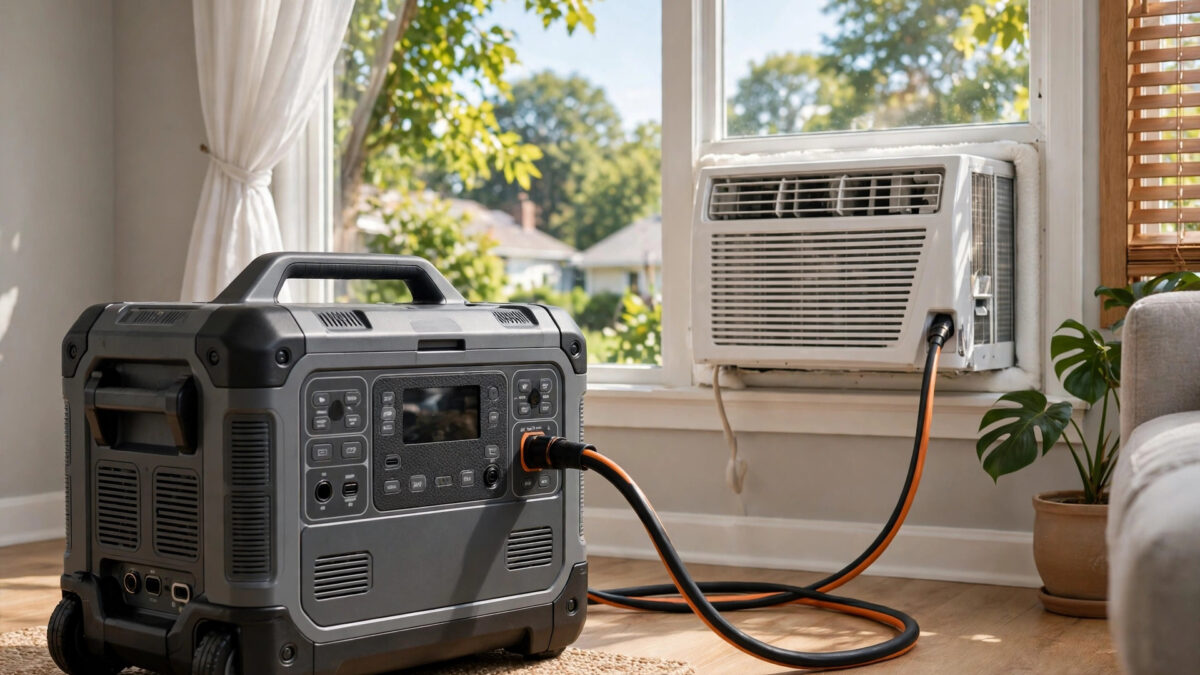
Running an air conditioner on a solar generator is the dream scenario for summer outages, off-grid cabins, and RV life — and it is also one of the most misunderstood topics in portable power. The short answer is yes, a solar generator can run an air conditioner, but only if the station is big enough to handle two things most appliances never demand at once: a massive startup surge and hours of continuous high-wattage draw.
Get those two factors right and you can keep cool through a blackout. Get them wrong and your station will shut down the moment the compressor kicks in. Here is exactly how to figure out which side you are on.
How Much Power Does an Air Conditioner Actually Use?
Air conditioners are among the hungriest household appliances. Here are typical numbers:
- 5,000 BTU window unit: 450 to 550W running, 1,200 to 1,800W startup surge
- 8,000 BTU window unit: 650 to 750W running, 1,800 to 2,500W startup surge
- 12,000 BTU portable AC: 1,000 to 1,400W running, 2,500 to 3,500W startup surge
- Mini-split / inverter AC: 400 to 900W running, very low surge (inverters ramp up gently)
The startup surge is the killer. When the compressor kicks on, a conventional AC can draw three to five times its running wattage for a few seconds. Your solar generator must survive that spike — not just the steady running load. This is why a station rated for 1,800W continuous might still trip on a 700W window unit if its surge rating is too low.
Inverter-style air conditioners (including most mini-splits and newer portable units) are dramatically easier to run because they ramp the compressor up gradually instead of slamming it on. If you are buying an AC specifically for off-grid or backup use, an inverter model is worth every penny.
The Two Real Barriers: Startup Surge and Runtime
Barrier 1: surge capacity. Check your station’s surge or peak rating, not just its continuous output. A 5,000 BTU window unit with a 1,500W startup surge needs a station whose surge rating clears 1,500W with margin. Many 1,000W-class stations advertise 2,000W surge, which technically covers it — but running that close to the limit is stressful for the electronics and leaves no headroom.
Barrier 2: runtime. Even if the station starts the AC, the battery has to feed it for hours. The math is simple:
Runtime (hours) = Battery capacity (Wh) × 0.85 ÷ AC running watts
The 0.85 factor accounts for inverter losses. So a 1,024Wh station running a 500W window unit gives you roughly 1,024 × 0.85 ÷ 500 = 1.7 hours. That same station on an efficient 400W mini-split stretches to about 2.2 hours. For overnight cooling, you need a much bigger battery — or expansion batteries.
Which Solar Generators Can Actually Do It?
For reliable, whole-room cooling — especially larger units or longer runtimes — you want a high-output station with 240V capability:
EcoFlow DELTA Pro 3 — With 4,096Wh of capacity, 4,000W of continuous output (6,000W with X-Boost), and 120V/240V output, this is the benchmark for running air conditioners. It will start and run even a 12,000 BTU portable unit, and its expandable capacity (up to 48kWh with extra batteries) makes multi-hour or overnight cooling realistic. Check the DELTA Pro 3 price on Amazon.
Jackery HomePower 3600 Plus — 3,584Wh capacity with 3,600W output (7,200W surge) and 120V/240V support. Another strong whole-home option that handles central-AC-scale loads and pairs well with expansion batteries. Check the HomePower 3600 Plus price on Amazon.
Mid-size stations (2kWh class) — Units like the BLUETTI AC200PL (2,304Wh, 2,400W output with 3,600W Power Lifting mode) can run a small 5,000–6,000 BTU window unit, especially an inverter model. Expect 2 to 4 hours of cooling depending on the AC’s draw.
1kWh stations — Possible but marginal. A 1,024Wh unit with 1,800W+ surge can start a small 5,000 BTU window AC, but you will get 1 to 2 hours at most. This works for taking the edge off a hot afternoon in an RV, not for all-night cooling. See our best solar generators for RV guide for right-sized picks.
For whole-home backup scenarios, our large solar generators for whole-home backup roundup covers the heavy hitters in detail.
Tips to Make It Work Reliably
Install a soft starter. A soft-start capacitor (such as a MicroAir EasyStart) on your AC’s compressor can cut startup surge by up to 70 percent. This single upgrade is what makes borderline setups work — it can turn a 2,000W surge into 600W, bringing far more stations into play.
Pre-cool on grid power. If an outage is forecast, run the AC hard while you still have grid power to pull the house temperature down, then let the solar generator maintain it. Maintaining a cool room takes far less energy than cooling a hot one.
Keep solar panels connected. While the AC runs, every watt your panels produce goes straight into offsetting the load. A 700W array feeding a 500W AC effectively extends your runtime enormously during daylight hours.
Use eco mode and a higher setpoint. Raising the thermostat from 68°F to 74°F can cut energy use by 20 to 30 percent. Pair that with a fan to circulate air and you stay comfortable on far less battery.
Consider expansion batteries. For overnight cooling, battery capacity matters more than output wattage. Adding an expansion battery to a DELTA Pro 3 or HomePower 3600 Plus doubles or triples your cooling hours without changing anything else.
Can a solar generator run an air conditioner?
Yes, if the station’s continuous output and surge rating exceed the AC’s startup surge, and its battery is large enough for your desired runtime. Large 240V stations like the EcoFlow DELTA Pro 3 handle even 12,000 BTU units, while 1kWh stations can only manage small window units for 1 to 2 hours.
What size solar generator do I need for a 5000 BTU air conditioner?
A 5,000 BTU window unit draws about 500W running with up to 1,800W startup surge. You need a station rated for at least 1,000W continuous with 2,000W+ surge. For runtime, a 1kWh station gives roughly 1.7 hours; a 2kWh station gives 3 to 4 hours.
How long can a solar generator run an AC?
Use this formula: battery Wh × 0.85 ÷ AC watts = hours. A 4,096Wh DELTA Pro 3 running a 700W window unit lasts about 5 hours; the same station on a 400W mini-split lasts nearly 9 hours. Adding solar panels during the day or expansion batteries extends this significantly.
What is a soft starter and do I need one?
A soft starter is a device wired to your AC’s compressor that reduces startup surge by up to 70 percent. It is the single most effective upgrade for running an AC on a solar generator, often making the difference between a station tripping on startup and running smoothly.
Can a solar generator run central air conditioning?
Whole-house central AC typically needs 3,000 to 5,000W running with very large startup surges, plus 240V power. Only the largest solar generators — 240V units like the EcoFlow DELTA Pro 3 or Jackery HomePower 3600 Plus, ideally with expansion batteries — can handle it, and runtime will be limited without substantial battery capacity.
Our verdict
Yes, a solar generator can run an air conditioner — but size matters enormously. Match the station’s surge rating to your AC’s startup draw (a soft starter helps hugely), then do the runtime math honestly: small stations cool for an hour or two, while 240V units like the DELTA Pro 3 with expansion batteries can carry you through the night. For most people, an efficient inverter AC paired with a 2kWh+ station is the sweet spot for staying cool off-grid.

Related Guides
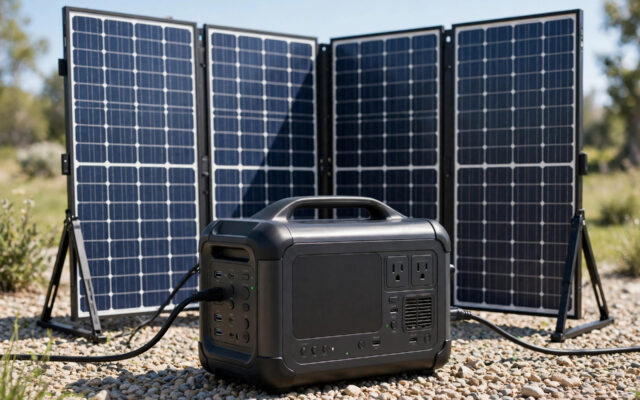
Best Solar Generator Bundles with Panels for 2027
Save money with the best solar generator bundles of 2027 — power station plus solar panel kits ready to use out of the box.

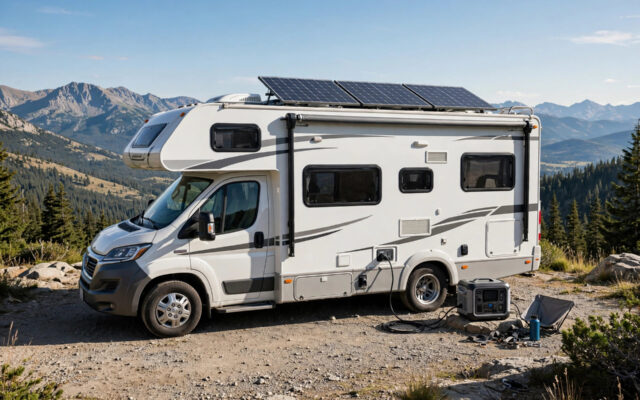
Best Solar Generators for RVs in 2027
Power your RV adventures with the best solar generators for RVs in 2027, featuring TT-30 outlets and fast solar charging.
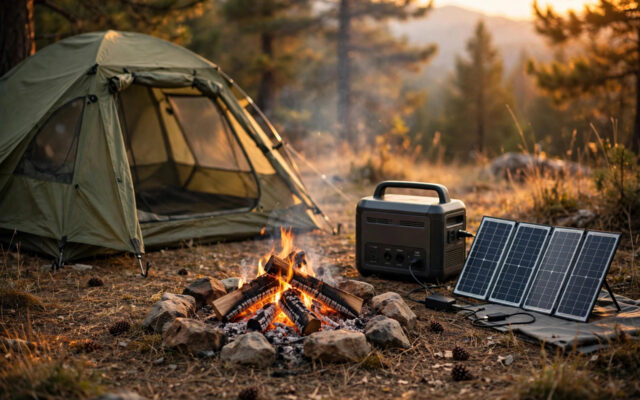
Best Solar Generators for Camping in 2027
The best solar generators for camping in 2027: lightweight, quiet power stations that keep your gear charged off-grid.