


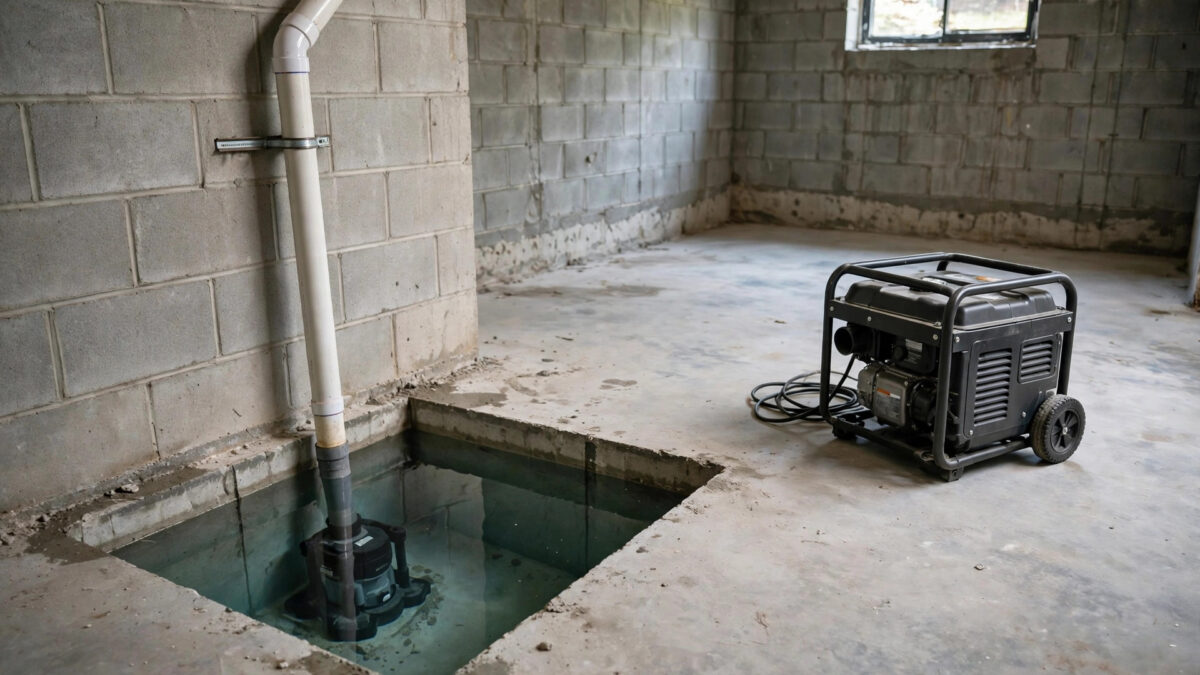
Wondering what size generator for a sump pump you actually need? Most residential sump pumps run fine on a 2,000 to 4,000-watt generator. A typical 1/3 HP sump pump draws about 800 watts while running and needs roughly 1,300 watts to start, so even a small inverter generator can handle it. The catch is that sump pumps matter most during storms — exactly when you need the generator to start reliably, run for hours, and sit safely outside in bad weather.
A sump pump is a small but critical load. When the power goes out during heavy rain, your basement’s defense against flooding is a pump that cycles on and off every few minutes, often for hours at a stretch. In this guide, we researched published wattage data for common sump pumps, plus the real-world details that matter during a storm: fuel runtime, extension cords, GFCI protection, and safe generator placement in the rain.
Key Takeaways
- A 1/3 HP sump pump needs about 800 running watts and 1,300 starting watts; a 1/2 HP pump needs about 1,050 running watts and 2,150 starting watts (approximate).
- A 2,000-watt generator covers most 1/3 HP pumps; step up to 3,000–4,000 watts for 1/2 HP models or to run other essentials alongside.
- Sump pumps cycle on and off — size for the starting surge, and let the generator cool down between heavy cycles.
- Use a heavy-duty outdoor extension cord (12-gauge or thicker) and keep connections dry and elevated.
- Never run a generator indoors or in a garage — carbon monoxide kills in minutes. Keep it at least 20 feet from the house.
- Consider a battery backup sump pump as a second layer of protection for when the generator is not running.
What Size Generator Do I Need for a Sump Pump?
Most sump pumps need a generator rated for 2,000 to 4,000 watts. A standard 1/3 HP sump pump draws roughly 800 watts running and 1,300 watts starting, which a 2,000-watt inverter generator handles comfortably. A larger 1/2 HP pump draws about 1,050 watts running and 2,150 watts starting, so a 3,000-watt generator is the safer pick. These are approximate figures from published wattage charts — check your pump’s nameplate for exact amps, and always size to the starting watts rather than the running watts.
Sump Pump Wattage Chart: Running vs. Starting Watts
Sump pump wattage depends on horsepower and whether the pump is submersible (sits in the pit) or pedestal (motor above the pit). Both types draw similar power for the same horsepower. The table below shows commonly published approximate figures.
| Pump size | Typical running watts | Typical starting watts | Generator size (approx.) |
|---|---|---|---|
| 1/4 HP | 600 W | 1,000 W | 2,000 W |
| 1/3 HP (most common) | 800 W | 1,300 W | 2,000 W |
| 1/2 HP | 1,050 W | 2,150 W | 3,000–3,500 W |
| 3/4 HP | 1,500 W | 2,800 W | 3,500–4,500 W |
| 1 HP (heavy duty) | 2,000 W | 4,000 W | 5,000–6,500 W |
Most homes have a 1/3 HP or 1/2 HP pump, which is good news — you do not need a big generator. A compact inverter generator in the 2,000 to 3,500-watt range is the sweet spot for most sump pump backup setups, and it will also run lights, phone chargers, and a refrigerator alongside the pump.
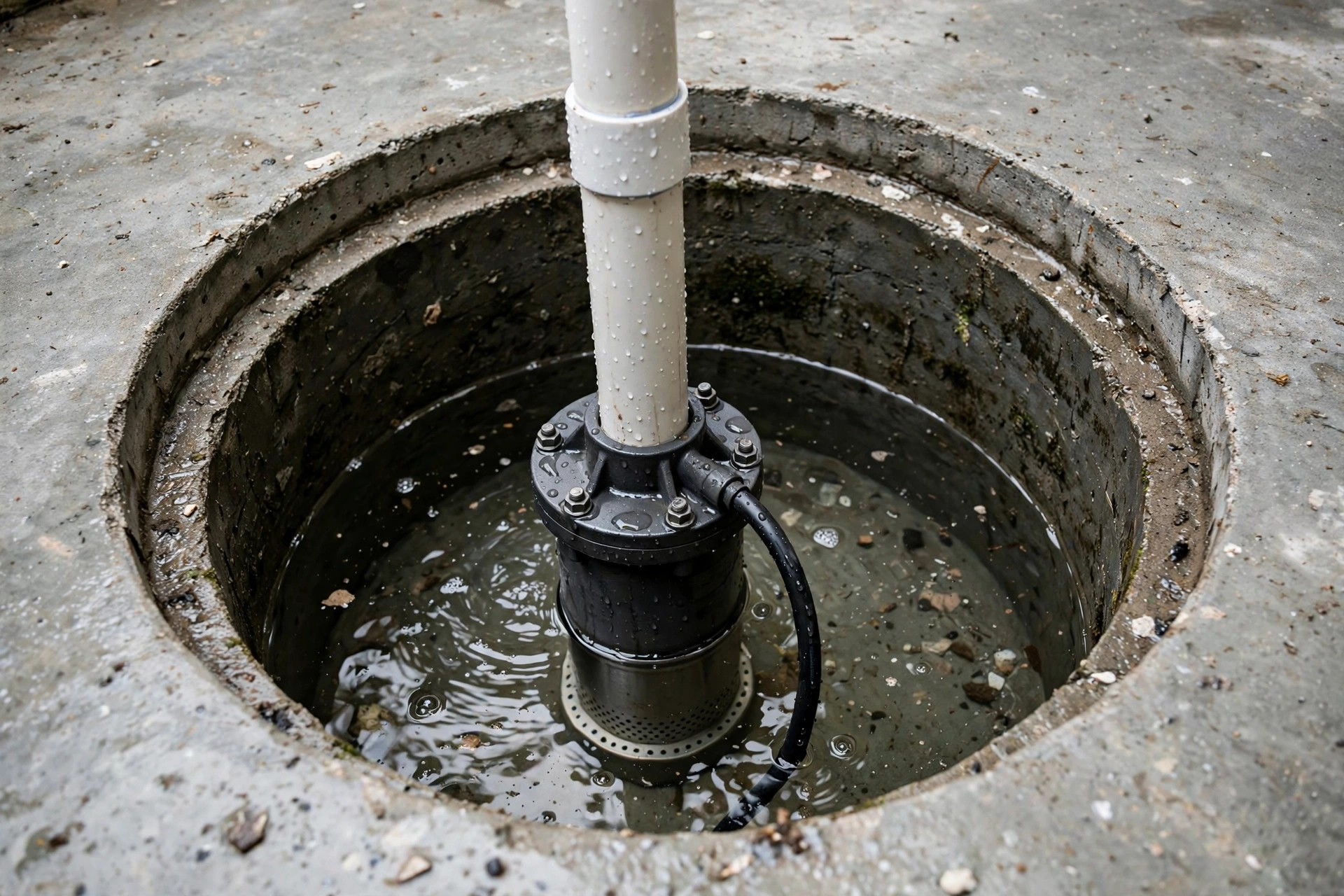
How to Find Your Sump Pump’s Exact Wattage
Charts are a starting point, but your pump’s nameplate is the authority. Here is how to get the real numbers.
Read the nameplate
The pump motor has a label showing voltage, running amps, and sometimes locked-rotor (starting) amps. Multiply amps by volts (usually 120V for sump pumps) to get watts. A pump drawing 9 running amps at 120 volts uses about 1,080 running watts.
Check the owner’s manual
If the nameplate is worn or underwater, the manual or the manufacturer’s website lists full-load amps and locked-rotor amps by model number. This takes two minutes and removes all guesswork.
When in doubt, round up
If you cannot find the numbers, assume the next size up. Sump pumps are inexpensive loads to oversize for — a slightly larger generator costs little extra and guarantees the pump starts every time it cycles, even as the motor ages and draws more current.
Why Sump Pumps Are Tricky Loads: Constant Cycling
What makes a sump pump demanding is not its wattage but its duty cycle. During a storm, a sump pump may switch on every two to five minutes and run for 30 to 60 seconds each time. Every start pulls the full starting surge, so the generator faces repeated surge demands for hours. This is why you should size generously and avoid running the generator at its absolute limit — repeated surges near the breaker’s trip point can eventually trip it at the worst possible moment.
An older pump with a worn motor or a partially clogged intake draws more current than its nameplate suggests. If your pump is more than seven to ten years old, consider that a reason to size up one step — or to replace the pump before storm season.
Extension Cords and GFCI: Getting Power to the Pump Safely
Sump pumps live in basements; generators must live outdoors. The extension cord between them matters more than most people think.
Use a heavy-duty outdoor-rated cord
Use a 12-gauge (or thicker 10-gauge) outdoor extension cord, and keep it as short as practical — ideally under 50 feet. Thin cords cause voltage drop, which makes motors draw more current, run hotter, and sometimes fail to start. A 100-foot 16-gauge cord is one of the most common reasons a “big enough” generator still trips on a sump pump.
Keep connections dry and elevated
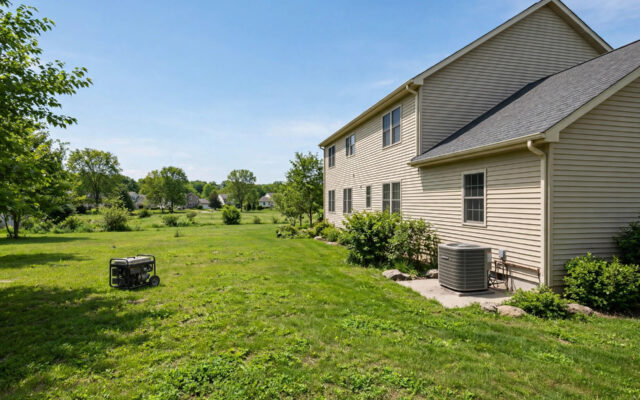
Plug connections should be off the ground and sheltered from direct rain — a simple cord-connection box or even an overturned plastic tub works. Never let a connection sit in a puddle. The generator itself can run in rain under a purpose-built generator tent or canopy, but it must stay ventilated on all sides.
GFCI protection still applies
Sump pumps are normally on GFCI-protected circuits because water and electricity are a dangerous mix. When running on generator power, plug the pump into the generator’s GFCI-protected outlet if it has one. Do not bypass or remove GFCI protection to stop nuisance tripping — investigate the cause instead.
What Size Generator Runs a Sump Pump Longest? Fuel and Runtime
A sump pump does not run continuously, so fuel goes further than the wattage suggests. A typical 1/3 HP pump drawing 800 watts might run a 30 percent duty cycle during heavy rain — 20 minutes per hour — averaging under 300 watts per hour of wall-clock time. A small inverter generator with a one-gallon tank can often run 6 to 10 hours at that kind of light, intermittent load.
Still, plan for refueling. Keep enough fresh gasoline on hand for at least 24 hours of runtime, and never refuel a hot generator — shut it down, let it cool for 15 minutes, and refuel away from the house. For longer outages, a dual-fuel generator running on propane is worth considering, since propane stores indefinitely and a 20-pound tank runs a small generator for many hours at light load.
Should You Also Get a Battery Backup Sump Pump?
A battery backup sump pump is a smart second layer, not a replacement for a generator. It is a separate small pump in the same pit, powered by a deep-cycle battery, that takes over automatically when the main pump loses power. It typically runs for 4 to 12 hours depending on the battery and how often it cycles — enough to bridge the gap while you get the generator set up, or to cover short outages while you sleep.
The ideal storm setup is layered: a battery backup pump for automatic short-term coverage, plus a generator for long outages. Neither one alone covers every scenario, and a flooded basement costs far more than both combined.
Generator Safety During Storms
FAQs
What size generator do I need for a 1/3 HP sump pump?
Will a 2000-watt generator run a 1/2 HP sump pump?
Can I run a sump pump on an extension cord from a generator?
Can you run a generator in the rain to power a sump pump?
How long can a generator run a sump pump on one tank?
Is a battery backup sump pump better than a generator?
Conclusion
Sizing a generator for a sump pump is refreshingly simple: most homes need just 2,000 to 4,000 watts. Match the generator’s surge rating to the pump’s starting watts, use a heavy-duty cord, keep the generator safely outdoors, and test the whole setup before storm season. Add a battery backup pump for automatic short-term coverage, and your basement stays dry through even a long outage.

Related Guides
Whole House Generator Installation Cost in 2027: Complete Price Guide
Whole house generator installation costs $9,000-$16,000 in 2027. Full price breakdown: equipment, labor, gas line work, permits, and costs by generator size.

Generator Transfer Switch Installation Cost in 2027: Labor & Equipment
Generator transfer switch installation costs $600-$1,800 in 2027. Compare hardware, electrician labor, permit costs, and manual vs. automatic switch pricing.
What Size Generator Do I Need to Run Central AC? Complete Sizing Guide
What size generator to run central AC? Most systems need 14–24 kW standby. Tonnage wattage chart, RLA/LRA explained, soft-start savings, and safe hookup.