


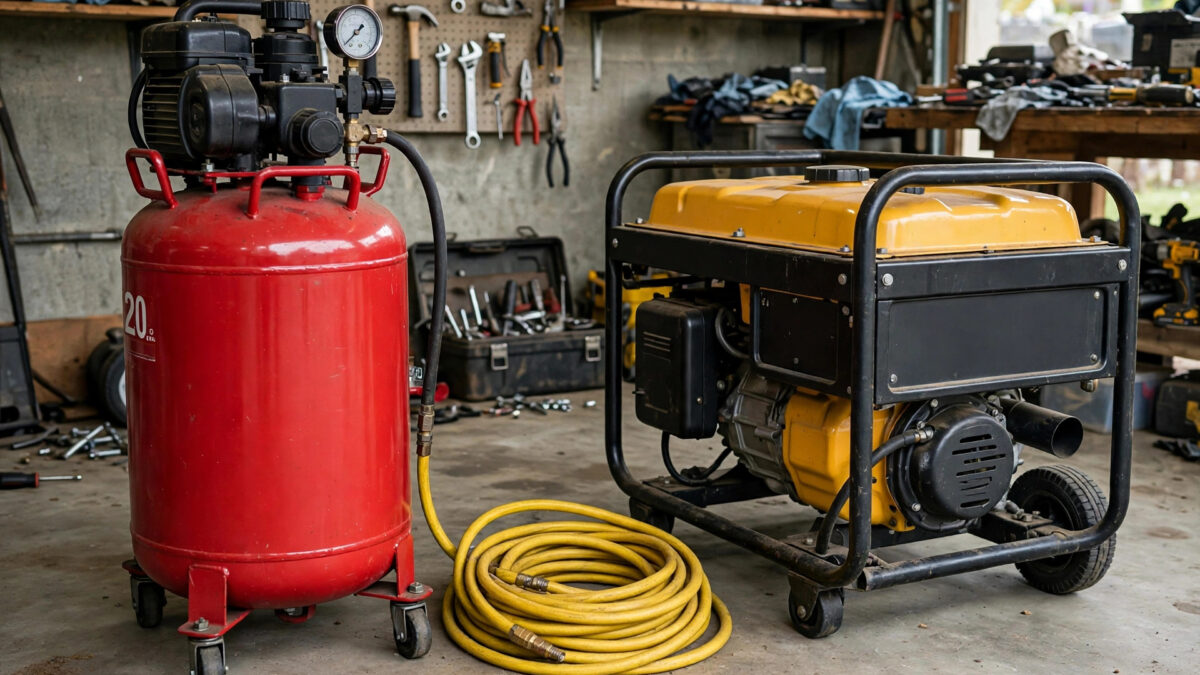
If your generator stalls out every time your air compressor kicks on, you’re dealing with the number-one sizing mistake in the DIY world: buying for running watts and forgetting starting watts. A typical 2 HP shop compressor needs about 2,000 watts to run — but 5,000+ watts to start. Buy a 2,500-watt generator for it and you’ll be staring at a tripped breaker wondering what went wrong.
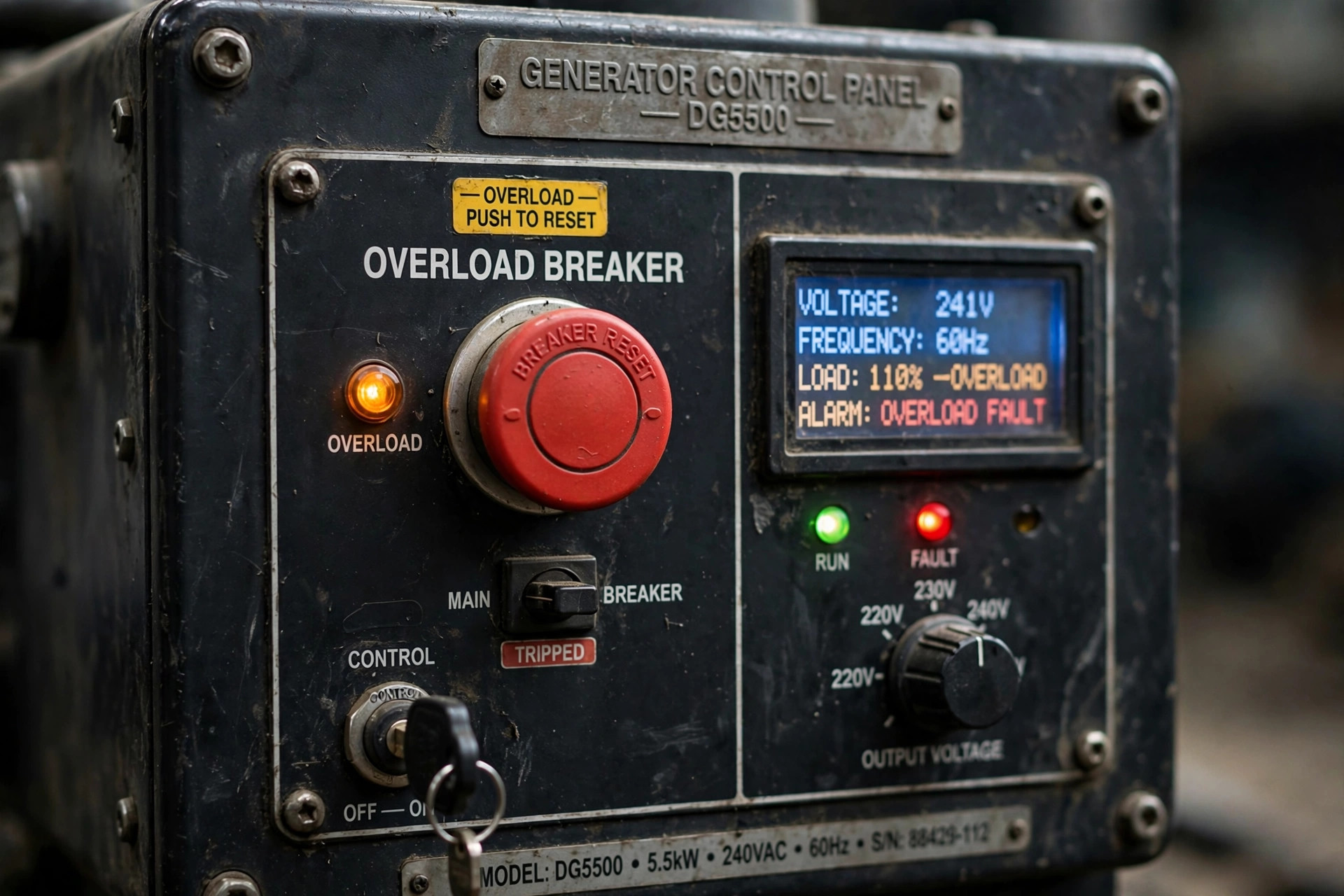
I’ve made this mistake myself. Years ago I tried to run a 2 HP, 20-gallon compressor off a 3,500-watt generator at a buddy’s farm. Every time the tank pressure dropped and the motor tried to restart under load, the generator’s overload breaker popped. We spent half the afternoon resetting it before I finally understood what was happening.
Key takeaways
- Air compressor motors draw 3–5× their running watts at startup (locked-rotor inrush) — the highest surge of any common tool.
- A 1 HP compressor needs roughly 3,000W starting / 1,000W running; a 2 HP needs roughly 5,100W starting / 2,000W running.
- Rule of thumb: size your generator for at least 2.5× the compressor’s running watts, and buy 6,500–7,500W for a typical 2 HP shop compressor.
- Start the compressor with the tank drained or the unloader valve open — starting under tank pressure roughly doubles the surge.
- Restarting under load (pressure switch cycling) is the failure point; that’s when the surge is worst.
Why Air Compressors Are the Hardest Motor Load
Every electric motor draws a big gulp of current when it starts from a dead stop — engineers call it locked-rotor current. For most motors it’s 2–3 times running current. But air compressors are worse than average for three reasons:
- They start under load. When the pressure switch kicks the motor on at 90–100 PSI, the compressor is already pushing against tank pressure from the first revolution.
- They cycle constantly. A fridge compressor starts once and runs for an hour. A compressor cycles dozens of times a day — every one of those cycles is a full starting surge hammering your generator.
- The motor is small but the surge is huge. That little 2 HP motor on a budget compressor is the reason this catches people off guard. It looks like it should sip power.
From motor data I’ve compiled over the years, here are realistic numbers for common compressor motors (capacitor-start induction run — the most common type on shop compressors):
| Motor size | Running watts | Starting watts | Minimum generator |
|---|---|---|---|
| 1 HP (120V) | ~1,000W | ~3,000W | 3,500W |
| 1.5 HP (120V) | ~1,600W | ~4,200W | 5,000W |
| 2 HP (120V/240V) | ~2,000W | ~5,100W | 6,500W |
| 3 HP (240V) | ~3,000W | ~6,800W | 8,000W |
| 5 HP (240V) | ~4,700W | ~12,000W+ | 15,000W |
Notice the multiplier: the starting watts run 3 to 5 times the running watts. If you’re sizing for a job site rather than a garage, our construction site generator sizing guide covers how to combine the compressor with saws, grinders, and everything else running at once.
The Formula: Check Your Motor’s Nameplate
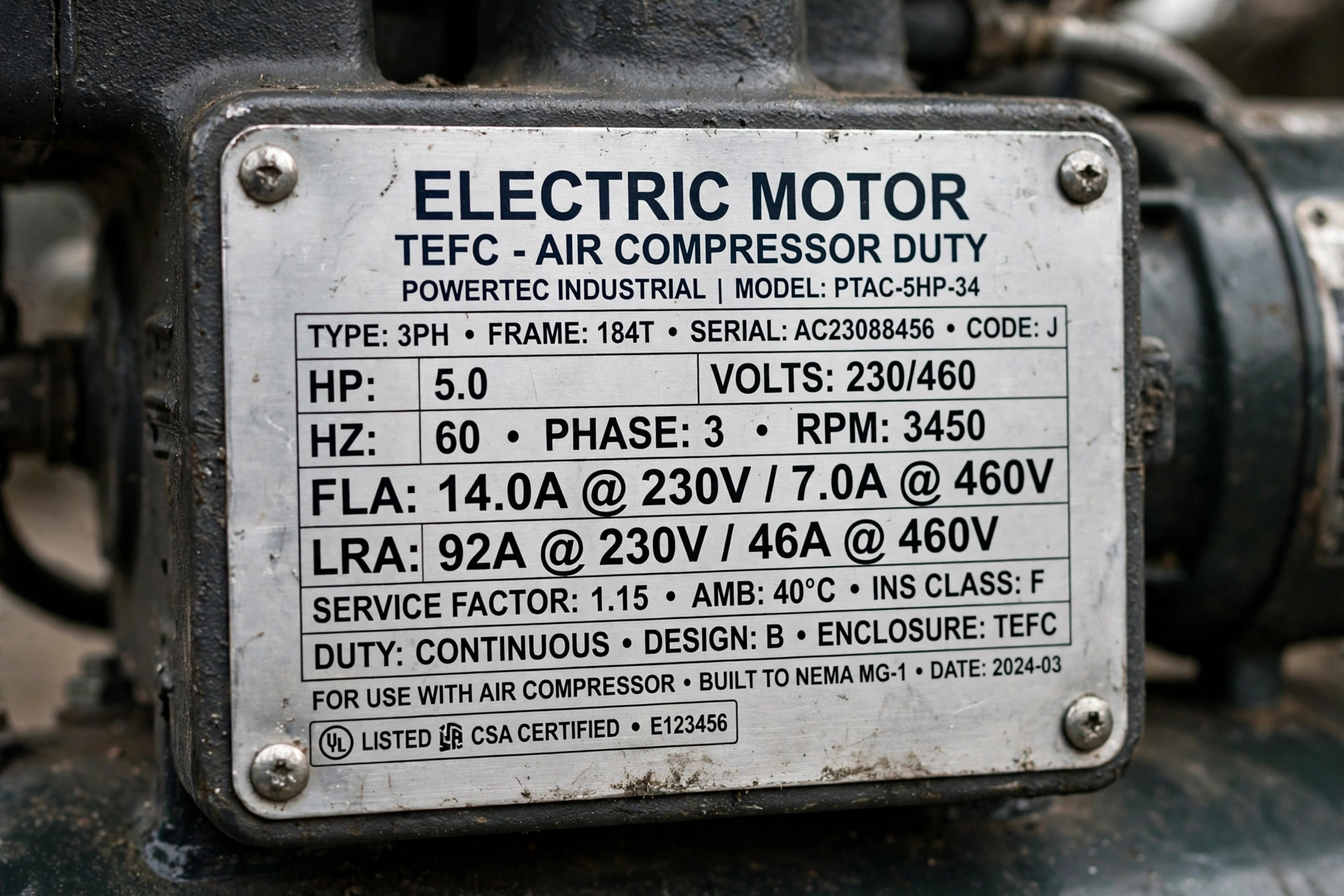
Tables are handy, but the honest way to size is to read the motor’s nameplate — the metal tag riveted to the motor housing. Look for two numbers: FLA (full-load amps) and, if you’re lucky, LRA (locked-rotor amps).
If you have LRA: starting watts = LRA × volts. A motor tagged 2 HP, 240V, with 30 LRA needs 30 × 240 = 7,200 starting watts. Size the generator’s surge rating above that number.
If you only have FLA, use the industry rule of thumb: running watts = FLA × volts, then multiply by 3 to 5 for starting watts. For compressors, I use 4× as my planning number because of the under-pressure starts. And add a 10–25% margin on top — nameplates describe the motor, not voltage drop through your extension cord or a hot day derating the generator.
The Restart-Under-Load Problem (My Afternoon at the Farm)
Here’s the detail that broke my first attempt and breaks most people’s: the compressor usually starts fine the first time — tank empty, no pressure, easy start. The generator trips on the second or third cycle, when the tank is at 100 PSI and the motor has to grunt against full pressure.
Two things fix this:
- Drain the tank or use the unloader valve. Starting with an empty tank (or with the pressure released via the drain valve) cuts the surge dramatically. Some compressors have an automatic unloader valve that bleeds head pressure — make sure yours actually works.
- Size for the worst start, not the first start. If your generator barely handles the first empty-tank start, it will fail the first loaded restart. Guaranteed.
What Size Generator for the Most Common Compressors?
Let me translate this into the compressors people actually own:
- Small pancake/hotdog compressor (1–1.5 HP, 6-gallon): A 3,500–4,000W generator handles these. They surge to about 3,000–4,200W. This is the trim-nailer/brad-nailer class.
- Typical 2 HP, 20–30 gallon shop compressor: You want a 6,500–7,500W generator. This is the most common pain point I hear about — people try a 4,000–5,000W unit and it trips on loaded restarts.
- 3–5 HP, 60–80 gallon two-stage compressor: These are 240V machines that surge to 7,000–12,000W+. You’re in 8,000–15,000W generator territory. At this point, check whether your generator even has a 240V outlet with enough amperage — many don’t.
Run the exact numbers for your setup in our generator size calculator — enter the compressor’s starting watts plus any other tools that’ll run at the same time.
Three Tricks That Actually Help
Beyond buying enough generator, these are the tricks I’ve used in the field:
1. Start the compressor with the tank drained
Open the drain valve, start the compressor, let it build a few PSI, then close the valve. You’ve just bypassed the hardest start of the day.
2. Turn off eco mode and other loads during starts
Generators with eco-throttle take a second to ramp up when a load hits. During a compressor restart, that delay is the difference between starting and tripping. Turn eco off, and unplug everything else while the compressor cycles.
3. Short, thick extension cord — or none
A 100-foot 16-gauge cord can drop enough voltage that a compressor which starts fine at the generator’s outlet won’t start at the end of the cord. Use 12-gauge minimum, keep it under 50 feet if you can, and never run the compressor through a power strip.
FAQs
Will a 3500 watt generator run an air compressor?
How many watts does a 2 HP air compressor use?
Why does my generator trip when the air compressor restarts?
Can I run an air compressor on a 120V outlet from my generator?
What size generator do I need for a 5 HP air compressor?
The Bottom Line
Air compressors punish undersized generators more than any other common tool because of that 3–5× starting surge and the constant loaded restarts. Read the motor nameplate, multiply FLA × volts × 4 for your planning number, and buy the generator that covers the worst restart — not the easy first start. Do the math once and you’ll never spend an afternoon resetting breakers like I did.

Related Guides
Why Does My Generator Backfire? Causes and Fixes (2027)
Why does your generator backfire? An exhaust bang means unburned fuel in the muffler; a pop through the carb means lean mixture or valve trouble. Here are the fixes.

Generator Valve Adjustment: How to Set Valve Lash (2027 Guide)
Generator valve adjustment: 0.006" intake, 0.008" exhaust on Honda GX engines. Tools, TDC procedure, and symptoms of bad valve lash explained.
How to Clean and Replace a Generator Air Filter (2027 Guide)
How to clean a generator air filter: wash foam filters in soapy water and re-oil; tap out paper filters, never wash them. Full steps inside.