


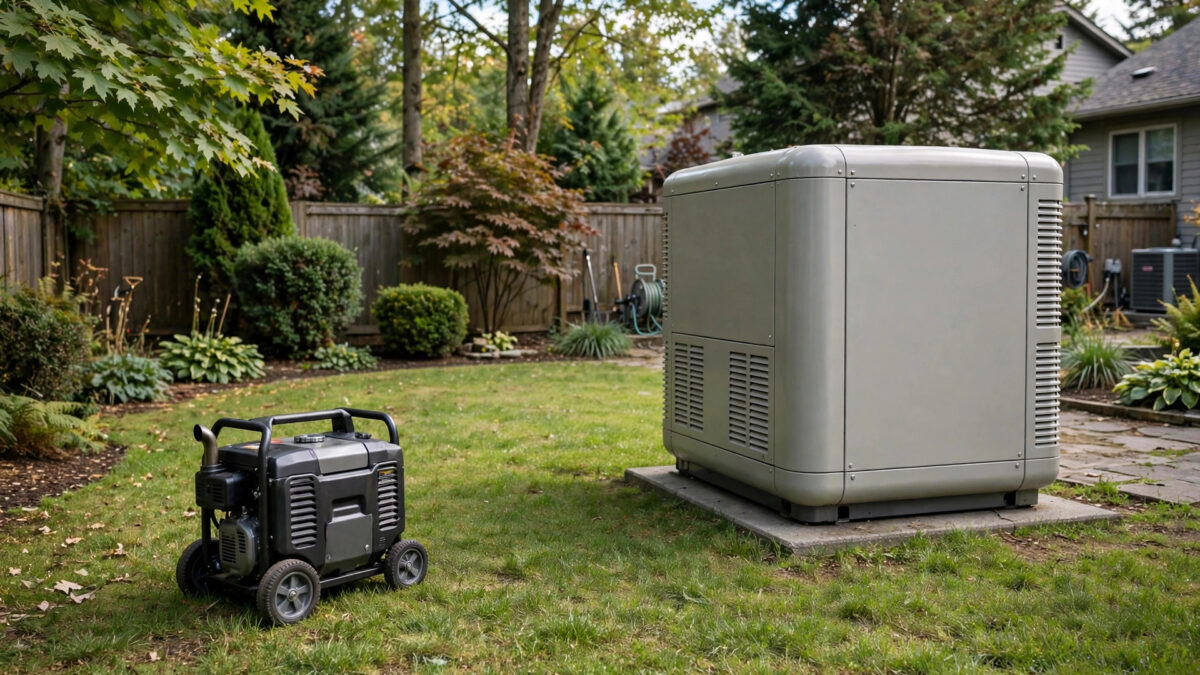
Portable vs standby generator — which is right for your home? Here is the direct answer: a portable generator ($500-$3,000 plus $600-$1,800 for a transfer switch install) is the right choice for most homeowners who face occasional outages and want affordable, flexible backup. A standby generator ($9,000-$20,000+ installed) is the right choice if you face frequent or long outages, have medical equipment or a home office to protect, or want fully automatic whole-house coverage with zero effort. The price gap is roughly 5-10x, but so is the convenience gap. This guide compares cost, runtime, maintenance, and pros and cons head-to-head, based on published specifications, contractor cost ranges, and aggregated owner feedback — not hands-on testing.
Key Takeaways
- Portable: $500-$3,000 for the unit + $600-$1,800 transfer switch install; manual operation; you refuel it.
- Standby: $9,000-$20,000+ installed; automatic operation; runs on natural gas or propane.
- Runtime: portables run 8-14 hours per tank; standbys run indefinitely on a gas line.
- Maintenance: portables need attention before/after each use; standbys self-test weekly and need annual dealer service.
- Choose portable for occasional outages and tight budgets. Choose standby for frequent outages, medical needs, or hands-free operation.
Portable vs. Standby Generator: What’s the Difference?
A portable generator is a self-contained unit on wheels (or light enough to carry) that you roll out, start manually, and connect to your home — either through extension cords or, far better, a manual transfer switch wired to your panel. It burns gasoline, propane, or both, from onboard or portable tanks. When the outage ends, you shut it down, let it cool, and roll it back into storage.
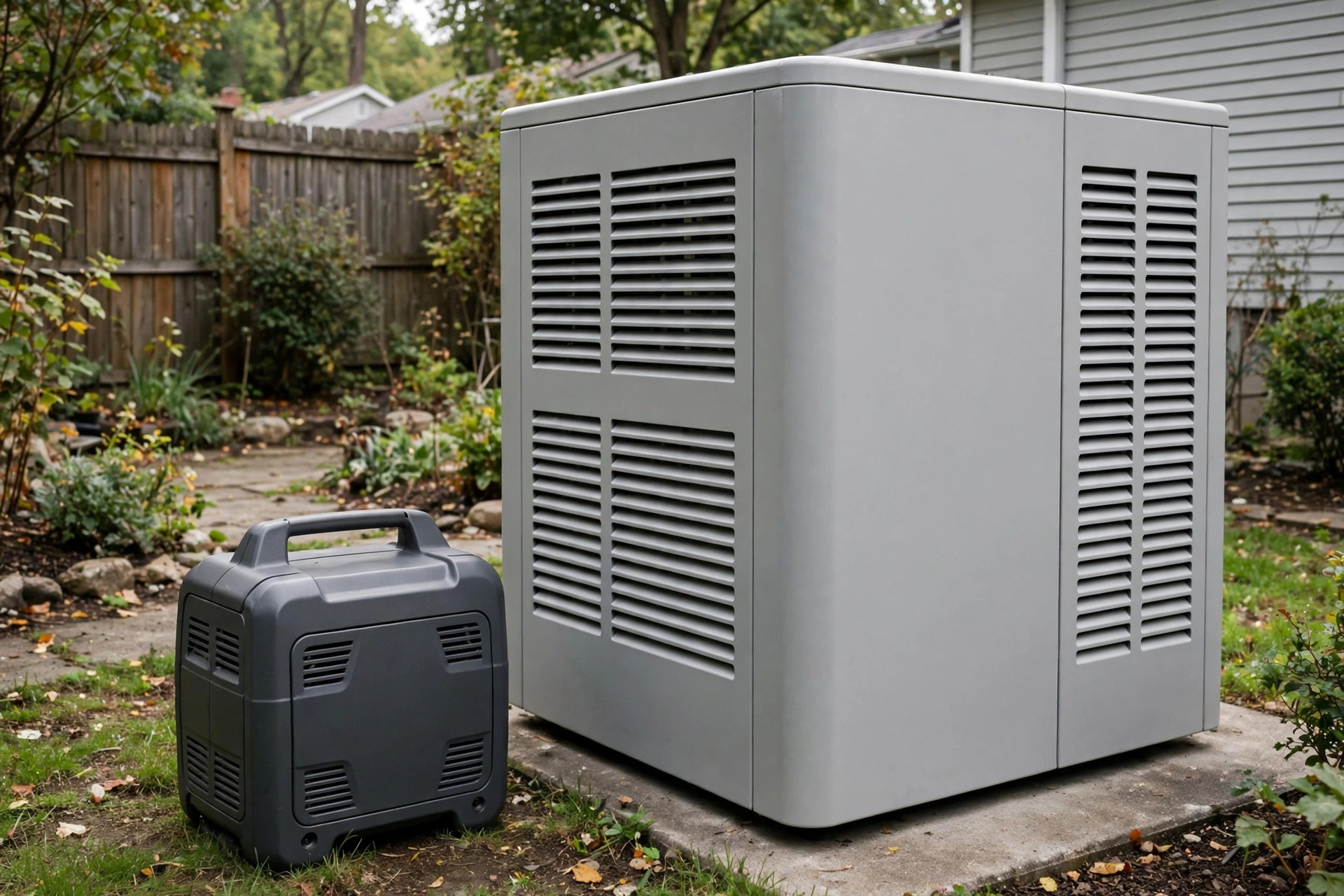
A standby generator is permanently installed outside your home on a concrete pad, wired into your electrical panel through an automatic transfer switch, and connected to natural gas or a propane tank. When the power fails, it starts itself within seconds — whether you are home or not — and shuts itself down when utility power returns. It exercises itself weekly to stay ready.
The core trade-off: portables are affordable and flexible but demand your time and effort during every outage; standbys are expensive but invisible — they just work. Everything below flows from that distinction.
Cost Comparison: Portable vs. Standby
Cost is where most buyers start, and the gap is enormous. A capable portable setup costs roughly one-tenth of a standby installation. Here is the full picture, using published 2027 price ranges.
| Cost item | Portable generator | Standby generator |
|---|---|---|
| Generator unit | $500-$3,000 | $3,000-$7,000 (14-24kW) |
| Transfer switch + install | $600-$1,800 (manual) | $1,000-$2,500 (automatic, in package) |
| Electrical labor | Included above | $1,500-$3,500 |
| Gas line work | $0 (portable tanks) | $500-$3,000+ |
| Pad / site prep | $0 | $300-$1,000 |
| Permits | $50-$200 | $200-$600 |
| Total installed | $1,100-$5,000 | $9,000-$20,000+ |
| Annual maintenance | $50-$150 (DIY) | $200-$600 (dealer plan) |
| Fuel cost per outage day | $8-$70 (size dependent) | $72-$173 (22kW, gas vs propane) |
Two cost nuances worth understanding. First, the portable total assumes you install a manual transfer switch — the right way to connect a portable to your home. Skip the switch and run extension cords, and the “install” is $0, but you lose the ability to power hardwired circuits (furnace, well pump) and gain a tangle of cords through windows. Second, standby fuel costs per day look high on propane, but on natural gas a 22kW standby costs roughly the same per day as a 7,500W portable on gasoline — while powering the entire house. Our fuel cost calculator guide walks through the hourly math.
Runtime and Fuel: How Long Can Each Run?
Portables are limited by their tanks. A typical 7,500W portable carries 6-8 gallons of gasoline and runs 8-12 hours at half load — meaning 2-3 refueling stops per day during a continuous outage. Dual-fuel models extend options (switch to propane when gas runs low), and tri-fuel models plumbed to natural gas remove the limit — but a gasoline portable’s fundamental constraint is that you are the fuel logistics department, including finding open gas stations during a widespread outage.
Standbys on natural gas run indefinitely — the utility is the fuel tank. On propane, runtime is limited by tank size: a 500-gallon tank (filled to 80%, the legal max) gives a 22kW standby roughly a week at half load. For multi-day outages, the standby’s autonomy is its killer feature: no refueling trips, no 2 AM tank swaps, no gas-station scavenger hunts. It just runs.
Maintenance Compared: What Each One Demands of You
| Maintenance task | Portable | Standby |
|---|---|---|
| Before each use | Check oil, check fuel, inspect cords | Nothing (self-monitoring) |
| During outage | Refuel 2-3x daily, monitor load | Nothing (automatic) |
| After each use | Cool down, stabilize or drain fuel, clean | Nothing (auto shutdown) |
| Routine exercise | Run 15-30 min every 1-2 months (your job) | Weekly auto self-test (automatic) |
| Annual service | Oil change, filter, plug (~$50-150 DIY) | Dealer service: oil, filters, battery check (~$200-600) |
| Battery | N/A (recoil) or small starter battery | Starter battery; replace every 3-5 years (~$100-200) |
| Biggest neglect risk | Stale fuel / gummed carburetor | Dead starter battery |
The maintenance story favors the standby for one reason: it maintains itself. The weekly self-test catches problems before an outage does, and dealer service plans keep records clean for warranty purposes. Portables fail most often from neglect between outages — the number one service call in the industry is a portable that will not start because last year’s gasoline turned to varnish in the carburetor. If you buy a portable, put “exercise monthly, stabilize fuel” on your calendar and treat it as non-optional. Our fuel storage guide covers the routine that prevents most no-start failures.
Pros and Cons: Portable Generator
Pros: affordable ($1,100-$5,000 all-in); flexible — take it camping, to a job site, or to a relative’s house; no permits or professional installation required for cord-connected use (transfer switch install still needs an electrician); wide selection from $500 budget units to $3,000 tri-fuel flagships like the Westinghouse WGen14500TFc; easy to upgrade or replace; useful even without outages.
Cons: manual everything — you must be home to start, refuel, and monitor it; limited runtime per tank; noisy (conventional portables run 68-78 dBA); must be stored securely (theft is a real issue during outages); cannot safely power the whole house in most configurations; you handle fuel storage and stale-gas risk.
Pros and Cons: Standby Generator
Pros: fully automatic — starts in seconds whether you are home, asleep, or traveling; whole-house coverage including central AC; indefinite runtime on natural gas; quieter than portables relative to power delivered (enclosed, ~63-67 dBA); weekly self-tests and Wi-Fi monitoring (e.g., Generac Mobile Link); can increase home value in outage-prone markets.
Cons: expensive ($9,000-$20,000+ installed); permanent — it stays with the house if you move; requires professional installation, permits, and inspections; ongoing dealer maintenance costs; propane models have high per-hour fuel costs; overkill if your outages are rare and brief.
When Portable Wins / When Standby Wins
Choose a portable generator when: outages in your area are occasional (a few per year) and short (hours, not days); your budget is under $5,000; you want flexibility for camping, RVing, or job sites; you are comfortable with hands-on operation; or you rent your home (a standby is a permanent fixture).
Choose a standby generator when: outages are frequent or multi-day (hurricane, ice-storm, wildfire-PSPS regions); anyone in the home depends on powered medical equipment; you work from home and cannot afford downtime; you travel frequently and need protection while away; or you simply want the “it just works” experience and the budget allows.
Consider neither — consider a power station — when: your needs are light (fridge, phones, laptops, CPAP) and outages are short. A 1-2kWh LiFePO4 power station like the Jackery Explorer 1000 v2 or EcoFlow DELTA 3 Plus is silent, indoor-safe, and maintenance-free — the right tool for short, light outages. Our power station guide covers the options.
Our verdict
Most homeowners should buy a portable generator with a professionally installed transfer switch — $1,100-$5,000 all-in buys reliable backup for essential and near-whole-house loads at a fraction of standby cost. Buy a standby if outages are frequent, long, or high-stakes (medical equipment, home office, frequent travel) — the $9,000-$20,000+ buys automation and peace of mind that no portable can match. Either way, size it properly, install the electrical connections professionally, and maintain it.
How we researched this
We compared published manufacturer specifications, contractor installed-cost ranges, fuel-consumption figures, and maintenance schedules for portable and standby generators, cross-checked against aggregated owner feedback. Cost figures are approximate 2027 ranges; labor rates, permit fees, and fuel prices vary by region. We did not test any generators hands-on. Get written quotes from licensed electricians and certified standby dealers for your specific situation.
Is a portable or standby generator better?
How much more does a standby generator cost than a portable?
Can a portable generator power a whole house?
Do standby generators need maintenance?
How long can a standby generator run continuously?
Does a standby generator increase home value?
Portable vs. standby is ultimately a question about your outages, not about generators. Occasional and short? A portable with a transfer switch covers you for a tenth of the price. Frequent, long, or high-stakes? A standby earns its premium the first time it starts itself at 3 AM while you’re asleep — or away. Size either one properly, get the electrical work done by a licensed professional, and see our best portable generators for home backup and best whole house generators roundups to pick the specific model.

Related Guides
Best Time to Buy a Generator: 2027 Price & Sales Calendar
The best time to buy a generator is Black Friday, with 10-30% off typical. 2027 price and sales calendar: clearance windows, pre-season deals, and timing tips.

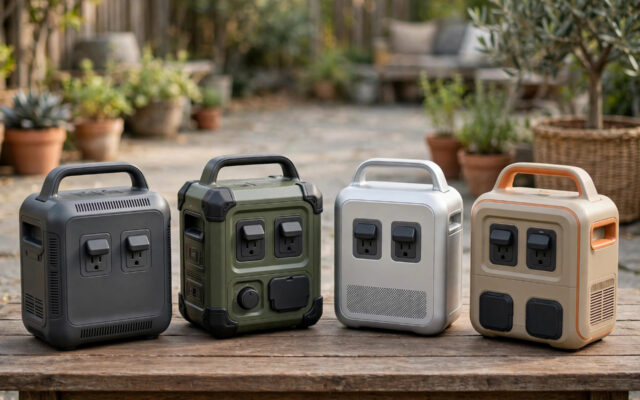
Jackery vs EcoFlow vs Bluetti vs Anker: Which Power Station Brand Is Best?
Jackery vs EcoFlow vs Bluetti vs Anker power stations compared on battery chemistry, charging speed, cycle life, and value. Includes the NMC vs LiFePO4 warning.
Champion vs Westinghouse vs DuroMax: Which Generator Brand Is Best?
Champion vs Westinghouse vs DuroMax compared on warranty, lineup breadth, CO safety tech, and value. Find which generator brand is best for your needs.