


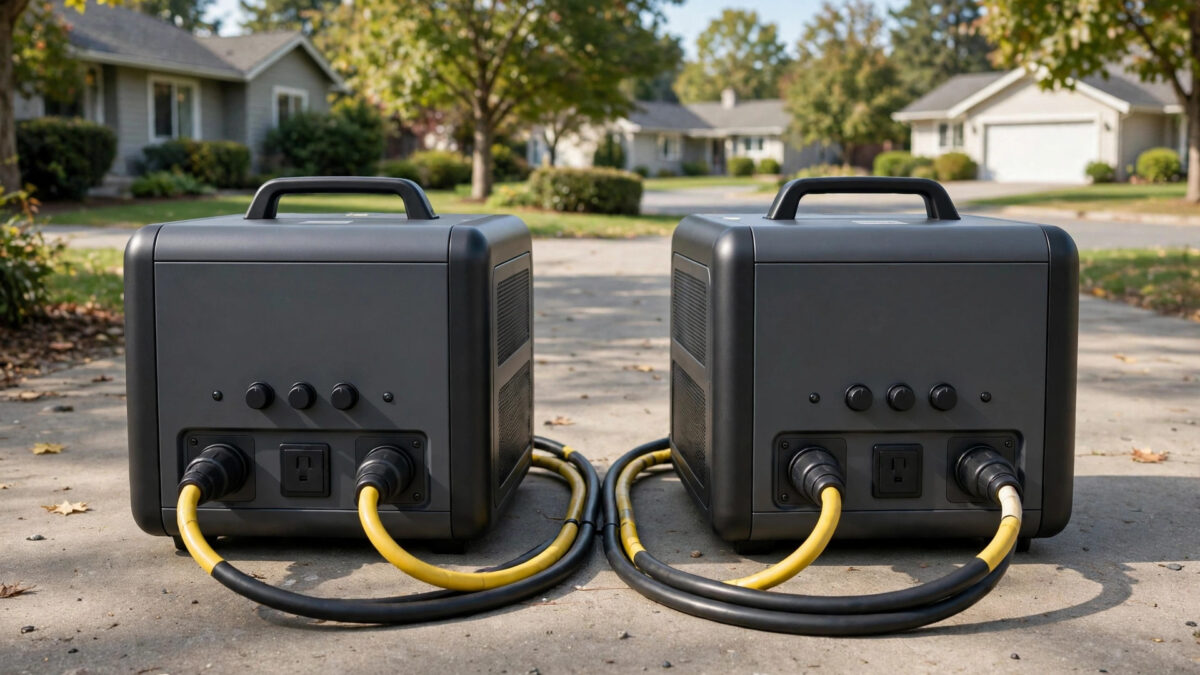
To parallel two inverter generators, you connect them with a manufacturer-approved parallel kit or parallel cables, start both units, and let the kit combine their output into a single higher-wattage feed. Done correctly, two 2,500-watt inverter generators can power loads around 4,500–5,000 watts combined — but only if the two units are compatible models designed to parallel together, and only using the kit made for them. This guide explains how to parallel two inverter generators safely: compatibility, setup, and the safety rules that keep paralleling safe.
Key Takeaways
- Paralleling combines two compatible inverter generators for roughly double the running watts — ideal when one small unit is not enough.
- Only parallel models the manufacturer lists as parallel-capable, using the parallel kit or cables made for those models; never mix brands or incompatible units.
- Combined output is slightly less than the sum of both units’ ratings — plan for about 90% of the total as a working rule.
- Never connect a paralleled setup to your home’s wiring without proper transfer equipment installed by a licensed electrician.
- Start both generators before applying heavy loads, balance fuel levels, and shut down heavy loads before switching units off.
What Does It Mean to Parallel Two Inverter Generators?
Paralleling means linking two inverter generators so their AC output combines into one larger power source. Inverter generators produce exceptionally clean, synchronized power, which is what makes paralleling possible: the two units lock their waveforms together through the parallel kit, so their outputs add instead of fighting each other. The result is a single 120V feed (on most kits) with roughly twice the wattage of one unit — enough to run a refrigerator plus a microwave, or an RV air conditioner that a single small generator could not start alone.
People parallel for two practical reasons. First, flexibility: two small generators are easier to carry, store, and maintain than one big one, and you can run just one when loads are light to save fuel. Second, cost and redundancy: if one unit needs service, you still have the other. The trade-off is complexity — two engines to maintain, two fuel tanks to manage, and strict compatibility rules you must not bend.
Which Generators Can Be Paralleled?
Compatibility is the entire ballgame. Inverter generators are designed to parallel only with specific sibling models, and the manufacturer’s parallel kit is engineered for those models’ control systems. Straying outside the approved combinations risks damaging one or both generators, tripping protection circuits, or producing unstable power.
The compatibility rules
Follow these rules without exception:
| Rule | What it means |
|---|---|
| Same brand and parallel-capable series | Both units must be models the manufacturer explicitly lists as parallel-compatible — usually the same model or a designated pair (e.g., a standard and a “companion” unit with a 30A outlet). |
| Use the correct parallel kit | Parallel kits are model-specific. A kit for one brand’s 2,000W series will not correctly serve another brand’s 3,500W series, even if the plugs look similar. |
| Match capacity sensibly | Manufacturers generally intend paralleling of equal or near-equal units. Pairing a 2,000W unit with a 4,500W unit is not a supported configuration. |
| Both must be inverter generators | Conventional (non-inverter) generators cannot be paralleled with a simple kit — their output cannot synchronize this way. Do not attempt it. |
What a parallel kit includes
A typical kit contains the parallel connection cables or a small parallel box with outlets, designed to link the dedicated parallel ports on each generator. Many kits add a higher-amperage outlet (such as a 30A RV-style or twist-lock receptacle) that neither generator offers alone — that outlet is the whole point for RV and worksite users. “Companion” models in a manufacturer’s lineup include this larger outlet built in, while the standard sibling provides the second half of the power.
How to Parallel Two Inverter Generators: Step-by-Step Setup
Setup is straightforward once you have two compatible units and the right kit. Work through these steps in order, with both generators off and cool.
Step 1: Place both generators correctly
Set both units outdoors on level ground, at least 20 feet from the home, with exhaust pointed away from buildings, doors, windows, and vents. Leave several feet of clearance around each unit for airflow and for you to work the controls. Both generators must be in the same outdoor location — never run one in a garage or enclosed space while the other is outside.
Step 2: Connect the parallel kit with both units off
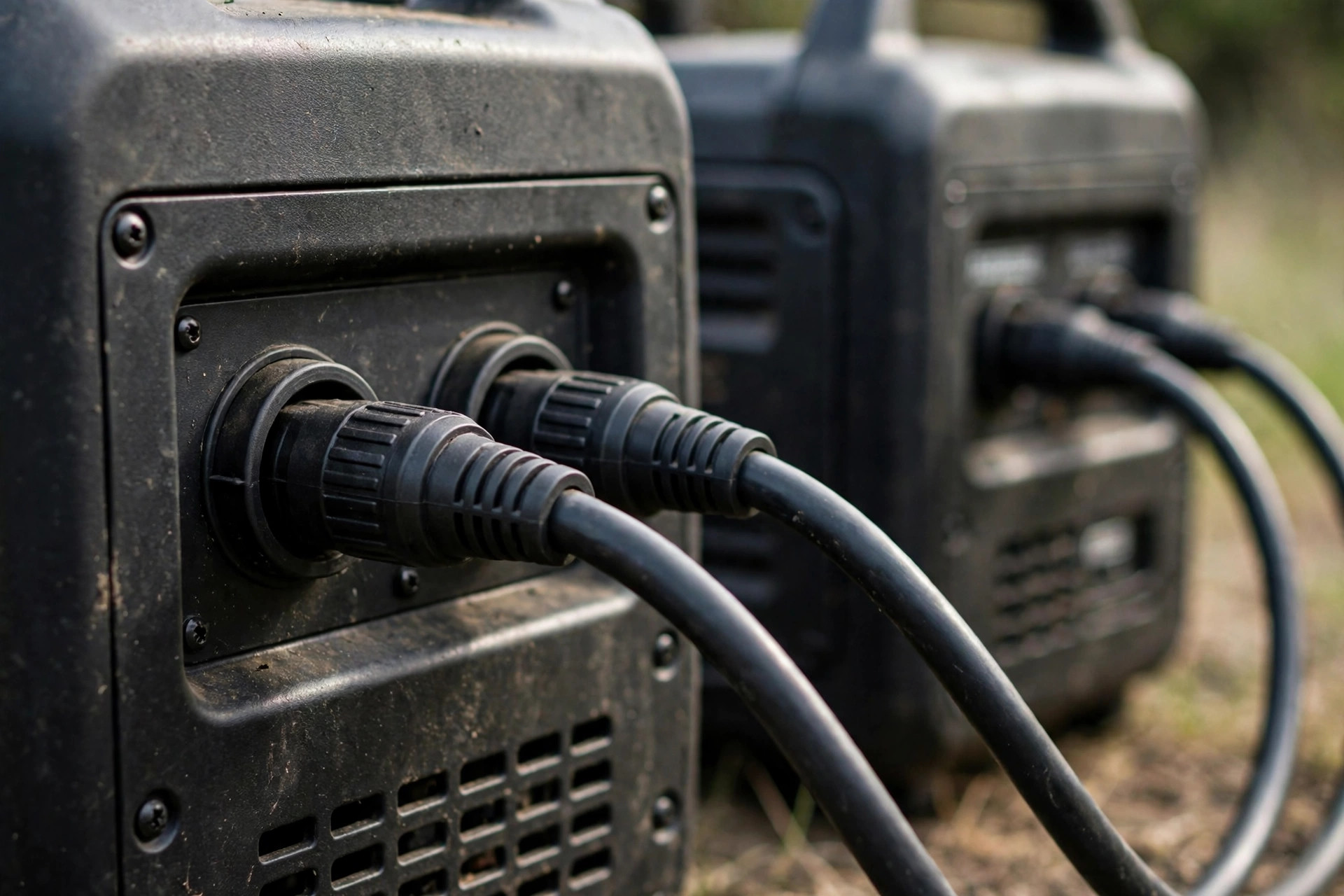
With both generators switched off, plug the parallel cables or parallel box into the dedicated parallel ports on each unit, following the kit’s diagram exactly. These ports are purpose-built and usually color-coded or keyed — they are not the same as the regular AC outlets. Confirm each connection is fully seated.
Step 3: Check oil and fuel on both units
Verify oil level and fuel on both generators before starting. Running the pair with wildly different fuel levels means one unit may run dry first, dropping the combined output unexpectedly under load. Fill both tanks so they deplete at roughly the same rate.
Step 4: Start both generators, then let them stabilize
Start the first generator, let it warm up for a minute or two, then start the second. Allow both to reach stable idle before connecting any load — most manufacturers recommend a brief warm-up, and eco/throttle modes should be set the same on both units (generally eco mode off when you plan to run near the combined capacity, so neither unit lags on throttle response).
Step 5: Connect your load to the kit’s outlet
Plug your extension cord or RV cable into the parallel kit’s combined outlet — not into one generator’s individual outlets. Add loads gradually, starting with the largest motor load first so its startup surge is handled while headroom is greatest.
Step 6: Manage loads within the combined capacity
Add up the running watts of everything connected and keep the total comfortably below the pair’s combined running watts — remember the ~90% working rule. Watch for the overload indicators on either unit; if one trips, reduce load before resetting.
Step 7: Shut down in the right order
Remove heavy loads first, let the units run unloaded for a few minutes to cool, then switch both off. Disconnect the parallel cables only after both units are off and cool.
How Much Power Do You Actually Get?
Two paralleled generators deliver slightly less than the arithmetic sum of their ratings, because of small synchronization and conversion losses. As a planning rule, expect roughly 90% of the combined running watts to be usable. The table below shows typical pairings using common inverter generator sizes.
| Pairing | Combined running watts (approx.) | Usable planning figure (~90%) | Good for |
|---|---|---|---|
| 2 × 2,000W | 4,000W | ~3,600W | Fridge + lights + small appliances; light RV use |
| 2 × 2,500W | 5,000W | ~4,500W | RV air conditioner + basics; sump pump + fridge + freezer |
| 2 × 3,500W | 7,000W | ~6,300W | Heavier RV setups; multiple large appliances |
These are approximate planning figures, not promises — check your specific models’ parallel ratings in their manuals, since some manufacturers publish a dedicated “parallel running watts” figure that already accounts for the losses. Size your loads against the manual’s number, and always leave headroom for motor starting surges, which can briefly demand two to three times an appliance’s running watts.
How to Parallel Two Inverter Generators Safely: Key Rules
Paralleling doubles your power and doubles the number of engines producing carbon monoxide, heat, noise, and fuel vapor. Every standard generator safety rule applies to both units, plus a few paralleling-specific ones.
Carbon monoxide: two engines, twice the vigilance
Both generators must be outdoors, 20+ feet from the home, exhausts pointed away. Working CO alarms inside the home are mandatory. Never bring one unit into a garage “temporarily” while the other runs outside — CO does not care about your intentions.
Never backfeed your home’s wiring
A paralleled pair must never be connected to household wiring except through properly installed transfer equipment. The temptation is real — “it’s just for the outage” — but backfeeding through a dryer outlet or similar improvisation is illegal, can kill utility line workers, and can destroy both generators when utility power returns. If you want whole-house backup, have a licensed electrician install a transfer switch or interlock kit.
Fuel and electrical handling
Refuel only with both units off and cool. Keep fuel stored per local fire codes, away from the running units. Use outdoor-rated extension cords in good condition, sized for the amperage — the combined 30A-class output of a paralleled pair will overload a light-duty cord. Keep connections dry; if rain threatens, shut down and wait, or use a generator tent rated for the purpose (never a tarp draped over a running unit).
Can you parallel any two inverter generators?
Do you need a special kit to parallel generators?
How many watts do two paralleled 2,500W generators produce?
Can paralleled generators run an RV air conditioner?
Can I connect paralleled generators to my house panel?
Should eco mode be on when paralleling?
Conclusion
Learning how to parallel two inverter generators gives you a flexible, scalable backup power system: run one small unit for light loads, or link the pair when the air conditioner, well pump, or workshop tools need to run. The entire practice rests on three non-negotiables — compatible models, the correct parallel kit, and proper transfer equipment for any connection to home wiring. Respect those, manage your loads against the combined rating, and keep both units outdoors with CO alarms inside, and paralleling is one of the most practical upgrades a generator owner can make. If you have not bought your units yet, our guide to the best inverter generators of 2027 is the place to start.

Related Guides
How to Store a Generator Long-Term: Fuel, Battery & Winterization Checklist
How to store a generator long term: fuel stabilizer vs draining, oil change, fogging oil, battery care, winterization extras, plus a printable checklist.

Can You Run a Generator in the Rain? What Is Safe & What Is Not
Can you run a generator in the rain? Only under a proper cover. Learn the safe setups, the deadly mistakes to avoid, and when to shut down in severe storms.
How to Break In a New Generator: Step-by-Step First-Use Guide
How to break in a new generator: pre-start setup, the varying-load running schedule, the critical first oil change, and 5 mistakes that shorten engine life.