


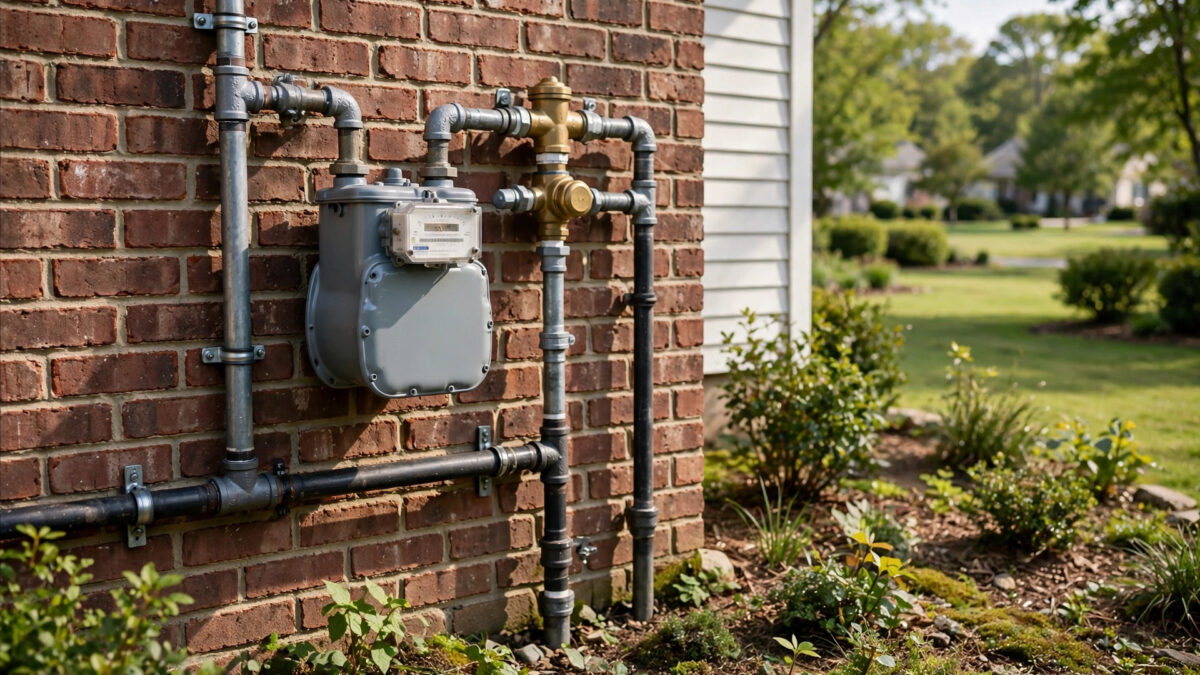
Often, yes — a natural gas standby generator frequently requires a bigger gas meter, because the generator adds a large new gas load on top of everything else in the house. A typical residential gas meter delivers around 250 cubic feet per hour (CFH), while a 20–24 kW standby generator alone can demand 200–300+ CFH at full load. Whether you need an upgrade depends on your total connected load versus your meter’s rated capacity — and the only people who can answer definitively are your gas utility and your installer, who will run a proper load calculation.
Key Takeaways
- Many standby generator installations need a bigger gas meter because the generator’s demand can exceed the existing meter’s capacity when added to the home’s other gas appliances.
- A typical residential meter (~250 CFH) may be fully consumed by a 20–24 kW generator alone, leaving nothing for the furnace, water heater, or stove.
- The deciding factor is a gas load calculation: total BTU/hr demand of all appliances, converted to CFH, versus the meter’s rated capacity.
- Meter upgrades are usually performed by the gas utility — often at low or no cost — but they take scheduling lead time, so start early.
- Undersized gas supply causes hard starting, surging under load, and shutdowns — and can void the generator’s warranty.
Why a Natural Gas Generator Might Need a Bigger Gas Meter
Your gas meter is sized for the home as it was built — furnace, water heater, stove, dryer, fireplace — with some headroom the utility engineered in. A standby generator is not a small addition to that picture; it is typically the single largest gas appliance in the home by a wide margin. A 20 kW air-cooled standby generator at full load demands roughly 200–300 cubic feet of natural gas per hour (around 200,000–300,000 BTU/hr), which can equal or exceed the entire rest of the house combined.
When total demand exceeds what the meter and service line can deliver, gas pressure at the appliances drops. The generator — the hungriest and most pressure-sensitive appliance — feels it first: hard starting, hunting and surging under load, failure to pick up the full house load, or protective shutdowns. These are not just annoyances; chronic fuel starvation causes lean running that can damage the engine, and manufacturers can deny warranty claims when the fuel supply does not meet their specifications. Sizing the gas supply correctly is as important as sizing the generator’s wattage.
How Gas Load Calculations Work
Installers and utilities decide the meter question with a gas load calculation — an inventory of every gas appliance’s maximum demand, summed and compared against the meter’s rated capacity. Understanding the math helps you follow the conversation and sanity-check the result.
Step 1: Convert every appliance to BTU per hour
Each gas appliance has a nameplate input rating in BTU/hr. Typical residential values:
| Appliance | Typical input (BTU/hr) |
|---|---|
| Standby generator, 14 kW | ~150,000–200,000 |
| Standby generator, 20 kW | ~200,000–260,000 |
| Standby generator, 24–26 kW | ~250,000–330,000 |
| Furnace (typical) | ~60,000–120,000 |
| Tank water heater | ~35,000–50,000 |
| Tankless water heater | ~150,000–200,000 |
| Gas range/oven | ~50,000–70,000 |
| Clothes dryer | ~25,000–35,000 |
| Gas fireplace | ~20,000–40,000 |
These are representative ranges — your specific appliances’ nameplates are what count in a real calculation. Note how the generator dwarfs nearly everything else, and how a tankless water heater plus a generator together can demolish a standard meter’s capacity.
Step 2: Convert BTU/hr to cubic feet per hour
Natural gas contains roughly 1,000 BTU per cubic foot (utilities publish the exact heating value locally; it varies slightly by region and supply). So divide total BTU/hr by ~1,000 to get CFH. A home totaling 450,000 BTU/hr of connected load needs about 450 CFH of meter capacity.
Step 3: Compare against the meter’s rating
Gas meters carry a rated capacity, commonly expressed in CFH at a standard pressure drop. Typical residential meters are rated around 250 CFH, with larger residential/light-commercial meters at 400, 425, 600, or 1,000+ CFH. The rating is stamped on the meter’s badge — your installer will read it during the site survey. If total connected load exceeds the meter’s rating (with the diversity factors the local code allows), the meter must be upgraded.
When Does a Natural Gas Generator Need a Bigger Gas Meter?
The honest answer is “when the load calculation says so,” but these patterns cover most homes:
| Scenario | Typical outcome |
|---|---|
| Small generator (10–14 kW) + gas furnace + standard water heater, 250 CFH meter | Often fits, but tight — calculation required |
| 20 kW generator + gas furnace + tank water heater, 250 CFH meter | Very likely needs a meter upgrade |
| Any standby generator + tankless water heater | Almost always needs a bigger meter — the two largest residential gas loads combined |
| 24 kW+ generator, any gas-heated home | Expect a meter upgrade as standard practice |
| Generator + pool heater or other large gas loads | Upgrade plus possible service line upsizing |
Two subtleties matter. First, diversity factors: codes and utilities recognize that not every appliance runs at maximum simultaneously, so the calculation may apply diversity allowances — but generators are typically counted at full load because during an outage they genuinely can run at full load while the furnace also runs. Second, the meter is only half the system: the underground service line from the street and the house piping must also carry the total flow. A bigger meter on an undersized service line does not solve the problem — the utility evaluates the whole path.
Getting a Bigger Gas Meter for Your Natural Gas Generator: The Process
A meter upgrade is routine utility work, but it runs on utility scheduling — start it early in your generator project, not the week before installation.
Step 1: Get the load calculation done
Your generator installer or a licensed plumber/gas fitter performs the site survey: appliance nameplates, meter rating, pipe sizes and lengths, and the generator’s fuel requirements from its spec sheet (full-load BTU/hr and minimum inlet pressure). Reputable standby installers do this as standard practice before quoting.
Step 2: Contact the gas utility
The installer or you submit the load information to the gas utility and request a meter capacity review. The utility determines whether the existing meter suffices, and if not, what size is required and whether the service line needs upsizing too. In many regions the utility performs meter upgrades at little or no charge to the homeowner, since a larger meter is their asset — but policies and fees vary, so ask.
Step 3: Schedule the utility work ahead of the generator install
Utility lead times range from days to several weeks depending on the region, season, and whether trenching for a larger service line is involved. The meter work should be complete (or firmly scheduled) before the generator installation day — discovering an undersized meter with the electrician already on site is an expensive delay.
Step 4: Verify pressure under load after installation
After everything is installed, the commissioning process should include verifying gas pressure at the generator while it runs under load — typically with other major appliances firing to simulate worst case. This is the proof the whole fuel system works as designed. Ask your installer to confirm this test was performed; it is the commissioning step most often skipped.
Pipe Sizing: The Other Half of the Fuel System
The meter gets the attention, but the piping from the meter to the generator matters just as much. Gas pipe is sized by length, diameter, and total load using standardized sizing tables (such as those in the fuel gas code). A long run of undersized pipe to a distant generator pad starves the unit exactly like an undersized meter does — pressure drops along the pipe’s length, and the generator sees the shortfall.
Practical implications: the generator’s placement affects fuel cost, not just electrical cost. A pad close to the meter means a shorter, cheaper gas run; a pad at the far corner of the lot may need larger-diameter pipe for the whole run. Your gas fitter sizes this from the tables — but when you are choosing between two pad locations, ask which one makes the gas run simpler. Sometimes moving the pad ten feet closer to the meter saves hundreds in pipe upsizing.
What If the Utility Says No — or Quotes a Big Fee?
Occasionally the news is bad: the service line cannot be upsized without major trenching, or the upgrade fee is substantial. You still have options:
Option 1: A smaller generator
Dropping from a 24 kW to a 14–18 kW unit, possibly paired with load management (smart modules that shed the water heater or AC during generator operation), can bring the gas demand within existing capacity. Right-sizing with load management is good practice anyway — see our generator sizing guide.
Option 2: Convert some loads off gas
Replacing a gas dryer or range with electric models during a remodel reduces the connected gas load. This is a long-game strategy, not a quick fix, but it is worth knowing during planned renovations.
Option 3: Propane instead of natural gas
Many standby generators are available in propane or dual-fuel configurations. A propane-fed standby with its own tank sidesteps the meter question entirely — at the cost of tank installation and fuel deliveries. For homes where the gas utility cannot economically upsize, propane is often the practical answer.
Does a natural gas generator need a bigger gas meter?
How do I know what size gas meter I have?
Who pays for a gas meter upgrade for a generator?
What happens if the gas supply is undersized for my generator?
How long does a gas meter upgrade take?
Can I use propane instead to avoid a meter upgrade?
Conclusion
A bigger gas meter is one of the most common — and most commonly overlooked — requirements in a natural gas standby generator project. The generator is the hungriest gas appliance your home will ever have, and the load calculation is what determines whether your meter can feed it. Get the calculation done during the quoting phase, coordinate the utility early, verify pressure under load at commissioning, and the fuel system will be as reliable as the generator itself. If you are still choosing the unit, our standby generator sizing guide will help you pick the right capacity before the gas conversation even starts.

Related Guides
How Much Propane Does a Generator Use? Runtime by Tank Size
How much propane does a generator use per hour? Consumption by generator size, runtime estimates for 20–100 lb tanks, and the cold-weather factor owners miss.


Best Propane Generators for Camping & RV in 2027: 7 Tested Picks
Propane generators allow campers to enjoy modern necessities off-grid. Check out our picks for the 15 best propane generators for camping in 2027. We cover top options across power outputs, weights, and prices to help you find the perfect fit.


Propane Vs Natural Gas Generator
When choosing between propane and natural gas generators, propane offers more portability while natural gas provides abundant fuel. This guide explores both types to help you determine the better option.