


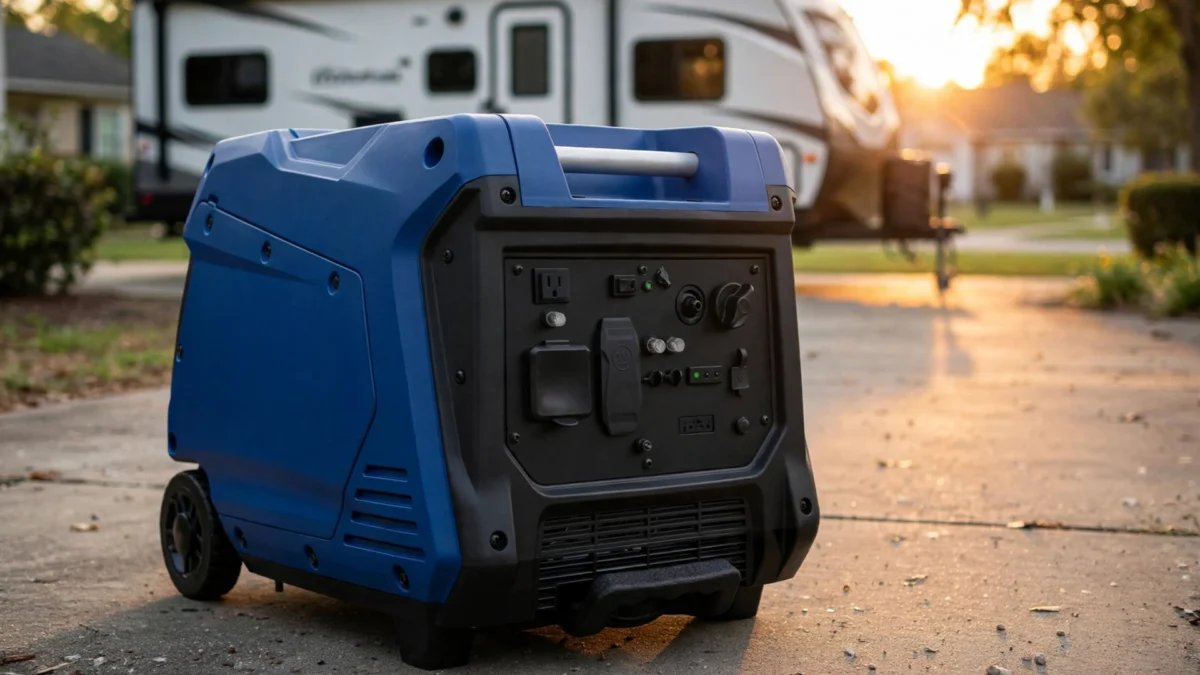
The Westinghouse iGen4500DF is the generator I recommend most often — and the one I get asked about most. It’s a 4,500-watt dual-fuel inverter that sells for roughly half what a comparable Honda costs, and it shows up in more “what should I buy” conversations than any other single model. After years of watching owner reports roll in and running one myself, I have a clear picture of where it shines and where the Honda money still buys something.
The short version: this is the best value in dual-fuel inverters. It’s quiet, it’s genuinely RV-ready with a 30-amp outlet, remote start is standard, and the dual-fuel flexibility means you can run propane when gasoline storage gets annoying. It’s not a Honda — fit and finish are a step down, and long-term refinement lags — but at $800–$1,100, it doesn’t need to be.
Key takeaways
- 4,500 starting / 3,700 running watts on gas (4,050 / 3,330 on propane) — enough for an RV AC plus more.
- 52 dBA — genuinely quiet; holds normal conversation next to it.
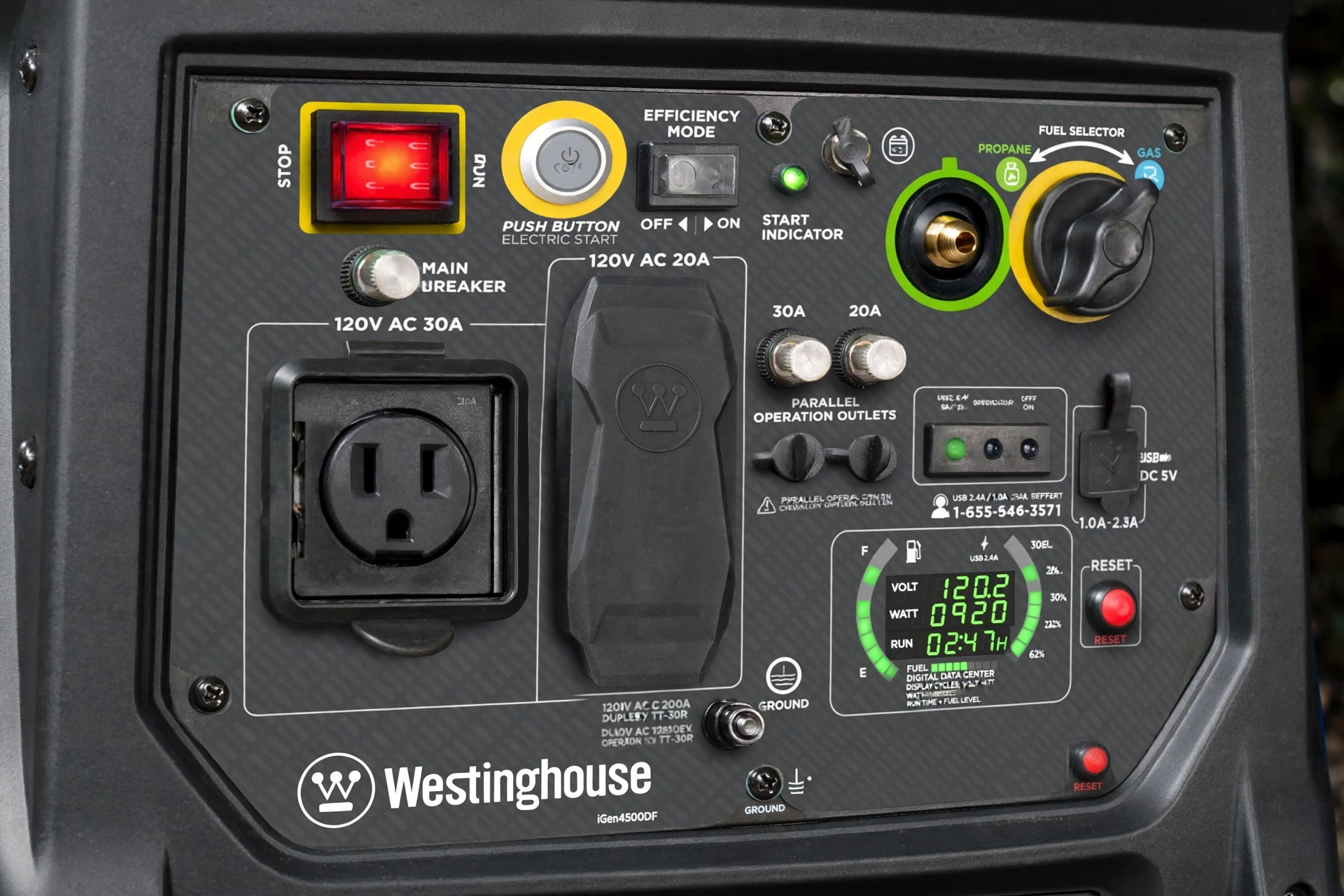
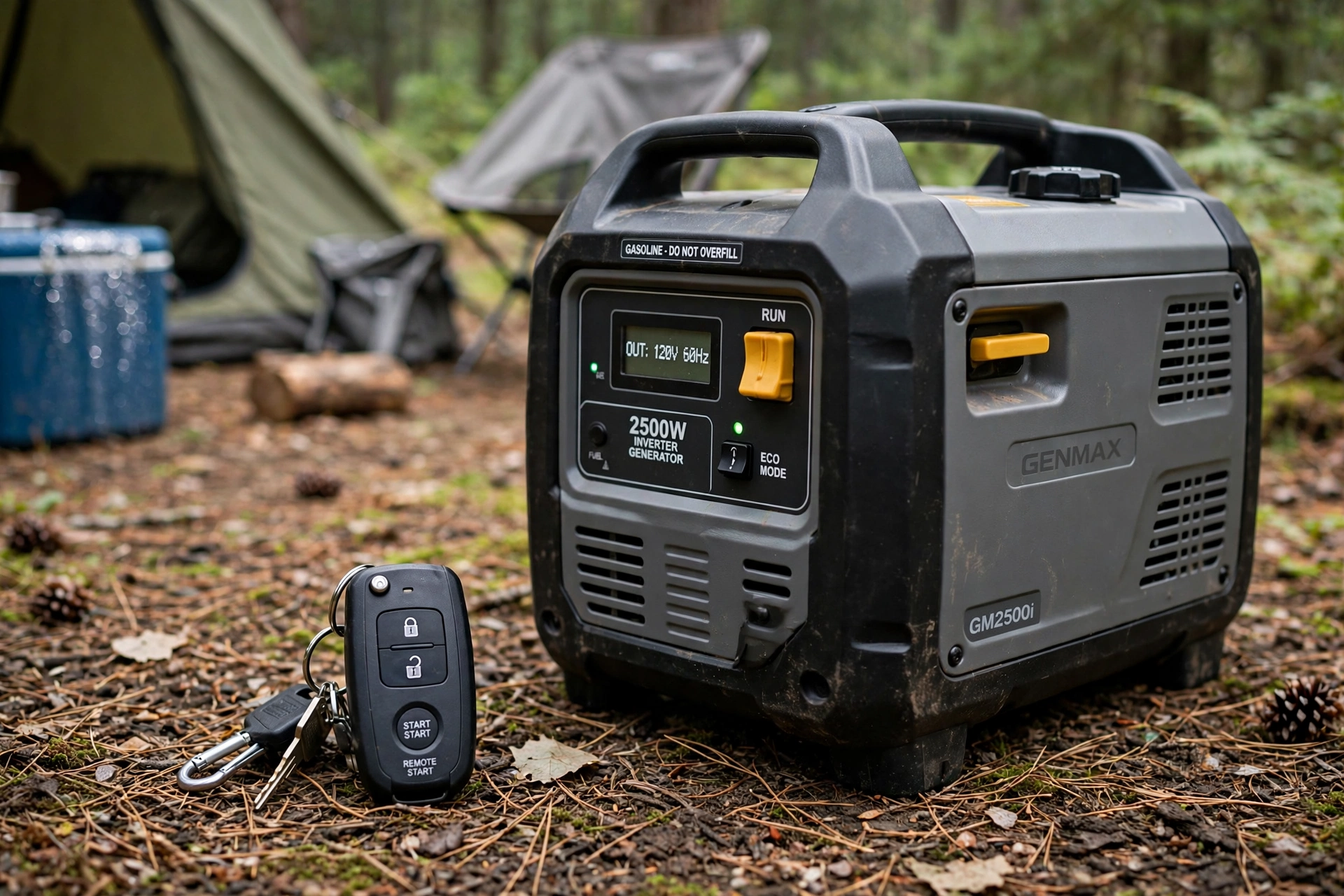
- Dual fuel standard, remote start with key fob included, 3.4-gallon tank with up to 18 hours runtime.
- Main compromises vs. Honda: heavier (~100+ lbs), less refined fit and finish, shorter track record.
Quick verdict
The iGen4500DF is the dual-fuel inverter to beat in 2027. Quiet, RV-ready, remote start, and dual fuel at a price the premium brands can’t touch. Buy it if you want maximum capability per dollar. Buy the Honda EU3200i instead if you want the lightest, most refined machine and don’t need dual fuel.
Specs at a glance
| Starting / running watts (gas) | 4,500 / 3,700W |
| Starting / running watts (propane) | 4,050 / 3,330W |
| Engine | 224cc Westinghouse OHV |
| Noise | 52 dBA (rated) |
| Fuel tank | 3.4 gallons; up to 18 hrs runtime |
| THD | Under 3% — safe for electronics |
| Outlets | TT-30R 30A RV, 5-20R duplex, 2× USB |
| Starting | Remote (key fob), electric, recoil |
| Weight | ~100–106 lbs |
| Warranty | 3-year limited |
| Price range | $800–$1,100 |
Power: enough for the real loads
4,500 starting watts and 3,700 running watts on gasoline is the sweet spot for a mid-size inverter. It starts a 13,500 BTU RV air conditioner (the classic test), runs a full-size fridge plus a freezer plus lights with headroom, and handles a microwave — not all at once, but any realistic combination. On propane you lose about 10% (4,050 / 3,330W), which is the standard dual-fuel tax and still plenty for RV duty.
The power is clean, too — under 3% THD, so laptops, phones, and the RV’s converter all run happy. This is the inverter advantage over open-frame units at the same wattage, and it’s why the iGen4500DF works as a home backup machine, not just a campsite toy.
Noise: genuinely quiet
Westinghouse rates it at 52 dBA, and owner measurements back that up at light loads — it’s in the same conversation as the Honda EU2200i for perceived quietness, which is remarkable at this price. At full load it gets louder (all generators do), but the enclosed case and variable-throttle engine keep it civilized. I’ve stood next to one running an RV AC and held a normal conversation without raising my voice.
If quiet matters to you — campgrounds, neighborhoods, nighttime fridge duty — this is one of the quietest generators per dollar you can buy. Our quiet generator roundup has the full comparison if noise is your top priority.
Dual fuel: the feature that sells it
Dual fuel is standard, not an upgrade. Gasoline for maximum power, propane for everything else — and “everything else” is most of the time. Propane never goes stale, so the generator can sit for a year and still start. It burns cleaner, so the engine stays cleaner. And a 20-pound grill tank gives you roughly 10–12 hours of typical use.
The switchover is simple: a fuel selector dial, a propane hose connection, and it starts on either fuel. In my experience, most owners end up running propane 90% of the time and keeping gasoline as the backup option — which is exactly backwards from how the marketing reads, and exactly right in practice. For the full fuel-system picture, see our best dual-fuel generators roundup.
Remote start and the LED data center
The key fob remote start is the kind of feature you don’t think you need until you’ve used it. Start the generator from inside the RV on a cold morning. Shut it down from the porch when the power comes back. It’s a small thing that changes how the machine fits into your life.
The LED data center shows fuel level, power output, remaining runtime, and voltage — the information you actually want during an outage, without guessing. The fuel gauge alone is worth it; running a generator dry at 2 a.m. is a mistake you make once.
Weight and portability: the compromise
Here’s the honest trade-off: at 100–106 pounds, this is not a one-hand carry like the 47-pound Honda EU2200i. It’s a two-person lift or a roll-it-on-its-wheels move. The wheels and telescoping handle help — it’s designed to be rolled, not carried — but if you need to load it into a truck bed solo, you’ll feel it.
This is the price of 4,500 watts in an inverter package. Physics doesn’t negotiate: more copper and a bigger engine weigh more. If portability is the top priority, a smaller inverter (or the Honda EU3200i at ~78 lbs) is the answer — and our EU2200i vs. Predator 2000 comparison covers the lightweight end of the market.
Reliability and warranty
Westinghouse backs it with a 3-year limited warranty and a US-based service network — solid for the price tier. Owner reports over several years show the expected pattern for a value brand: the vast majority run fine for years with basic maintenance, and the failures that do happen tend to be minor (a sensor, a fuel gauge) rather than engine problems.
It doesn’t have Honda’s decades-long track record or resale value. That’s the real premium-brand advantage — not that the Honda never breaks, but that a 5-year-old Honda sells for 70% of new while a 5-year-old Westinghouse sells for 40%. If you keep generators for a decade, the math favors Westinghouse. If you upgrade every few years, factor in the resale.
What I’d buy with it
Three accessories that earn their keep:
GenTent inverter cover — if you’ll ever run it in rain, this is the safe way. It keeps the generator dry while running with proper ventilation, which a tarp can’t do.
SHINESTAR generator cover — for storage. Keeps dust and UV off between uses; a $30 cover protects a $900 machine.
Parallel kit — the iGen4500DF is parallel-capable, so a second unit down the road doubles your power. Westinghouse’s parallel kits are widely available; check the model-specific kit for the iGen4500DF. Our parallel kit guide covers how it works.
Setup: from box to running in 20 minutes
Unboxing is straightforward: wheel kit and handle bolt on with basic tools, add the included oil (10W-30), fill with fresh gasoline, connect the battery cable for electric start, and you’re ready. The manual’s break-in guidance is the standard drill — vary the load for the first 5 hours, change the oil early — and our break-in guide walks through it step by step if this is your first generator. The remote fob pairs in seconds. Total time from sealed box to running: about 20 minutes if you’ve done it before, 40 if you haven’t.
One tip from experience: run the first tank on gasoline even if you plan to use propane long-term. It seats everything properly and confirms full power output before you switch fuels.
Real-world runtime: what the numbers mean
Westinghouse’s “up to 18 hours” is at 25% load — about 925 running watts, roughly a fridge plus lights and chargers. That’s honest marketing (many brands quote runtime at loads nobody runs), but know your own number. At half load (~1,850W — fridge, freezer, some lights, TV), expect 10–12 hours from the 3.4-gallon tank. Running an RV air conditioner plus the usual loads (~2,500–3,000W), plan on 7–9 hours — still a full night’s sleep on one tank.
On propane, a standard 20-pound grill tank holds about 4.7 gallons of propane. At moderate loads that translates to roughly 10–12 hours — a full day of fridge-and-lights duty per tank. Keep two tanks and you’re covered for a long weekend without touching gasoline.
What we like
- Dual fuel standard at a price competitors charge for gas-only
- 52 dBA — genuinely quiet for 4,500W
- Remote start with key fob included
- TT-30R RV outlet + LED data center with fuel gauge
- Clean <3% THD power, safe for electronics
- 3-year warranty with US-based support
What could be better
- 100+ lbs — not a one-person carry
- Fit and finish a step below Honda
- Resale value won’t match premium brands
- ~10% power loss on propane (standard, but worth knowing)
Maintenance: keeping it healthy
Maintenance is standard small-engine stuff: oil change every 100 hours (or yearly), air filter check each season, spark plug yearly, and fuel stabilizer if gasoline sits more than a month. The LED data center tracks hours, so there’s no guessing. Running on propane most of the time — which I’d recommend — keeps the carburetor clean and stretches the maintenance intervals in practice, since propane doesn’t varnish. Westinghouse sells a maintenance kit with the correct oil, filter, and plug bundled — grab it with the generator so the first service isn’t a scavenger hunt. Our oil change guide covers the actual procedure; it’s a 15-minute job.
Who should buy it — and who shouldn’t
Buy it if: you want a dual-fuel inverter for RV use, home backup, or both; you value quiet operation; you want remote start; or you want the most watts per dollar in the inverter category. This is most buyers.
Skip it if: you need something one person can easily lift into a truck (get a smaller inverter), you need more than 4,500 starting watts (step up to a larger unit or a conventional generator), or you’re brand-loyal to Honda’s refinement and resale and the price gap doesn’t move you.
Frequently asked questions
Is the Westinghouse iGen4500DF reliable?
Will the iGen4500DF run my RV air conditioner?
How long does the iGen4500DF run on a tank?
Is the iGen4500DF dual fuel worth it over the gas-only version?
How loud is the iGen4500DF really?
Our verdict
The Westinghouse iGen4500DF is the best value in dual-fuel inverter generators in 2027, and it’s not close. Quiet, RV-ready, remote start, clean power, dual fuel — at $800–$1,100 it delivers what costs twice as much from the premium brands. It’s heavier and less refined than a Honda, and the resale won’t match, but for a generator you buy to use for a decade, those are acceptable trades. This is the one I’d buy with my own money for RV and home backup duty.
How we researched this: We analyzed the iGen4500DF’s published specs, aggregated thousands of owner reviews, compared it head-to-head against the Honda EU3200i and Champion 4500W dual-fuel on specs and pricing, and verified Amazon availability in October 2026. Runtime and noise figures are manufacturer ratings corroborated by owner measurements.

Related Guides
Champion vs Generac Generators: Which Brand Is Better in 2027?
Champion vs Generac: Champion wins portable value, Generac wins standby. We compare lineups, reliability, safety tech, and support to pick the right brand.

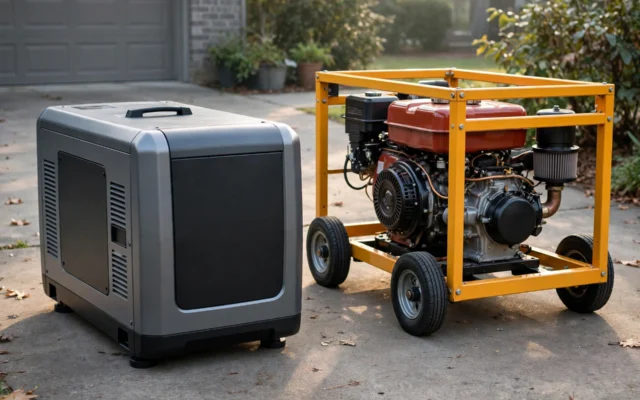
Inverter vs Conventional Generators: Which Should You Buy in 2027?
Inverter vs conventional generators: inverters win on noise, fuel use and clean power; conventional wins on watts per dollar. Here's how to choose in 2027.
Best Generators With Carbon Monoxide Shutoff in 2027
The best generators with carbon monoxide shutoff stop themselves before CO turns deadly. We compare 7 models with Honda CO-MINDER, Champion CO Shield and more.