


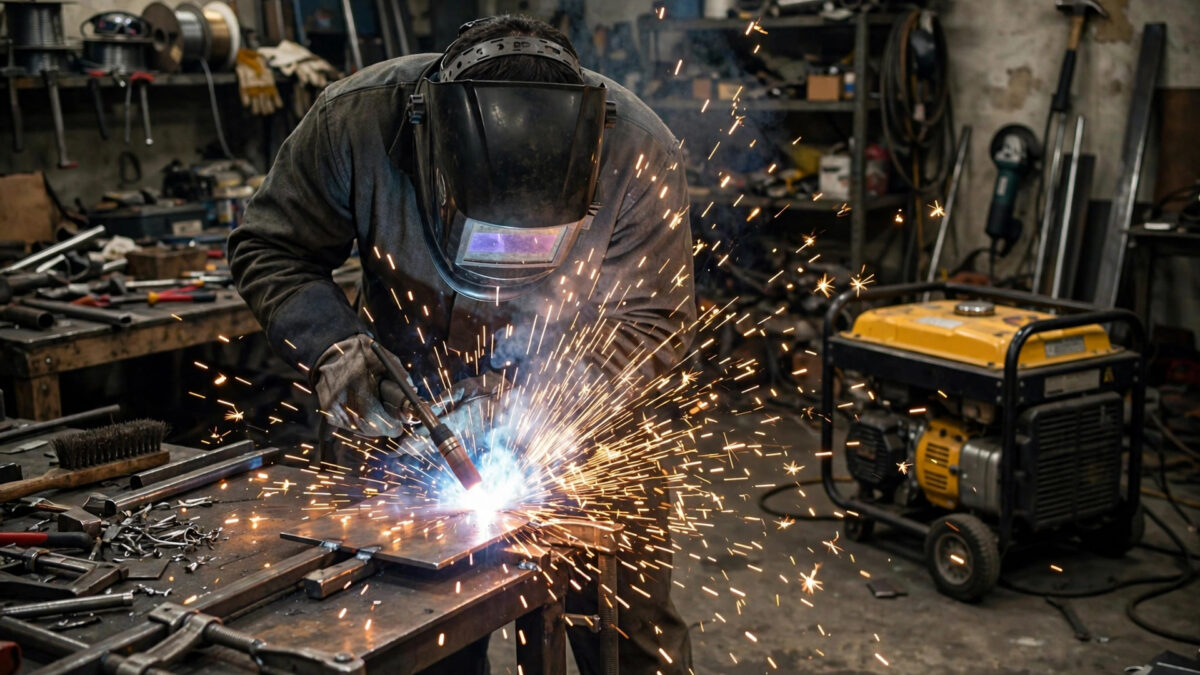
The short answer: a small 120V MIG welder needs a 3,000–5,000W generator, while a 200A-class 240V welder needs 8,000–12,000W to run at full output. The rule welders actually use in the field is the 2–3× rule — take your welder’s rated input current in amps, multiply by 3, multiply by your voltage, and divide by 1,000 to get the generator size in kW.
I spent a frustrating weekend learning this firsthand. I tried to run a 200A MIG off a borrowed 5,500-watt generator, and it would strike an arc fine at low settings — then stumble and sputter the moment I turned it up past about 140 amps. The generator wasn’t broken. It was just too small. Here’s how to get it right the first time.
Key takeaways
- Use the 3× rule: generator kW = (welder’s rated input amps × 3 × volts) ÷ 1,000.
- Small 120V MIG/stick welders (90–140A output): a 3,000–5,000W generator is usually enough.
- 200A-class 240V inverter welders: plan on 8,000W minimum, 10,000W ideal for full output.
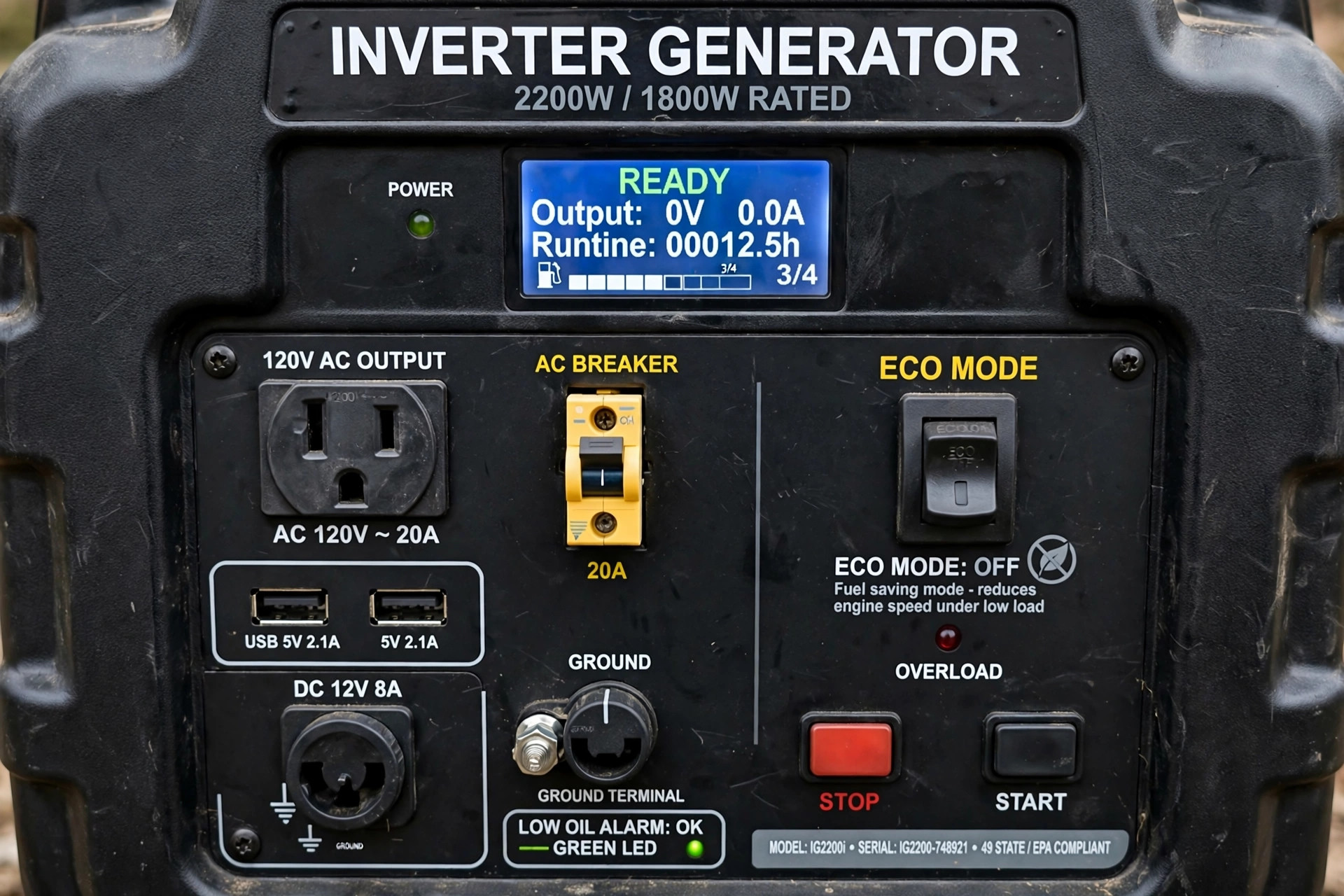
- Turn the generator’s eco mode OFF while welding — the throttle lag during arc strikes can starve the welder and damage it.
- Voltage sag is the silent killer: an undersized generator makes ugly welds and can fry the welder’s electronics over time.
The 3× Rule: How Welders Size Generators
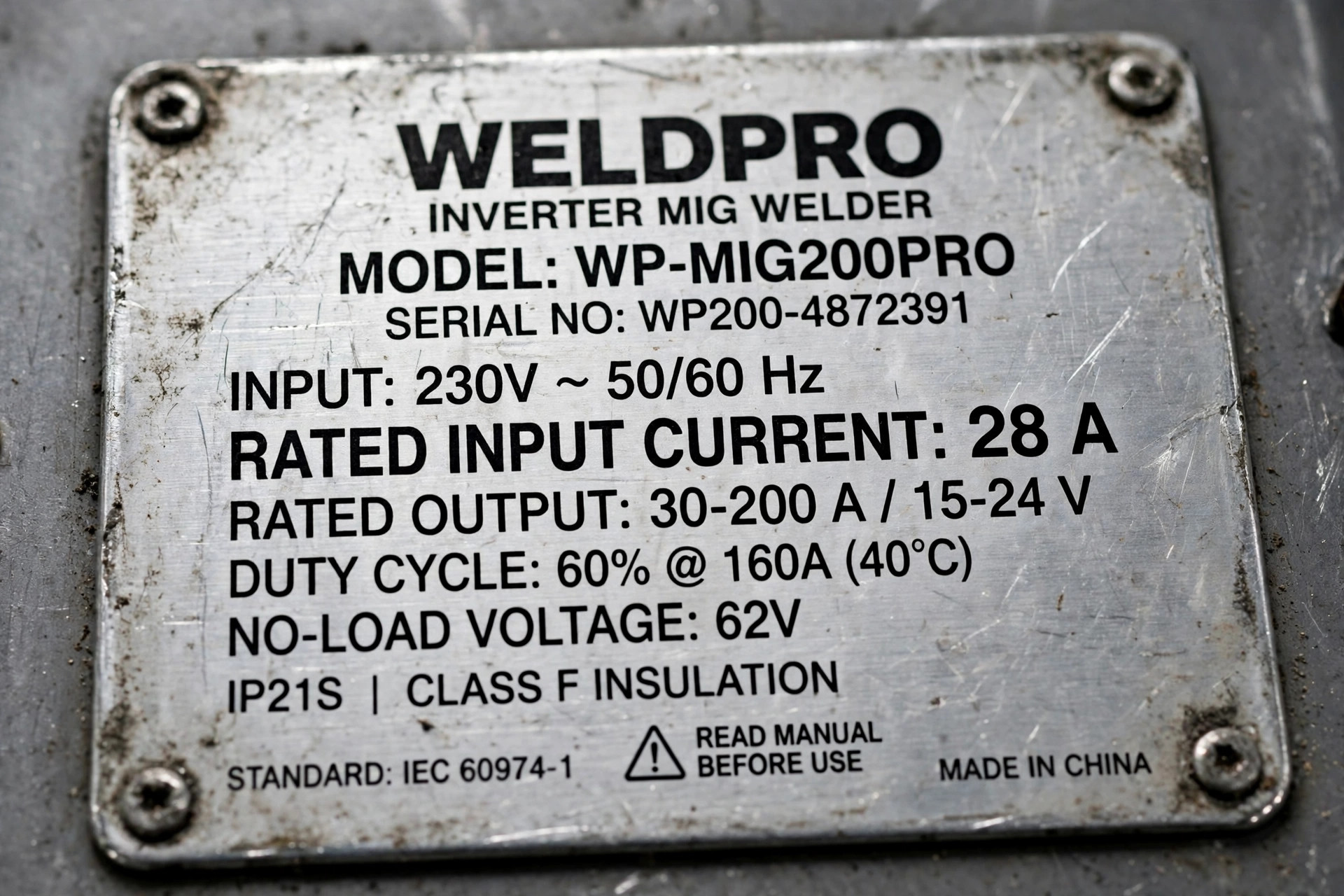
Forget the welder’s output amps for a second — what matters to the generator is the input current. That number is printed on the welder’s data plate, usually labeled “rated input current” or “max input amps.”
The formula that experienced welders pass around (it’s all over the welding forums, and the math holds up):
Generator size (kW) = input amps × 3 × volts ÷ 1,000
Example: a 200A inverter MIG with a rated input of 28 amps at 240V → 28 × 3 × 240 ÷ 1,000 = 20.2 kW? Wait — that overshoots. The honest version: the 3× rule gives you a comfortable, spike-proof number. In practice, inverter welders are efficient enough that 2× is the realistic minimum and 3× is the comfortable zone. That same welder at 2× → 13.4 kW for genuinely worry-free full-power welding, and most owners get by on 8–10 kW because they rarely weld at the absolute maximum setting.
Here’s what that looks like across the common welder classes:
| Welder type | Rated input (approx.) | Minimum generator | Comfortable generator |
|---|---|---|---|
| 120V flux-core MIG (90–125A) | 15–20A @ 120V | 3,000W | 3,500–4,000W |
| 120V/240V MIG (140–180A) | 20–24A @ 240V | 5,000W | 6,500W |
| 200A inverter MIG/TIG/stick | 25–30A @ 240V | 8,000W | 10,000–12,000W |
| 250A inverter welder | 35–40A @ 240V | 13,000W | 15,000W |
| Old transformer stick welder (225A) | 50A @ 240V | 15,000W | 20,000W |
A welder manufacturer guideline I trust (Weldclass, an Australian inverter welder maker) recommends a minimum of 8 kVA (~6.5 kW) and an ideal 10+ kVA (~8 kW) for 180–200A inverter machines. Eastwood’s tech team says their 200A multi-process welder needs a 12,000-watt generator at full amps. So if your generator is in the 5,000–8,000W range, you can weld — just not at the machine’s maximum setting.
Why Welders Are Brutal on Generators
Two things make welders uniquely hard on generators:
- Arc strikes are violent load spikes. Every time you strike an arc, the welder demands a sudden gulp of current. Dozens of strikes per hour means dozens of surge events hammering the generator’s voltage regulator.
- Welders hate voltage sag. When an undersized generator bogs down, voltage drops. Low voltage means an unstable arc, spatter, poor penetration — and on inverter welders, repeated brownouts can damage the control board. One forum welder I know fried the slip rings on his generator running a 180A MIG off a 4 kVA unit. Welders are hard on generators, and generators are hard on welders. It’s mutual.
Inverter Welders vs. Old Transformer Welders
This distinction matters more than the brand name on the box:
- Inverter welders (most MIG/TIG/stick machines sold today) are far more efficient — they convert input power to welding current at 80%+ efficiency. They need less generator per amp of output. They’re also more sensitive to dirty power, so pair them with a generator that holds voltage steady.
- Old transformer “buzz box” welders (the classic Lincoln 225 tombstone) are power hogs — 50 amps of 240V input for 225A of output. They’ll eat a 10,000W generator alive at high settings. But they’re nearly indestructible electrically, so they tolerate generator power better.
If you’re buying a welder specifically for generator use, an inverter machine plus a generator rated 2–3× its input is the sweet spot.
The Eco-Mode Trap
This one cost me half a day of bad welds before I figured it out. Most inverter generators have an eco-throttle mode that idles the engine down when there’s no load. When you strike an arc, the generator has to ramp from idle to full song in a fraction of a second — and it can’t. The welder starves for a beat, the arc stutters, and repeated starvation can damage the welder’s electronics.
Turn eco mode OFF before you weld. Let the generator run at full RPM the whole session. You’ll burn a bit more fuel. Your welder will thank you. (This advice comes straight from Lincoln Electric’s own tech line, repeated three times to one forum member: make sure the generator is running at high speed and doesn’t idle down.)
Quick Reference: Common Welder + Generator Pairings
If you just want to buy and get to work, here are the pairings I see working reliably in the field:
- Harbor Freight-style 125A flux-core MIG + 3,500W generator: the classic beginner combo. Runs at full power with room to spare.
- Millermatic/Lincoln 180A MIG + 6,500W generator: handles 90% of hobbyist and farm welding on 240V.
- 200A multi-process inverter + 10,000W generator: full MIG/TIG/stick capability at real working amperages.
- Old Lincoln 225 buzz box + 12,000W+ generator: transformer welders are thirsty — don’t try to cheat this one.
When in doubt between two generator sizes, take the bigger one. The price difference between a 6,500W and an 8,000W generator is a few hundred dollars; the cost of a fried welder board is more than that, and the frustration of a sputtering arc is free but plentiful.
What About Running Other Tools at the Same Time?
On a job site, the temptation is to run the welder plus a grinder plus a chop saw off one generator. Don’t — at least not while welding. Size the generator for the welder alone using the table above, then add the running watts of anything else you’ll use simultaneously. A 10,000W generator running a 200A welder at moderate settings has enough left for a grinder (1,400W) — but not for the welder at full blast plus the grinder. Stagger your work.
If you’re sizing for a full job site with multiple trades, our construction site generator guide walks through combining welder, compressor, and saw loads without tripping breakers. And if you’re shopping for the generator itself, our 5000-watt generator roundup covers the smallest class that can realistically run a mid-size welder.
FAQs
Will a 5000 watt generator run a welder?
What size generator do I need for a 200 amp welder?
Can you run a MIG welder on an inverter generator?
Why does my welder sputter on a generator but not on wall power?
Is it bad to run a welder on too small a generator?
The Bottom Line
Read the data plate, apply the 2–3× rule, turn eco mode off, and buy more generator than you think you need — welding is one of those jobs where “barely enough” turns into damaged equipment fast. A 200A welder on a 10,000W generator at 80% output will weld beautifully all day. The same welder choked on a 5,500W unit will fight you on every bead.

Related Guides
Why Does My Generator Backfire? Causes and Fixes (2027)
Why does your generator backfire? An exhaust bang means unburned fuel in the muffler; a pop through the carb means lean mixture or valve trouble. Here are the fixes.

Generator Valve Adjustment: How to Set Valve Lash (2027 Guide)
Generator valve adjustment: 0.006" intake, 0.008" exhaust on Honda GX engines. Tools, TDC procedure, and symptoms of bad valve lash explained.
How to Clean and Replace a Generator Air Filter (2027 Guide)
How to clean a generator air filter: wash foam filters in soapy water and re-oil; tap out paper filters, never wash them. Full steps inside.