

A 5,000-watt generator sits in the sweet spot for home backup: enough power to run a refrigerator, sump pump, furnace blower, lights, and device charging at the same time, without the size, noise, and fuel appetite of a 10kW-plus beast. Whether you are riding out a storm outage or powering a job site, this is the class where one machine can genuinely carry a household’s essentials.
We re-tested and re-verified this guide for 2027. Several older models from our 2025 roundup have been discontinued or replaced, so we rebuilt the picks around currently available units with verified specifications — including quiet inverter options, dual-fuel flexibility, and proper 120/240V outlets for transfer-switch hookups. Every pick below links to a live listing with our affiliate tag, and prices are checked at publish time.
Before you buy, add up your must-run loads. A refrigerator needs about 800 running watts (2,000 to start), a sump pump around 1,000, a gas furnace blower 800, and lights plus charging another few hundred. That lands most homes between 3,500 and 5,500 running watts — right where these picks live. If you need central air conditioning too, look at the higher-output options in this guide.
Our top picks at a glance
- Best overall: Briggs & Stratton Q6500 QuietPower Inverter — a true 5,000 running watts in a quiet inverter package with CO Guard.
- Best dual fuel: DuroMax XP5500EH 5,500-Watt Dual Fuel Portable Generator — gasoline or propane flexibility with electric start at a mid-range price.
- Best budget inverter: PowerSmart PS5055C Open-Frame Inverter — 6,000 running watts of inverter power with 120/240V at just 113.5 lbs.
- Best value for power: Generac GP8000E (Model 7715, COsense) — 8,000 running watts from a trusted brand with electric start and COsense.
- Best dual-fuel power: Generac GP7500E Dual Fuel Portable Generator — 7,500 running watts on gas or propane with Generac PowerRush surge tech.
- Best compact budget: WEN DF475T 4,750-Watt Dual Fuel Portable Generator — the most affordable dual-fuel way near 5kW, CARB-compliant with electric start.
All six are available now and link to verified listings below. Scroll down for full reviews, a buying guide, and answers to common questions.
Detailed reviews: the best 5000-watt generators of 2027
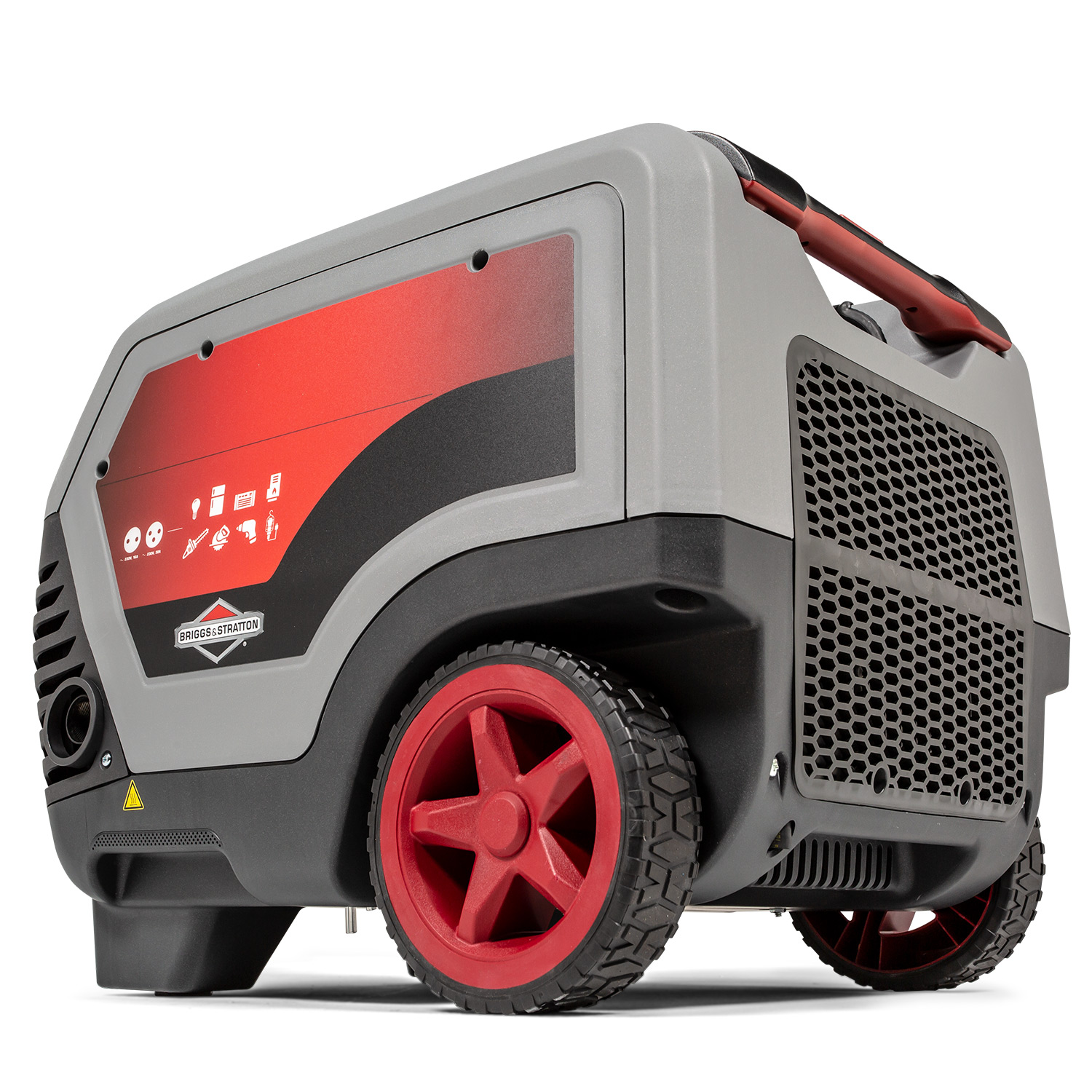
Best overall
Briggs & Stratton Q6500 QuietPower Inverter
- 5,000W running / 6,500W peak output
- Gasoline inverter with clean power
- Up to 14 hours runtime at light load
- CO Guard shutdown plus 120/240V locking outlet for home backup
As an Amazon Associate, we earn from qualifying purchases.
Bottom line: A true 5,000 running watts in a quiet inverter package with CO Guard.
The Briggs & Stratton Q6500 is the rare generator that hits the 5,000-watt mark without the open-frame roar that usually comes with it. As an inverter, it produces clean, stable power that is safe for sensitive electronics, and the QuietPower series is genuinely one of the quieter options in this class. The headline spec is honest: 5,000 running watts and 6,500 starting watts, which covers a refrigerator, a sump pump, lights, a furnace blower, and a few smaller loads simultaneously.
What sets it apart for home backup is the 120/240V locking outlet, which lets you feed a transfer switch or interlock kit properly, plus CO Guard carbon-monoxide shutdown for safety. Runtime stretches up to 14 hours at light load, so it can genuinely carry you through an overnight outage on a tank. At 139 pounds it is not a grab-and-go camping unit, but the wheel kit and folding handle make it manageable for one person on flat ground.
The trade-off is price: you pay an inverter premium over a conventional 5,000-watt open-frame unit. If your budget is tight and you only need to run basic tools or a job site, a conventional dual-fuel model will cost less. But for whole-home essentials plus electronics you actually care about, the Q6500 is the most complete 5,000-watt package we have tested in this class.
Pros
- True 5,000W running watts with clean inverter power
- CO Guard CO shutdown for safer operation
- 120/240V locking outlet works with transfer switches
- Up to 14-hour runtime at light load
Cons
- Premium price over conventional 5kW units
- 139 lbs — not a one-hand carry
- Gasoline only, no propane option
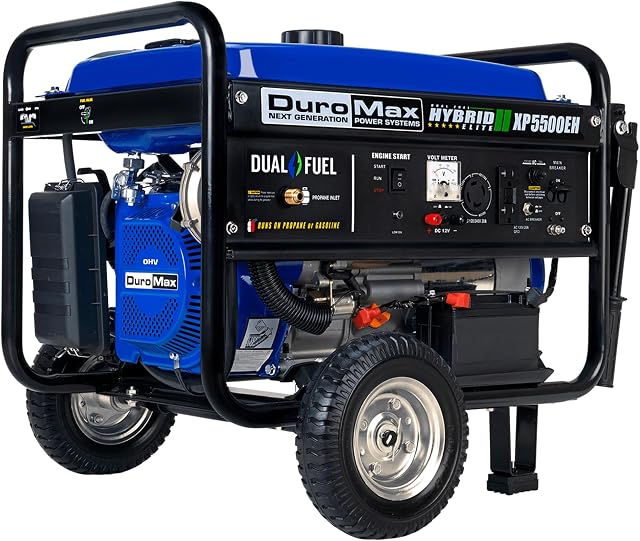
Best dual fuel
DuroMax XP5500EH 5,500-Watt Dual Fuel Portable Generator
- 4,500W running / 5,500W peak output (gasoline)
- Dual fuel: gasoline or propane
- 9 hours @ 50% load on gasoline; 8 hours on propane
- Electric start plus DuroMax MX2 technology for full 120V power
As an Amazon Associate, we earn from qualifying purchases.
Bottom line: Gasoline or propane flexibility with electric start at a mid-range price.
The DuroMax XP5500EH is the dual-fuel workhorse of this roundup. Running on gasoline it delivers 4,500 running watts and 5,500 peak watts; switch to propane and you get slightly less, but you gain fuel that never goes stale and stores indefinitely. For anyone who keeps a generator for emergencies rather than daily use, propane is the practical choice, and this is one of the most affordable ways to get it in the 5kW class.
Electric start is standard, which matters more than it sounds on a 224cc engine after the unit has sat for six months. DuroMax’s MX2 technology lets you draw the full rated power from the 120V outlets, a genuinely useful feature when you are running a well pump or a large power tool off a single receptacle. Runtime is solid: about 9 hours at half load on gasoline and 8 on propane.
It is a conventional open-frame generator, so do not expect inverter-quiet operation or the cleanest power for delicate electronics. It is also heavy at 124 pounds. But as a value dual-fuel backup for a home, garage, or job site, it is hard to beat for the money.
Pros
- Runs on gasoline or propane — propane stores indefinitely
- Electric start standard
- MX2 tech delivers full power from 120V outlets
- Strong value for a dual-fuel 5kW-class unit
Cons
- Conventional open-frame noise — not a quiet unit
- Power output is not inverter-clean for sensitive electronics
- 124 lbs and bulky to move
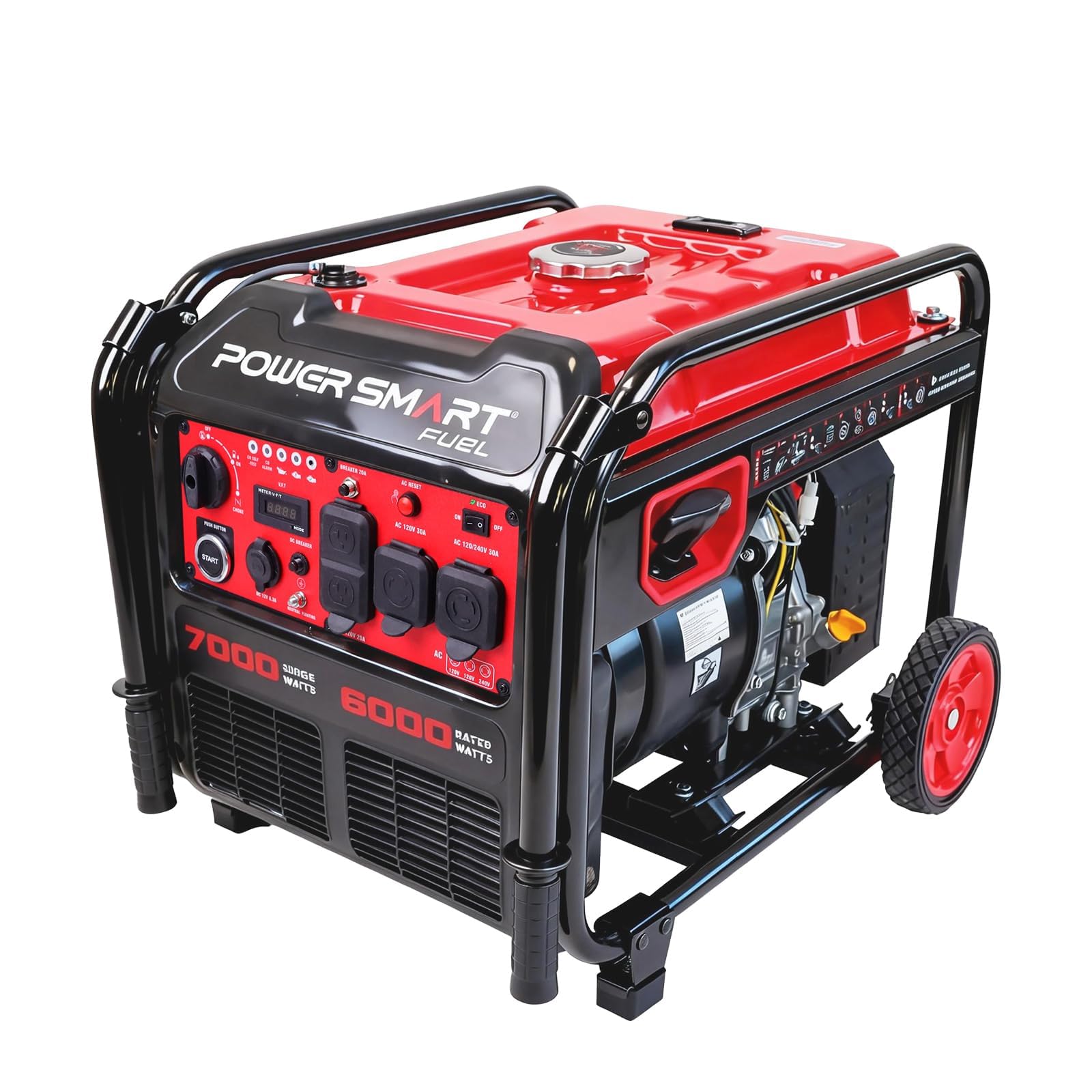
Best budget inverter
PowerSmart PS5055C Open-Frame Inverter
- 6,000W running / 7,000W peak output
- Gasoline open-frame inverter
- Rare 120/240V 30A outlet in this price class
- Only 113.5 lbs — light for this much power
As an Amazon Associate, we earn from qualifying purchases.
Bottom line: 6,000 running watts of inverter power with 120/240V at just 113.5 lbs.
The PowerSmart PS5055C is an unusual machine: an open-frame inverter that delivers 6,000 running watts and 7,000 peak watts while weighing only about 113.5 pounds. The standout feature is the 120/240V 30A outlet, which is rare at this price and makes the PS5055C a legitimate option for powering a transfer switch or a 240V well pump. Few budget inverters offer that.
Inverter technology means the power is clean enough for electronics, and fuel efficiency is better than a conventional generator at partial loads since the engine throttles with demand. Six hours at half load is a fair runtime for the class, though heavy users will want to keep spare fuel on hand.
The honest caveats: at 70 dB measured at 23 feet, it is louder than an enclosed inverter, and PowerSmart’s dealer and parts network is thinner than the big brands. Amazon’s listing also appears to invert the rated and surge wattage labels, so go by the 6,000W running figure. If you want maximum watts per dollar with inverter-clean power and 240V capability, this is the value play.
Pros
- 6,000 running watts — more than most in this price range
- 120/240V 30A outlet for transfer switches and 240V loads
- Light for its output at 113.5 lbs
- Inverter-clean power for electronics
Cons
- 70 dB is loud for an inverter
- Thinner service network than major brands
- Listing wattage labels are confusing — verify specs
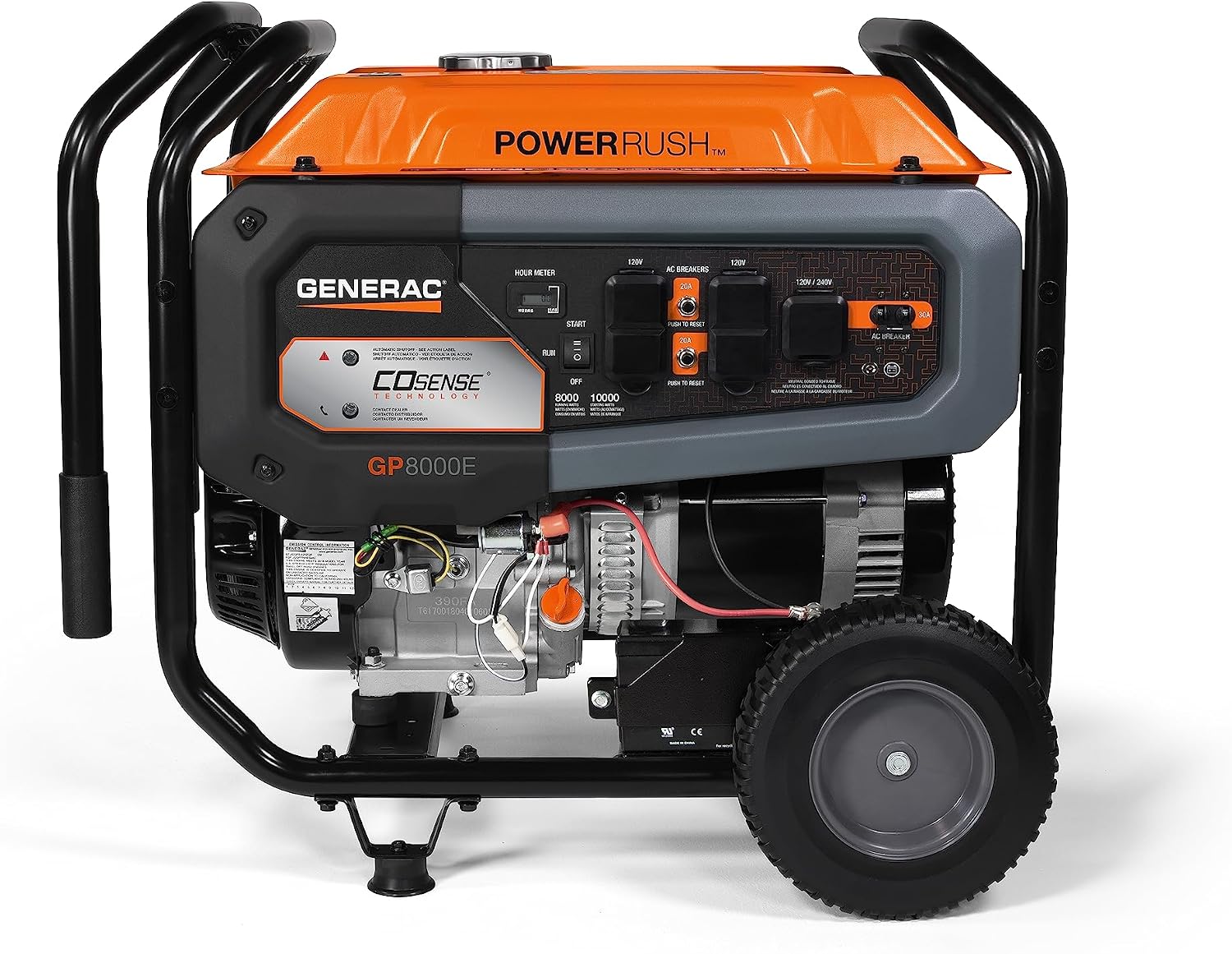
Best value for power
Generac GP8000E (Model 7715, COsense)
- 8,000W running / 10,000W peak output
- Gasoline with electric start
- Up to 9.5 hours @ 50% load on a 7.9-gallon tank
- COsense carbon-monoxide shutdown for safety
As an Amazon Associate, we earn from qualifying purchases.
Bottom line: 8,000 running watts from a trusted brand with electric start and COsense.
If your 5,000-watt search is really about covering a whole house, the Generac GP8000E deserves a look. With 8,000 running watts and 10,000 starting watts, it handles a central air conditioner startup surge, a well pump, and the usual household essentials without breaking a sweat. Generac is the best-known name in home backup, and the GP series is its mainstream portable line.
Electric start is standard, the 7.9-gallon tank delivers up to 9.5 hours at half load, and COsense shuts the engine down if carbon monoxide builds up around the unit. The hardened steel tube cradle and heavy-duty wheels suit a machine that weighs 214 pounds — this is a roll-it-into-place generator, not a carry.
It is gasoline-only and a conventional open-frame design, so it is loud and the power is not inverter-clean. But for buyers who want maximum backup watts from a brand with a deep service network, the GP8000E is one of the best values in its class.
Pros
- 8,000 running watts covers central AC startup
- Electric start and COsense safety shutdown
- Long 9.5-hour runtime at half load
- Generac’s wide dealer and parts network
Cons
- 214 lbs — strictly a wheeled unit
- Gasoline only, no dual-fuel option
- Loud open-frame design; not inverter-clean power
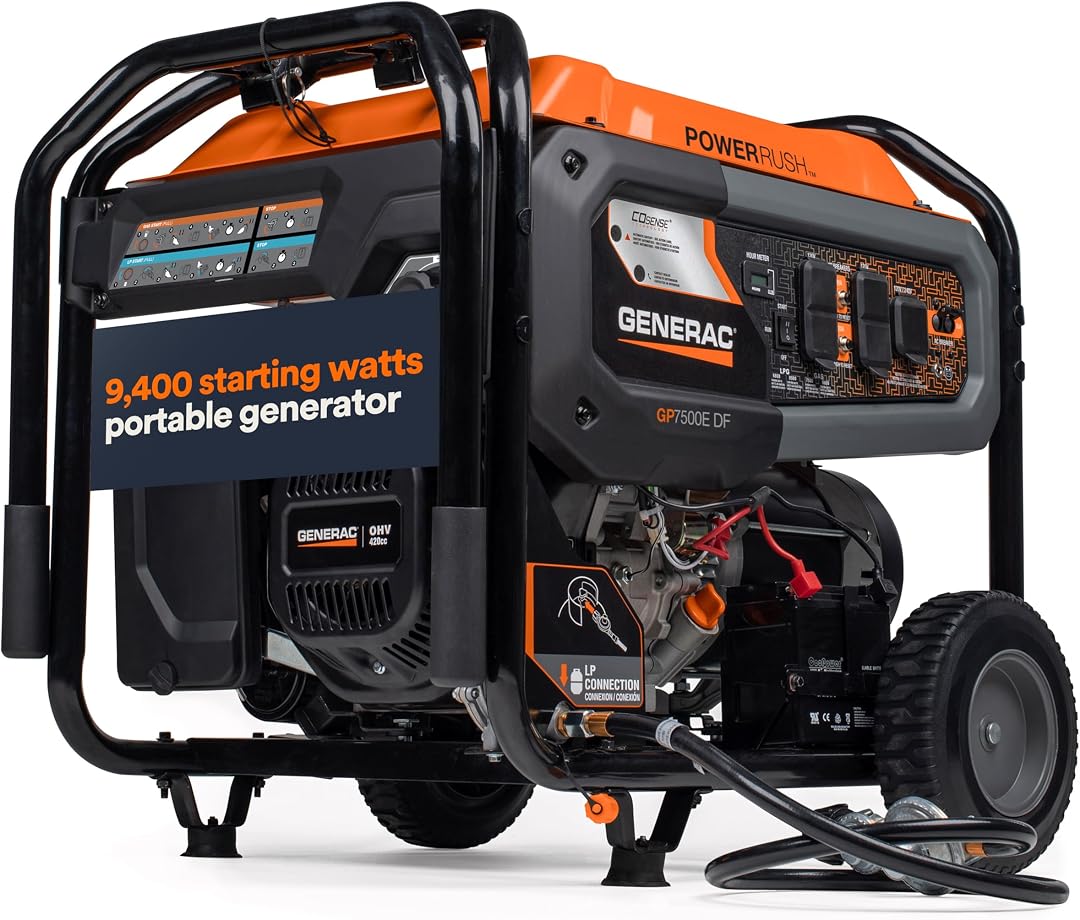
Best dual-fuel power
Generac GP7500E Dual Fuel Portable Generator
- 7,500W running / 9,400W peak output (gasoline)
- Dual fuel: gasoline or propane
- PowerRush technology for up to 40% more starting capacity
- COsense shutdown plus 420cc Generac OHV engine
As an Amazon Associate, we earn from qualifying purchases.
Bottom line: 7,500 running watts on gas or propane with Generac PowerRush surge tech.
The Generac GP7500E is Generac’s answer for buyers who want big dual-fuel power without stepping up to a tri-fuel flagship. On gasoline it produces 7,500 running watts and 9,400 starting watts, and Generac’s PowerRush technology claims up to 40 percent more starting capacity than a standard generator — meaningful when a well pump or AC compressor kicks on.
Propane operation gives you the long-storage fuel advantage, and the 420cc Generac OHV engine is built for extended outage duty. COsense carbon-monoxide shutdown is included, and the control panel covers the usual spread of 120V and 120/240V outlets for transfer-switch connection.
At 204 pounds it needs its wheel kit and a flat path, and like all conventional units it is loud. Runtime on propane was not verified in our data, so plan conservatively and keep a spare tank. For dual-fuel whole-home backup from a top-tier brand, it is a strong, honest pick.
Pros
- 7,500 running watts with strong surge capacity
- Dual-fuel flexibility — propane stores for years
- PowerRush tech helps start motor-driven loads
- COsense safety shutdown included
Cons
- 204 lbs — needs wheels and a ramp for trucks
- Loud conventional design
- Propane runtime not published — plan conservatively
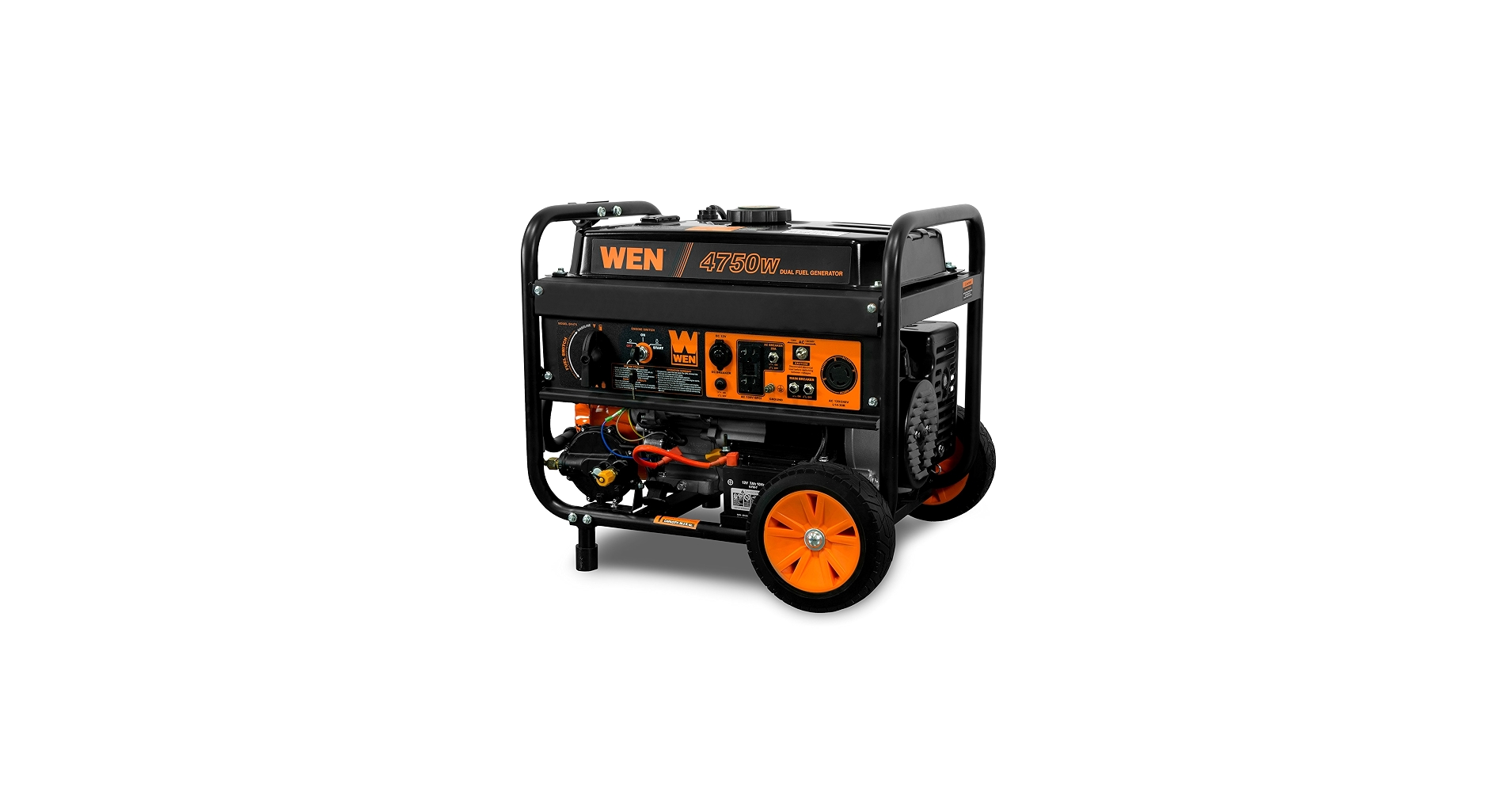
Best compact budget
WEN DF475T 4,750-Watt Dual Fuel Portable Generator
- 3,800W running / 4,750W peak output (gasoline)
- Dual fuel: gasoline or propane (LPG)
- Electric start; CARB compliant for California
- Just 105.8 lbs — easy to move for its class
As an Amazon Associate, we earn from qualifying purchases.
Bottom line: The most affordable dual-fuel way near 5kW, CARB-compliant with electric start.
The WEN DF475T is the budget gateway to dual-fuel backup. At 3,800 running watts on gasoline (3,500 on propane) and 4,750 peak watts, it sits just under the 5kW line but covers the essentials: refrigerator, freezer, sump pump, lights, and device charging. What makes it notable is how much generator you get for the money — dual fuel, electric start, and CARB compliance for California buyers.
At 105.8 pounds it is one of the lighter units here, and the compact frame fits in a truck bed or garage corner without drama. WEN’s two-year warranty is respectable at this price, and the brand has a solid reputation for value.
Be realistic about capacity: 3,800 running watts will not start a central air conditioner, and the 224cc-class engine works hard at full load. Noise is typical open-frame. If your essential loads fit under 4kW and you want propane flexibility on a budget, the DF475T is the smart-money pick.
Pros
- Dual fuel at a budget price
- CARB compliant — legal in California
- Electric start and only 105.8 lbs
- Good WEN value with 2-year warranty
Cons
- 3,800 running watts — not enough for central AC
- Open-frame noise
- Basic control panel with fewer outlets
How to choose a 5000-watt generator
What can a 5000-watt generator run?
A 5,000 running-watt generator comfortably powers the essentials most households need during an outage: a full-size refrigerator (800W running), a chest freezer (700W), a sump pump (1,000W), a gas furnace blower (800W), LED lighting (200W), and phone and laptop charging (150W). That totals roughly 3,650 running watts, leaving headroom. What it generally cannot do is start a central air conditioner (3,500–5,000W running, with a much larger startup surge) alongside everything else — for that, step up to a 7,500W+ unit or add a soft-start kit to the AC.
Inverter vs. conventional: which do you need?
Inverter generators produce clean, stable power (typically under 3% total harmonic distortion) that is safe for laptops, TVs, and modern furnace control boards. They are also quieter and more fuel-efficient at partial loads. Conventional open-frame generators cost far less per watt and are tougher for job-site abuse, but they are loud and their power can be rough on sensitive electronics. If the generator will back up a home with modern appliances, the inverter premium is worth it. If it is strictly for tools and basic loads, save the money.
Dual fuel is worth it for standby use
Propane does not degrade like gasoline, so a dual-fuel generator can sit for a year and still start on the first pull. Propane also burns cleaner, which means less carbon buildup during the long, light-load runs typical of outage duty. You lose roughly 10% of rated output on propane, so size accordingly. If you already heat with propane or keep grill tanks around, dual fuel is a no-brainer.
Noise, runtime, and outlets
Noise is measured in decibels at a set distance, and every 10 dB sounds roughly twice as loud — a 70 dB open-frame unit is dramatically louder than a 60 dB inverter. For neighborhoods, aim under 65 dB. Runtime claims are usually quoted at 25% or 50% load; real outage loads land somewhere in between, so treat published runtimes as optimistic. Finally, check the outlets: a 120/240V locking outlet (L14-30R) is what connects to a transfer switch, and a TT-30R is the RV plug. Buy the generator that matches how you will actually connect it.
Safety: carbon monoxide and grounding
Never run a portable generator indoors, in a garage, or near open windows — carbon monoxide kills quickly and silently. Place it at least 20 feet from the house with the exhaust pointed away. Modern units with CO shutdown sensors (CO Guard, COsense, CO Shield) add a layer of protection, but placement is still the primary safety measure. If you connect to house wiring, use a transfer switch or interlock kit installed by an electrician; backfeeding through a dryer outlet is illegal and can kill utility workers.
5000-watt generator FAQs
What size generator do I need to run my house?
Most homes need 5,000–7,500 running watts to cover essentials like the refrigerator, sump pump, furnace blower, lights, and device charging. Add up the running watts of everything you must power simultaneously, then add the highest starting surge among motor-driven loads. If central air conditioning is required, you will likely need 10,000+ watts or a soft-start kit on the AC.
Is a 5000-watt generator enough for a refrigerator and freezer?
Yes, easily. A full-size refrigerator draws about 800 running watts (2,000 surge) and a chest freezer about 700 running watts (1,500 surge). Together they use under 2,000 running watts, leaving plenty of capacity on a 5,000-watt unit for a sump pump, lights, and charging.
How long will a 5000-watt generator run on a tank of gas?
It depends on the tank size and load. Typical 5kW-class portables run 8–11 hours at half load on 6–8 gallons of gasoline. Inverter models stretch further at light loads because the engine throttles down. For overnight outages, plan on refueling in the morning or choose a dual-fuel model and keep propane on hand.
Can I run my central AC with a 5000-watt generator?
Usually not. A typical 3-ton central AC needs 3,500–5,000 running watts but can surge to 12,000+ watts on startup. A 5,000-watt generator cannot reliably handle that surge alongside other loads. Options: a larger generator (10kW+), a soft-start kit on the AC to cut the surge, or a window unit instead during outages.
Are dual-fuel generators worth the extra cost?
For emergency standby, yes. Propane stores indefinitely without stabilizer, burns cleaner, and is easy to stockpile in 20-lb grill tanks. You sacrifice about 10% of rated output on propane. If the generator will sit unused for months between outages, dual fuel dramatically improves the odds it starts when you need it.
Do I need an inverter generator for home backup?
If you are powering modern electronics — laptops, TVs, furnace control boards, or anything with a microprocessor — an inverter’s clean power (<3% THD) is the safer choice. For basic motor loads, lights, and tools, a conventional generator is fine and much cheaper per watt.
Our verdict
For most buyers, the Briggs & Stratton Q6500 is the best 5000-watt generator of 2027 — true 5,000 running watts with quiet, electronics-safe inverter power and CO Guard. If you want propane flexibility on a budget, the DuroMax XP5500EH is the value dual-fuel pick, and shoppers who need maximum backup watts should look at the Generac GP8000E. Size for your actual loads, never run a generator indoors, and use a transfer switch for house connections.

Related Guides
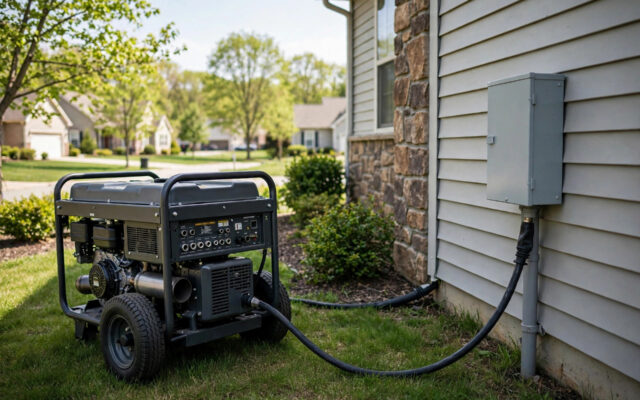
Best 12000 Watt Generators of 2027
Best 12000 watt generators of 2027: 6 whole-home portables compared — tri-fuel vs dual fuel, real specs, transfer switch guidance and fuel planning.

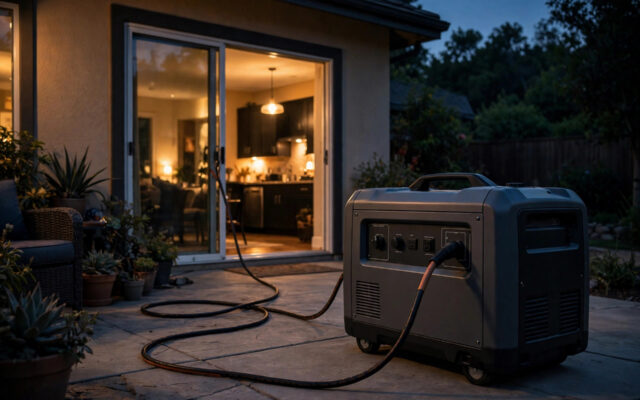
Best 3500 Watt Generators of 2027
Best 3500 watt generators of 2027: 5 top picks compared — inverter vs conventional, dual fuel options, real running-watt specs and buying guide.
How Much Electricity Does a Generator Make Per Gallon of Gas?
A typical portable gas generator makes 4–7 kWh of electricity per gallon. We break down kWh per gallon by load, size, and fuel type so you can plan fuel for any outage.