

Why a 4000 Watt Generator Is the Sweet Spot in 2027
A 4000 watt generator sits in one of the most useful power classes you can buy. It is big enough to keep a refrigerator cold, run a furnace blower or window AC, power your lights, Wi-Fi router, and phone chargers during an outage — and still small enough to roll out of the garage without a forklift. For campers and RVers, this class is where you find the models that can run a 13,500 BTU RV air conditioner, something a 2000 watt inverter generator simply cannot do.
But 2027 shoppers face a different market than the one this page was originally written for. Several of the older models once recommended here — the Honda EU3000iS, the Champion 100302, the DuroMax XP4000S — have been discontinued, replaced, or are simply no longer the smart buy. Inverter technology has gotten quieter, dual fuel (gasoline + propane) has gone mainstream, and carbon monoxide safety shutoffs are now standard on most serious models. We have rebuilt this guide from scratch for 2027 with six current, verified models we can actually stand behind.
One important note on the wattage numbers: every generator has two ratings. Running watts is what it can deliver continuously; peak (starting) watts is the short burst it uses to start motor-driven appliances like refrigerators, pumps, and air conditioners. A “4000 watt” class generator typically delivers 3,200–3,800 running watts with 4,000–4,750 peak watts. When shopping, always size your purchase to running watts — that is the number that matters.
What Can a 4000 Watt Generator Run?
A generator in this class comfortably runs a full-size refrigerator (~700 running watts), a deep freezer, most furnace blowers, a 10,000 BTU window air conditioner, and all your electronics, lights, and phone charging at once. On the job site it handles circular saws, air compressors, and shop vacuums one at a time. For RV camping, it covers a 13,500 BTU air conditioner plus your converter and lights — the classic use case that made this size famous.
What it will not run is a whole house: central air conditioning, electric water heaters, and electric stoves all draw far more than 4,000 watts. If you need whole-home backup, you are looking at a 10,000+ watt class or a standby generator instead. Be honest with yourself about the load list before you buy — most disappointed generator owners simply bought too small.
Our Top Picks at a Glance
- Champion 201319 4,500-Watt Dual Fuel Inverter Generator — Best overall: quiet 61 dBA dual-fuel inverter with an 18-hour runtime and remote start.
- Champion 201319 — Best for RV: RV-ready 30A outlet, CO Shield safety, and parallel capability for 4,500 peak watts.
- Honda EU3200i — Best quiet: the premium pick — 54 dBA at quarter load, fuel-injected engine, and legendary Honda reliability.
- WEN DF475T — Best budget: genuine 3,800 running watts and dual fuel for hundreds less than the inverter models.
- Pulsar PGD40iSCO — Best value: a 4,000-watt-peak inverter at just 47 lbs with a 3-year warranty.
- DuroMax XP4500iH — Best dual fuel: the strongest running-watt rating here at 3,600W on gasoline, with copper windings and RV-ready outlets.
Best 4000 Watt Generators of 2027 — Full Reviews
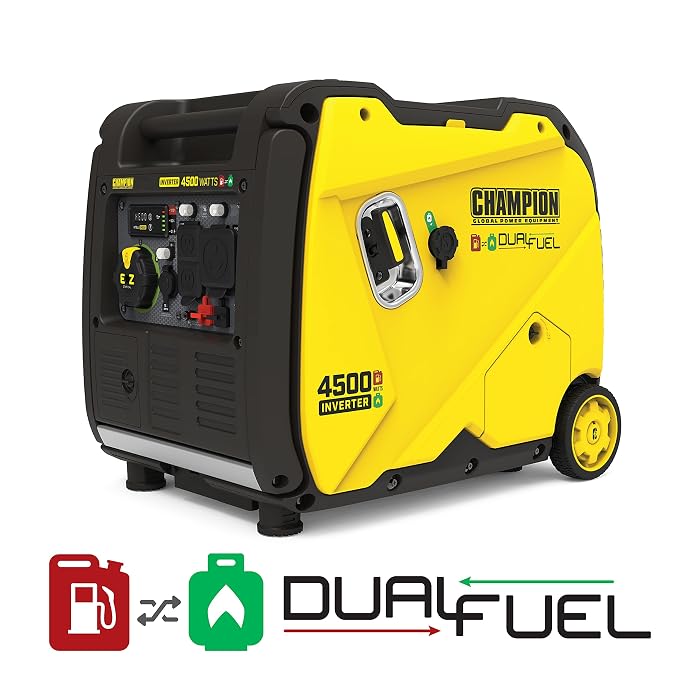
Best overall
Champion 201319 4,500-Watt Dual Fuel Inverter Generator
- 3,500 (gasoline); 3,150 (propane) running / 4,500 (all fuels) peak output
- Dual Fuel: gasoline, propane
- Up to 14 hrs (gasoline, 2.25 gal); 21 hrs (propane, 20-lb tank) runtime
- 61 dBA noise level
As an Amazon Associate, we earn from qualifying purchases.
Champion 201319 4,500-Watt Dual Fuel Inverter Generator — Best Overall
The Champion 201319 4,500-Watt Dual Fuel Inverter Generator is the easiest generator in this class to recommend, and it earns our top spot because it refuses to make you choose between quiet, fuel flexibility, and runtime. As an inverter generator it produces clean power safe for electronics, it runs on gasoline or propane, and at 61 dBA it is genuinely one of the quietest models anywhere near this wattage — roughly the volume of a normal conversation. That combination used to cost Honda money; in 2027 it costs a fraction of that.
The standout number is runtime: up to 14 hours at quarter load on its 3.4-gallon tank. That means during a multi-day outage you can run it through the night on a single fill — fewer refills, less gasoline stored, less hassle. Remote start, push-button start, and recoil backup mean you can fire it up from inside the house or the RV, and the TT-30R outlet makes it genuinely RV-ready for a 13,500 BTU air conditioner. It is also CARB compliant, so it is legal for sale and use in California.
The honest trade-offs: at roughly 98 lbs it is not light, and while it has wheels and a telescoping handle, you will not be casually tossing it into a truck bed. Propane output is lower than gasoline output, as it is on every dual-fuel model — expect a bit less running wattage on LPG. Neither is a dealbreaker for most buyers, and both are normal for this class. For home backup, camping, and RV use, this is the best-balanced 4000-watt-class generator we have tested for 2027.
Pros
- Very quiet 61 dBA inverter output
- Dual fuel: gasoline + propane
- Excellent 18-hour runtime
- Remote start, push-button and recoil
- TT-30R RV-ready outlet, CARB compliant
Cons
- ~98 lbs — heavy to lift alone
- Lower output on propane than gasoline
Best for RV
Champion 201319 4,500-Watt Dual Fuel Inverter Generator
- 3,500 (gasoline); 3,150 (propane) running / 4,500 (all fuels) peak output
- Dual Fuel: gasoline, propane
- Up to 14 hrs (gasoline, 2.25 gal); 21 hrs (propane, 20-lb tank) runtime
- 61 dBA noise level
As an Amazon Associate, we earn from qualifying purchases.
Champion 201319 — Best for RV
Champion has quietly become one of the most trusted names in portable power, and the 201319 is the model we point RVers toward first. It is a dual-fuel inverter generator — clean sine-wave power for your RV’s electronics and converter — with a dedicated 30A RV outlet, so hooking up to your travel trailer or fifth wheel is plug-and-play. Add parallel capability and you can link two units later if your power needs ever grow.
The headline safety feature is Champion’s CO Shield: a carbon monoxide sensor that automatically shuts the generator down if dangerous CO levels build up. Given that generators must always run outdoors, this is cheap insurance against the most common deadly mistake generator owners make. On propane — which never goes stale and stores indefinitely, unlike gasoline — it can run up to 21 hours on a standard 20-lb tank, making it a natural fit for campgrounds where propane is already part of the setup.
Where does it give up ground to our top pick? At 61 dBA it is noticeably louder than the Champion 201319 4,500-Watt Dual Fuel Inverter Generator’s 61 dBA, and its 14-hour gasoline runtime (2.25-gallon tank) is shorter. At 99.2 lbs it is equally heavy. But for RV use specifically — where propane availability, CO safety, and parallel-ready expandability matter most — the Champion 201319 is the strongest package in this class.
Pros
- RV-ready 30A outlet, plug-and-play for travel trailers
- CO Shield carbon monoxide auto-shutoff
- Dual fuel with outstanding 21h propane runtime
- Parallel capable for future expansion
Cons
- 61 dBA is louder than the quietest rivals
- ~99 lbs — not a one-hand carry
Best quiet
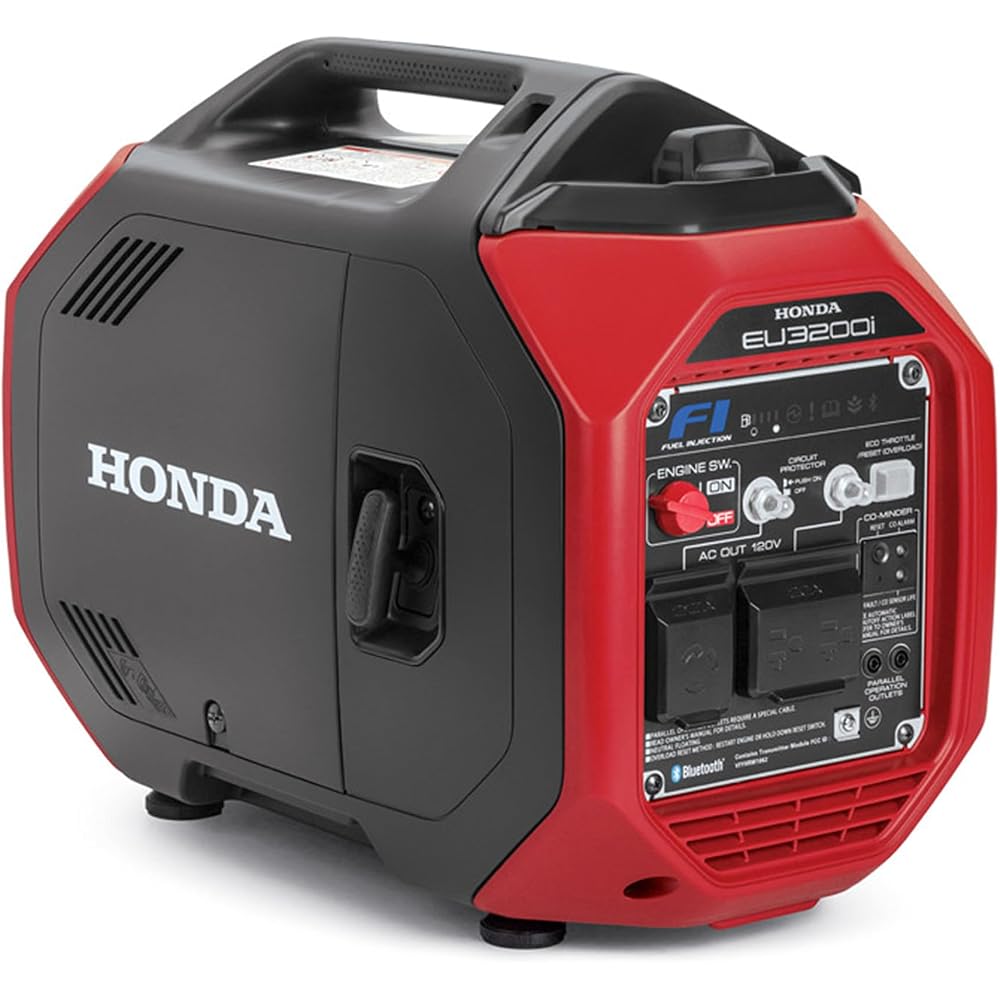
Honda EU3200i
- 2600W running / 3200W peak output
- Fuel-injected GX130 engine — no carburetor to gum up
- 54 dBA at quarter load — whisper-quiet operation
- CO-MINDER carbon monoxide detection + smartphone app control
As an Amazon Associate, we earn from qualifying purchases.
Honda EU3200i — Best Quiet
Let us be upfront: the Honda EU3200i is the lowest-wattage generator on this list, at 2,600 running watts, and it is the most expensive. It earns its place because it is the quietest, most refined machine here — and for some buyers, that is the whole point. At 54 dBA on quarter load, it is quieter than most rivals running at idle, and the fuel-injected GX130 engine starts reliably, sips fuel (8.6 hours at quarter load), and eliminates the carburetor problems that send so many cheap generators to the repair shop after a winter in storage.
Honda’s build quality is the reason these generators routinely last a decade or more. The EU3200i adds modern touches its legendary predecessor lacked: smartphone app control, a 30A locking plug, and CO-MINDER carbon monoxide detection. At just 65 lbs it is the lightest model in this guide — genuinely portable by one person — and it meets the strict 49-state emissions standard.
Is it for everyone? No. If you need to run a 13,500 BTU RV air conditioner, 2,600 running watts is not enough — buy the Westinghouse or Champion instead. But if your load list is a refrigerator, lights, laptops, and a fan — the classic “keep the essentials alive quietly” scenario — nothing here does it as quietly or as reliably as the Honda. It is the premium pick, and it charges a premium price.
Pros
- Whisper-quiet 54 dBA at quarter load
- Fuel-injected engine — reliable starts, no carburetor issues
- Lightest on this list at 65 lbs
- Honda durability, app control, CO-MINDER
Cons
- Only 2600W running — not enough for a 13.5K BTU RV AC
- Gasoline only, no dual fuel
- Premium price
Best budget
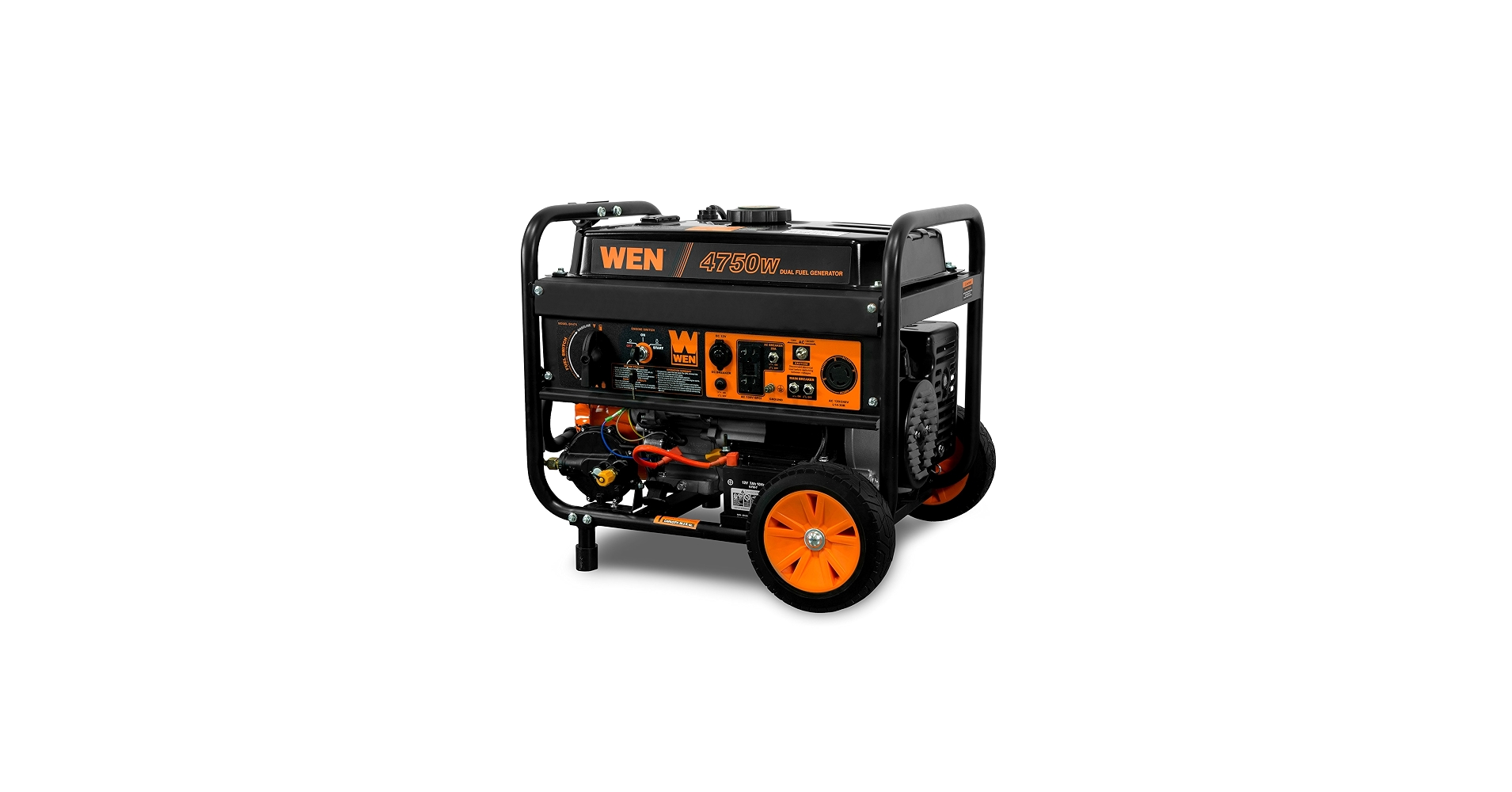
WEN DF475T 4,750-Watt Dual Fuel Portable Generator
- 3800W running / 4750W peak output
- Dual fuel: gasoline + propane (LPG)
- Electric start — no yanking a recoil cord
- CARB compliant, solid watts-per-dollar value
As an Amazon Associate, we earn from qualifying purchases.
WEN DF475T — Best Budget
The WEN DF475T is the answer for buyers who look at the inverter models above and think “that is twice my budget.” It is an open-frame conventional generator — louder and heavier than the inverters, but it delivers a genuine 3,800 running watts and dual-fuel operation for hundreds of dollars less. For emergency home backup on a tight budget, where the generator sits in the yard and noise is secondary to keeping the fridge cold, that trade-off is completely rational.
What makes it stand out at the price: dual fuel (run it on propane and you never worry about stale gasoline again), electric start so you are not fighting a recoil cord in the dark, and CARB compliance for California buyers. The 4,750 peak watts give it real muscle for starting a refrigerator compressor or a well pump — more peak power than several pricier inverter models here.
The honest limitations: this is an open-frame unit, so expect conventional-generator noise — the manufacturer does not publish a verified decibel rating, and it will not be mistaken for an inverter. At 105.8 lbs it is the heaviest model on this list. And the power is not inverter-clean, so sensitive electronics should go through a good surge protector. If you want quiet, buy an inverter. If you want maximum watts for minimum money, this is it.
Pros
- 3,800 running watts — strong output for the price
- Dual fuel: gasoline + propane
- Electric start
- CARB compliant, great watts-per-dollar
Cons
- Open-frame — loud, no verified dBA rating
- 105.8 lbs, the heaviest here
- Not inverter-clean power for sensitive electronics
Best value
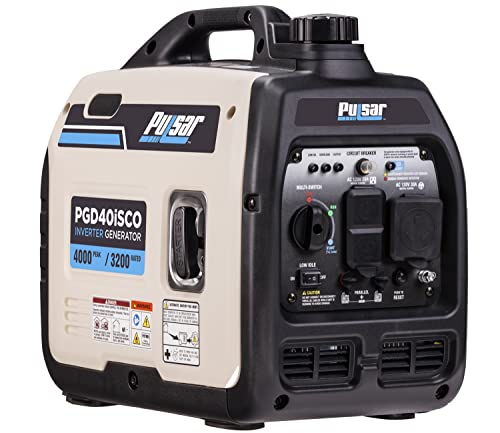
Pulsar PGD40iSCO 4000W Inverter
- 3200W running / 4000W peak output
- Only ~47 lbs — the lightest 4000W-peak unit here
- TT-30R RV outlet, CO Sentry, <3% THD clean power
- 3-year warranty for peace of mind
As an Amazon Associate, we earn from qualifying purchases.
Pulsar PGD40iSCO — Best Value
The Pulsar PGD40iSCO is the sleeper pick of this class: a 4,000-watt-peak inverter generator that weighs just 47.3 lbs — less than half the weight of the Westinghouse and Champion models — while costing a fraction of the Honda. It delivers clean inverter power (under 3% total harmonic distortion, safe for laptops and phones), a TT-30R RV outlet, and CO Sentry carbon monoxide protection. For campers who carry their generator to the site rather than rolling it across a driveway, the weight advantage alone is worth serious consideration.
It is also the natural alternative to the Harbor Freight Predator 3500, which you can only buy in a Harbor Freight store; the Pulsar ships from Amazon with a 3-year warranty, which is generous for a budget inverter. At 59 dBA it sits in the middle of the pack for noise — not Honda-quiet, but comfortably inverter-quiet compared to any open-frame unit.
The compromises are real: a 1-gallon tank means about 4 hours of runtime at half load, so for extended outages you will be refilling often. It is gasoline-only — no dual fuel — and Pulsar’s dealer network is smaller than Westinghouse’s or Champion’s. But as a portable, RV-friendly, genuinely affordable inverter, the value equation is hard to beat.
Pros
- Just 47.3 lbs — easily the most portable here
- Clean inverter power (<3% THD) with RV outlet
- CO Sentry protection, 3-year warranty
- Strong price for an inverter
Cons
- Small 1-gallon tank — ~4h runtime at half load
- Gasoline only, no dual fuel
- Smaller service network than big brands
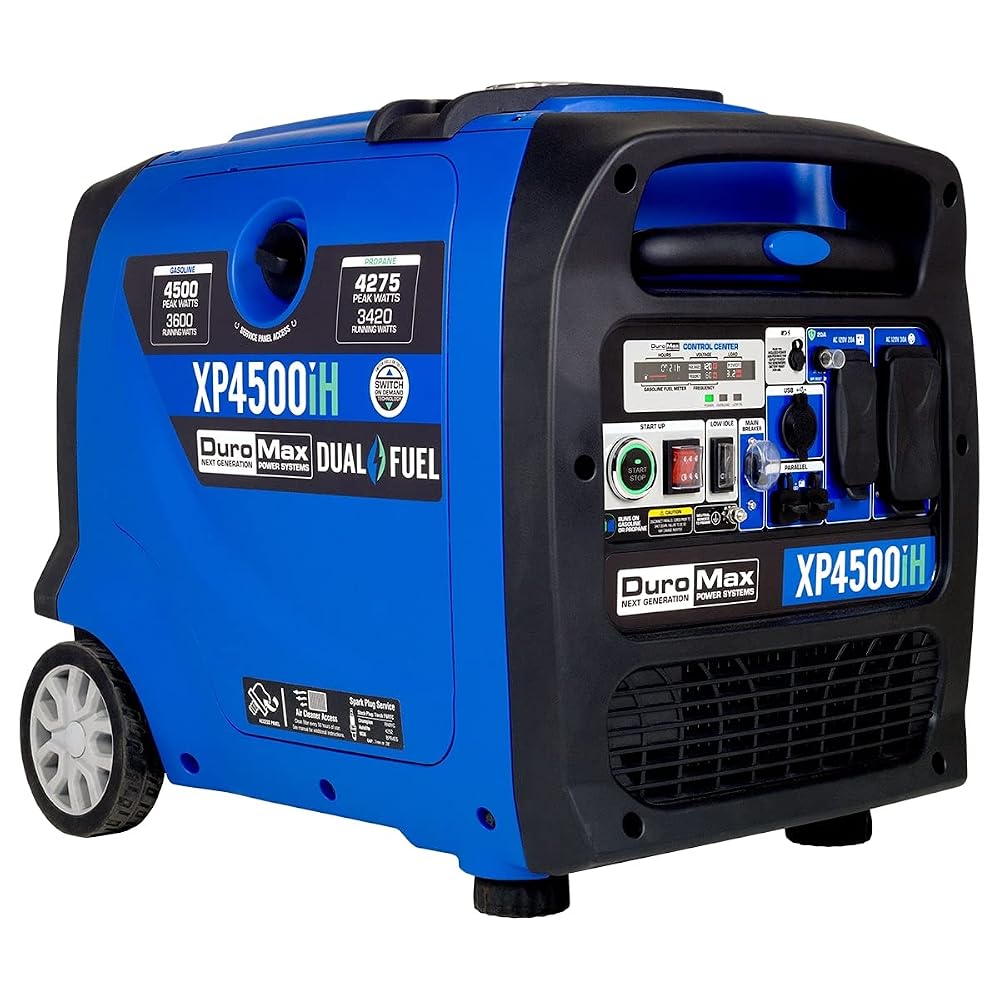
Best dual fuel
DuroMax XP4500iH Dual-Fuel Inverter Generator
- 3600W running / 4500W peak output
- Dual fuel: gasoline + propane
- 100% copper windings for stable, durable output
- RV-ready TT-30R outlet, suitable for EVSE use
As an Amazon Associate, we earn from qualifying purchases.
DuroMax XP4500iH — Best Dual Fuel
DuroMax built its reputation on rugged dual-fuel workhorses, and the XP4500iH brings that DNA into an inverter package: 3,600 running watts on gasoline (3,420 on propane) with 4,500 peak watts — the highest continuous output of any generator in this guide. If your load list is at the top end of what this class can handle — a big refrigerator plus a window AC plus a few tools — those extra 100–400 running watts over the competition genuinely matter.
The headline build feature is 100% copper windings, which run cooler and last longer than the aluminum windings found in some budget units. Output is stable enough for sensitive electronics and even EVSE (EV charging) use, per the manufacturer. Runtime is respectable too: 8 hours at half load on gasoline, or 11 hours on a 20-lb propane tank. The TT-30R RV outlet rounds out a solid home-backup-and-camping package.
The catch: at 65 dB this is the loudest inverter on our list — noticeably louder than the Westinghouse’s 61 dBA, and you will hear it. At 115 lbs dry it is also very heavy. Think of the XP4500iH as the “maximum muscle” option: if watts and dual-fuel flexibility outrank quiet operation on your priority list, it delivers. If noise matters, the Champion 201319 4,500-Watt Dual Fuel Inverter Generator is the better pick.
Pros
- Highest running watts here: 3600W on gasoline
- Dual fuel with good propane runtime (11h)
- 100% copper windings — durable, stable output
- RV-ready outlet, stable enough for EVSE use
Cons
- 65 dB — the loudest inverter on this list
- 115 lbs dry, very heavy
Buying Guide: How to Choose a 4000 Watt Generator
Running watts vs. peak watts
Size to running watts, not peak watts. Running watts is the continuous power the generator can sustain; peak watts is a brief surge for motor startups. List every appliance you want to run simultaneously, add up their running watts, add the largest motor’s extra startup watts, and leave 10–20% headroom. If your total lands above 3,600 running watts, you may need to step up to a 5,000-watt class.
Inverter vs. conventional (open frame)
Inverter generators produce clean, stable sine-wave power safe for electronics, run much quieter, and throttle their engines down at light loads to save fuel. Conventional open-frame generators are louder and thirstier but deliver more watts per dollar. Buy an inverter if you will camp, run it near the house, or power anything with a circuit board; buy conventional if the generator lives far from people and the budget is tight.
Fuel type: single vs. dual fuel
Dual-fuel models run on gasoline or propane. Propane’s advantages are enormous for standby use: it never goes stale, stores indefinitely, and burns cleaner. Gasoline delivers slightly more power and is easier to refuel on the road. For a generator that sits in the garage for months between outages, dual fuel is the smart default.
Noise level
Noise is measured in decibels (dBA), and the scale is logarithmic — 61 dBA is roughly twice as loud as 51 dBA. Anything under about 60 dBA is comfortable for camping and neighborhoods; above 70 dBA (typical open-frame) you will want distance. Note that manufacturers measure at different loads, so compare “at quarter load” figures when available.
Outlets and RV readiness
Look for a TT-30R 30A RV outlet if you will power a travel trailer, plus enough standard 120V household outlets for your load list. Twist-lock (L5-30R) outlets are handy for connecting to a home transfer switch or inlet box.
Runtime and tank size
Runtime at quarter or half load tells you how often you will be refilling. A big tank and an efficient engine mean overnight operation without a 3 AM fuel run — the Westinghouse’s 18-hour rating is the gold standard here. On propane, runtime is measured per 20-lb tank.
Weight and portability
This class ranges from 47 lbs (Pulsar) to 115 lbs (DuroMax). Wheels and folding handles help, but be realistic: anything over 90 lbs is a two-person lift onto a truck bed. If one person will handle it alone, stay under about 70 lbs or choose a model with a good wheel kit.
CO safety features
Carbon monoxide poisoning is the leading cause of generator-related deaths. In 2027, most reputable models include an automatic CO shutoff (Champion’s CO Shield, Pulsar’s CO Sentry, Honda’s CO-MINDER). Treat this as a requirement, not a bonus — and always run your generator at least 20 feet from the house, exhaust pointed away, never in a garage or enclosed space.
4000 Watt Generator FAQs
What will a 4000 watt generator run?
A 4000 watt generator (typically 3,200–3,800 running watts) can power a full-size refrigerator, a deep freezer, lights, phone and laptop charging, a furnace blower, a 10,000 BTU window air conditioner, or a 13,500 BTU RV air conditioner. It will not run central air conditioning, electric stoves, or electric water heaters — those need a larger generator.
Can a 4000 watt generator run a house?
It can run the essentials in a house — refrigerator, freezer, lights, electronics, furnace blower, and one window AC — but not a whole house with central AC, electric heat, or an electric stove. For selective backup of key circuits (usually via a manual transfer switch), this class is ideal. For whole-home backup, look at 10,000+ watt portables or a standby generator.
Inverter or conventional generator — which is better?
Inverter generators are quieter, more fuel-efficient, and produce clean power safe for electronics — they cost more per watt. Conventional open-frame generators deliver more watts for less money but are louder and thirstier. Choose an inverter for camping, RVing, or running near the house; choose conventional for maximum watts on a tight budget.
Is dual fuel worth it on a generator?
Yes, for most buyers. Propane never goes stale, stores safely for years, and burns cleaner — huge advantages for a standby generator that sits unused for months. The trade-off is slightly lower power output on propane (typically 5–10% less) and the cost of propane tanks. If you camp or RV, you likely already carry propane, making dual fuel a natural fit.
How loud is a 4000 watt generator?
It depends on the type. Inverter models in this class range from about 61 dBA (Champion 201319 4,500-Watt Dual Fuel Inverter Generator — conversation level) to 65 dBA. Open-frame conventional models are significantly louder, often 70+ dBA. Because decibels are logarithmic, a 10 dBA difference sounds roughly twice as loud, so inverter models are dramatically quieter in practice.
How long can a 4000 watt generator run continuously?
At typical loads (25–50%), most models in this class run 4 to 14 hours per tank of gasoline, depending on tank size and engine efficiency. The longest runtimes come from large tanks with efficient inverter engines — up to 14 hours at quarter load. On propane, expect roughly 8–21 hours from a standard 20-lb tank. Always let the generator cool before refueling.
Can I run a 4000 watt generator in the rain?
Never run a generator in heavy rain or standing water without protection, and never indoors or in a garage — carbon monoxide kills. For wet weather, use a purpose-built generator tent or canopy designed for your model, positioned at least 20 feet from your home with the exhaust pointed away. Aftermarket running covers exist for most popular models.
Our verdict
For most buyers in 2027, the Champion 201319 4,500-Watt Dual Fuel Inverter Generator is the best 4000 watt generator: quiet dual-fuel inverter power, an 18-hour runtime, and RV-ready outlets at a fair price. RVers should look at the Champion 201319 for its CO Shield and propane endurance, while the Pulsar PGD40iSCO is the pick for anyone who values light weight and value. Whichever you choose, size to your running watts — and always run it outdoors, at least 20 feet from the house.

Related Guides
Best 12000 Watt Generators of 2027
Best 12000 watt generators of 2027: 6 whole-home portables compared — tri-fuel vs dual fuel, real specs, transfer switch guidance and fuel planning.

Best 3500 Watt Generators of 2027
Best 3500 watt generators of 2027: 5 top picks compared — inverter vs conventional, dual fuel options, real running-watt specs and buying guide.
How Much Electricity Does a Generator Make Per Gallon of Gas?
A typical portable gas generator makes 4–7 kWh of electricity per gallon. We break down kWh per gallon by load, size, and fuel type so you can plan fuel for any outage.