


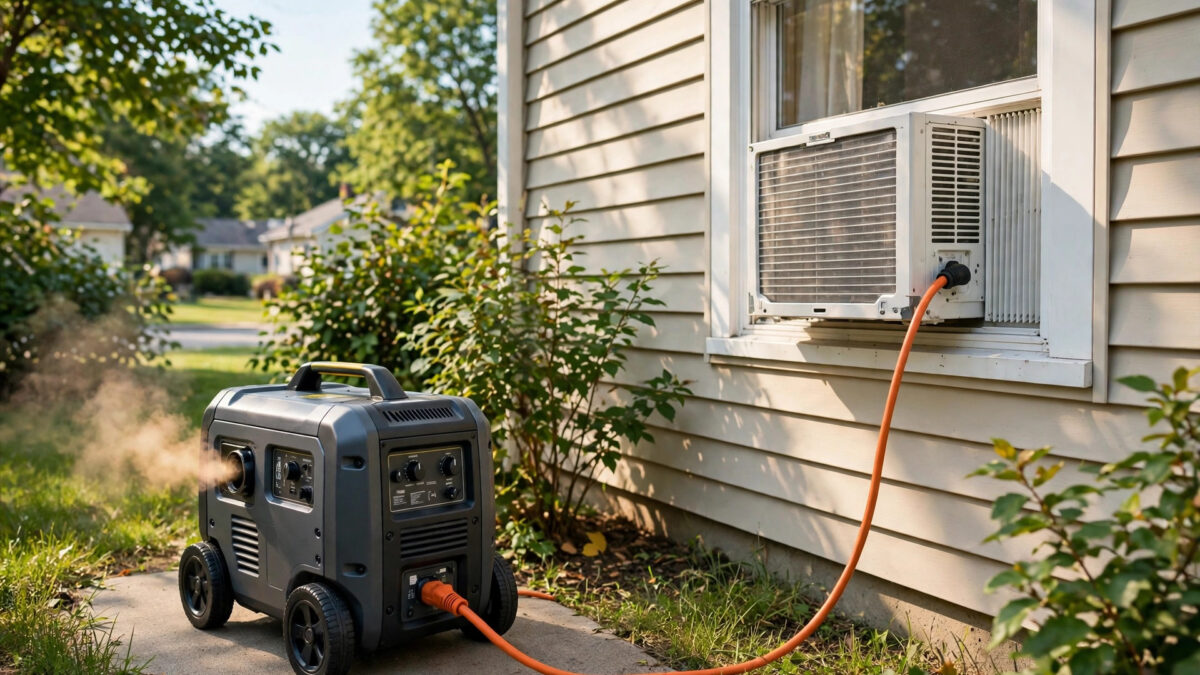
If you’re staring down hurricane season or a summer outage and wondering whether your generator can run your window AC, here’s the short answer: a 2,000 to 3,000-watt generator covers almost every window air conditioner sold today. A small 5,000 BTU unit needs about 2,000 watts to start reliably, while a big 12,000 BTU unit needs closer to 2,800–3,000 watts.
I learned this the practical way. During a three-day outage a couple summers back, I ran my 8,000 BTU bedroom window unit off a 2,200-watt inverter generator. It handled the compressor kick just fine — as long as I kept everything else unplugged while the compressor was starting. That little experience taught me more about generator sizing than any spec sheet ever did.
Key takeaways
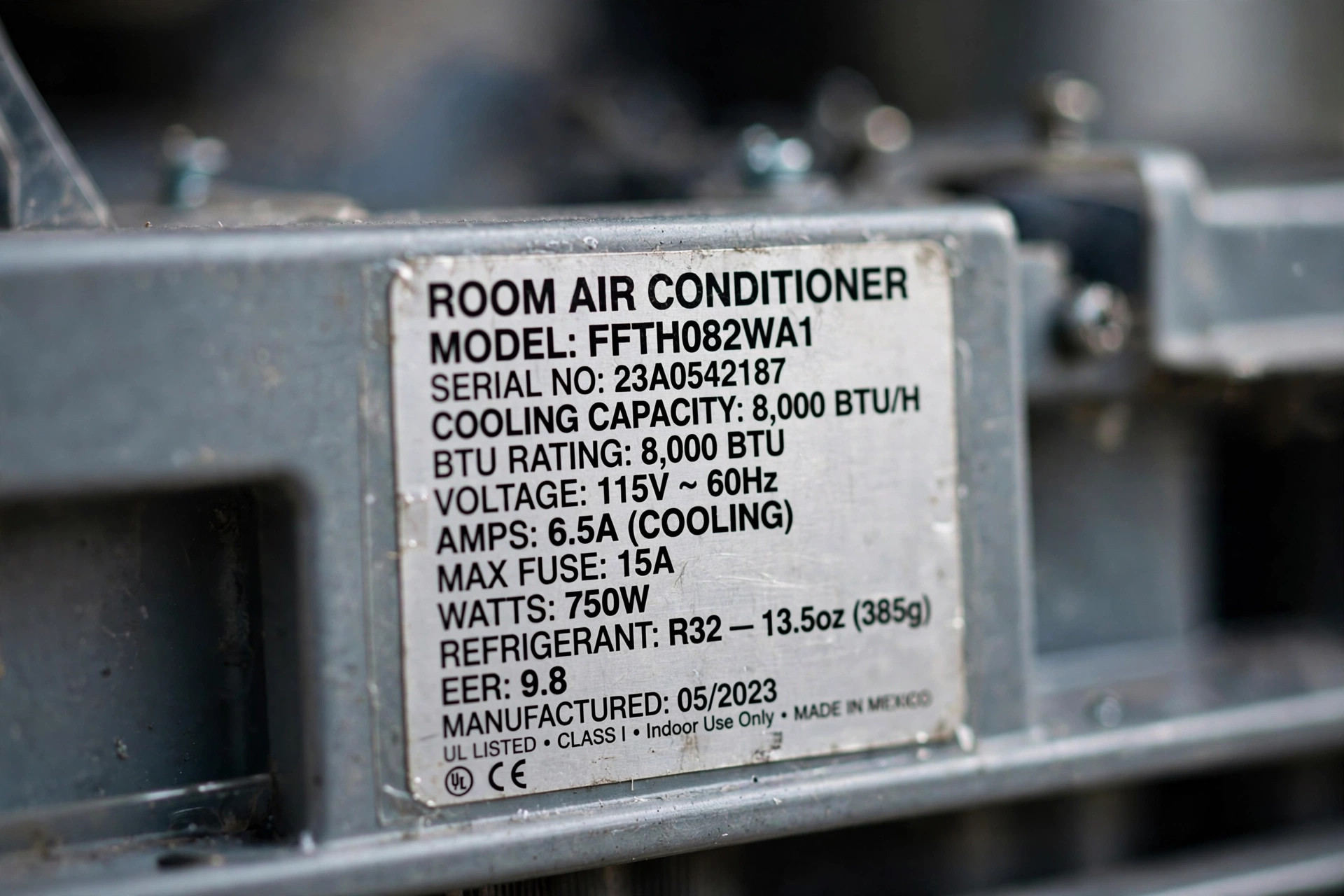
- Running watts = BTU ÷ EER. A 5,000 BTU window AC uses about 500 watts running; 12,000 BTU uses about 1,200 watts.
- Size the generator for starting watts (2–3× running watts), not running watts — that’s the part that trips people up.
- As a rule of thumb: 5,000 BTU → 2,000W generator, 8,000 BTU → 2,200W, 10,000 BTU → 2,500W, 12,000 BTU → 2,800–3,000W.
- Let the compressor start before you plug anything else in — the starting surge is the hardest moment.
- Use a heavy-duty 12-gauge extension cord and keep it as short as possible.
How Many Watts Does a Window AC Actually Use?
This is the part almost every sizing guide skips: your AC’s power draw isn’t a mystery number. The U.S. Department of Energy formula is dead simple — watts = BTU ÷ EER (the Energy Efficiency Ratio on your unit’s yellow Energy Guide label). Most window units sold today have an EER between 8 and 12, so an EER of 10 makes a good middle ground.
Here’s what that works out to in the real world:
| Window AC size | Running watts (EER 10) | Starting watts (approx.) |
|---|---|---|
| 5,000 BTU | ~500W | 1,000–1,500W |
| 6,000 BTU | ~600W | 1,200–1,800W |
| 8,000 BTU | ~800W | 1,600–2,400W |
| 10,000 BTU | ~1,000W | 2,000–3,000W |
| 12,000 BTU | ~1,200W | 2,400–3,600W |
| 14,000 BTU | ~1,400W | 2,800–4,200W |
| 18,000 BTU | ~1,800W | 3,600–5,400W |
Check the nameplate on the side of your unit if you want the exact number — it lists amps, and amps × 120 volts = watts. My 8,000 BTU unit is rated 7.1 amps, which works out to about 852 watts. Right in line with the table.
Starting Watts Are the Part That Matters
Here’s where I see people go wrong. They read “500 watts” on their 5,000 BTU AC and figure a tiny 1,000-watt generator will do. Then the compressor kicks on, the generator groans and trips its overload breaker, and they’re sweating in the dark.
The compressor motor in your AC needs a burst of power to get moving from a dead stop — engineers call this locked-rotor current. For window ACs, that burst is typically 2 to 3 times the running watts, lasting a second or two. Your generator has to deliver that spike or the compressor never starts.
So for a 5,000 BTU unit pulling 500 watts running, you need a generator that can surge to at least 1,200–1,500 watts. That’s a 2,000-watt-class generator in practice.
The Right Generator Size for Each Window AC
This is the table I wish I’d had during that outage. These are minimum generator sizes that give you enough surge headroom:
| Window AC size | Minimum generator | Comfortable pick |
|---|---|---|
| 5,000 BTU | 2,000W | 2,000W inverter |
| 6,000–8,000 BTU | 2,200W | 2,200–2,500W |
| 10,000 BTU | 2,500W | 3,000–3,500W |
| 12,000 BTU | 2,800W | 3,500W |
| 14,000–18,000 BTU | 3,500W | 4,000W+ |
I say “minimum” deliberately. A 10,000 BTU unit will start on a 2,500-watt generator — but it leaves you zero headroom for anything else, and on a hot day when the compressor restarts against high head pressure, it can be marginal. If you want to run lights and charge phones at the same time, step up one size. Our generator size calculator lets you plug in your exact AC plus the other loads you want to run.
Can a 2,000-Watt Inverter Generator Run a Window AC?
Yes — this is one of the most common real-world setups I see. A Honda EU2200i-class 2,000-watt inverter generator will run a 5,000 or 6,000 BTU window AC comfortably. An 8,000 BTU unit is right at the edge; it’ll work, but turn off eco mode during compressor starts and don’t run anything else big at the same time.
I ran my 8,000 BTU unit exactly this way. The trick: start the generator with the AC’s fan set to “fan only” first, then switch to cool. That way the compressor starts with the fan already spinning and there’s no simultaneous fan-plus-compressor surge. It shaved just enough off the peak that my little generator never broke a sweat.
What Else Can You Run Alongside the AC?
Once the compressor is up and running, a window AC sips power — my 8,000 BTU unit settled to around 750 watts steady. On a 3,500-watt generator, that leaves you roughly 2,500 watts for:
- Fridge (150W running, but 600W+ to start — don’t let it start at the same moment as the AC compressor)
- A few LED lights and phone chargers (negligible)
- WiFi router and a laptop (~100W)
- A box fan to move cool air through the house (~100W)
The golden rule: start loads one at a time, biggest motor first. Let the AC compressor finish its startup surge (about 2 seconds), then plug in the fridge. If you want the full picture for your whole house, see our guide to sizing a generator for central AC, which walks through the same math for whole-house systems.
Extension Cord Rules (Don’t Skip This)
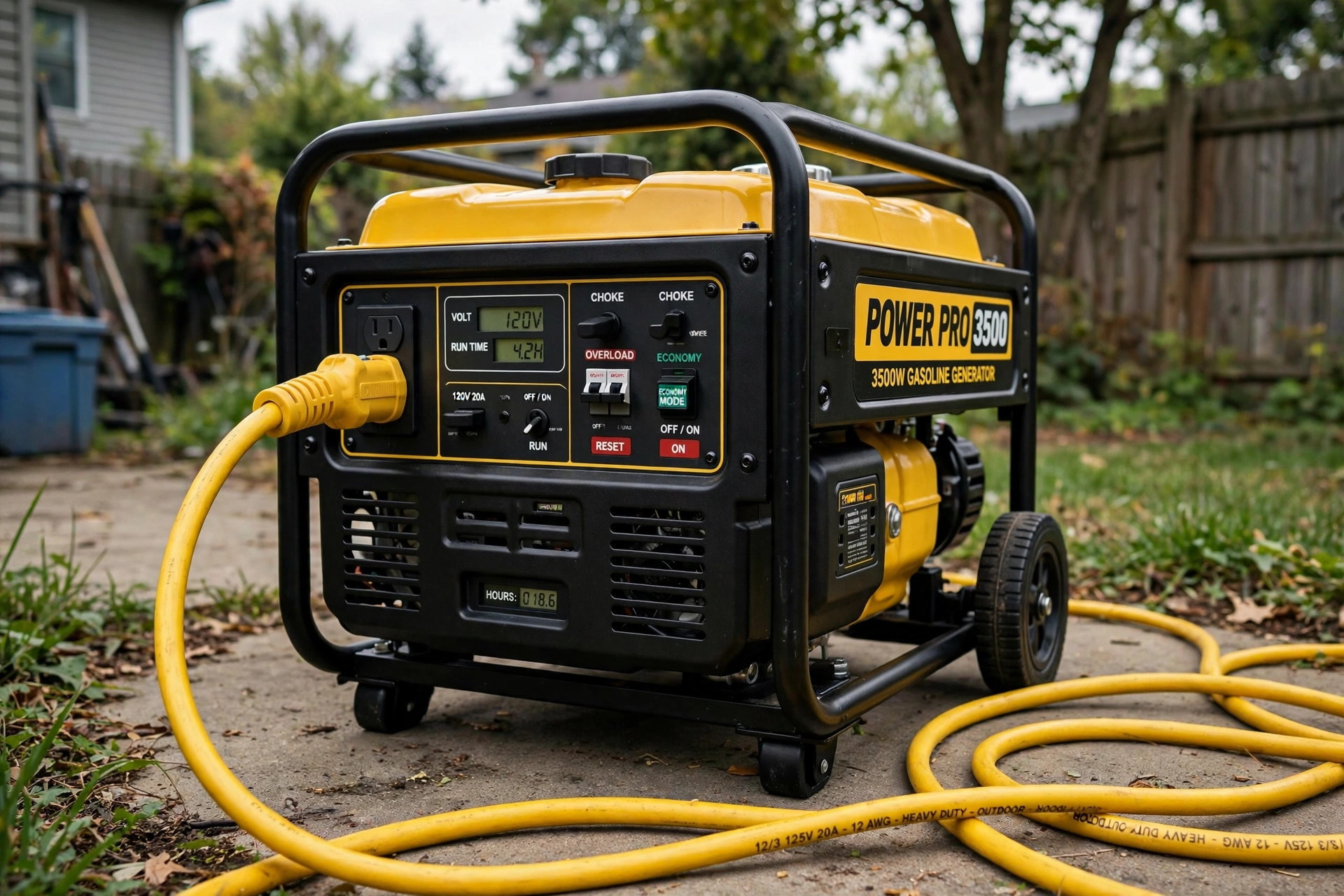
A generator outside and an AC in the window means an extension cord in between — and the cord matters more than people think. Voltage drops over long, thin cords, and low voltage makes compressor motors draw more current, run hotter, and trip generators they should have handled easily.
My rules:
- 12-gauge cord minimum for any run over 25 feet. A skinny orange 16-gauge cord from the garage is how you turn a working setup into a tripped breaker.
- Shorter is better. Every extra 25 feet of cord adds voltage drop. Put the generator as close to the window as safety allows (at least 20 feet from the house for carbon monoxide — see our solar generator and AC guide for the same distance math applied to power stations).
- One cord, one AC. Don’t daisy-chain cords or run the AC and the fridge through the same strip.
FAQs
Will a 2000 watt generator run a 5000 BTU air conditioner?
What size generator do I need for an 8000 BTU window AC?
Can I run a window AC and a refrigerator on one generator?
Do inverter generators work better for window ACs?
How do I calculate my window AC’s wattage exactly?
The Bottom Line
Most window ACs need far less generator than people assume — but the generator you pick has to be sized for the starting surge, not the running number on the label. Match your BTU to the table above, add headroom for whatever else you want to run, and start your loads one at a time with the biggest motor first. Do that, and you’ll be the cool house on the block during the next outage.

Related Guides
Why Does My Generator Backfire? Causes and Fixes (2027)
Why does your generator backfire? An exhaust bang means unburned fuel in the muffler; a pop through the carb means lean mixture or valve trouble. Here are the fixes.

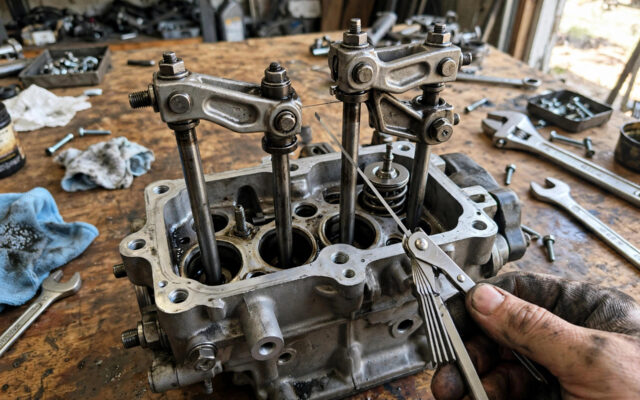
Generator Valve Adjustment: How to Set Valve Lash (2027 Guide)
Generator valve adjustment: 0.006" intake, 0.008" exhaust on Honda GX engines. Tools, TDC procedure, and symptoms of bad valve lash explained.

How to Clean and Replace a Generator Air Filter (2027 Guide)
How to clean a generator air filter: wash foam filters in soapy water and re-oil; tap out paper filters, never wash them. Full steps inside.