


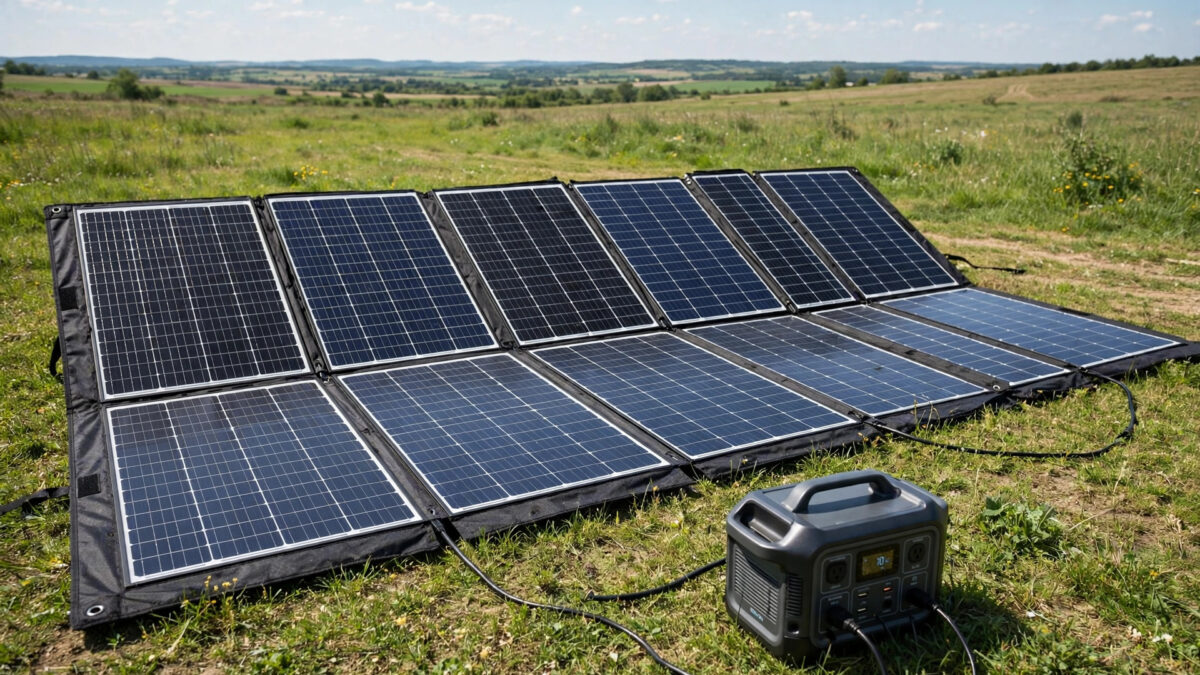
It is one of the most common questions new solar generator owners ask: how many solar panels do I actually need? The honest answer is that there is no single number. The right amount of solar depends on three things: the size of your power station, its solar input limit, and how fast you want to recharge it. A pair of 200W panels can fully recharge a 1kWh station on a sunny afternoon, while a 4kWh home-backup unit can absorb well over 1,000W of solar without breaking a sweat.
The good news is that the math is simple, and once you understand it you will never overspend on panels you do not need or undersize your setup and wait all day for a charge. This guide walks you through the whole process step by step.
Step 1: Start With Your Station’s Capacity
Your station’s battery capacity, measured in watt-hours (Wh), is the starting point. It tells you how much energy you need to replace. A 1,024Wh station like the EcoFlow DELTA 3 Plus needs roughly 1,024Wh of solar energy (plus charging losses) to go from empty to full. A 2,073Wh station like the BLUETTI Elite 200 V2 needs about twice that.
The general rule of thumb that experienced users follow is straightforward: for a full recharge in one good solar day (about 4 to 6 peak sun hours), aim for total panel wattage equal to roughly one-third to one-half of your battery capacity in watt-hours. That means:
- Around 1kWh station: 300 to 500W of panels
- Around 2kWh station: 600 to 900W of panels
- Around 4kWh station: 1,000 to 1,600W of panels
These are starting targets. The exact number also depends on your sunlight, your panels, and how you wire them — which we will cover below.
Step 2: Check the Solar Input Limit
Every power station has a maximum solar input, and it is the ceiling you must design around. You will find it on the spec sheet or in the manual, expressed as a combination of:
- Maximum watts: the total solar power the station will accept at once
- Maximum open-circuit voltage (Voc): the critical safety number for series wiring
- Maximum input current (amps): relevant when wiring panels in parallel
There is no point buying 1,200W of panels for a station that only accepts 800W — the extra 400W simply goes unused. More importantly, if you wire panels in series their voltages add together, and the combined Voc must stay below the station’s limit. Exceeding the Voc rating can damage the charge controller, and that kind of damage is not covered by warranty. When in doubt, check the manual before you buy.
As a practical example, mid-size stations in the 1kWh class typically accept 500 to 800W of solar, 2kWh-class stations usually accept 1,000 to 1,600W, and large home-backup units accept 2,000W or more. Your station’s manual will give you the exact numbers.
Step 3: Series vs Parallel — How You Wire Panels Matters
When you connect more than one panel, you have two choices, and each has a purpose:
Series wiring connects panels end to end. Voltages add up while current stays the same. This is the most common setup because higher voltage means the charge controller starts working earlier in the morning and keeps working later in the evening, and you lose less energy over long cable runs. The trade-off: the combined Voc of the string must stay under your station’s voltage limit, and if one panel is shaded, the whole string’s output drops.
Parallel wiring connects all the positive terminals together and all the negatives together. Current adds up while voltage stays the same. This setup handles partial shading much better — one shaded panel does not drag the others down — but the combined current must stay under the station’s amp limit, and you may need thicker, more expensive cables.
For most people with two to four panels and an unshaded roof or yard, series (or series-parallel combinations for larger arrays) is the simplest and most efficient choice. If you deal with trees, chimneys, or other partial shade, lean toward parallel.
Step 4: Rated Watts vs Real-World Output
Here is the part that surprises most beginners: solar panels almost never produce their rated wattage. A 200W panel does not deliver 200W in normal use. Laboratory ratings assume perfect conditions — direct noon sun, a cool panel, and ideal angles — that you will rarely see.
In real-world conditions, expect 70 to 85 percent of the rated wattage during good sun hours. That 200W panel will typically deliver 140 to 170W at midday. Heat, haze, dust, imperfect angles, and cable losses all shave off output.
This is why the formula below includes an efficiency factor. Always size your array using realistic output, not the number printed on the box — otherwise you will end up wondering why your “400W” of panels recharges so slowly.
The Simple Formula
Here is the practical formula for sizing your panels:
Panel watts needed = Battery capacity (Wh) ÷ (Peak sun hours × 0.75)
Peak sun hours are the hours of strong, direct sunlight your location gets — typically 4 to 6 in most of the US, less in winter or cloudy regions. The 0.75 factor accounts for real-world panel efficiency and charging losses.
Example: a 1,024Wh station in a location with 5 peak sun hours needs 1,024 ÷ (5 × 0.75) = 273W of panels for a full day’s recharge. Round up to account for imperfect days, and you land at 300 to 400W — two 200W panels, for instance. That matches the rule of thumb from Step 1.
Worked Examples: 1kWh, 2kWh, and 4kWh Stations
1kWh station (e.g., EcoFlow DELTA 3 Plus, 1,024Wh): Two 200W panels — 400W total — will recharge it from empty in roughly 3 to 4 hours of strong sun. A great match here is a pair of Jackery SolarSaga 200W panels, which are bifacial, foldable, and easy to carry for camping or RV trips.
2kWh station (e.g., BLUETTI Elite 200 V2, 2,073Wh): Aim for 700 to 800W of panels. Two BLUETTI PV350 350W panels give you 700W in a compact footprint and will refill the station in about 4 to 5 hours of good sun. The PV350’s 23.4% efficiency means more power per square foot, which matters when roof or ground space is limited.
4kWh station (e.g., EcoFlow DELTA Pro 3, 4,096Wh): Plan on 1,000 to 1,600W of panels. Three to four 350–400W rigid panels, or a mix of portables like the PV350, will do the job. At this scale many owners mount rigid residential-style panels permanently, since portable panels get bulky — four 400W rigid panels are a common setup for home backup.
If you want our full breakdown of the stations mentioned here, see our guides to the best solar generators of 2027 and the best portable power stations of 2027.
What About Over-Paneling?
You may hear about “over-paneling” — connecting more panel wattage than the station’s input limit. This is generally safe and sometimes smart: the station’s charge controller simply draws what it can handle and ignores the rest. The benefit is faster charging in weak morning and evening light, when your oversized array still produces decent power.
But two rules are absolute. First, never exceed the Voc voltage limit, no matter what. Second, stay within the current (amp) limit for your wiring configuration. Over-paneling on watts is fine; over-volting is not. If you are unsure, stick to the input limit printed in the manual.
How many solar panels do I need for a 1000W solar generator?
For a 1kWh (1,000Wh-class) station, 300 to 500W of panels — typically two 200W panels — will fully recharge it in one sunny day. Using the formula (capacity ÷ sun hours × efficiency), 400W of panels refills a 1,024Wh station in about 3 to 4 hours of strong sun.
Can I use any solar panel with my solar generator?
Mostly yes, as long as the panel’s voltage and connectors are compatible and the combined Voc stays under your station’s limit. Third-party panels work fine with most stations via MC4 or DC adapters, but always verify the voltage and current ratings against your station’s input specs first.
Is it better to wire solar panels in series or parallel?
Series is usually better for unshaded setups — higher voltage means earlier morning startup, better low-light performance, and thinner cables. Parallel is better when panels face partial shade, since one shaded panel will not drag down the whole array. Always respect your station’s Voc (series) and amp (parallel) limits.
Why are my solar panels producing less than their rated wattage?
Rated wattage is measured in perfect lab conditions. In the real world, heat, haze, dust, imperfect tilt angles, and cable losses typically reduce output to 70 to 85 percent of rated. This is normal. Clean your panels, angle them toward the sun, and size your array using realistic output figures.
Can I mix different solar panels together?
You can, but it is not ideal. In series, the whole string is limited by the lowest-current panel; in parallel, by the lowest-voltage panel. Mismatched panels waste potential output. For best results, use identical panels — same wattage, voltage, and ideally the same model.
Our verdict
Size your panels to your station, not the other way around. Start from your battery capacity, apply the one-third to one-half rule of thumb, verify your station’s input limits, and remember that real-world output runs 70 to 85 percent of rated. Two 200W panels suit most 1kWh stations, 700 to 800W suits 2kWh units, and 4kWh home-backup stations want 1,000W or more. Buy for your actual sunlight and recharge needs, and you will get a setup that just works.

Related Guides
Best Solar Generator Bundles with Panels for 2027
Save money with the best solar generator bundles of 2027 — power station plus solar panel kits ready to use out of the box.

Best Solar Generators for RVs in 2027
Power your RV adventures with the best solar generators for RVs in 2027, featuring TT-30 outlets and fast solar charging.

Best Solar Generators for Camping in 2027
The best solar generators for camping in 2027: lightweight, quiet power stations that keep your gear charged off-grid.