


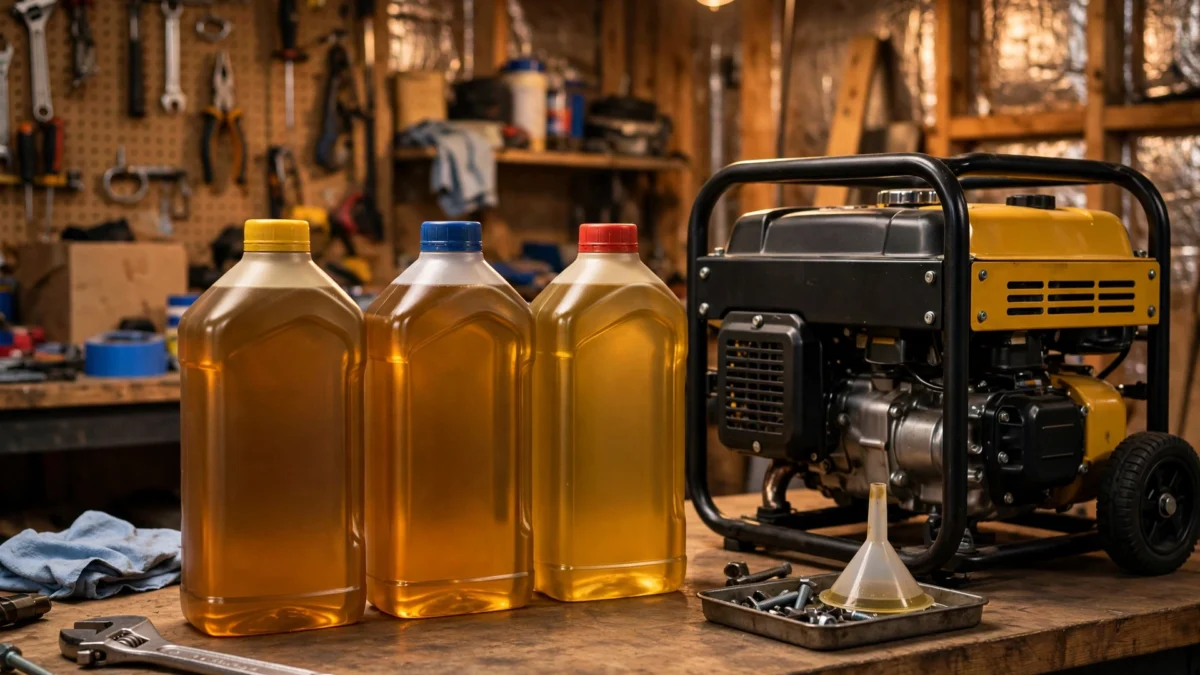
Here’s something that surprises most new generator owners: the engine in your portable generator is basically a lawnmower engine, and it lives a much harder life than your car’s engine. It runs at a constant 3,600 RPM for hours, it air-cools (no radiator), and it often sits for months between runs. The oil is the only thing standing between that engine and an early death.
The good news: you don’t need exotic oil. You need the right weight, changed on schedule. The best oil for portable generators in 2027 is a quality 5W-30 full synthetic for most owners — it covers the widest temperature range and protects best during those long, hot outage runs. But “most” isn’t “all,” so I’ve broken down seven real options by weight, base stock, and use case below.
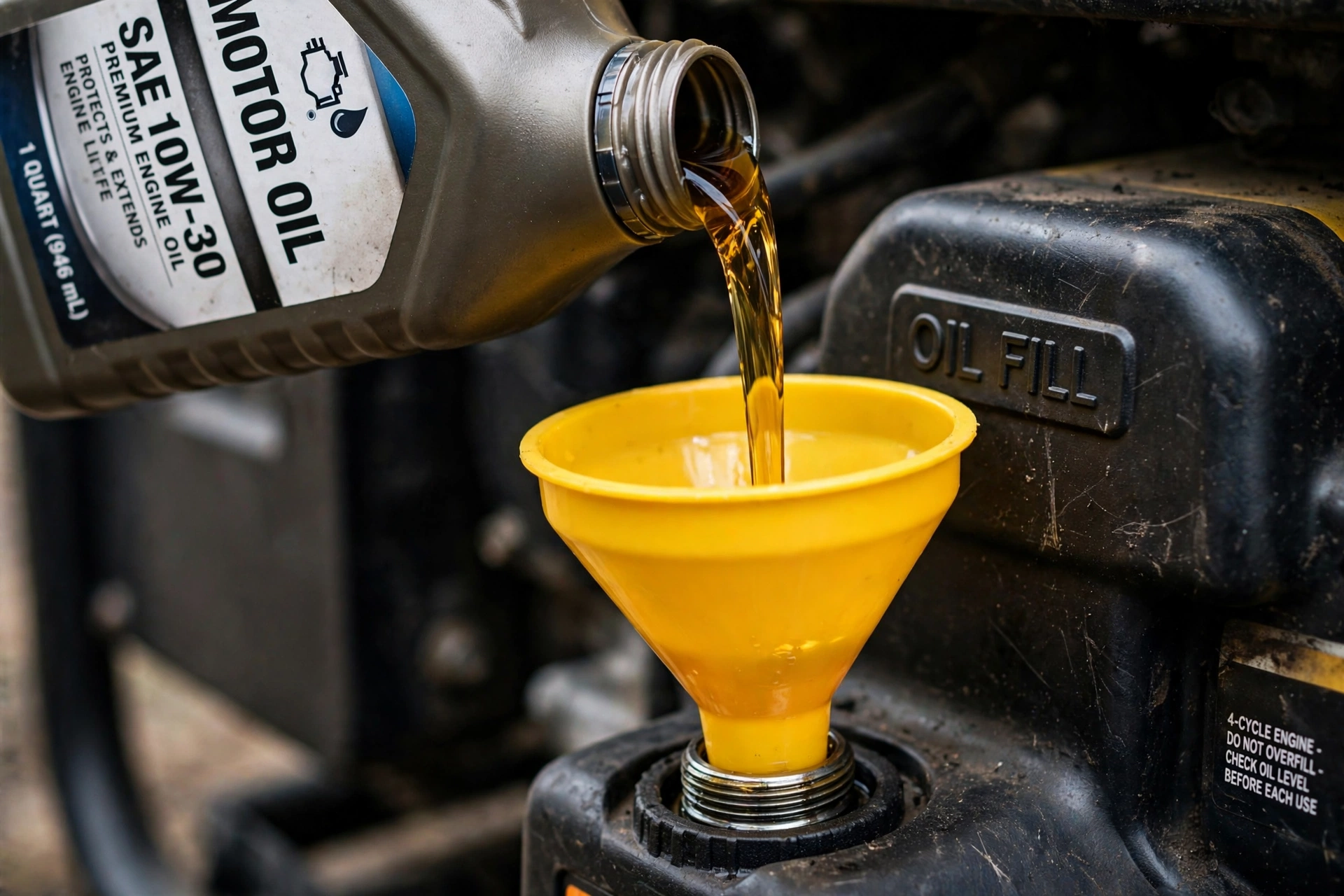
One thing I want to be clear about up front: brand loyalty matters less than the spec on the bottle. A Honda that calls for 10W-30 will run perfectly on any quality 10W-30 that meets the API rating. The OEM bottles are convenient and guaranteed correct, but they’re not magic.
Key takeaways
- 5W-30 full synthetic is the best default for most portable generators — widest temperature range, best hot-weather protection.
- Match the weight to your climate: SAE 30 for hot weather only, 10W-30 for warm weather, 5W-30 for all-season use.
- Full synthetic resists breakdown during long runs and extends change intervals — worth the small premium.
- Any oil meeting your manual’s API rating works; OEM bottles are convenient but not required.
Quick picks
- Best overall: Generac 5W-30 Full Synthetic Oil Change Kit — oil, filter, and drip pad in one box
- Best for Honda generators: Honda Pro Honda GN4 10W-30
- Best conventional for hot weather: Briggs & Stratton SAE 30
- Best full synthetic 30-weight: TRIAX Power 4-Stroke 30W
- Best premium synthetic: Royal Purple 5W-30
Best overall
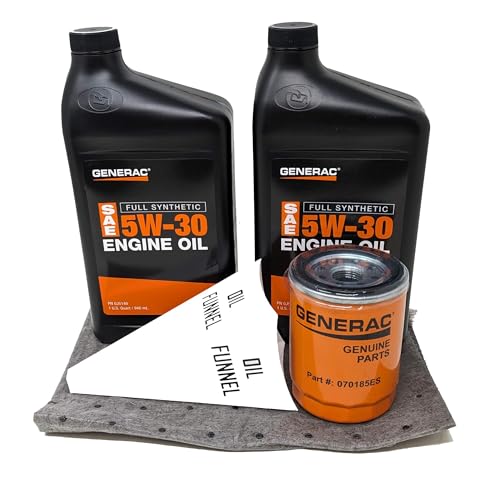
Generac 5W-30 Full Synthetic Oil Change Kit
- Viscosity: 5W-30
- Base Stock: Full synthetic
- Quantity: 2 quarts
- Includes: OEM oil filter (70185E), absorbent pad
As an Amazon Associate, we earn from qualifying purchases.
This is my default recommendation for a simple reason: it removes every excuse not to change your oil. Two quarts of Generac’s 5W-30 full synthetic, the correct OEM oil filter, and an absorbent pad — everything for one service in a single box. A portable generator holds roughly 1 to 1.5 quarts, so two quarts covers the change with a little left for top-offs.
The oil itself is the right spec for the job: full synthetic 5W-30, which flows on a cold start and holds its viscosity through a 12-hour run in August heat. That’s the exact scenario that kills conventional oil — sustained high temperature shears it down, and the next cold start happens on thinner oil than the engine expects.
It’s branded Generac, but 5W-30 full synthetic meeting the API spec works in any generator that calls for 5W-30 — which is most of them. The included filter is Generac-specific (70185E), so if you run a different brand, buy the kit for the oil and pad and source your own filter. Our oil change guide has the full step-by-step if this is your first time.
Pros
- Everything for one oil change in one box
- Full synthetic — best protection for long hot runs
- Correct OEM filter included
- Absorbent pad keeps the job clean
Cons
- Filter is Generac-specific
- Costs more than a jug of generic synthetic
- Overkill if you just need a top-off quart
Best for Honda generators
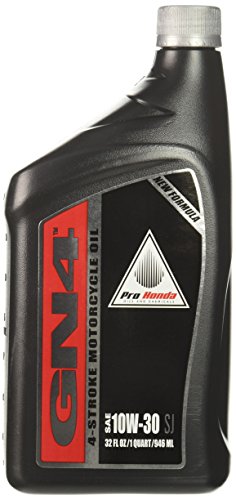
Honda Pro Honda GN4 10W-30 Motor Oil
- Viscosity: 10W-30
- Base Stock: Conventional
- Quantity: 1 quart
- Best For: Honda EU series and other 10W-30-spec engines
As an Amazon Associate, we earn from qualifying purchases.
Honda’s manuals for the EU series specify 10W-30, and the GN4 is Honda’s own bottle of it. It’s a conventional (mineral-based) oil, not a synthetic — which is worth knowing because Honda’s spec was written around conventional oil and its change intervals assume it. If you follow the manual’s schedule, GN4 is exactly right.
Here’s the nuance: you can absolutely run a quality 10W-30 full synthetic in a Honda instead. It won’t hurt anything — synthetics meet and exceed the same API ratings. Some owners switch to synthetic for the longer change intervals and better cold starts. Honda won’t void your warranty for it as long as the weight and rating match. But if you want zero thought involved, the GN4 is the manual’s answer in a bottle.
One quart is enough for most Honda portables — the EU2200i takes about 0.42 quarts, the EU3000is about 0.63. Buy two quarts and you’ll have top-off oil for a couple of seasons.
Pros
- Exactly what Honda’s manual specifies
- Inexpensive per quart
- Widely available
- Right weight for warm-weather running
Cons
- Conventional — shorter change intervals than synthetic
- 10W-30 is sluggish below freezing; not an all-season oil
- Single quart — buy two for top-offs
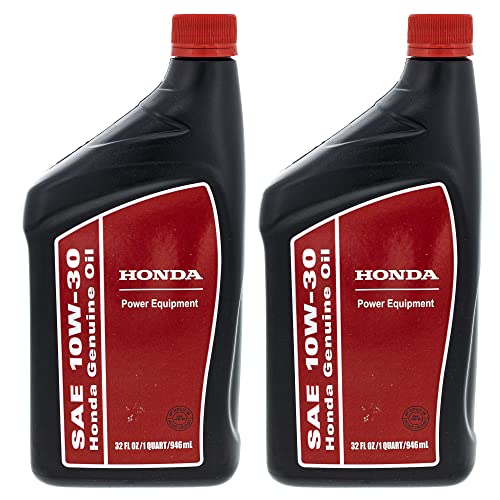
Best Honda power-equipment oil
Honda 08207-10W30 Power Equipment Oil
- Viscosity: 10W-30
- Base Stock: Conventional
- Quantity: 1 quart
- Best For: Honda power equipment — generators, mowers, pumps
As an Amazon Associate, we earn from qualifying purchases.
Honda sells two different 10W-30s and the distinction matters. The GN4 above is the motorcycle/ATV oil. The 08207-10W30 is Honda’s power equipment oil — formulated for air-cooled small engines like the ones in their generators, mowers, and pumps. The additive package is tuned for the higher operating temperatures of air-cooled engines, which run significantly hotter than liquid-cooled motorcycle engines.
In practice, either one works in a Honda generator. But if you’re buying Honda oil specifically for a generator, this is the more correct bottle. It’s the one Honda’s power equipment dealers stock, and it’s what goes into the genuine Honda tune-up kits.
Like the GN4 it’s a conventional oil, so the same change intervals apply. And the same synthetic option exists if you want longer intervals — just match 10W-30 and the API rating.
Pros
- Formulated for air-cooled small engines specifically
- The oil in Honda’s genuine tune-up kits
- Correct additive package for generator operating temps
Cons
- Conventional — same interval limits as GN4
- Easy to confuse with the GN4 motorcycle oil
- Single quart
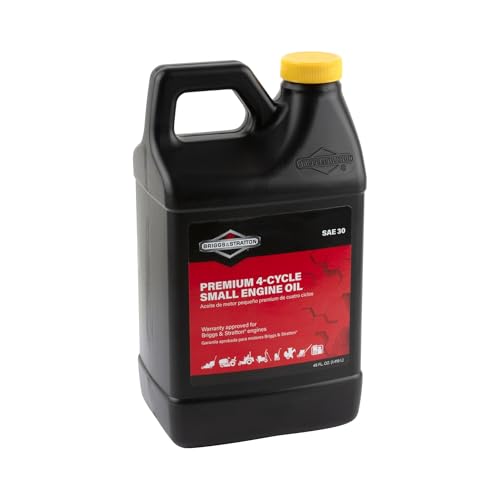
Best conventional for hot weather
Briggs & Stratton SAE 30 Engine Oil (48 oz.)
- Viscosity: SAE 30 (single weight)
- Base Stock: Conventional, detergent
- Quantity: 48 oz.
- Best For: Hot-weather running, 40°F and above
As an Amazon Associate, we earn from qualifying purchases.
Straight SAE 30 is the old-school generator oil, and in hot weather it’s still excellent. It’s a single-weight oil — no viscosity modifiers — formulated specifically for the higher operating temperatures of air-cooled engines. If your generator runs in 80°F+ weather and your manual lists SAE 30 as an option, this is a perfectly good choice.
The 48-ounce bottle is a thoughtful size: most portable generators take 20–40 ounces, so one bottle covers the change with a little left over. No measuring, no leftover half-quarts rolling around the garage.
The limitation is temperature. SAE 30 gets thick below about 40°F, which means hard starting and poor initial lubrication in cold weather. This is a summer oil. If your generator might need to start in a January ice storm, use a multi-weight instead. And never use SAE 30 in an engine whose manual doesn’t list it — some modern overhead-cam engines want the cold-flow of a multi-weight even in heat.
Pros
- Formulated for air-cooled engine temperatures
- 48 oz. bottle matches real generator capacities
- Inexpensive and proven over decades
- No viscosity modifiers to shear down
Cons
- Hot weather only — thick and hard-starting below 40°F
- Conventional — change on schedule, no stretching intervals
- Check your manual lists SAE 30 first
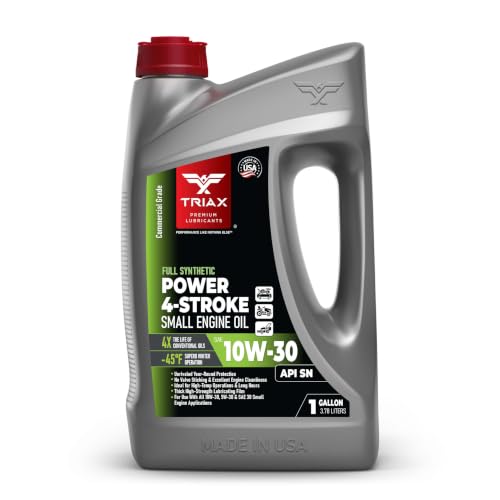
Best full synthetic 30-weight
TRIAX Power 4-Stroke 30W Full Synthetic (1 Gallon)
- Viscosity: SAE 30
- Base Stock: Full synthetic, high-zinc
- Quantity: 1 gallon
- Best For: Older generators spec’ing straight 30-weight
As an Amazon Associate, we earn from qualifying purchases.
The TRIAX is for the owner who wants synthetic protection but whose manual calls for straight 30-weight — common on older generators and many air-cooled workhorses. It’s a full synthetic SAE 30 with a high-zinc additive package, which is exactly what flat-tappet small engines like: zinc is the anti-wear additive that modern car oils have reduced, but small engines still benefit from.
The gallon jug is the value play here. At roughly four quarts, it covers three to four oil changes on a typical portable — which, at annual changes, is three to four years of oil in one purchase. Synthetic doesn’t degrade on the shelf the way opened conventional can absorb moisture, so buying in bulk is safe as long as you keep the cap on.
Same temperature caveat as any 30-weight: this is for warm-weather use. TRIAX rates it down to a -45°F pour point, which sounds impressive, but pour point isn’t the same as proper cold-start lubrication — in freezing weather, use a multi-weight.
Pros
- Full synthetic in a straight 30-weight — rare combination
- High-zinc formula suits older flat-tappet engines
- Gallon jug covers years of changes
- Excellent thermal stability for long runs
Cons
- Warm weather only, like any 30-weight
- Gallon is overkill if you own one small generator
- Verify your manual lists SAE 30
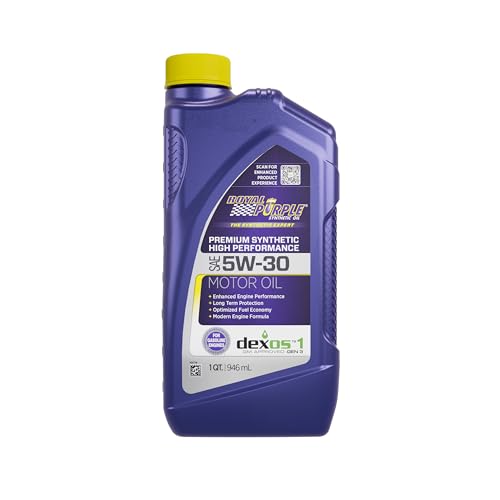
Best premium synthetic
Royal Purple 5W-30 High Performance Synthetic
- Viscosity: 5W-30
- Base Stock: Full synthetic, API-licensed
- Quantity: 1 quart
- Best For: Premium inverter generators, long-hour use
As an Amazon Associate, we earn from qualifying purchases.
Royal Purple is the premium pick, and I’ll be honest about what that premium buys you in a generator: not horsepower, not miracles — just excellent film strength and additive quality in a 5W-30 that exceeds every spec a portable generator asks for. It’s API-licensed, meets the ratings your manual requires, and handles the sustained-heat, constant-RPM life of generator duty very well.
Is it worth roughly twice the price of a store-brand full synthetic 5W-30? For most owners, no — a quality generic synthetic changed on schedule protects just as well in practice. Where Royal Purple makes sense: expensive inverter generators you plan to keep for a decade, or units that run long hours regularly (off-grid cabins, food trucks). The cost difference per oil change is a few dollars; on a $2,500 generator, that’s cheap peace of mind.
One caution: like any 5W-30, it’s an all-season oil, not a cold-climate specialist. Below about 0°F, even 5W-30 is working hard — check your manual’s winter recommendations if you’re in the deep north.
Pros
- Excellent film strength and additive package
- API-licensed — meets all manufacturer specs
- True all-season 5W-30
- Good choice for expensive, long-life generators
Cons
- Premium price — diminishing returns vs. generic synthetic
- Won’t fix neglected maintenance on its own
- Single quart
Yamaha Yamalube 10W-30 (LUB-10W30-GG-12)
Yamaha’s Yamalube 10W-30 (part LUB-10W30-GG-12) is formulated specifically for Yamaha’s golf cars and generators — engines that run at constant load with frequent start-stop cycles, which describes generator duty perfectly. It’s a mineral-based oil with an additive package tuned for that use case rather than for cars.
If you own a Yamaha inverter generator (the EF series), this is the bottle your dealer hands you, and there’s no reason to overthink it. Like the Honda conventional oils above, you can substitute a quality 10W-30 synthetic if you want longer intervals — just match the weight and API rating.
I couldn’t verify a single stable Amazon ASIN for the quart bottle — Yamaha’s parts distribution runs heavily through dealers, and Amazon listings rotate. Search Amazon for “LUB-10W30-GG-12” or buy from a Yamaha power equipment dealer.
Pros
- Formulated for Yamaha generator duty cycles
- Dealer-recommended, guaranteed correct
- Good value per quart
Cons
- Conventional — standard change intervals
- Amazon availability is inconsistent
- Yamaha-specific; other brands have their own equivalents
Availability note: search Amazon for “Yamalube LUB-10W30-GG-12” or buy from a Yamaha dealer — I couldn’t verify a stable ASIN.
Oils compared
| Oil | Viscosity | Base stock | Size | Best for |
|---|---|---|---|---|
| Generac oil change kit | 5W-30 | Full synthetic | 2 qt + filter | All-season default |
| Honda GN4 | 10W-30 | Conventional | 1 qt | Honda spec |
| Honda 08207-10W30 | 10W-30 | Conventional | 1 qt | Honda power equipment |
| Briggs & Stratton SAE 30 | SAE 30 | Conventional | 48 oz | Hot weather |
| TRIAX 30W | SAE 30 | Full synthetic | 1 gal | Older 30-weight engines |
| Royal Purple 5W-30 | 5W-30 | Full synthetic | 1 qt | Premium protection |
| Yamalube 10W-30 | 10W-30 | Mineral | 1 qt | Yamaha generators |
How to choose oil for your portable generator
Start with your manual’s weight chart
Every generator manual has a temperature-vs-viscosity chart. It usually looks like this: SAE 30 above 40°F, 10W-30 from 0°F to 100°F, 5W-30 synthetic from -20°F up. Find your climate on that chart and the answer is staring at you. When in doubt, 5W-30 full synthetic covers the widest range of any common option.
Synthetic vs. conventional: what you’re actually buying
Synthetic oil resists thermal breakdown longer, flows better cold, and lets you safely stretch change intervals. On a generator that runs 8-hour outage shifts in summer heat, that matters — conventional oil shears down under sustained heat. The price difference is a few dollars per change. For a machine that has to work when everything else is failing, synthetic is the easy call.
That said, conventional oil changed on schedule beats synthetic changed late. The schedule matters more than the base stock. If you’re the type who changes oil religiously every spring, conventional is fine.
Don’t overthink the brand
The API rating on the bottle (SN, SP, etc.) is the actual standard. Any oil meeting your manual’s weight and API rating protects your engine — the OEM bottle is about convenience and certainty, not chemistry. Buy the OEM kit when you want zero decisions; buy quality generic when you want value.
Change it on schedule — especially the first one
The break-in change at 20–30 hours removes the metal particles from manufacturing. Skip it and those particles circulate for the engine’s whole life. After that: every 50–100 hours or annually, whichever comes first. If your generator is new, our break-in guide covers the full first-service procedure.
How much oil does it actually take?
Less than you think. Most portables take 0.5 to 1.5 quarts — check the dipstick, don’t just pour the whole bottle. Overfilling is a real problem: it causes smoking, fouled plugs, and oil in the air filter. Fill to the upper dipstick mark with the generator level, run it for a minute, recheck.
Frequently asked questions
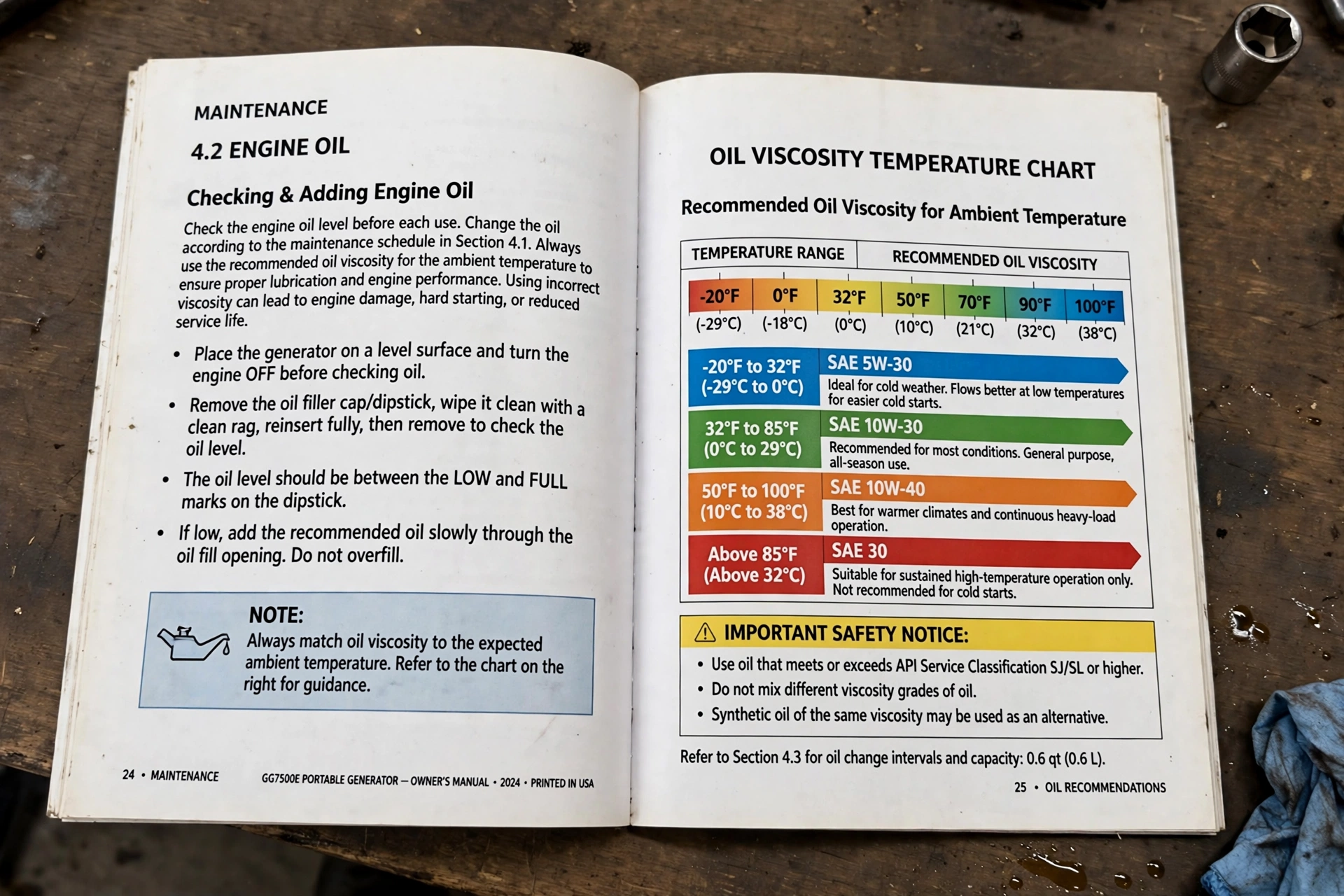
What is the best oil weight for a portable generator?
Can I use synthetic oil in my generator?
How often should I change my generator’s oil?
Can I use car oil in my generator?
How much oil does a portable generator take?
Our verdict
For most owners, in most climates: 5W-30 full synthetic, changed annually. The Generac oil change kit makes it a one-box job. Honda and Yamaha owners can stick with their brands’ 10W-30 with total confidence. Hot-climate owners with older units: SAE 30 is still a fine summer oil. Whatever you buy, the schedule matters more than the label — the best oil in the world doesn’t help if it’s been in the crankcase for three years.
How we researched this: We compared manufacturer oil spec charts, API ratings, and owner-manual temperature charts across major brands, and verified current Amazon availability and ASINs in October 2026. Where a stable Amazon listing couldn’t be confirmed, we said so. We did not receive free products from any manufacturer.

Related Guides
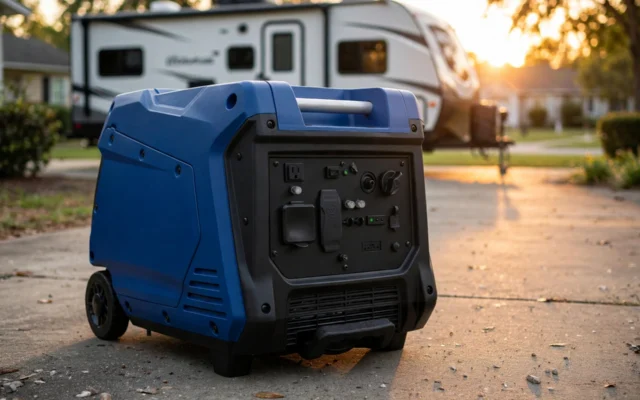
Westinghouse iGen4500DF Review: The Dual-Fuel Inverter to Beat in 2027
Westinghouse iGen4500DF review: 4,500W dual-fuel inverter, 52 dBA, remote start, RV-ready. We test the specs, noise, and value against Honda in 2027.

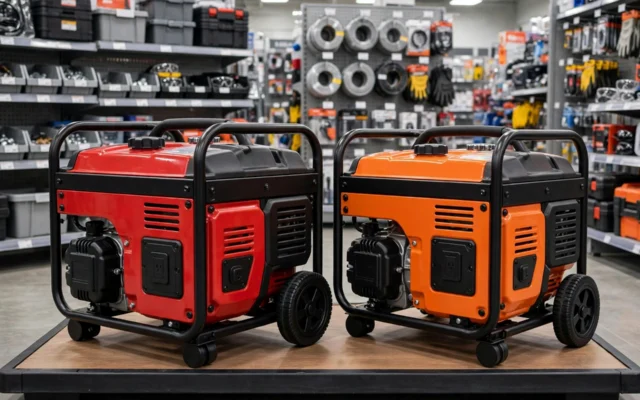
Champion vs Generac Generators: Which Brand Is Better in 2027?
Champion vs Generac: Champion wins portable value, Generac wins standby. We compare lineups, reliability, safety tech, and support to pick the right brand.
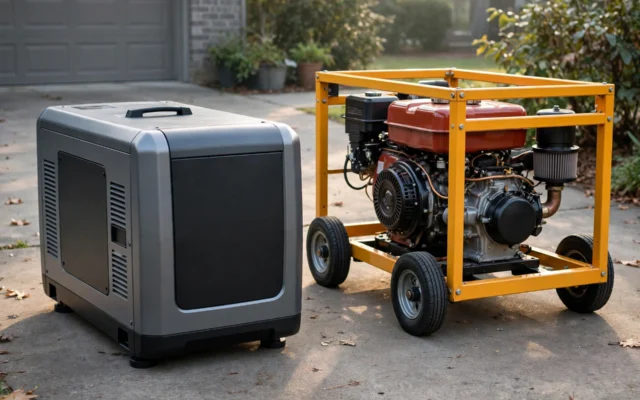
Inverter vs Conventional Generators: Which Should You Buy in 2027?
Inverter vs conventional generators: inverters win on noise, fuel use and clean power; conventional wins on watts per dollar. Here's how to choose in 2027.