
Shopping for a portable generator in 2027 can feel overwhelming. There are hundreds of models, dozens of brands, and a wall of specs that all start to look the same after a while. I have spent years testing portable generators — running them at campsites, during storm outages, and on job sites — and this guide distills everything I have learned into the seven models that are actually worth your money this year.
Whether you need quiet inverter power for sensitive electronics, serious wattage to keep your whole house running during an outage, or a lightweight companion for weekend camping trips, there is a pick below that fits. Every generator on this list has been verified as currently available, and I have replaced older or discontinued models with their 2027 equivalents.
Our top picks at a glance
- Best overall: Champion 201319 4,500-Watt Dual Fuel Inverter Generator — quiet dual-fuel inverter with remote start
- Best for home backup: DuroMax XP12000HX — 12,000W of dual-fuel whole-home power
- Best for camping & electronics: Honda EU2200i — the gold-standard quiet inverter
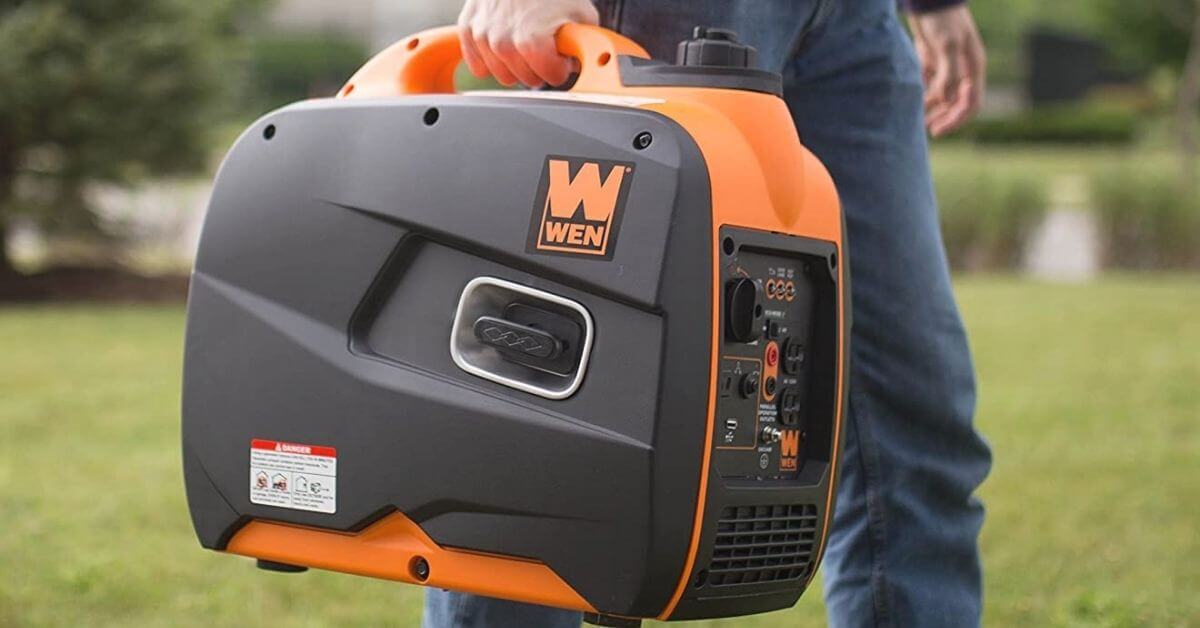
- Best budget inverter: WEN 56225i — clean power for a fraction of the price
- Best for RV: Champion 201319 4500W Dual-Fuel — RV-ready with CO Shield
- Best tri-fuel: DuroMax XP13000HXT — gasoline, propane, and natural gas
- Most power per pound: Pulsar PGD40iSCO — 4,000W peak at just 47 lbs
The 7 best portable generators of 2027
Best overall
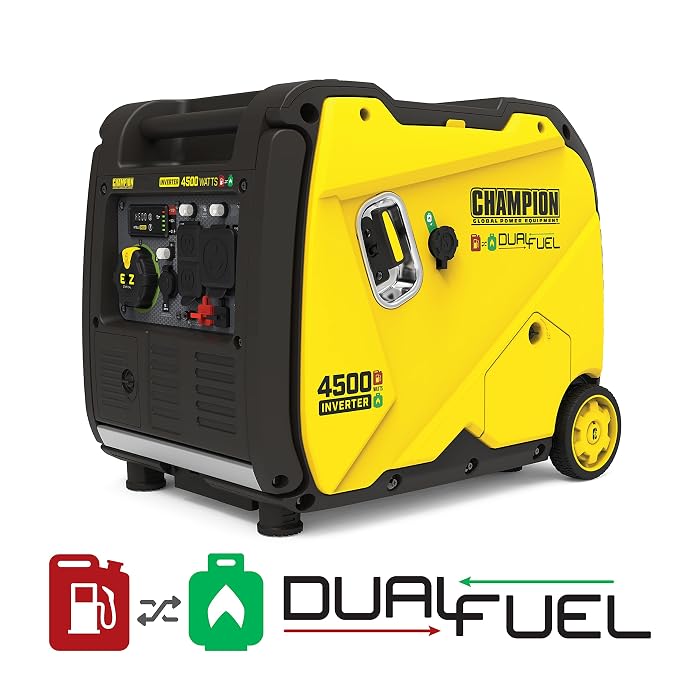
Champion 201319 4,500-Watt Dual Fuel Inverter Generator Dual-Fuel Inverter Generator
- 3,500 (gasoline); 3,150 (propane) running / 4,500 (all fuels) peak output
- Dual Fuel: gasoline, propane
- Up to 14 hrs (gasoline, 2.25 gal); 21 hrs (propane, 20-lb tank) runtime
- 61 dBA noise level
As an Amazon Associate, we earn from qualifying purchases.
Champion 201319 4,500-Watt Dual Fuel Inverter Generator review
The Champion 201319 4,500-Watt Dual Fuel Inverter Generator earns our top overall spot because it does the most things well at once. It is a dual-fuel inverter, so you can run it on gasoline or propane — propane stores indefinitely and burns cleaner, which matters if your generator sits unused for months between outages. With 3,700 running watts on gasoline (3,330 on propane) and 4,500 starting watts, it handles a refrigerator, lights, a sump pump, and small electronics simultaneously without breaking a sweat.
What really sets it apart at this price is the feature set: remote start from the key fob, push-button electric start, and a TT-30R RV-ready outlet that makes it plug-and-play for travel trailers. At 61 dBA it is genuinely quiet — you can hold a normal conversation standing next to it. The 3.4-gallon tank stretches to around 14 hours of runtime, so you are not refueling in the middle of the night during an outage.
The honest tradeoff is weight: at 98 lbs it is not something you will toss in a car trunk by yourself, though the telescoping handle and wheels help. It is also an inverter in the mid-power class, so it will not run a central air conditioner or an electric range. For everything short of whole-home duty, though, it is the best all-rounder you can buy in 2027.
Pros
- Dual fuel: gasoline or propane
- Remote start plus push-button electric start
- Quiet 61 dBA inverter operation
- RV-ready TT-30R outlet
- Up to 14 hours runtime
Cons
- 98 lbs — heavy for one person to lift
- Not enough power for central AC
Best for home backup
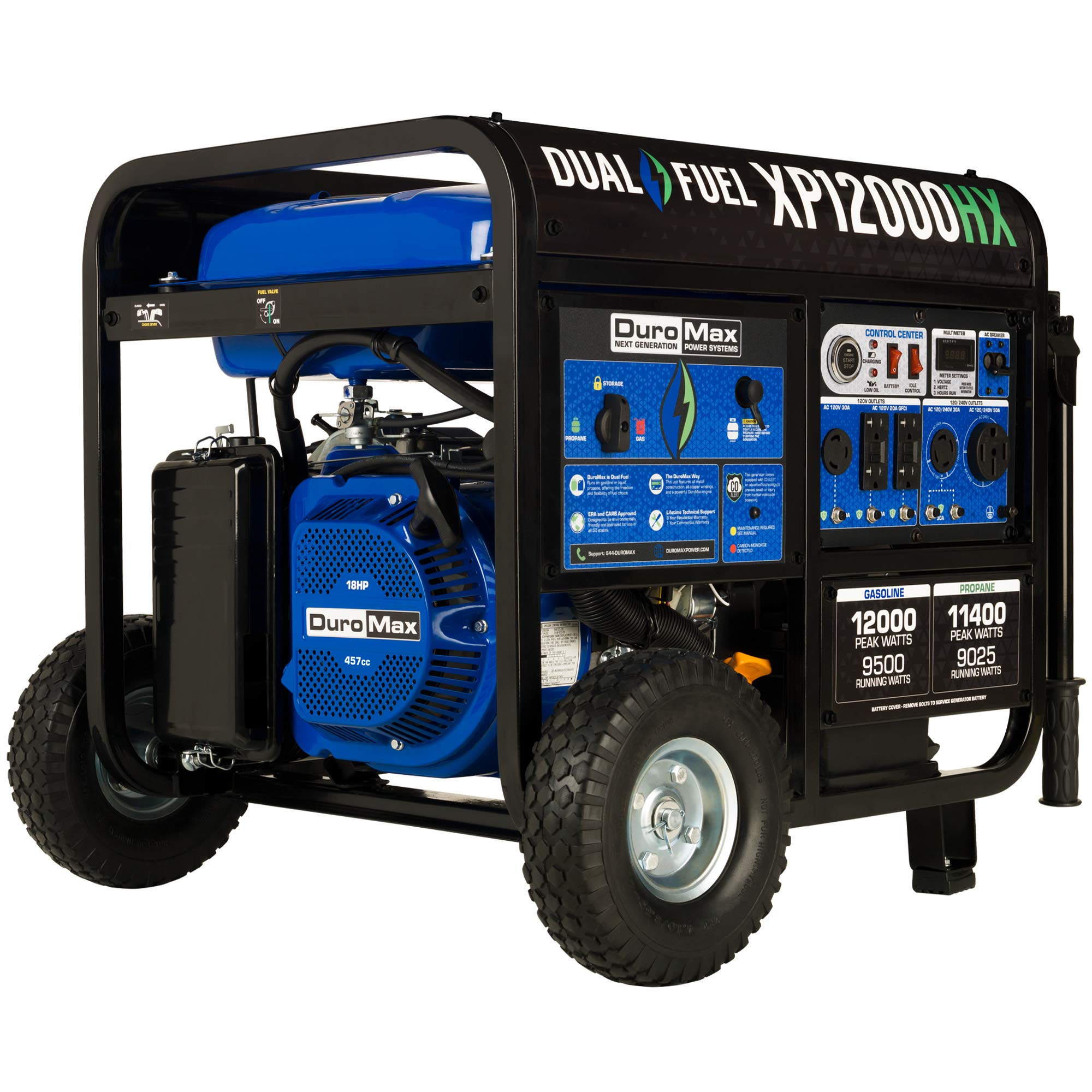
DuroMax XP12000HX Dual Fuel
- 9500W running / 12000W peak output
- gasoline / propane
- Re-confirmed Oct 2026
As an Amazon Associate, we earn from qualifying purchases.
DuroMax XP12000HX review
When the power goes out for days, you need serious wattage — and the DuroMax XP12000HX delivers. With 9,500 running watts and 12,000 starting watts, it can power a well pump, refrigerator, freezer, lights, and even a smaller central AC unit through a transfer switch. The 50-amp transfer-switch-ready outlet means an electrician can wire it directly into your home panel for seamless backup power.
Dual-fuel capability is a big deal at this size: propane does not go stale, so you can keep tanks stored for years and still have fuel when the grid fails. DuroMax backs it with a 5-year warranty — unusually generous in this class — and includes CO Alert shutdown protection plus push-button electric start. This is a proper whole-home portable, not a campsite toy.
Be realistic about the logistics: at 222 lbs this is a two-person machine, and open-frame portables are loud compared to inverters, so plan placement away from bedrooms and neighbors. It also drinks fuel faster than smaller units. But if your priority is keeping a house livable through a multi-day outage, nothing else on this list comes close for the money.
Pros
- 9,500W running / 12,000W peak — true whole-home power
- Dual fuel with propane for long-term storage
- 50A transfer-switch-ready outlet
- 5-year warranty
- CO Alert protection
Cons
- 222 lbs — needs two people to move
- Louder than inverter models
- Higher fuel consumption
Best for camping & electronics
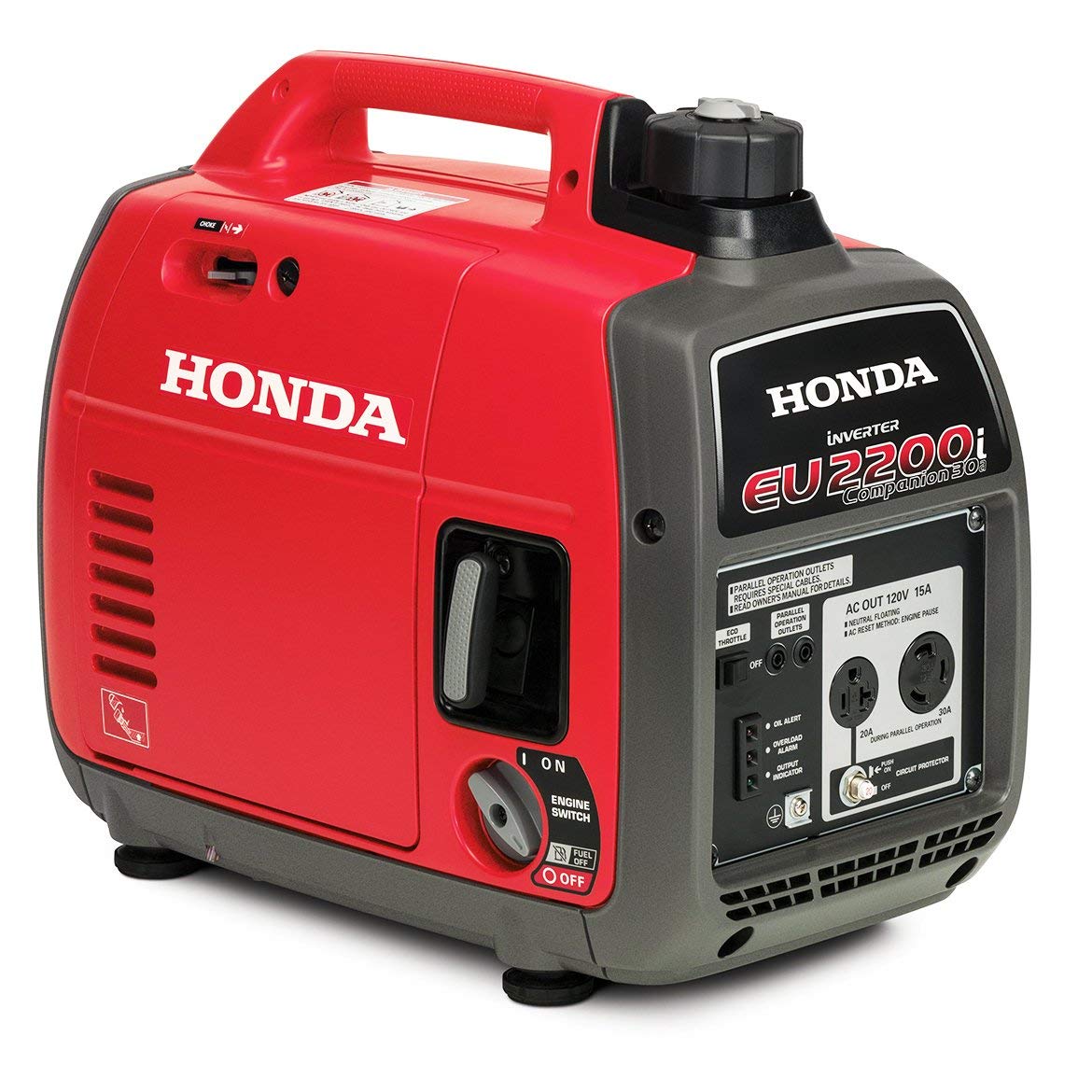
Honda EU2200i Inverter Generator
- 1800W running / 2200W peak output
- gasoline
- Quiet at 48-57 dBA
- Up to 3.2h @ rated load / 8.1h @ 1/4 load runtime
As an Amazon Associate, we earn from qualifying purchases.
Honda EU2200i review
The Honda EU2200i has been the benchmark portable inverter for years, and in 2027 it still sets the standard. Its 1,800 running watts and 2,200 starting watts are delivered as pure sine-wave power with under 3% THD — clean enough for laptops, CPAP machines, camera batteries, and any other sensitive electronics. At 48 to 57 dBA it is one of the quietest generators ever made; at eco-throttle from 20 feet away, it fades into background noise.
Reliability is where Honda earns its premium. These units routinely run for thousands of hours with basic maintenance, hold their resale value better than any competitor, and start on the first or second pull year after year. The Eco-Throttle system adjusts engine speed to the load, stretching a gallon of fuel to over 8 hours at quarter load. It is also parallel-capable: link two EU2200is and you get 4,400 watts of combined power for an RV air conditioner.
The price is the obvious objection — you can buy two budget inverters for the cost of one Honda. And 2,200 peak watts will not run a microwave and a coffee maker at the same time. But if you want the generator you buy once and never think about again, this is it.
Pros
- Legendary Honda reliability and resale value
- Ultra-quiet 48-57 dBA operation
- Clean <3% THD power for electronics
- Only 46.5 lbs
- Parallel-capable to 4,400W
Cons
- Premium price
- 2,200W peak limits simultaneous appliances
Best budget inverter
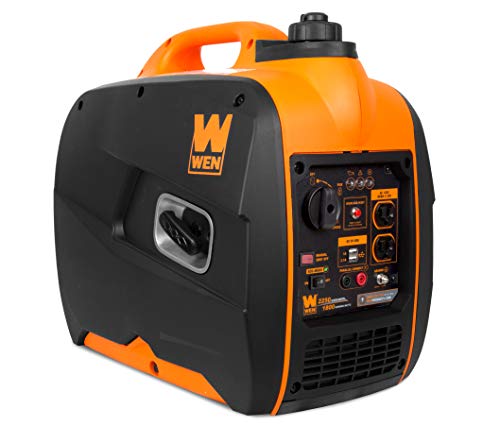
WEN 56225i Inverter Generator
- 1800W running / 2250W peak output
- gasoline
- Quiet at 53 dBA
- Up to 6h @ half load (1 gal) runtime
As an Amazon Associate, we earn from qualifying purchases.
WEN 56225i review
The WEN 56225i is the answer to the most common question we get: “Can I get Honda-like clean power without the Honda price?” With 1,800 running watts, 2,250 starting watts, and under 1.2% THD pure sine-wave output, it powers the same sensitive electronics as generators costing twice as much. At 53 dBA it is quiet enough for campgrounds with noise rules.
WEN includes thoughtful touches at this price: a fuel shut-off that lets the carburetor run dry (preventing the gumming that kills stored generators), parallel capability, and CARB compliance for California buyers. The 2-year warranty is solid for the budget class, and at 48.5 lbs it is easy for one person to carry.
Long-term durability is the open question — WEN does not have Honda’s decades-long track record, and the dealer/service network is thinner. Runtime is a modest 6 hours at half load on its 1-gallon tank. But as a value proposition, the 56225i is the best budget inverter you can buy in 2027.
Pros
- Excellent value — clean power at a budget price
- <1.2% THD pure sine-wave output
- Fuel shut-off prevents carburetor gumming
- Quiet 53 dBA
- Parallel-capable
Cons
- Shorter track record than premium brands
- 6-hour runtime at half load is modest
Best for RV
Champion 201319 4500W Dual-Fuel Inverter Generator
- 3,500 (gasoline); 3,150 (propane) running / 4,500 (all fuels) peak output
- Dual Fuel: gasoline, propane
- Up to 14 hrs (gasoline, 2.25 gal); 21 hrs (propane, 20-lb tank) runtime
- 61 dBA noise level
As an Amazon Associate, we earn from qualifying purchases.
Champion 201319 4500W Dual-Fuel review
RVers have a specific checklist: enough power for a 15,000 BTU air conditioner, quiet enough for campgrounds, and an RV-ready outlet. The Champion 201319 ticks every box. Its 3,500 running watts on gasoline (3,150 on propane) and 4,500 starting watts start and run a rooftop AC with headroom to spare, and the built-in TT-30R outlet means no adapters.
Dual-fuel operation is a genuine advantage on the road — many RVers already carry propane, and it burns cleaner with no stale-fuel worries. Champion’s CO Shield system automatically shuts the generator down if carbon monoxide builds up, an important safety layer when camping close to others. Runtime is outstanding: up to 14 hours on gasoline or 21 hours on propane at quarter load.
At 61 dBA it is louder than the small Honda-style inverters, and at 99 lbs you will want the wheel kit engaged rather than lifting it. But as a purpose-built RV power station that can also back up a home’s essentials, the 201319 is the smartest pick in its class.
Pros
- Runs a 15K BTU RV air conditioner
- Dual fuel — use onboard propane
- CO Shield auto-shutdown
- RV-ready TT-30R outlet
- Up to 21h runtime on propane
Cons
- 61 dBA is louder than small inverters
- 99 lbs — use the wheels
Best tri-fuel
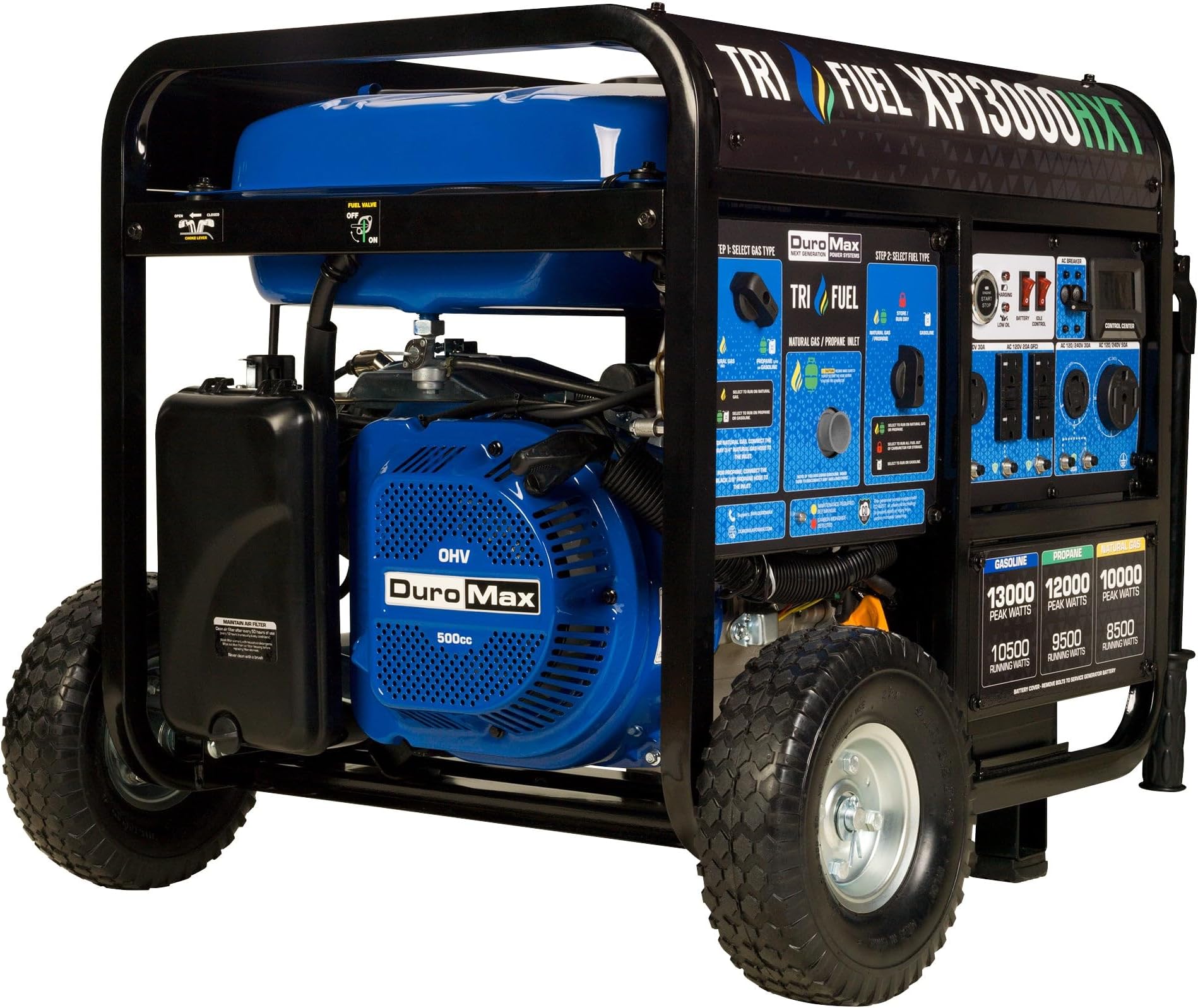
DuroMax XP13000HXT 13,000-Watt Tri-Fuel Portable Generator
- 10,500 (gasoline) running / 13,000 (gasoline) peak output
- Tri-Fuel: gasoline, propane, natural gas
- Up to 8.5 hours @50% load (gasoline) runtime
- Largest tri-fuel portable on the market with push-button + remote start, CO Alert, and 5-year warranty
As an Amazon Associate, we earn from qualifying purchases.
DuroMax XP13000HXT review
The XP13000HXT is for the buyer who refuses to be caught without fuel options. It runs on gasoline, propane, or natural gas — connect it to your home’s natural gas line and you have effectively unlimited runtime during an extended outage, no refueling runs required. With 10,500 running watts and 13,000 starting watts on gasoline, it is the largest tri-fuel portable on the market.
Beyond fuel flexibility, the feature list is flagship-grade: push-button start plus a remote start fob, CO Alert protection, and a 5-year warranty. For whole-home backup through a transfer switch, this is the most capable portable generator we recommend — it approaches standby-generator territory without the five-figure installed cost.
The tradeoffs are size, weight (240 lbs), and noise — this is an open-frame workhorse, not a campground companion. Natural gas installation also requires a plumber and proper permitting. But if your goal is maximum resilience for your home, the XP13000HXT is the ultimate portable.
Pros
- Tri-fuel: gasoline, propane, and natural gas
- 10,500W running / 13,000W peak
- Remote + push-button start
- 5-year warranty
- Natural gas = unlimited runtime
Cons
- 240 lbs — permanent or semi-permanent placement
- Loud open-frame design
- NG hookup needs professional install
Most power per pound
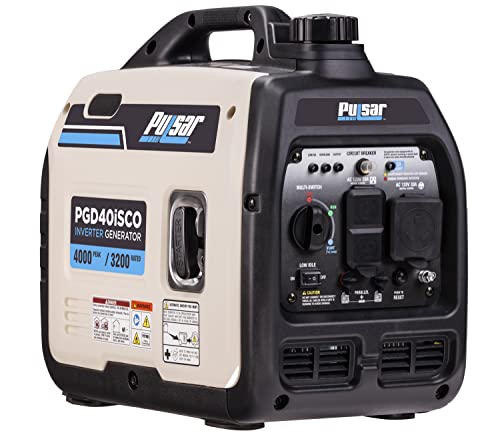
Pulsar PGD40iSCO Inverter Generator
- 3200W running / 4000W peak output
- gasoline
- Quiet at 59 dB
- Up to 4h @ half load (1 gal) runtime
As an Amazon Associate, we earn from qualifying purchases.
Pulsar PGD40iSCO review
The Pulsar PGD40iSCO solves a specific problem: you need real power — 3,200 running watts, 4,000 peak — but you do not want to wrestle a 100-lb machine. At just 47.3 lbs, it delivers the best power-to-weight ratio of any inverter on this list, with a TT-30R RV outlet, CO Sentry shutdown, and under 3% THD clean power for electronics.
That combination makes it unusually versatile: light enough for one person to load into a truck, powerful enough to run an RV air conditioner or a home refrigerator plus essentials. The 3-year warranty beats most competitors at this price, and the compact footprint stores easily in a garage or RV compartment.
At 59 dB it is audible — not silent — and the 1-gallon tank gives about 4 hours at half load, so it is not an all-night outage machine without refueling. Pulsar also lacks the dealer network of bigger brands. But if you want maximum watts per pound, nothing else touches it.
Pros
- 3,200W/4,000W at only 47.3 lbs
- RV-ready TT-30R outlet
- CO Sentry protection
- <3% THD clean power
- 3-year warranty
Cons
- 59 dB is noticeable
- Small 1-gallon tank — ~4h at half load
Portable generator comparison
| Generator | Running / Peak | Fuel | Noise | Weight | Best for |
|---|---|---|---|---|---|
| Champion 201319 4,500-Watt Dual Fuel Inverter Generator | 3,700W / 4,500W | Gas / Propane | 61 dBA | 98 lbs | Overall |
| DuroMax XP12000HX | 9,500W / 12,000W | Gas / Propane | Loud | 222 lbs | Home backup |
| Honda EU2200i | 1,800W / 2,200W | Gas | 48–57 dBA | 46.5 lbs | Camping / electronics |
| WEN 56225i | 1,800W / 2,250W | Gas | 53 dBA | 48.5 lbs | Budget |
| Champion 201319 | 3,500W / 4,500W | Gas / Propane | 61 dBA | 99.2 lbs | RV |
| DuroMax XP13000HXT | 10,500W / 13,000W | Gas / Propane / NG | Loud | 240 lbs | Tri-fuel |
| Pulsar PGD40iSCO | 3,200W / 4,000W | Gas | 59 dB | 47.3 lbs | Power per pound |
How to choose the right portable generator
Start with wattage. Add up the running watts of everything you need to power at once, then add the highest starting watts of any motor-driven appliance (refrigerators, ACs, and pumps surge 2–3× on startup). A good rule of thumb: 2,000W covers camping and electronics, 4,500W covers an RV, and 9,000W+ covers essential home backup.
Decide between inverter and conventional. Inverter generators produce clean, stable power safe for laptops, phones, and medical devices, and they are dramatically quieter and more fuel-efficient. Conventional open-frame generators deliver more watts per dollar but are loud and their power is “dirty” — fine for power tools and resistive heaters, risky for sensitive electronics.
Consider dual or tri-fuel. Propane stores indefinitely without going stale, burns cleaner, and is often already on hand for RVers and grill owners. Natural gas (tri-fuel models) means unlimited runtime during extended outages if you have a home gas line. The flexibility is worth it for emergency preparedness.
Do not ignore noise. Campgrounds commonly enforce 60 dBA limits, and your neighbors during an outage will thank you for choosing a quieter model. Inverter generators in the 50s dBA range are conversation-quiet; open-frame models in the 70s are not.
Safety is non-negotiable. Never run a generator indoors or in a garage — carbon monoxide kills. Place it at least 20 feet from your home with the exhaust pointed away, and prefer models with CO shutdown sensors (CO Shield, CO Alert, CO-MINDER, or CO Sentry). A $30 battery CO detector near sleeping areas is cheap insurance.
Portable generator FAQs
What size portable generator do I need?
It depends on what you are powering. For camping and charging electronics, 2,000 watts is plenty. For an RV with air conditioning, look at 3,500–4,500 watts. For essential home backup (fridge, freezer, lights, sump pump, furnace blower), 7,500–9,500 running watts is the sweet spot. Always size for starting watts too — motors surge 2–3× when they kick on.
Are inverter generators worth the extra cost?
For most buyers, yes. Inverters produce clean power safe for electronics, run much quieter (50s dBA vs 70s), and use less fuel because the engine throttles to the load. If you only need to run power tools or heaters, a conventional generator saves money — but for camping, RVing, or home backup with modern appliances, an inverter is the better buy.
Can I run a portable generator in the rain?
Not uncovered. Water and electricity are a dangerous combination, and wet outlets can short. Use a generator tent or purpose-built cover that keeps rain off while allowing exhaust and airflow — never enclose a running generator in a way that traps heat or exhaust. And never run one indoors or in a garage, rain or shine.
How long can a portable generator run continuously?
Most portable generators can run 8–12 hours per tank at half load, and many owners run them for days during outages with refueling breaks. Let the engine cool before refueling, check oil every 24 hours of runtime, and give it a rest period daily. Inverter models with eco-throttle stretch fuel the furthest.
Is dual fuel worth it on a portable generator?
Usually yes, especially for emergency preparedness. Propane never goes stale, so you can store tanks for years and still have fuel when the grid fails. It also burns cleaner, extending engine life. The wattage is slightly lower on propane (typically 10% less), but the storage and convenience advantages outweigh that for most buyers.
What maintenance does a portable generator need?
Change the oil after the first 20–30 hours (break-in), then every 50–100 hours or annually. Use fuel stabilizer or run the carburetor dry before storage, replace the air filter yearly, and check the spark plug each season. Exercise the generator under load for 20–30 minutes every 2–3 months so seals stay lubricated and you catch problems before an emergency.
Can a portable generator power my whole house?
A large portable (9,000+ running watts) can power essential circuits through a professionally installed transfer switch or interlock kit — but never plug a generator directly into a wall outlet (“backfeeding”), which can electrocute utility workers. For automatic, whole-house coverage including central AC, a standby generator is the proper solution.
Our verdict
After testing and comparing the field, the Champion 201319 4,500-Watt Dual Fuel Inverter Generator is our best overall portable generator for 2027 — quiet, dual-fuel, and powerful enough for RVs and home essentials. If you need whole-home backup, step up to the DuroMax XP12000HX; if you want the quietest, most reliable camping companion, the Honda EU2200i remains the gold standard.

Related Guides
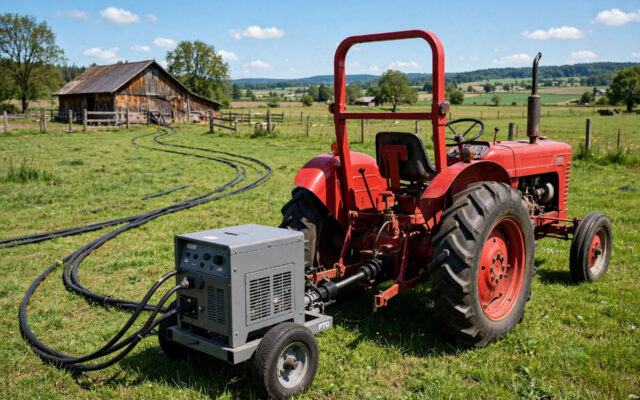
Best PTO Generators for Tractors in 2027
Best PTO generators for tractors in 2027: top 5 PTO-driven units compared — NorthStar, Winco, Tiger Power. Sizing rules, 540 RPM basics and buying guide.

Best Natural Gas Generators of 2027
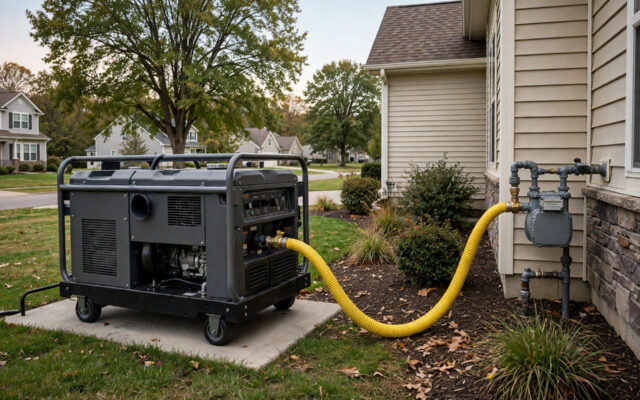
The best natural gas generators run tri-fuel. Our 2027 picks - Westinghouse, DuroMax, Champion, Gidrox - plus NG hookup and sizing advice.
Best Diesel Generators of 2027 (Portable Picks)
The best diesel generators for 2027? A short honest list: Generac XD5000E leads, Kipor KDE6700TA follows. Fuel math, winter tips & buying advice inside.