

There’s a special kind of misery that comes from firing up a generator at a quiet lakeside campsite — only to have it cough, sputter, and die because the gasoline in the carburetor turned to varnish over the winter. Ask any seasoned camper and they’ll tell you: the fuel, not the generator, is usually the problem. That’s exactly why propane generators have become the camping favorite in 2027.
Propane burns cleaner than gasoline, produces far less odor and soot, and — the big one — it never goes stale. That 20-pound tank you used for last summer’s camp grill will still be perfectly good this spring. No carburetor gumming, no stabilizer, no draining the tank before storage. And since most campers and RVers already carry propane for their grill, stove, or RV furnace, you’re simply adding one more appliance to a fuel you already own.
But not every propane-capable generator is a good fit for a campsite. The models below were chosen for what actually matters at a campground: dual-fuel flexibility (propane plus gasoline as backup), inverter-clean power that’s safe for phones, laptops, and CPAP machines, noise levels that won’t get you uninvited from the site next door, enough starting wattage for an RV air conditioner or microwave, and a TT-30R 30-amp outlet so you can plug your travel trailer straight in. We also weighed them against propane’s honest trade-offs — roughly 10% less power on propane than gasoline, and weaker performance in freezing weather — and picked units that still clear the bar on their propane ratings.
Our top picks at a glance
- Best overall: Champion 201319 4,500-Watt Dual Fuel Inverter — quiet, RV-ready, CO Shield, and up to 21 hours on a 20-lb propane tank
- Best for RV: Champion 201319 4,500-Watt Dual Fuel Inverter Generator — 61 dBA, remote start, TT-30R outlet, CARB compliant
- Best dual-fuel power: DuroMax XP4500iH — the heavyweight inverter pick for bigger trailers
- Best quiet: Champion 2500W Dual Fuel Inverter — 53 dBA, ultralight, 25-hour propane runtime
- Best budget: WEN DF475T — 4,750 starting watts of dual-fuel power for the money
- Best value: Champion 76533 — the proven RV-ready dual-fuel workhorse
- Best runtime: FIRMAN H03655 — 14 hours at half load for long stays off-grid
Every pick below is dual fuel — propane first, gasoline as backup — because running out of propane mid-trip shouldn’t end your weekend.
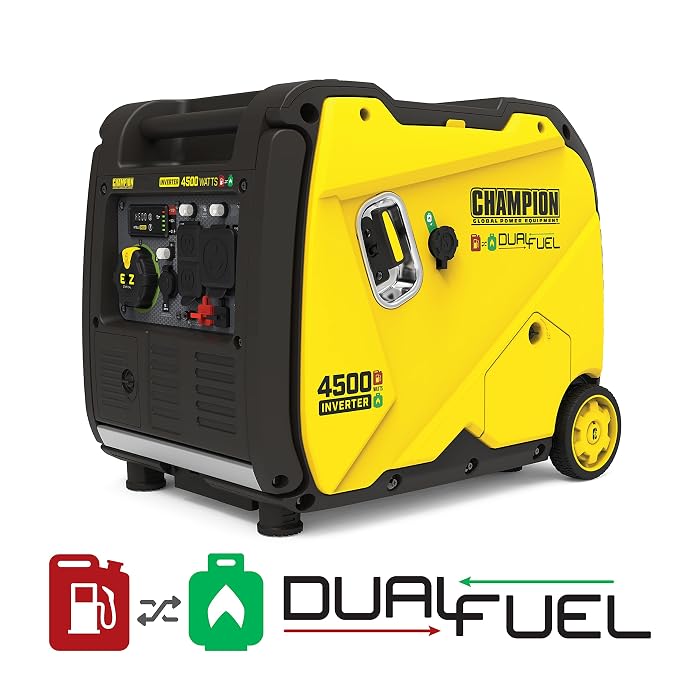
Best overall
Champion 201319 4,500-Watt Dual Fuel Inverter Generator
- 3,500 (gasoline); 3,150 (propane) running / 4,500 (all fuels) peak output
- Dual Fuel: gasoline, propane
- Up to 14 hrs (gasoline, 2.25 gal); 21 hrs (propane, 20-lb tank) runtime
- 61 dBA noise level
As an Amazon Associate, we earn from qualifying purchases.
Champion 201319 4,500-Watt Dual Fuel Inverter Generator — Best Overall
If you only buy one propane generator for camping and RVing in 2027, make it this one. The Champion 201319 nails the combination that matters at a campsite: inverter-quiet power (61 dBA, about the volume of a normal conversation), dual-fuel flexibility so you’re never stranded if one fuel runs out, and an RV-ready 30-amp outlet that plugs straight into a travel trailer. It starts with 4,500 watts on any fuel and runs 3,500 watts on gasoline or 3,150 on propane — that ~10% propane derating is standard physics, and Champion prints both numbers honestly so you can size your loads properly.
Where it really shines for campers is propane runtime. On a single 20-pound propane tank, it can run up to 21 hours — effectively a full weekend of evening lights, phone charging, a fan, and a morning coffee maker on one tank you can swap at any gas station or campground store. Champion’s CO Shield carbon-monoxide auto-shutoff adds a layer of safety that matters when generators run near tents and RVs, and the parallel kit option means two units can combine for a big air conditioner down the road. At 99.2 pounds it’s a two-person lift into the truck bed, which is the price of real wattage — this is a camp-home-base generator, not a backpacking one.
The honest caveat: on propane you’re getting 3,150 running watts, so a 13,500-BTU RV air conditioner (which needs roughly 2,800–3,000 watts to start) fits, but it’ll be doing most of the heavy lifting. Pair it with the economy mode on for overnight electronics-only loads and you’ll stretch that tank even further. For the most common camper/RV combination — lights, fridge, microwave, phones, and one A/C — this is the sweet spot of price, power, and quiet.
Pros
- True dual fuel with honest propane wattage ratings
- 61 dBA inverter-quiet — fine for campgrounds
- Up to 21 hours on one 20-lb propane tank
- CO Shield shutoff and RV 30-amp outlet
- Parallel-capable for doubling power later
Cons
- 99.2 lbs — a two-person lift
- Propane running watts (3,150) trail gasoline (3,500)
- Big AC + microwave simultaneously may need load management
Best for RV
Champion 201319 4,500-Watt Dual Fuel Inverter Generator
- 3,500 (gasoline); 3,150 (propane) running / 4,500 (all fuels) peak output
- Dual Fuel: gasoline, propane
- Up to 14 hrs (gasoline, 2.25 gal); 21 hrs (propane, 20-lb tank) runtime
- 61 dBA noise level
As an Amazon Associate, we earn from qualifying purchases.
Champion 201319 4,500-Watt Dual Fuel Inverter Generator — Best for RV
The Champion 201319 4,500-Watt Dual Fuel Inverter Generator is the pick for RVers who care about two things above all: quiet and convenience. At 61 dBA it’s genuinely one of the quietest dual-fuel generators you can buy — quieter than many gasoline-only inverters — and the remote start means you can fire it up from inside the trailer when the batteries are sagging and it’s raining outside. That’s a small luxury that becomes a big deal at 6 a.m. in a downpour.
Power-wise it mirrors the Champion class: 4,500 starting watts and 3,500 running watts on gasoline, with the standard propane derate (budget roughly 10% less on propane). It comes RV-ready with a TT-30R 30-amp outlet, offers push-button, remote, and recoil starting, and runs up to 14 hours at quarter load on its 3.4-gallon gas tank. It’s also CARB compliant, so campers in California and other strict-emissions states are covered. At roughly 98 pounds it’s in the same two-person-lift class as the Champion.
So why is the Champion our overall pick and this one the RV pick? Honestly, they’re close — but the remote start and the 61 dBA noise rating give the Westinghouse the edge for RVers who park close to neighbors, while the Champion’s longer propane runtime and CO Shield nudge it ahead for pure camping versatility. You can’t go wrong with either; choose the Westinghouse if quiet and push-button convenience top your list.
Pros
- 61 dBA — whisper-quiet for a dual-fuel unit
- Remote start from inside the RV
- TT-30R RV outlet; CARB compliant
- Three ways to start: remote, push-button, recoil
- Up to 18 hrs at 25% load on gasoline
Cons
- ~98 lbs — not a one-person carry
- Plan on ~10% less power on propane
- Premium price vs. open-frame dual-fuel models
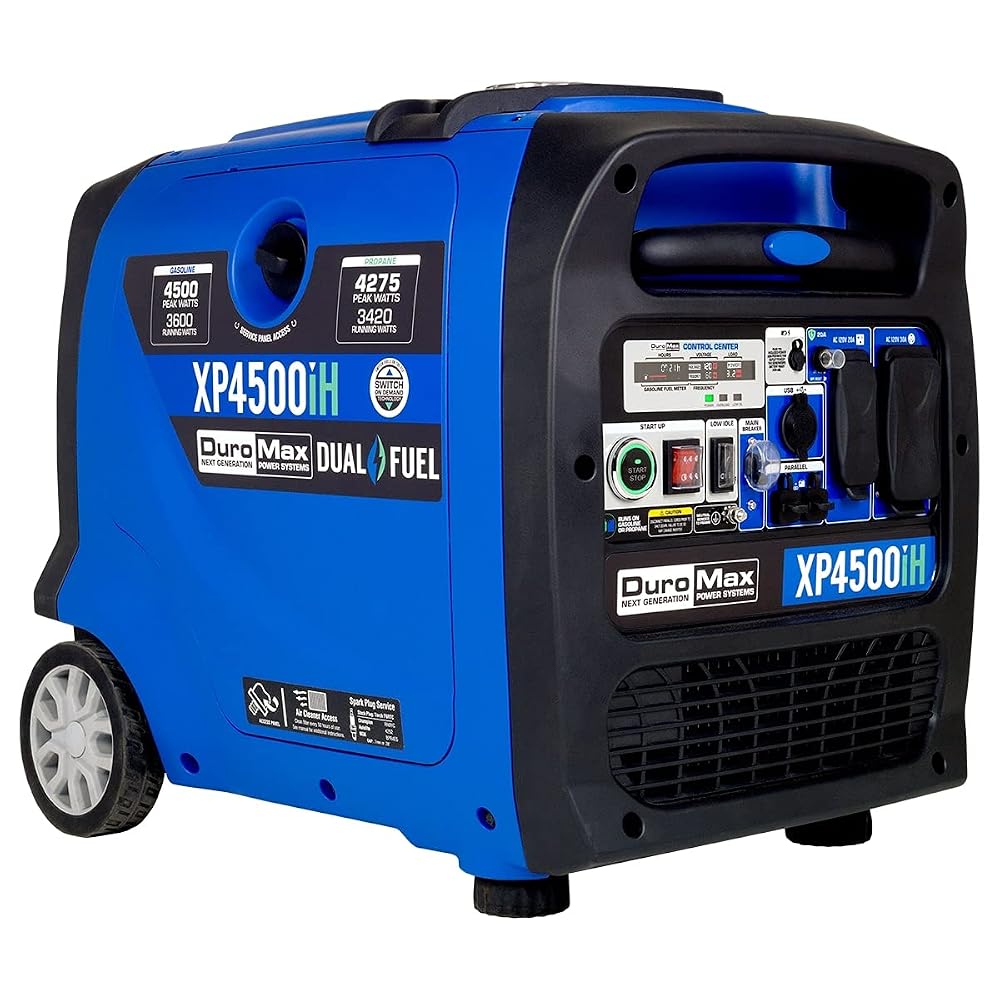
Best dual-fuel power
DuroMax XP4500iH Dual-Fuel Inverter Generator
- 4,500 starting watts (3,600 running gas; 4,275/3,420 on propane)
- Dual fuel digital inverter with 100% copper windings
- Up to 11 hrs on propane (20-lb tank) at 50% load
- RV-ready TT-30R outlet for full-size travel trailers
As an Amazon Associate, we earn from qualifying purchases.
DuroMax XP4500iH Dual-Fuel Inverter Generator — Best Dual-Fuel Power
The DuroMax XP4500iH is the muscle car of this roundup: a dual-fuel digital inverter built around 100% copper windings that delivers 4,500 starting watts and 3,600 running watts on gasoline, or 4,275/3,420 on propane. If your camping setup includes a bigger travel trailer with a 13,500-BTU air conditioner, an electric water heater element, and a microwave you actually want to run without playing load tetris, the extra propane-rated power here gives you real headroom that lighter dual-fuel inverters don’t.
It’s an inverter, so the power is clean and safe for electronics, and the TT-30R RV outlet plugs straight into your shore-power cord. On a 20-pound propane tank it runs up to 11 hours at half load — a solid evening-to-morning stretch. DuroMax’s build quality reputation is strong, and the all-copper windings are a legitimate durability plus over aluminum-wound budget units.
The trade-off is noise and weight. At 65 dB and 115 pounds dry, this is the loudest and heaviest unit in our roundup — fine for boondocking on BLM land or a big dispersed site, but not the pick for a tight campground with quiet hours and close neighbors. Think of it as the choice for campers who need power first and can park with some distance: overland rigs, toy haulers, and big fifth-wheels.
Pros
- Serious dual-fuel wattage (4,275 starting on propane)
- Inverter-clean power safe for electronics
- 100% copper windings for durability
- 11 hrs on propane at 50% load
- TT-30R RV outlet included
Cons
- 65 dB — the loudest pick here; avoid tight campgrounds
- 115 lbs dry — two-person lift, always
- Overkill (and pricier) for tent campers
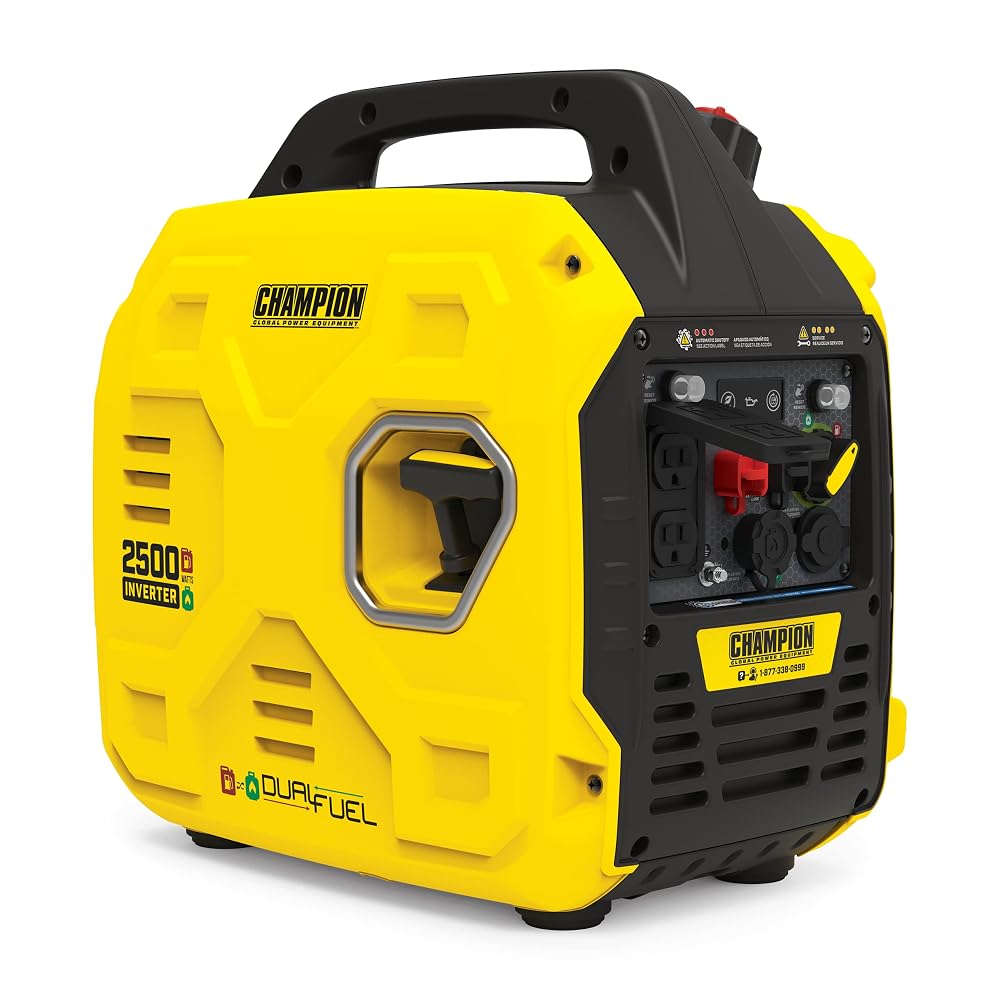
Best quiet
Champion 2500W Dual Fuel Inverter Generator (CO Shield)
- 2,500 starting / 1,850 running watts output
- Dual fuel: gasoline or propane
- 53 dBA whisper-quiet — you can talk over it
- Ultralight and parallel-ready, with up to 25 hrs on a 20-lb propane tank
As an Amazon Associate, we earn from qualifying purchases.
Champion 2500W Dual Fuel Inverter Generator — Best Quiet
Not everyone needs 4,500 watts. If your camping power list is lights, a fan, phones and laptops, a small TV, a CPAP machine, or charging e-bikes and a portable fridge, the Champion 2500W dual-fuel inverter is all you need — and it’s the most pleasant generator in this roundup to actually live with. At 53 dBA it hums along at conversational volume, it’s the lightest class here, and it sips propane: up to 25 hours on a single 20-pound tank, which is three or four full evenings of camp life per tank.
Being dual fuel in this size class is a genuine rarity — most ultra-quiet inverters are gasoline-only. Here you get propane’s clean, no-stale-fuel convenience in a package you can lift with one hand, plus Champion’s CO Shield shutoff and the option to parallel two units if your needs grow (two of these in parallel will start a small RV air conditioner). The power is inverter-clean, so CPAP machines and laptops are safe.
The honest limitation is wattage: 1,850 running watts will not start a 13,500-BTU rooftop A/C by itself, and a microwave plus a coffee maker at the same time will trip the overload. If you know your loads are modest — tent campers, van lifers, teardrop trailers, and pop-ups — this is the sweet spot of quiet, weight, and fuel economy. If you’re not sure, size up to the 4,500-watt class above.
Pros
- 53 dBA — barely louder than a conversation
- Ultralight one-hand carry
- Rare dual-fuel option in the 2,500W class
- Up to 25 hrs on one 20-lb propane tank
- Parallel-ready; CO Shield included
Cons
- 1,850 running watts — no RV air conditioner solo
- Load management needed with big appliances
- No built-in 30-amp RV outlet (parallel kit + adapter needed for TT-30R)
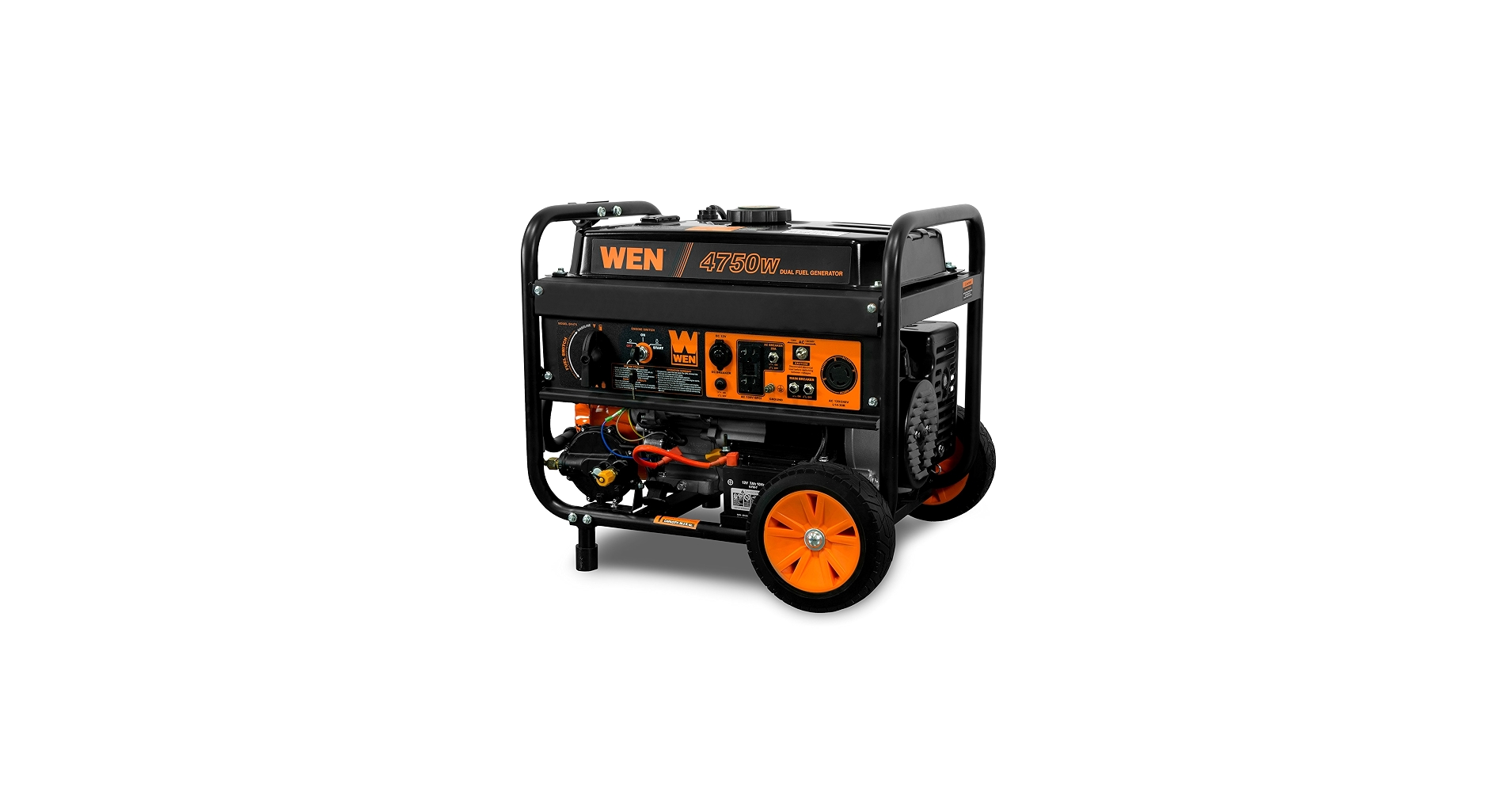
Best budget
WEN DF475T 4,750-Watt Dual Fuel Portable Generator
- 4,750 starting watts (3,800 running on gas; 4,350/3,500 on propane)
- Dual fuel: gasoline or propane (LPG)
- CARB-compliant with push-button electric start
- Big output per dollar — the value open-frame pick
As an Amazon Associate, we earn from qualifying purchases.
WEN DF475T 4,750-Watt Dual Fuel Portable Generator — Best Budget
The WEN DF475T is the answer to “I want real dual-fuel wattage but I don’t want to pay inverter prices.” You get 4,750 starting watts and 3,800 running watts on gasoline (4,350/3,500 on propane), push-button electric start, and CARB compliance — all typically in the most affordable price bracket of this roundup. For the camper who needs to run an RV A/C and a microwave on a budget, this gets you there.
Being open-frame rather than inverter, it trades quiet for watts-per-dollar. Expect conventional-generator noise — noticeably louder than the 52–61 dBA inverter models above — which makes it better suited to dispersed camping, tailgating, and jobsites than tight campgrounds with quiet hours. At 105.8 pounds with never-flat wheels, it’s a roll-it-don’t-carry unit, and the electric start saves your shoulder on cold mornings.
One more honest note: open-frame power isn’t as clean as inverter power (higher total harmonic distortion), so run sensitive electronics like laptops through a good surge protector or charge them off a small inverter unit instead. As a propane-first budget workhorse for A/C, microwaves, and power tools at camp, though, the DF475T is hard to argue with on value.
Pros
- Most starting watts per dollar in this roundup
- True dual fuel with published propane ratings
- Push-button electric start; CARB compliant
- Wheels and handles for rolling to the site
Cons
- Open-frame noise — too loud for strict quiet-hour campgrounds
- 105.8 lbs — roll it, don’t carry it
- Not inverter-clean power for sensitive electronics
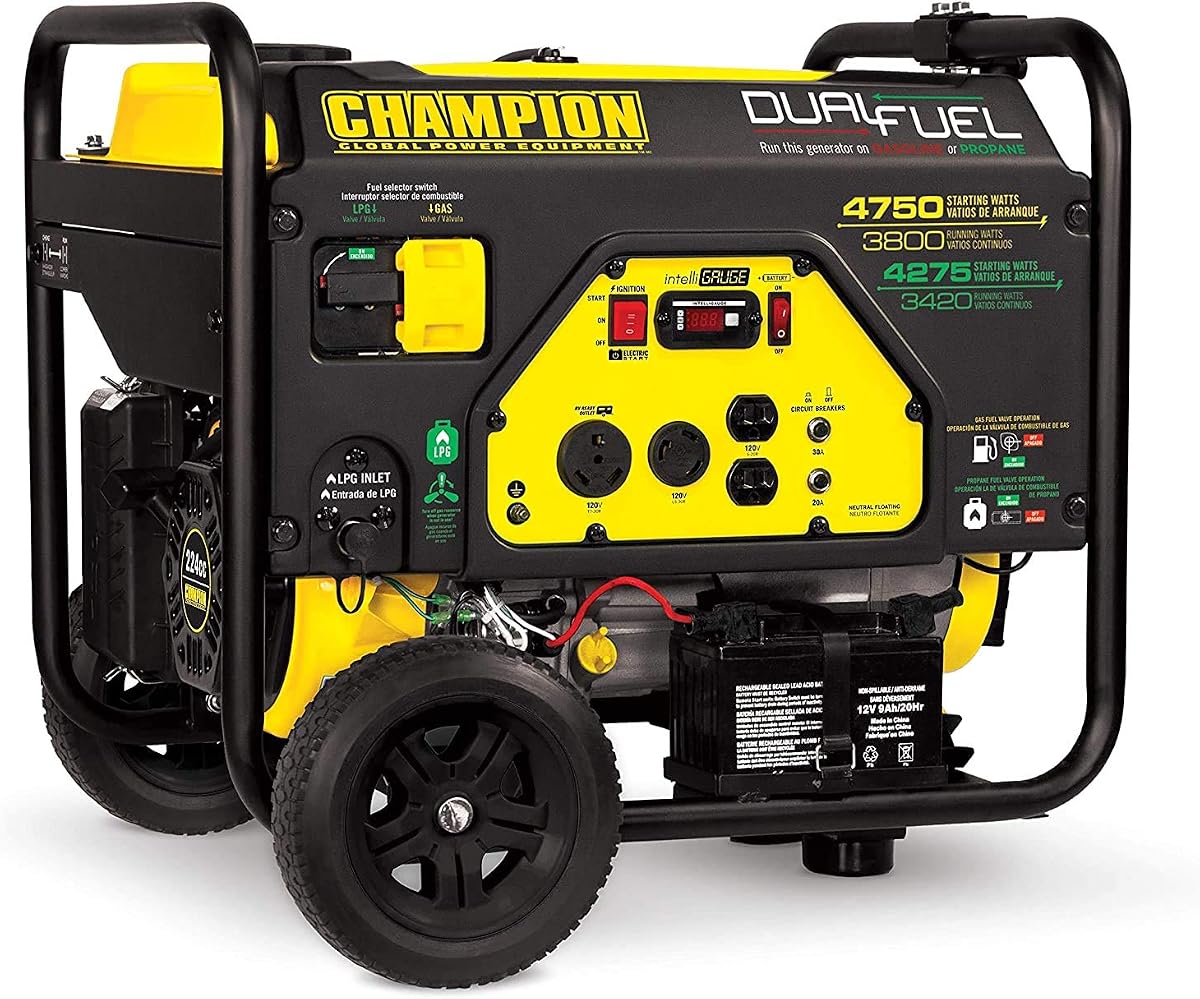
Best value
Champion 76533 4,750-Watt Dual Fuel Portable Generator
- 4,750 starting / 3,800 running watts output
- Dual fuel: gasoline or propane (LPG)
- Electric start with Volt Guard surge protection
- Proven RV-ready workhorse — classic dual-fuel design
As an Amazon Associate, we earn from qualifying purchases.
Champion 76533 4,750-Watt Dual Fuel Portable Generator — Best Value
The Champion 76533 is the veteran of this list — a dual-fuel design Champion has been refining for years, and it shows in the details that matter for camping. It delivers 4,750 starting and 3,800 running watts on gasoline, runs about 8 hours at half load on its 3.4-gallon gas tank or 5.5 hours on a 20-pound propane tank, and comes with an electric start plus Champion’s Volt Guard, which guards your RV’s appliances against voltage spikes.
What makes it a “value” pick rather than just a budget pick is the track record: this is one of the most widely owned dual-fuel generators in North America, which means parts, how-to videos, and real-world reviews are everywhere. It’s RV-ready with the right outlets, it starts reliably on propane (a common complaint with cheaper dual-fuel units), and at 119 pounds on wheels it’s built to be rolled around camp, not babied.
Like the WEN it’s an open-frame conventional generator, so it’s louder than the inverter models — plan your site accordingly. And the propane runtime at half load (5.5 hours on 20 lbs) is shorter than the inverter picks, so for heavy propane use you’ll want a spare tank or a bigger cylinder. But for campers who want proven, no-drama dual-fuel power at a fair price, the 76533 is the safe recommendation.
Pros
- Years of proven dual-fuel reliability
- 4,750 starting watts — runs RV A/C easily
- Electric start + Volt Guard protection
- RV-ready outlets; huge owner community
Cons
- Open-frame noise — not for quiet-hour campgrounds
- 119 lbs — wheels required
- Shorter propane runtime (5.5 hrs at 50% on 20 lbs)
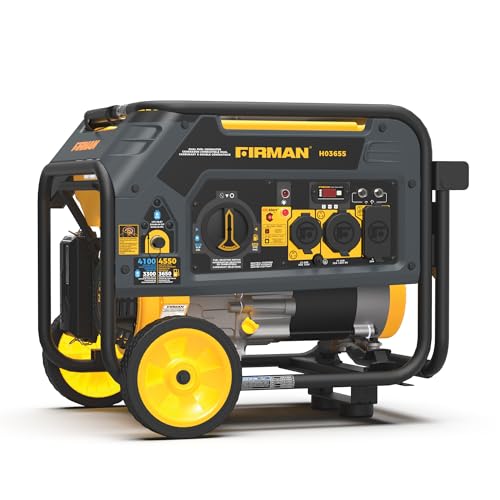
Best runtime
FIRMAN H03655 4,550-Watt Dual Fuel Portable Generator
- 4,550 starting watts (3,650 running gas; 4,100/3,300 on propane)
- Dual fuel: gasoline or propane
- 14-hour runtime at 50% load on a 5-gallon gas tank
- Long-haul power for extended stays off-grid
As an Amazon Associate, we earn from qualifying purchases.
FIRMAN H03655 4,550-Watt Dual Fuel Portable Generator — Best Runtime
The FIRMAN H03655 earns its spot with one standout number: 14 hours of runtime at half load on its 5-gallon gasoline tank. For campers who boondock for days — desert trips, hunting camps, off-grid cabins — refueling less often is a genuine quality-of-life upgrade. It’s a proper dual-fuel unit too: 4,550 starting / 3,650 running watts on gasoline, derating to 4,100/3,300 on propane, with both fuels honestly rated.
FIRMAN’s Hybrid series has a solid reputation for straightforward, dependable machines, and the H03655 fits that mold: dual fuel, capable output for an RV air conditioner plus house loads, and a big tank that means you’re not pouring fuel at midnight. At 112 pounds it’s in the roll-it class, and the build feels a notch above the cheapest open-frame units.
The honest downside is noise: at 67 dBA it’s audible from a good distance, so this is a dispersed-camping and open-country pick, not a campground-neighbor pick. And while the gasoline runtime is excellent, note that the published 14-hour figure is for gasoline — propane runtime will be shorter per tank. Pair it with a second 20-pound cylinder (or your RV’s onboard propane) and long stays are effortless.
Pros
- 14 hrs at 50% load on gasoline — class-leading
- Honest dual-fuel ratings (4,100 starting on propane)
- RV-capable wattage for A/C + house loads
- Solid FIRMAN build quality
Cons
- 67 dBA — keep your distance from neighbors
- 112 lbs — roll, don’t carry
- Best runtime figure is on gasoline, not propane
Buying guide: choosing a propane generator for camping & RV in 2027
Propane vs. gasoline: why campers prefer propane. Propane’s three camping superpowers are no stale fuel (it never degrades in the tank), no carburetor varnish (the #1 cause of “my generator won’t start after winter”), and cleaner, less smelly exhaust. The trade-offs are real too: propane delivers about 10% less power than gasoline from the same engine, propane tanks get bulky (a 20-lb tank holds roughly 4.6 gallons of propane), and in freezing weather tank pressure drops, which can starve the generator at high loads. Dual-fuel models are the answer — run propane 95% of the time, keep a gallon or two of gasoline as backup for the edge cases.
How many watts do you actually need? Add up your running watts, then make sure the generator’s starting watts cover your biggest motor’s startup surge. A typical camping load: LED lights and phone charging (100W), a portable fridge (150W running, 600W starting), a fan (75W), a coffee maker (1,000W), a microwave (1,000–1,200W). An RV adds the big one: a 13,500-BTU rooftop air conditioner needs roughly 2,800–3,000 watts to start and ~1,500 to run. That’s why the 4,500-watt class dominates this list — it starts an A/C with room to spare on propane. Tent and van campers doing electronics-only can happily live with 2,000–2,500 watts.
Noise: the campground rule that matters. Generator noise is measured in dBA, and the scale is logarithmic — 65 dBA isn’t “a little” louder than 55 dBA, it’s perceived as roughly twice as loud. Most campgrounds enforce quiet hours (typically 10 p.m.–6 a.m.) and many have informal “no loud generators” expectations all day. Inverter models in this roundup run 52–61 dBA; open-frame models are noticeably louder. If your sites are close together, an inverter is worth every penny.
Runtime on a 20-lb propane tank. A standard 20-pound grill tank holds about 4.6 gallons of propane. At light camping loads (25–50%), expect roughly 10–25 hours depending on the generator’s size and efficiency — the 2,500-watt Champion stretches a tank to 25 hours, while a 4,500-watt unit at half load gives you a solid evening-to-morning (~11 hours). Always carry a spare tank if you’re running an air conditioner; A/C is the fastest way to empty a cylinder.
Weight and portability. Inverters in the 4,500-watt class weigh 98–115 pounds — a two-person lift or a truck-bed ramp. The 2,500-watt class is a genuine one-hand carry. Open-frame models add wheels and folding handles, which work fine on pavement and packed gravel but not on soft sand or mud — plan your parking spot.
RV outlets: look for the TT-30R. A TT-30R is the 30-amp, 120-volt RV outlet that matches your travel trailer’s shore-power cord — no adapter needed. The Champion 201319, Champion 201319 4,500-Watt Dual Fuel Inverter Generator, DuroMax XP4500iH, and Champion 76533 all include one. If your trailer is 50-amp, you’ll need a 50A-to-30A dogbone adapter and realistic expectations: a single portable generator powers one A/C, not a whole 50-amp rig.
Carbon monoxide safety is non-negotiable. Never run a generator inside a tent, camper, truck bed with a cap, or garage — even “just for a minute.” Place it at least 20 feet from tents, RVs, and neighbors’ sites, with the exhaust pointed away from people. Models with CO auto-shutoff (like the Champion’s CO Shield) add a safety net, but distance and wind awareness are still your primary protection.
Propane Camping Generator FAQs
How long will a 20-lb propane tank run a generator?
A 20-pound propane tank holds about 4.6 gallons of propane. On a typical dual-fuel inverter generator, expect roughly 11–21 hours at light-to-moderate loads — smaller 2,500-watt models can stretch to 25 hours, while a 4,500-watt unit running an RV air conditioner at half load will use a tank in about 11 hours. Always carry a spare cylinder for A/C use.
Is propane or gasoline better for a camping generator?
For camping, propane wins on convenience: it never goes stale, won’t gum up the carburetor during storage, and burns cleaner with less odor. Gasoline wins on raw power (about 10% more watts from the same engine) and energy density. That’s why dual-fuel generators are ideal — run propane as your daily fuel and keep gasoline as backup.
Can a propane generator run my RV air conditioner?
Yes, if it’s sized right. A 13,500-BTU RV air conditioner needs roughly 2,800–3,000 starting watts, so a 4,500-watt dual-fuel generator (like the Champion 201319, Champion 201319 4,500-Watt Dual Fuel Inverter Generator, or DuroMax XP4500iH) handles it even on propane, where output is about 10% lower than on gasoline. A 2,500-watt generator alone generally can’t start an A/C — you’d need two paralleled units.
Do propane generators work in cold weather?
Propane works in cold weather but with a caveat: as temperatures drop toward freezing, tank pressure falls, and the generator may starve for fuel at high loads. Keep the tank as warm as practical (sunlight, an insulated blanket — never an open flame or heater), reduce loads in extreme cold, and keep gasoline as your dual-fuel backup for the coldest mornings.
Is it safe to run a propane generator near my tent or RV?
Propane exhaust still contains carbon monoxide, so the same rules apply as gasoline: never run a generator inside a tent, RV, or enclosed space, and keep it at least 20 feet away from tents, campers, and neighboring sites with the exhaust pointed away from people. Models with CO auto-shutoff add a safety net, but placement and wind awareness come first.
Can I hook my generator to my RV’s onboard propane tanks?
Often yes, with the right hose and fittings — most dual-fuel generators connect to a standard 20-lb cylinder via a POL/QCC1 connection, and adapters exist for RV quick-connect low-pressure ports. Check your RV’s propane system pressure and the generator’s requirements first, and never modify fuel lines yourself if you’re unsure — a propane dealer can set you up with the correct kit in minutes.
Do I need an adapter to plug my RV into a generator?
If your generator has a TT-30R 30-amp RV outlet — as the Champion 201319, Champion 201319 4,500-Watt Dual Fuel Inverter Generator, DuroMax XP4500iH, and Champion 76533 do — your travel trailer’s shore-power cord plugs straight in with no adapter. Smaller generators without a TT-30R need a 15A-to-30A dogbone adapter, and 50-amp trailers need a 50A-to-30A adapter with realistic single-A/C expectations.
Our verdict
For most campers and RVers in 2027, the Champion 201319 4,500-Watt Dual Fuel Inverter is the one to buy — quiet, RV-ready, and up to 21 hours on a single propane tank. Tight campgrounds and light loads call for the whisper-quiet Champion 2500W Dual Fuel, while big trailers that need maximum propane power should look at the DuroMax XP4500iH. Whichever you choose, run propane first, keep gasoline as backup, and park it 20 feet from the tent.

Related Guides
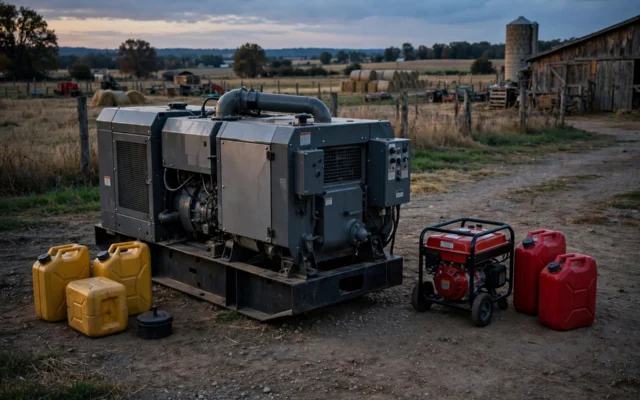
Diesel vs Gasoline Generators: Which Is Better in 2027?
Diesel vs gasoline generators: diesel wins on efficiency, lifespan and fuel storage; gas wins on price, weight and choice. Here's which fuel fits your use case.

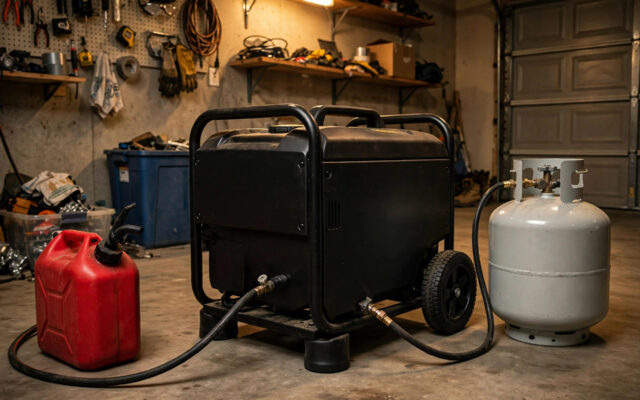
Gasoline vs Propane Generators: Which Fuel Is Better in 2027?
Gasoline vs propane generators in 2027: fuel cost, runtime, storage life, and cold-weather performance compared — plus why dual-fuel wins for most buyers.
Propane vs Gasoline: Generator Fuel Cost per kWh Compared
At October 2026 prices, propane costs ~$0.48/kWh vs ~$0.65/kWh for gasoline in a generator. See the full math and when gasoline still wins.