


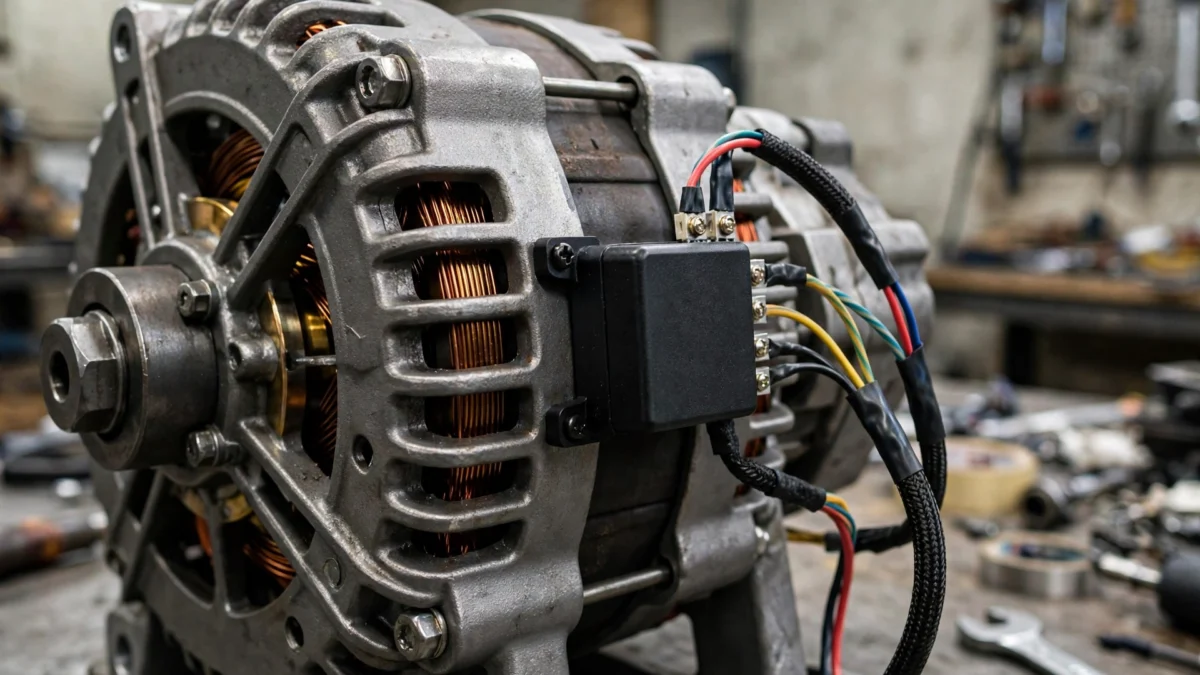
AVR (Automatic Voltage Regulation) is an electronic module that holds a generator’s output voltage steady — typically within ±1% — as loads switch on and off. Without it, voltage can sag when a big motor starts and spike when it stops, and those swings are what damage sensitive electronics.
When I first learned about AVR years ago, it was the feature that finally explained why one generator could run a laptop all day while a cheaper one made the lights flicker. Here’s how it works, what it protects, and how it differs from inverter technology.
Key takeaways
- AVR = steady voltage. It continuously adjusts the alternator’s magnetic field to hold output near 120V/240V, typically within ±1%.
- Without AVR, voltage can swing ±5–10% or more under changing loads — enough to stress electronics and motors.
- AVR protects against voltage problems; it doesn’t fix frequency drift or waveform distortion — that’s the inverter’s job.
- Look for AVR on any generator that will power electronics, well pumps, or HVAC equipment.
- AVR modules are replaceable wear parts — a $30–70 module can resurrect a generator with unstable voltage.
How AVR Works (The Simple Version)
A generator makes electricity by spinning magnets (the rotor) inside coils of wire (the stator). The voltage coming out depends on how strong that magnetic field is. Here’s the problem: when you plug in a heavy load, the extra current draw drags the voltage down. Unplug it, and the voltage jumps back up. Left alone, the output wanders.
AVR closes the loop with three steps, happening continuously:
- Sense: The AVR module constantly measures the actual output voltage.
- Compare: It compares the measured voltage against the target (120V).
- Correct: If voltage is low, it increases DC current to the rotor’s field winding, strengthening the magnetic field and pushing voltage back up. If voltage is high, it backs off.
This correction happens in milliseconds — fast enough that when your well pump kicks on and tries to drag the voltage to 100V, the AVR has already compensated before your lights visibly dim. Quality AVR modules hold regulation to better than ±1% under steady conditions, with brief dips during sudden load changes that recover almost instantly.
What AVR Protects You From
Electronics
Laptops, TVs, chargers, and anything with a switching power supply are designed for roughly 120V ±10%. Sustained overvoltage cooks components; sustained undervoltage makes power supplies draw more current and run hot. AVR keeps you inside the safe band even as the fridge cycles and the pump kicks on around it.
Electric motors
Motors are voltage-sensitive in the opposite direction from what you’d guess: low voltage is the killer. A motor starved of voltage draws more current to do the same work, overheats, and burns out its windings. Well pumps, sump pumps, and HVAC compressors running on generator power benefit enormously from AVR holding the line during startup surges.
The generator itself
Wild voltage swings stress the alternator windings and can cascade — a sagging generator causes motors to draw more current, which sags voltage further. AVR breaks that spiral.
AVR vs. Non-AVR: What You’re Actually Buying
| With AVR | Without AVR (capacitor-regulated) | |
|---|---|---|
| Voltage regulation | ±1% typical | ±5–10% or worse |
| Response to load changes | Corrects in milliseconds | Slow drift, overshoot |
| Safe for electronics | Yes | Risky |
| Safe for motors (pumps, HVAC) | Yes | Marginal — low-voltage burnout risk |
| Typical cost premium | Modest ($50–150 on the unit) | — |
| Repairability | Module swaps in minutes | Capacitor swap |
Cheaper generators use capacitor regulation instead of AVR — a fixed capacitor in the excitation circuit that provides rough, unregulated control. It’s fine for power tools and work lights on a job site. It’s not fine for the refrigerator’s control board or your home office.
AVR vs. Inverter: Don’t Confuse Them
This is the most common mix-up I see, so let’s be precise:
- AVR controls voltage magnitude. It takes the alternator’s raw AC and holds it at 120V. The frequency still follows engine speed, and the waveform is whatever the alternator produces.
- An inverter generator goes further: it converts the alternator’s AC to DC, then electronically reconstructs brand-new AC — controlling voltage, frequency, and waveform simultaneously. That’s why inverter output is clean sine wave with <3% THD (total harmonic distortion).
Think of it this way: AVR is cruise control for voltage. An inverter is a full autopilot for the entire power signal. Many inverter generators have AVR-like regulation built into their inverter stage, but a conventional AVR generator is not an inverter generator — and won’t have the inverter’s clean waveform or frequency stability.
For the most sensitive electronics, you want both ideas working together — which is exactly what an inverter generator delivers. If you’re choosing between technologies for home backup, our portable vs. standby guide walks through which generator types suit which loads.
When AVR Matters Most
- Home backup: You’re powering a mixed bag — fridge control boards, furnace electronics, Wi-Fi gear, phone chargers. AVR is non-negotiable here.
- Well pumps and sump pumps: Long wire runs already drop voltage; without AVR the pump sees the worst of both worlds during startup.
- Construction with sensitive instruments: Battery chargers for tool batteries, laser levels, and site electronics all prefer stable voltage.
- RVs: The converter/charger, refrigerator control board, and AC unit all live longer on regulated voltage.
Troubleshooting: When AVR Goes Bad
AVR modules are among the most commonly replaced generator parts, and the symptoms are distinctive: voltage that reads high (140V+) or low (under 100V) at no load, voltage that swings wildly with load changes, or a generator that was fine last season and now flickers the lights.
The good news: on most portable generators the AVR is a small potted module bolted to the alternator housing with a plug connector. Diagnosis is a multimeter on the outlets; replacement is usually four screws and a connector, with aftermarket modules running $30–70. If voltage is unstable and the engine runs smoothly, the AVR is suspect #1 — before you blame the alternator itself.
One caution: some no-name replacement modules regulate poorly (±3–5% instead of ±1%). For equipment that matters, buy the OEM module or a reputable aftermarket brand, and verify output voltage with a meter after installation.
How to Test Your Generator’s Voltage (60-Second Check)
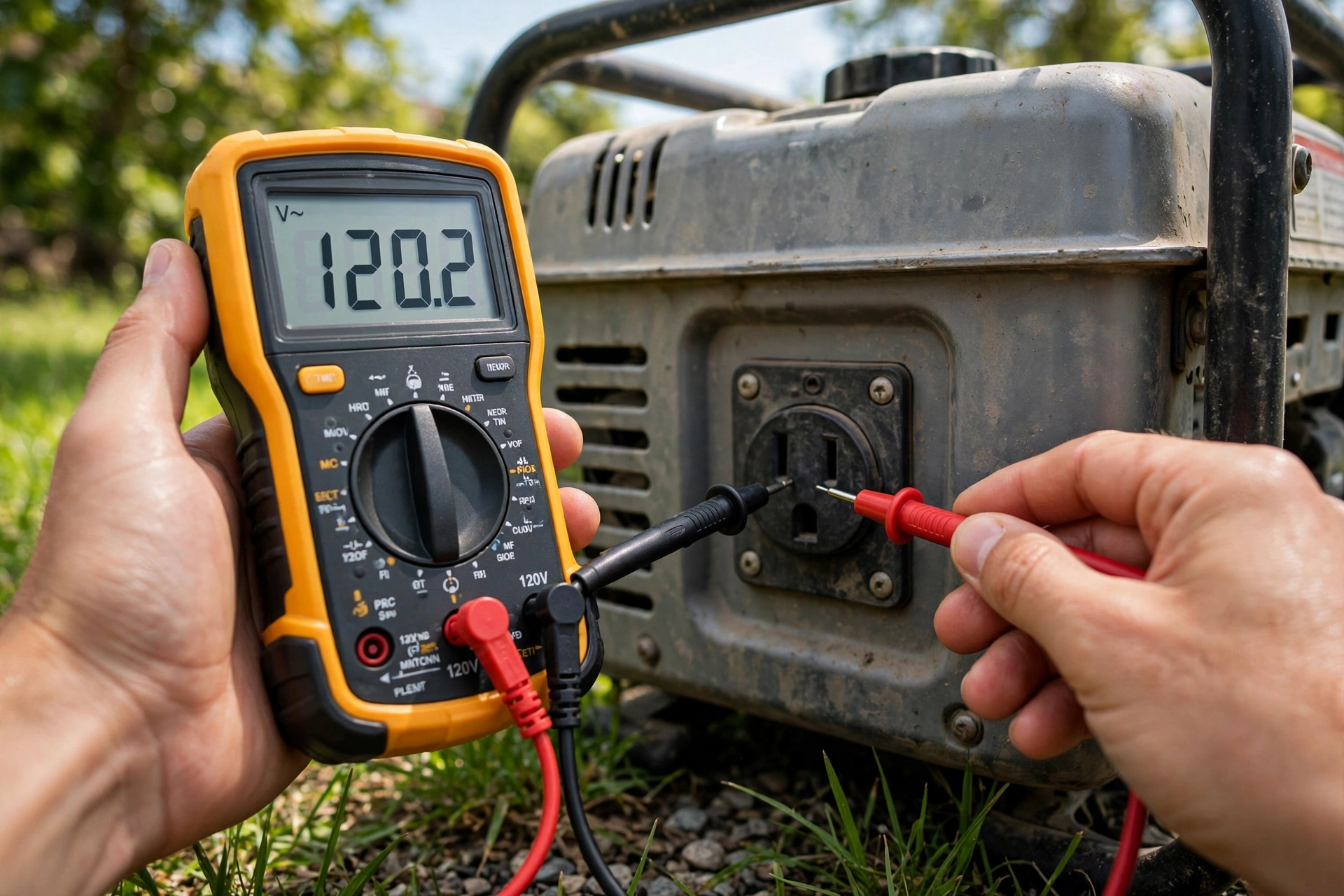
You don’t need an electrician to check whether your AVR is doing its job. Grab any basic multimeter, set it to AC volts, and measure a standard outlet while the generator runs:
- No load: should read 118–122V. If it’s 130V+ or under 110V with nothing plugged in, something’s wrong.
- Add a heavy load (a space heater or hair dryer): voltage should dip briefly, then recover to within a couple volts of the no-load reading. If it sags 10V+ and stays there, the AVR isn’t compensating.
- Remove the load: watch for overshoot past ~125V. A brief flicker is normal; sustained high voltage is not.
I do this check every spring when I exercise my generators — it takes a minute and catches a dying AVR before storm season. If the numbers are off, the AVR module is the prime suspect, and on most portables it’s a sub-$70 part.

Frequently Asked Questions
What does AVR mean on a generator?
Do I need AVR on my generator?
Is AVR the same as an inverter generator?
Can AVR fail? What are the symptoms?
Does AVR protect against power surges?
Bottom Line
AVR is the quiet guardian of everything you plug into a conventional generator — a small module doing thousands of corrections per second to hold your voltage at a steady 120V. When you’re shopping, treat it as a requirement for home backup and electronics, not a nice-to-have. And if an old generator starts acting electrically erratic, check the AVR before you assume the worst — it’s the cheapest fix in the machine. Size your generator properly with our generator size calculator and let AVR handle the rest.

Related Guides
How Do Generator CO Sensors Work?
Generator CO sensors sniff carbon monoxide and shut the engine down before levels turn deadly. How the electrochemical sensor, PGMA G300 thresholds, and auto-shutoff work.

Open Frame vs Enclosed Inverter Generators: What’s the Difference?
Open frame vs enclosed inverter generators: both make clean power, but noise (50-60 vs 62-72 dBA), cost per watt, and max power differ hugely. How to choose.
How to Power Your House With an EV: V2L vs V2H Explained
How to power your house with an EV: V2L runs appliances via extension cords; V2H feeds your panel. Compare power, cost, runtime, and safety needs here.