


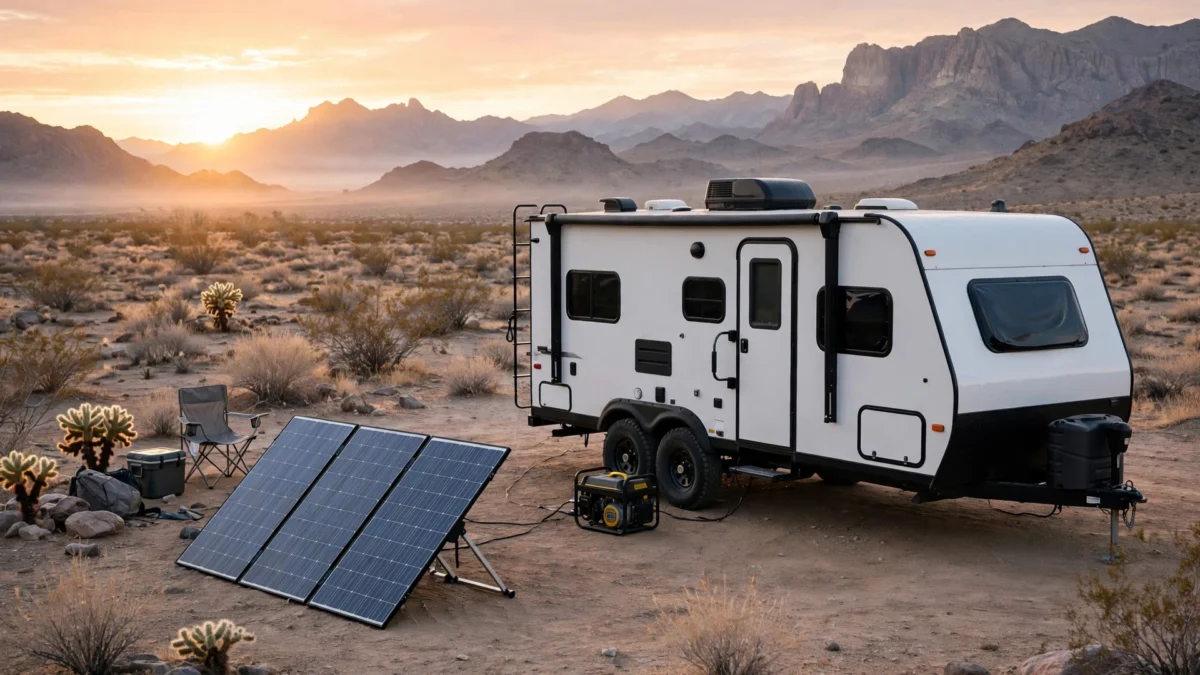
The best boondocking power setup is a hybrid: solar panels for silent daytime power, a battery bank as the buffer, and a small inverter generator for bulk charging and heavy loads. No single source does it all — solar can’t run the AC at midnight, a generator alone means noise all day, and batteries alone go flat. Together, they’re the off-grid trifecta.
I’ve iterated my own boondocking rig over several seasons, from “generator-only and miserable” to a balanced hybrid I barely think about. Here’s the load math, the three sizing tiers, and the daily rhythm that keeps the batteries full and the fuel cans nearly untouched.
Key takeaways
- A typical RV boondocking day uses 2–4 kWh; heavy AC use pushes it to 8–12+ kWh.
- The winning formula: 400W+ solar + 2kWh+ battery + 2,000W inverter generator for most campers.
- Run the generator 1–2 hours in the morning for bulk charging; let solar finish the job silently.
- A soft starter on the roof AC lets a small generator handle cooling.
- Size the battery for your overnight loads and the solar for your daytime recharge — they’re two separate calculations.
Step 1: Know Your Daily Load (Real Numbers)
Before buying anything, audit what you actually use. Here are realistic figures for a typical travel trailer or Class C:
| Load | Draw | Hours/day | Daily kWh |
|---|---|---|---|
| 12V fridge (compressor) | 40W avg | 24 | ~1.0 |
| LED lights | 20W | 5 | 0.1 |
| Water pump | 60W | 0.5 | 0.03 |
| Furnace fan (cold nights) | 80W | 6 | 0.5 |
| Phones/laptops | 65W | 4 | 0.26 |
| Vent fan | 30W | 8 | 0.24 |
| TV (evening) | 50W | 3 | 0.15 |
| Baseline total | ~2.3 kWh | ||
| Roof AC 13.5k BTU | 1,500W | 6 | 9.0 |
| Microwave | 1,000W | 0.25 | 0.25 |
See the story? Baseline living is ~2–2.5 kWh/day — easily solar territory. The air conditioner is a 9 kWh/day monster that changes everything. Your setup tier depends entirely on whether AC is in the picture.
Step 2: The Three Pieces and How They Divide the Work
Solar: the silent workhorse
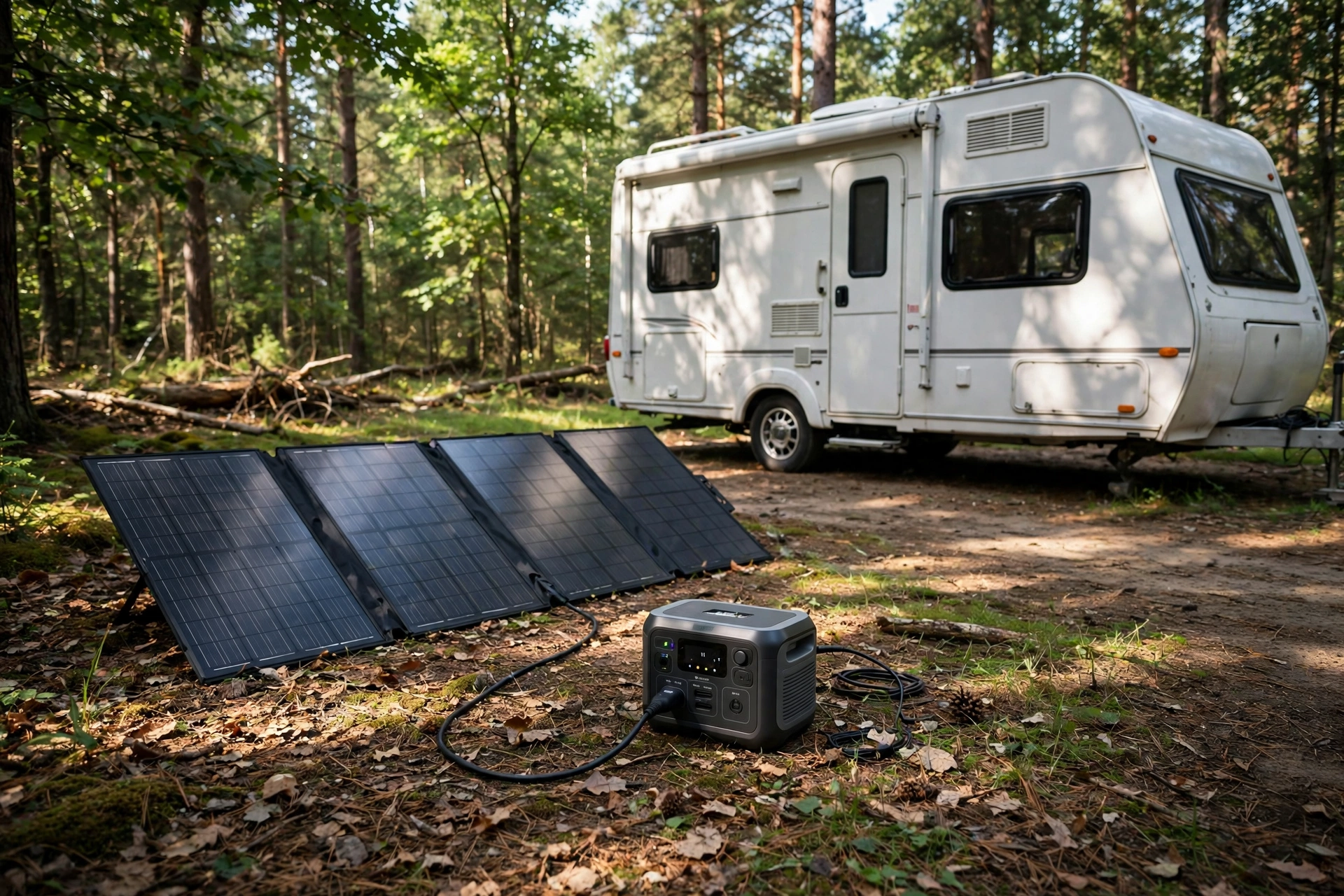
Solar’s job is the slow, steady daytime recharge. Rule of thumb: 200W of panels ≈ 0.8–1.0 kWh per day in decent sun (4–5 peak sun hours). So 400W of panels covers that ~2.3 kWh baseline with margin. Portable suitcase panels are great for boondocking because you can chase the sun while the rig stays shaded — a roof array stuck under trees produces almost nothing.
Solar’s limits are honest: no production at night, weak production in heavy overcast, and it can’t touch air conditioning loads on its own. That’s what the other two pieces are for.
Battery bank: the overnight buffer
The battery carries you from sundown to sunup and smooths every spike. Size it for 1.5–2x your overnight consumption. For the baseline rig above, overnight loads (fridge + furnace fan + a few lights) run ~1–1.5 kWh — so a 2kWh LiFePO4 bank (or power station) is the sweet spot. For AC evenings, you need 5kWh+ to be comfortable, which is where the generator earns its keep instead.
LiFePO4 is the only chemistry worth buying now: 3,000+ cycles, safe to discharge to near-empty, and roughly half the weight of lead-acid per usable kWh. Whether that’s a built-in RV battery bank or a portable power station depends on your rig — stations win on simplicity and portability.
Generator: the heavy lifter
The generator does two jobs solar can’t: bulk charging on cloudy days and running the big stuff (AC, microwave, electric water heater). A 2,000–2,200W inverter generator covers battery charging plus one major appliance at a time. It’s also your weather insurance — three cloudy days in a row is when generator owners smile and solar-only rigs start rationing.
Size it with our generator size calculator, and if AC is in the plan, check whether a soft starter changes the answer (it usually does — see below).
Step 3: Pick Your Tier
| Tier | Solar | Battery | Generator | Best for |
|---|---|---|---|---|
| Weekend minimalist | 200W portable | 1kWh station | None / borrow | Fair-weather weekends, no AC |
| Balanced hybrid (sweet spot) | 400W (portable or roof) | 2kWh LiFePO4 | 2,000W inverter | Week-long trips, all seasons |
| Full-time / AC capable | 600–800W+ | 5kWh+ | 3,000W+ inverter + soft start | Full-timing, summer desert |
The balanced hybrid is where most boondockers land and stay. It handles a week off-grid in mixed weather, runs everything except sustained AC, and the whole power system costs less than a single big generator alone once did.
The Daily Rhythm: How It All Works Together
Here’s the actual routine from my last two-week desert trip — the pattern that sips fuel:
Morning (generator hour): Fire up the inverter generator while making breakfast. It bulk-charges the battery bank from ~60% to ~85% in 60–90 minutes and simultaneously runs the microwave, coffee maker, and any other heavy loads. One concentrated noisy hour, then silence.
Midday (solar shift): Generator off. The 400W of panels carries daytime loads (fridge, vent fan, laptops) and floats the battery from 85% to full by early afternoon. This is the silent golden stretch — the reason for the whole hybrid design.
Evening (battery shift): Sun drops, battery takes over. Lights, TV, furnace fan, phones — the 2kWh bank barely notices. If we ran the AC for a cool-down, that came from the generator in the late afternoon, not the battery.
Night: Everything silent. Fridge and furnace sip from the bank. Wake up at 60–70%, repeat.
Fuel use with this rhythm: roughly 0.5–1 gallon per day — a 5-gallon can lasts a week. Compare that to generator-only boondocking at 3–5 gallons a day, and the hybrid pays for its solar panels in a single long season.
Taming the Air Conditioner
AC is the boondocking boss fight. A 13,500 BTU roof unit draws ~1,500W running but needs 3,000–4,000W for a split second at startup — which is why people buy 3,500W+ generators just for that one surge.
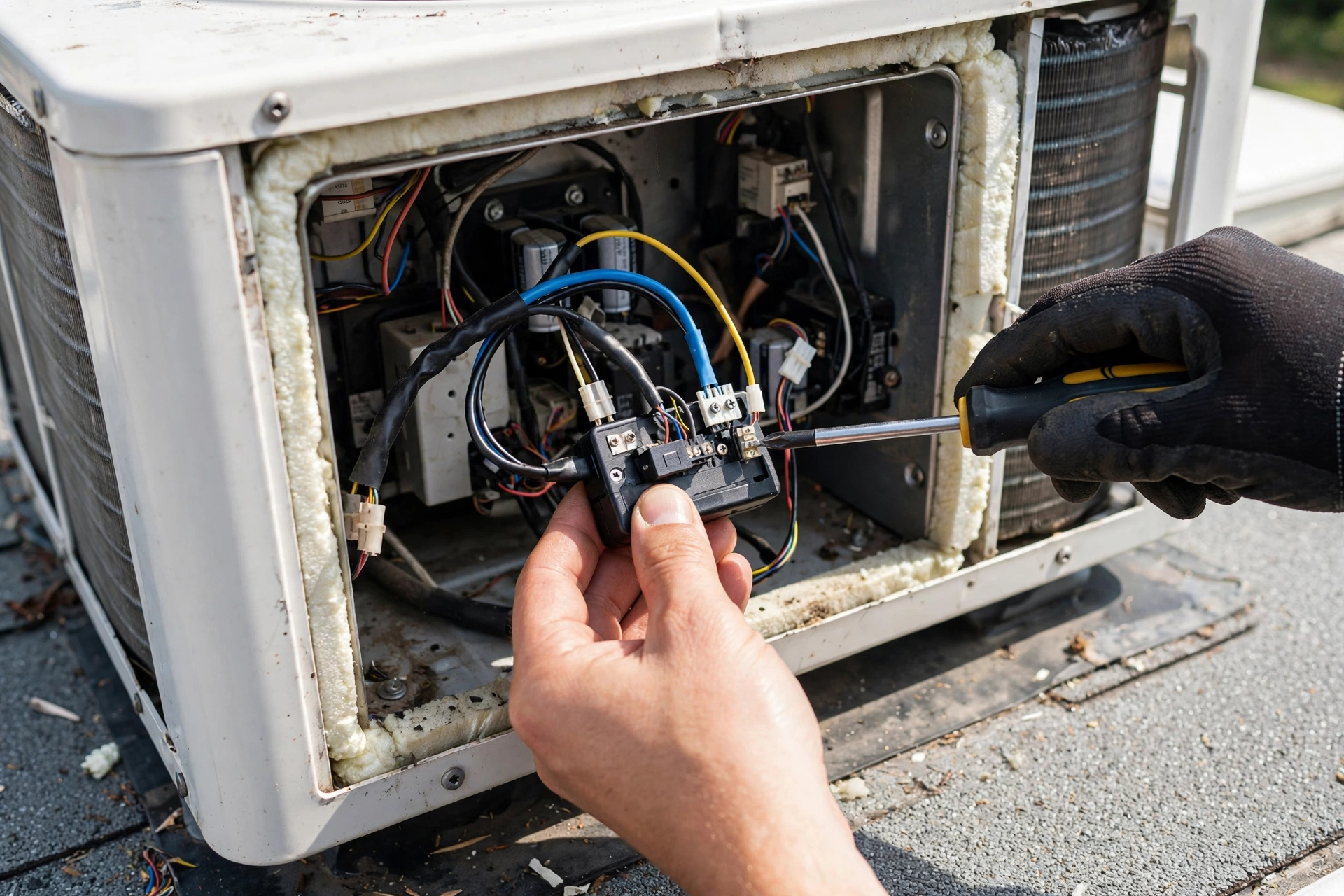
The fix is a soft starter like the MicroAir EasyStart 364, which cuts startup current by 65–75%. With one installed, a 2,000W-class inverter generator can start and run the AC — I’ve done it. That single $300-ish device can save you from buying a generator twice the size, twice the noise, and twice the fuel burn.
Even so, sustained AC on battery alone is brutal: 1,500W × 8 hours = 12 kWh, requiring a battery bank most rigs can’t carry. The realistic boondocking AC strategy is generator-powered cooling during the hot afternoon, then fans and open windows overnight. Anyone telling you to run AC all night off batteries is selling batteries.
Common Mistakes I See
- All solar, no generator: Works until the first 3-day storm. Then you’re driving to town for ice and a laundromat.
- Oversized generator, tiny battery: Running a 3,500W unit for hours just to charge phones is loud, wasteful, and annoying to everyone within earshot.
- Roof solar parked in shade: Boondockers love trees; panels hate them. Portable panels you can place 30 feet away in full sun outperform a bigger roof array in partial shade.
- Forgetting the converter: If charging house batteries from the generator, make sure your RV’s converter/charger can actually push decent amperage — old single-stage converters charge painfully slowly. A modern multi-stage charger (or charging a power station directly) cuts generator runtime in half.
Frequently Asked Questions
How much solar do I need for boondocking?
Can I boondock with just a generator and no solar?
What size generator do I need for boondocking?
How long will a 2kWh power station last boondocking?
Should I get a built-in battery bank or a portable power station for my RV?
Bottom Line
Boondocking power isn’t about one hero device — it’s the division of labor: solar for the silent daytime grind, batteries for the night shift, and a small inverter generator for the heavy lifting and bad weather. Size each piece to your real loads with our solar generator size calculator, run the generator in one efficient morning burst, and you’ll wonder why you ever thought off-grid meant roughing it.

Related Guides
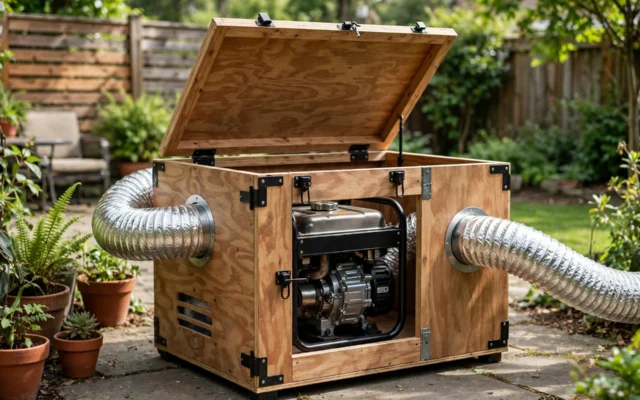
DIY Generator Quiet Box: How to Build a Noise-Reduction Enclosure
A DIY generator quiet box can cut noise 10–20 dB — but ventilation and CO safety are the whole project. Materials, baffle design, fan sizing, and the mistakes to avoid.

RV Generator Quiet Hours & Campground Etiquette Guide
RV generator quiet hours are usually 10pm–8am, with limited daytime generator windows in national parks. The rules, the unwritten etiquette, and how to stay neighborly.
Best Generators for Power Tools & Workshops in 2027
Best generators for power tools in 2027: 5 workhorses compared with real surge specs. Sizing for saws, compressors, welders — surge watts matter most.