


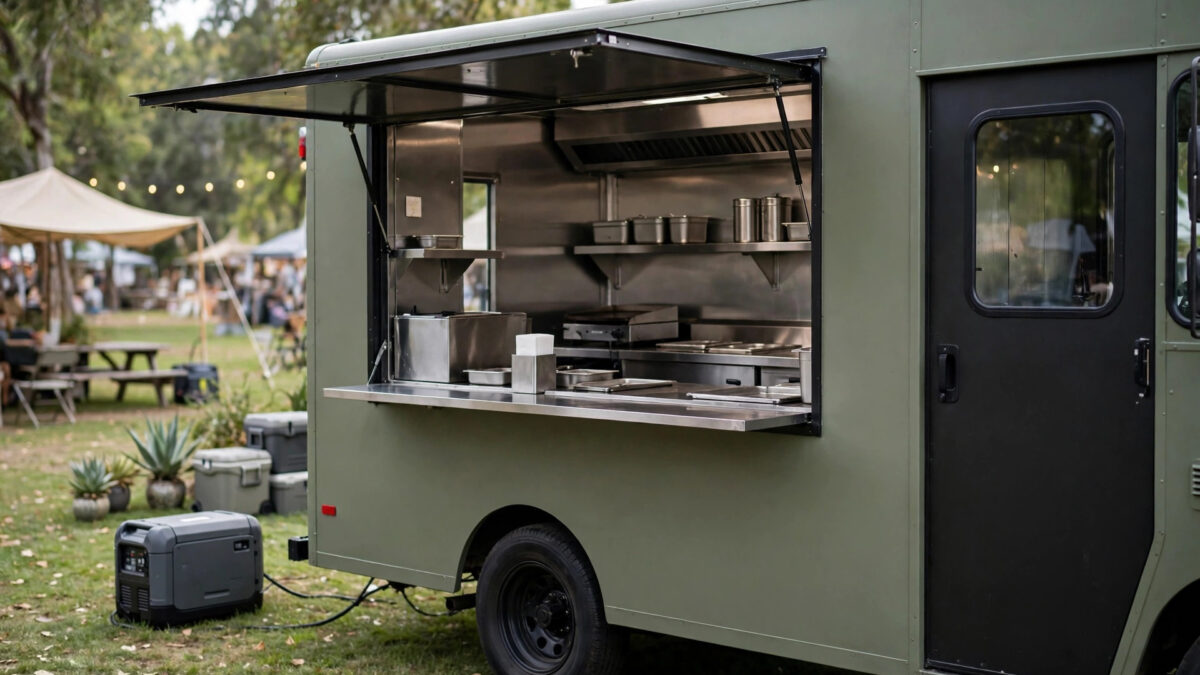
Most food trucks need 7,000–12,000 watts of generator capacity. A small coffee or dessert truck with minimal cooking equipment can get by on 5,000W; a full-service truck running fryers, a griddle, refrigeration, and warmers needs 12,000–15,000W or more. The exact number comes from adding up every electrical appliance on the truck — and food trucks carry more of them than most people expect.
Key takeaways
- Typical food truck: 7,000–12,000W. Full kitchen with multiple fryers: 15,000W+. Minimal coffee/dessert setup: ~5,000W.
- List every electrical load — refrigeration, cooking equipment, hood fans, water heater, lights, POS, AC — then add a 20% buffer.
- Gas/propane cooking equipment drastically cuts electrical demand; all-electric kitchens need the biggest generators.
- Noise matters commercially: many cities enforce 60–68 dB limits, which pushes serious operators toward quiet inverter models.
- Dual-fuel (gasoline/propane) is popular for cost and runtime flexibility; diesel dominates in permanently mounted commercial setups.
- Mount the generator with proper ventilation and CO safety — a truck is a workplace, and exhaust near the serving window is a health hazard.
Why food trucks are power-hungry
A food truck is a commercial kitchen, a retail storefront, and an RV electrical system stacked on top of each other. When I helped a friend spec power for his taco truck, the list kept growing: two commercial fridges, a freezer, a warming cabinet, the POS system, card reader, LED menu boards, interior and exterior lighting, the exhaust hood fan, a water pump, an on-demand water heater, and a rooftop AC for the Texas summer. Before we’d even talked about cooking equipment, we were past 6,000 watts.
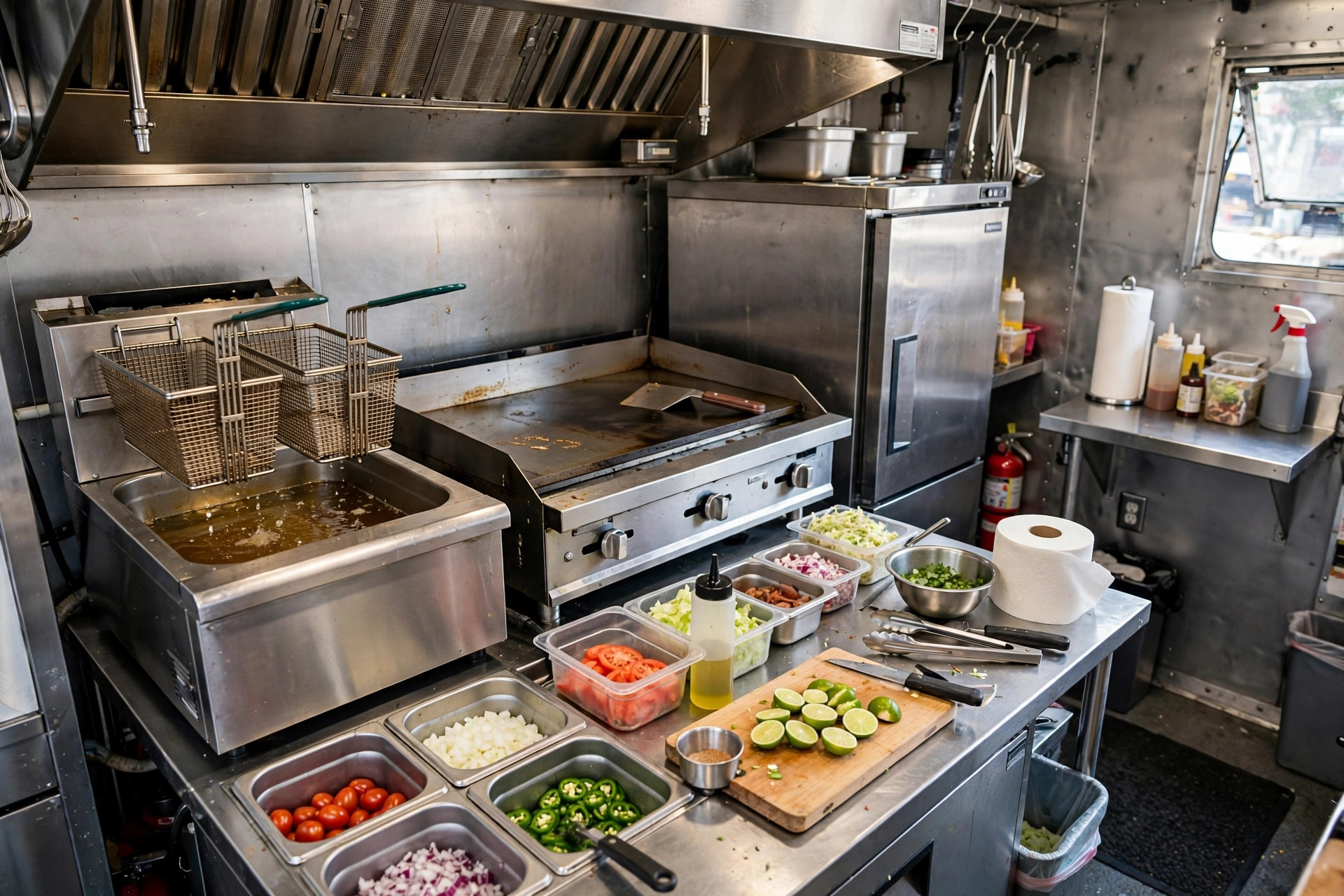
Cooking equipment is the swing factor. A propane griddle and propane fryer draw almost no electricity (just ignition and controls). An electric fryer, electric griddle, or electric convection oven can draw 3,000–6,000W each. This is why the first question any experienced food truck builder asks is: “What’s gas and what’s electric?”
Typical food truck electrical loads
| Equipment | Running watts | Notes |
|---|---|---|
| Commercial refrigerator (2-door) | 800–1,200 | Surge 2–3× on compressor start |
| Commercial freezer | 800–1,500 | Surge 2–3× |
| Electric fryer (single) | 3,000–6,000 | No surge; huge continuous draw |
| Electric griddle (36″) | 3,000–5,000 | Cycles on/off via thermostat |
| Warming cabinet / heat lamp | 500–1,500 | Continuous |
| Exhaust hood fan | 500–1,500 | Motor surge on start |
| On-demand water heater (electric) | 1,500–3,000 | Consider propane instead |
| Rooftop AC (13.5k BTU) | 1,500–1,800 | 2,800–3,500W surge |
| LED lighting + menu boards | 100–300 | Negligible |
| POS, card reader, sound | 100–200 | Negligible but critical |
| Water pump | 100–300 | Small surge |
How to size it: the worksheet method
- List everything electrical on the truck — including the stuff that’s easy to forget (hood fan, water heater, phone chargers).
- Write running watts for each (nameplate or the table above).
- Identify the largest motor surge (usually the AC compressor or a refrigeration compressor) and add that surge figure once.
- Add 20% buffer for simultaneous cycling — thermostats don’t coordinate, and two compressors will start at the same moment eventually.
Example — mid-size burger truck (propane grill, electric everything else):
- 2-door fridge: 1,000W
- Freezer: 1,200W
- Warming cabinet: 1,000W
- Hood fan: 800W
- Electric water heater: 1,500W
- Rooftop AC: 1,600W (surge 3,000W)
- Lights + POS + pump: 500W
Running total: 7,600W. Add the AC surge once: 7,600 + 3,000 = 10,600W. Add 20%: ~12,700W → a 12,000–13,000W-class generator (or a 10,000W unit with disciplined load management, water heater cycled manually). This is exactly why the 9,500–12,000W dual-fuel portables are the sweet spot for serious trucks.
Fuel type: the commercial decision
- Gasoline: cheapest generators, fuel available everywhere. Downsides: shorter runtime per tank, fuel goes stale, and hauling gas cans to events gets old.
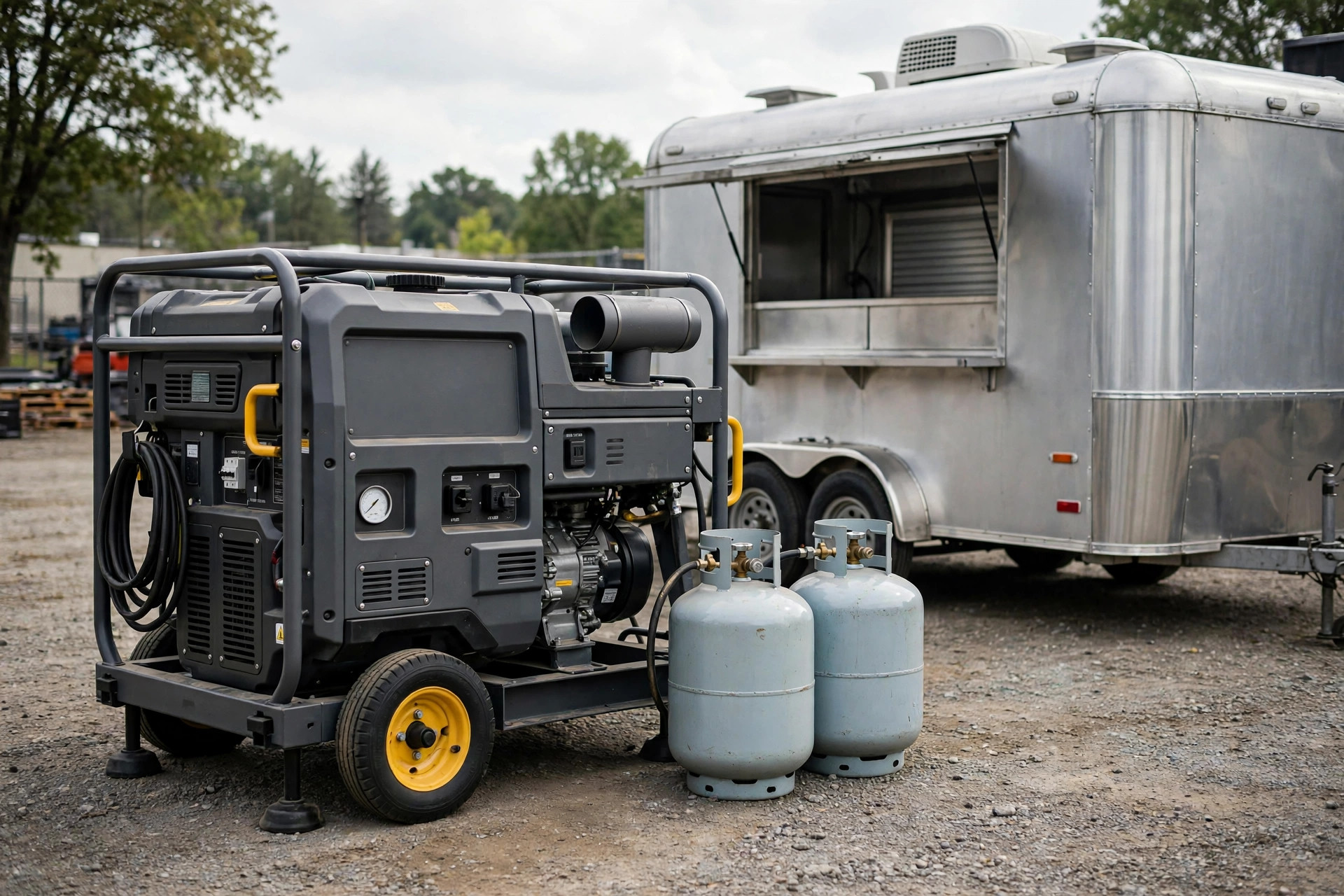
- Dual-fuel (gasoline/propane): the food-truck favorite. Propane burns cleaner, stores indefinitely, and many venues prefer it. Runtime on a standard 40-lb propane bottle is excellent, and you can carry spare bottles easily.
- Diesel: the choice for permanently mounted commercial setups (think Cummins Onan-style RV generators). Best fuel efficiency, longest engine life, safest fuel to store — but the generators cost several times more upfront.
Whatever you choose, size the fuel supply for your longest service day plus a margin. Running dry mid-lunch-rush with full fryers is a nightmare scenario — and restarting a hot commercial kitchen takes longer than you’d think.
Noise: the regulation you can’t ignore
Many cities and event venues enforce noise limits — commonly 60–68 dB at a set distance during operating hours. An open-frame contractor generator at 75+ dB will get you complaints, failed inspections, or removal from events. This is the strongest argument for enclosed inverter generators in the 9,000–12,000W class: they’re dramatically quieter, and the “super quiet” models in that range exist specifically for food trucks, events, and RVs.
Also consider where the generator sits. A unit bolted to the truck’s rear, away from the serving window and the customer queue, with the exhaust pointed away from people, is both quieter for customers and safer. Never run the generator where exhaust can drift into the serving window or the prep area — CO in a workspace is an OSHA and health-department problem, not just a comfort issue.
Fuel planning for a full service day
A food truck generator doesn’t run for an hour — it runs for 8–12 hours straight, often at 50–75% load. That changes the fuel math completely versus home backup use.
As a rough planning rule, a gasoline generator burns about 0.5–1 gallon per hour at half load, scaling with size — a 12,000W unit at 75% load can drink well over a gallon an hour. For a 10-hour service day, that’s potentially 8–12 gallons of gasoline, which means either a very large built-in tank or scheduled refueling (with the generator shut down and cooled — never refuel hot).
This is where propane earns its popularity with food truck operators: a standard 40-lb propane bottle holds about 9.5 gallons of propane equivalent, and dual-fuel generators sip it slower than gasoline in many cases. Two 40-lb bottles on the truck plus one spare covers most service days with margin. Diesel, for mounted setups, is the most efficient of all — roughly 0.4–0.6 gallons per hour at half load for a 12kW diesel — and diesel is far safer to store and transport in quantity than gasoline.
Whatever fuel you choose, build refueling into the day’s plan the way you plan food prep: know your burn rate, know your tank size, and never let “we’ll figure it out” be the strategy. A generator that dies at 1 p.m. with a line of customers is a business problem, not just a power problem.
Mounted vs. portable
- Portable (roll it out at each event): cheaper, easier to service or replace, and you can use it for other things. Downsides: setup/teardown at every event, theft risk, and it occupies ground space.
- Permanently mounted: always ready, harder to steal, cleaner setup. Downsides: higher install cost, the truck is down for service when the generator needs work, and weight distribution matters.
New operators usually start portable and graduate to mounted once the business is proven. Either way, the sizing math is identical.
What size generator does a food truck need?
Can I run a food truck on a 7000 watt generator?
Are gas or electric cooking appliances better for food truck generator sizing?
How loud can a food truck generator be?
Is dual fuel or diesel better for a food truck?
Where should the generator go on a food truck?
Size it once, size it right: list every load, add the biggest surge, add 20%, and buy the quietest generator in that class you can afford. A food truck that trips its breaker during the lunch rush doesn’t just lose power — it loses the line of customers watching it happen. For the detailed wattage math, our generator size calculator walks through the same worksheet method step by step — plus fuel planning in our calculator library.

Related Guides
Why Does My Generator Backfire? Causes and Fixes (2027)
Why does your generator backfire? An exhaust bang means unburned fuel in the muffler; a pop through the carb means lean mixture or valve trouble. Here are the fixes.

Generator Valve Adjustment: How to Set Valve Lash (2027 Guide)
Generator valve adjustment: 0.006" intake, 0.008" exhaust on Honda GX engines. Tools, TDC procedure, and symptoms of bad valve lash explained.
How to Clean and Replace a Generator Air Filter (2027 Guide)
How to clean a generator air filter: wash foam filters in soapy water and re-oil; tap out paper filters, never wash them. Full steps inside.