


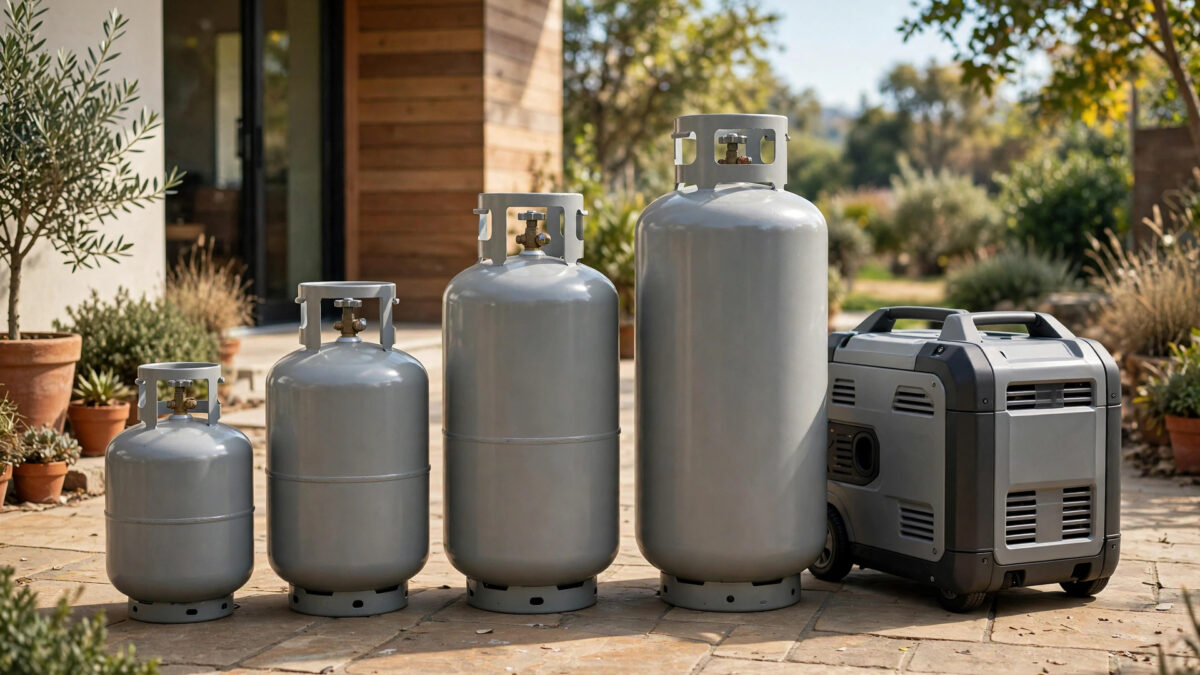
A generator typically burns about 0.5 to 1.5 gallons of propane per hour at half load, depending on its size — a small 2,500-watt inverter generator sips roughly half a gallon per hour, while a large 10,000-watt portable can drink well over a gallon per hour. Because propane carries less energy per gallon than gasoline (about 91,500 BTU per gallon), propane generators burn more fuel volume for the same power — the trade-off for fuel that never goes stale. This guide shows how much propane generators use: the consumption math, runtime tables by tank size, and the real-world factors that move the numbers.
Key Takeaways
- Propane consumption scales with load: expect roughly 0.5 gal/hr for a 2,500W unit, ~0.75–1.0 gal/hr for 5,000–7,500W units, and 1.5+ gal/hr for 10,000W+ units at half load (approximate).
- A standard 20 lb grill tank (about 4.6 gallons) runs a mid-size portable generator roughly 5–8 hours at half load.
- Propane has about 91,500 BTU per gallon vs. ~114,000 for gasoline, so propane runtimes per gallon are shorter — but the fuel stores indefinitely.
- Actual consumption varies with load, altitude, temperature, and the specific engine — treat all tables here as planning estimates, not promises.
- Cold weather reduces propane vaporization; large tanks and warm conditions deliver rated performance, small cold tanks may starve a big generator.
How Much Propane Does a Generator Use Per Hour?
Propane consumption is driven almost entirely by how much power the generator is producing. A generator loafing along at quarter load burns far less than the same unit near full load — the relationship is roughly linear, so doubling the electrical load roughly doubles the fuel burn. The table below gives approximate half-load consumption for common portable generator sizes, compiled from manufacturer-published propane specs. Treat these as planning figures: your actual burn rate depends on the engine, the load profile, altitude, and ambient temperature.
| Generator size (running watts) | Approx. propane use at half load | Approx. propane use at full load |
|---|---|---|
| 2,000–2,500W (small inverter) | ~0.4–0.5 gal/hr | ~0.7–0.9 gal/hr |
| 3,500–4,500W (mid inverter / small portable) | ~0.6–0.8 gal/hr | ~1.0–1.4 gal/hr |
| 5,000–7,500W (mid portable) | ~0.8–1.1 gal/hr | ~1.4–1.9 gal/hr |
| 9,000–12,000W (large portable) | ~1.3–1.8 gal/hr | ~2.2–3.0 gal/hr |
| 14,000W+ standby (whole-home) | ~1.8–2.5 gal/hr | ~3.0–4.0 gal/hr |
The math behind the table: propane contains roughly 91,500 BTU per gallon, and a typical small generator engine converts fuel to electricity at roughly 20–25% efficiency. So a generator producing 2,500 watts of electricity (about 8,500 BTU/hr of useful output) needs roughly 35,000–40,000 BTU/hr of propane input — about 0.4 gallons per hour. You do not need to run this calculation yourself; the table bakes it in. Just remember that “half load” on a bigger generator still burns more than “full load” on a smaller one — right-sizing the generator to your loads is the biggest fuel saver there is.
Propane Tank Sizes and Generator Runtime
Propane tanks are sold by weight (pounds of propane), but generators consume volume (gallons) — so the first step is converting. Propane weighs about 4.2 pounds per gallon, and tanks are filled to about 80% of their water capacity for safety expansion room. Here are the standard portable tank sizes with their usable propane:
| Tank size | Propane capacity (approx.) | Common use |
|---|---|---|
| 20 lb (grill tank) | ~4.6 gallons | Small/mid portables; easiest to exchange |
| 30 lb | ~7 gallons | RV and mid-size portable use |
| 40 lb | ~9.2 gallons | Larger portables; fewer refills |
| 100 lb | ~23.6 gallons | Large portables; semi-permanent backup |
Combine those capacities with the consumption rates above and you get practical runtimes. The table below assumes half-load operation — the most realistic planning assumption for outage use, where loads cycle on and off:
| Tank | 2,500W unit (~0.5 gal/hr) | 5,000W unit (~0.9 gal/hr) | 10,000W unit (~1.5 gal/hr) |
|---|---|---|---|
| 20 lb (~4.6 gal) | ~9 hours | ~5 hours | ~3 hours |
| 40 lb (~9.2 gal) | ~18 hours | ~10 hours | ~6 hours |
| 100 lb (~23.6 gal) | ~47 hours | ~26 hours | ~16 hours |
Read the 20 lb row carefully — it is the reality check most buyers need. A standard grill tank gives a mid-size portable roughly a single evening of outage coverage, not a multi-day supply. If your outage plan spans days, you need multiple tanks, larger tanks, or a bulk tank arrangement. Two 40 lb tanks with a changeover regulator is a popular setup: one runs while the other waits, and an auto-changeover valve switches seamlessly when the first empties.
Propane vs. Gasoline: The Fuel Consumption Trade-Off
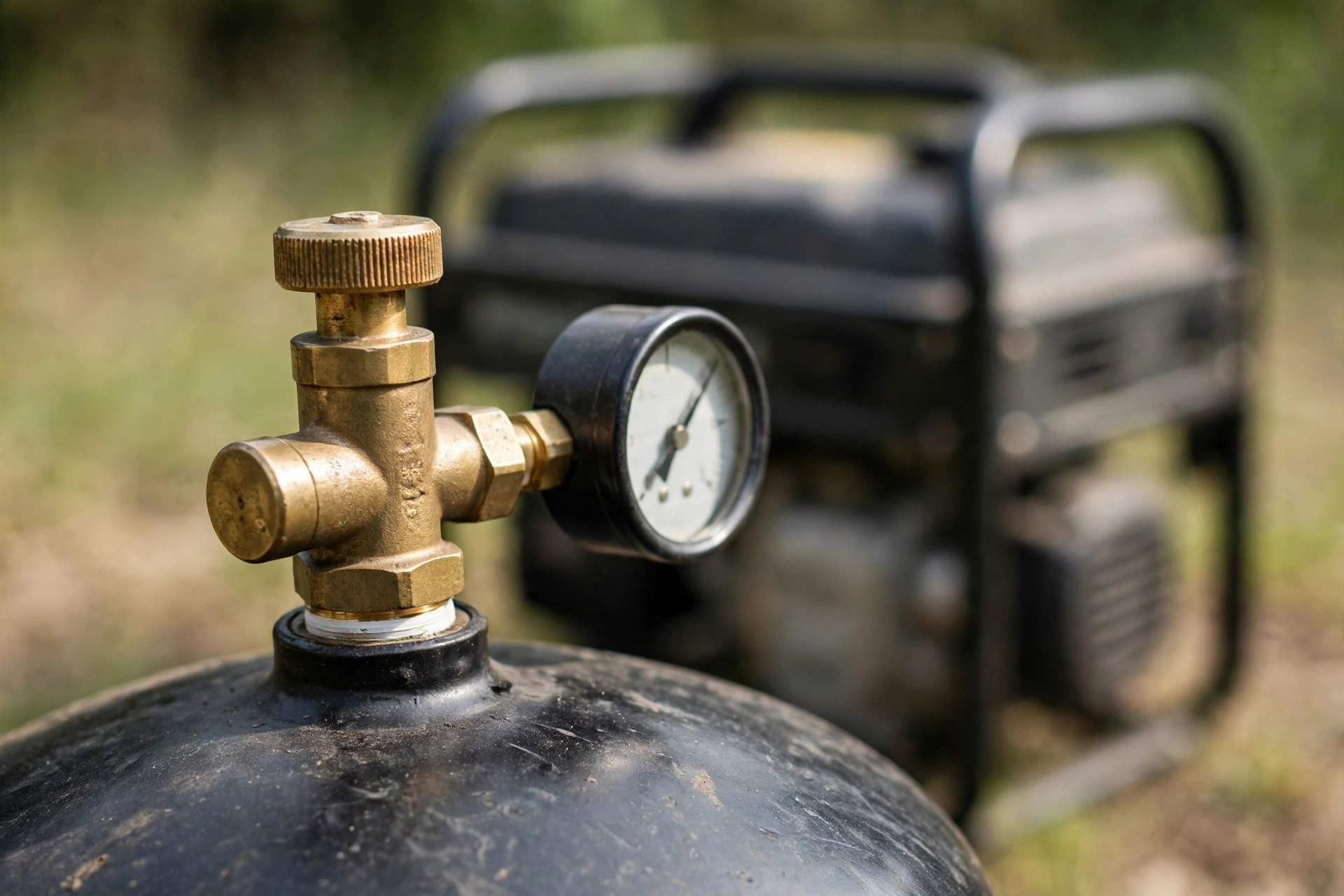
Propane’s energy density is the reason consumption looks high next to gasoline figures. At roughly 91,500 BTU per gallon versus gasoline’s roughly 114,000 BTU per gallon, propane delivers about 80% of the energy per gallon — so a dual-fuel generator makes about 10–15% less power and burns about 20–25% more fuel volume on propane than on gasoline. Manufacturers’ dual-fuel spec sheets reflect this openly: the propane wattage rating is lower and the propane runtime per tank is shorter than the gasoline equivalents.
So why do so many backup-power owners choose propane anyway? Three reasons: propane never goes stale (gasoline degrades in months), propane burns cleaner (less carbon buildup, longer oil life, easier starts after storage), and propane is safer to store in quantity (no spill risk, no vapor accumulation like gasoline). For a generator that sits idle for months between outages, those advantages outweigh the higher volume consumption for most owners. Our dual-fuel generator guide covers the full comparison if you are choosing between fuel types for 2027.
How Much Propane Does a Generator Use in Real-World Conditions?
The tables above assume moderate conditions and steady half loads. Reality moves the numbers:
Load profile matters most
Motor starting surges, cycling appliances (refrigerators, well pumps, furnaces), and resistive heating loads all change the average burn. A generator powering a cycling refrigerator averages far less than its “half load” figure suggests, while one running electric space heaters continuously can exceed the full-load estimate.
Altitude leans out the burn — and the power
Engines lose roughly 3–3.5% of power per 1,000 feet of elevation, and propane consumption per hour drops slightly with it — but you get less electricity for the fuel. High-altitude owners should derate both the generator’s output and these runtime estimates, and check whether the manufacturer recommends a high-altitude kit.
Cold weather can starve the generator
Propane must vaporize from liquid to gas inside the tank to feed the engine, and vaporization slows dramatically in the cold. A small tank feeding a large generator on a freezing night may be unable to vaporize fuel fast enough — the generator surges, sags, or stalls despite the tank being half full. This is the most misunderstood propane issue in winter outages. Larger tanks (more liquid surface area), keeping tanks out of wind, and full tanks (more thermal mass) all help. For whole-home standby units, installers size the tank and regulator for the coldest expected conditions.
Regulator and hose setup
An undersized regulator or a long, narrow hose run restricts propane flow exactly like a kinked garden hose restricts water. Use the regulator and hose configuration the manufacturer specifies, keep hose runs as short as practical, and never stack adapters to “make it reach.” Flow restriction shows up as surging under load — if your generator hunts at higher loads on propane but runs fine on gasoline, suspect fuel delivery before suspecting the engine.
How to Estimate Propane for Your Outage Plan
Work backward from your loads to size your propane supply:
Step 1: List your essential loads in watts
Add up the running watts of what you must power — refrigerator, freezer, furnace blower, sump pump, lights, phone chargers. Our generator sizing guide walks through this; most essential-load lists land between 2,000 and 5,000 watts.
Step 2: Pick the consumption rate for your generator size
Find your generator’s running watts in the consumption table above and note the half-load gallons-per-hour figure. If your loads average well below half the generator’s rating, you can shade the estimate down; if you will run near capacity, shade it up.
Step 3: Multiply by your target outage hours, then add margin
Consumption (gal/hr) × hours = gallons needed. Then add 25–50% margin for surge loads, colder weather, and the unexpected. Convert gallons to tanks using the tank table. Example: a 5,000W portable at ~0.9 gal/hr for a 24-hour outage needs ~22 gallons — roughly one 100 lb tank, or five 20 lb grill tanks. That example surprises most first-time buyers, which is exactly why you do the math before the storm.
How much propane does a generator use per hour?
How long will a 20 lb propane tank run a generator?
Does a generator use more propane than gasoline?
Why does my propane generator stall in cold weather?
How many propane tanks do I need for a 3-day power outage?
Is it cheaper to run a generator on propane or gasoline?
Conclusion
Propane consumption is straightforward once you know the two numbers that matter: your generator’s gallons-per-hour at your typical load, and your tanks’ gallons of capacity. Size the supply with honest math and a healthy margin, respect cold-weather vaporization limits, and store tanks safely outdoors — and propane becomes what it is at its best: the always-ready fuel that starts on the first pull after a year of sitting idle. For help picking the generator itself, see our best dual-fuel generators of 2027 roundup, and our propane safety and storage guide for the handling details.

Related Guides
Does a Natural Gas Generator Need a Bigger Gas Meter?
Does a natural gas generator need a bigger gas meter? Often yes. Learn the BTU load calculation, when upgrades are required, costs, and the utility process.


Best Propane Generators for Camping & RV in 2027: 7 Tested Picks
Propane generators allow campers to enjoy modern necessities off-grid. Check out our picks for the 15 best propane generators for camping in 2027. We cover top options across power outputs, weights, and prices to help you find the perfect fit.


Propane Vs Natural Gas Generator
When choosing between propane and natural gas generators, propane offers more portability while natural gas provides abundant fuel. This guide explores both types to help you determine the better option.