


The Jackery Explorer 1000 v2 is the 2027 sweet spot of portable power stations: 1,070Wh of LiFePO4 capacity, 1,500W of continuous output (3,000W surge), and a full recharge in about an hour — all at 23.8 pounds. After researching its specifications, owner feedback, and how it compares to the 1kWh competition, our verdict is that the 1000 v2 is the best-balanced 1kWh power station for most buyers in 2027, provided you understand exactly what the “v2” means.
That last point matters, so let us be precise: this review covers only the Jackery Explorer 1000 v2 (1070Wh, LiFePO4 chemistry). It is a distinct product from the original Explorer 1000 v1 (1002Wh, older NMC lithium-ion chemistry, separate older listing). The two share a name but differ in battery chemistry, capacity, charging speed, and lifespan — do not mix their specifications, and do not confuse this review with our separate coverage of the v1.
Product reviewed
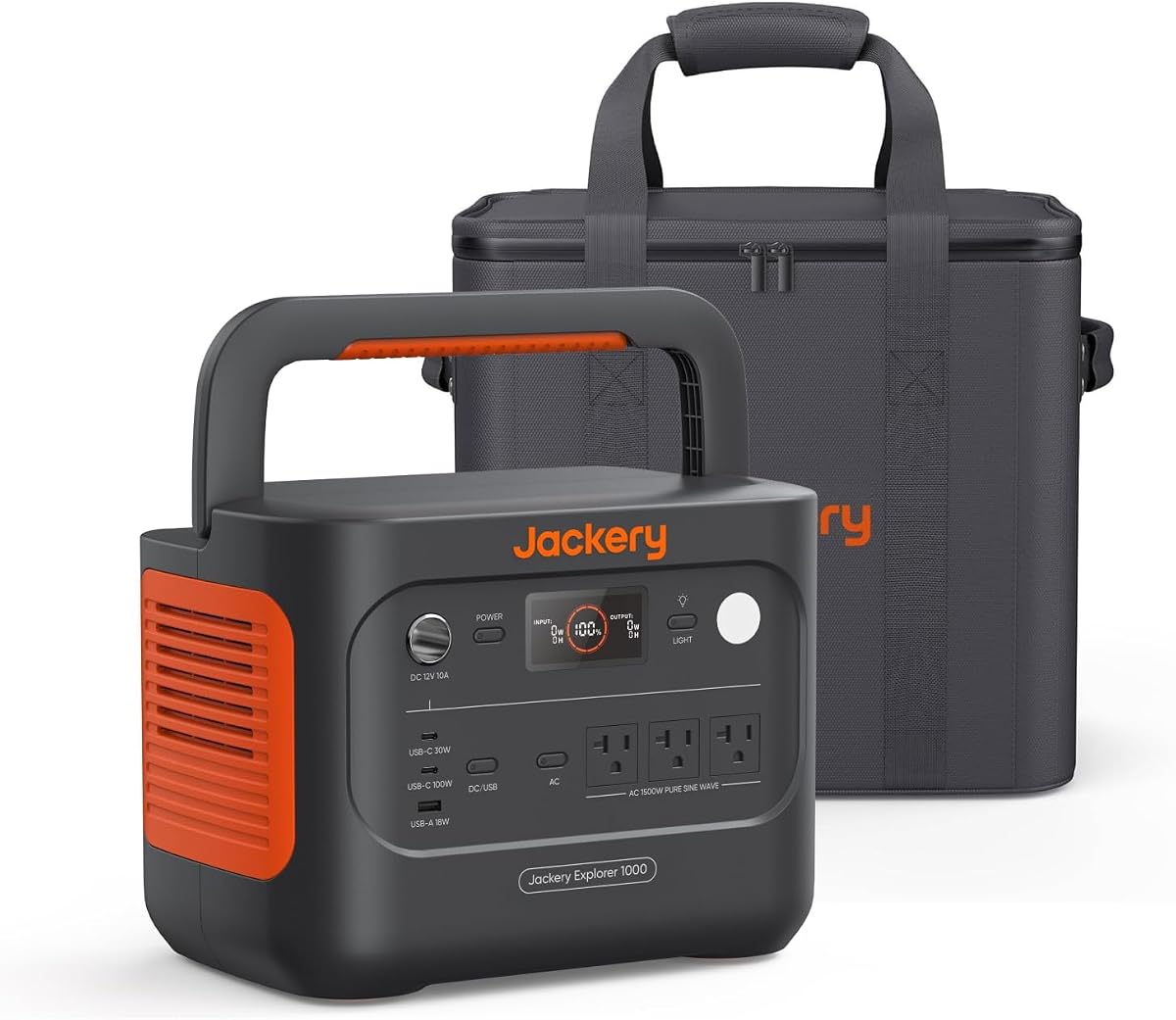
Jackery Explorer 1000 v2
- Capacity Wh: 1070
- Output Watts: 1500 (3000W surge)
- Chemistry: LiFePO4 (4000+ cycles to 70%, 10+ year design life)
- v2 verified as a distinct listing from the v1: v1 = 1002Wh NMC (separate older listing)
- 1070 capacity
- 23.8 lbs
As an Amazon Associate, we earn from qualifying purchases.
Key Takeaways
- The Explorer 1000 v2 delivers 1,070Wh LiFePO4 capacity with 1,500W continuous output — a major chemistry and longevity upgrade over the v1’s NMC cells.
- LiFePO4 means 4,000+ charge cycles to 70% capacity and a 10+ year design life — roughly 4x the cycle life of the old NMC version.
- Emergency AC charging refills the station in about 1 hour via the app (1.7 hours standard); up to 600W of solar input for off-grid refills.
- The ≤10ms UPS switchover protects sensitive electronics during outages — a genuine backup-power feature, not a marketing footnote.
- At 23.8 lbs it remains genuinely portable; best for home backup, RVs, camping, and outages rather than whole-home replacement.
Our verdict up front
The Jackery Explorer 1000 v2 is the 1kWh power station we would recommend to most buyers in 2027. The LiFePO4 chemistry fixes the v1’s biggest weakness (battery longevity), the 1-hour emergency recharge is best-in-class, and 1,500W of output covers the real-world loads that matter — full-size refrigerators, power tools, CPAP machines, and RV appliances. It is not the cheapest 1kWh station and not the most powerful, but it is the most balanced. Read on for the full breakdown.
| Capacity | 1,070Wh |
|---|---|
| Output | 1,500W continuous (3,000W surge) |
| Battery chemistry | LiFePO4 (lithium iron phosphate) — 4,000+ cycles to 70%, 10+ year design life |
| AC recharge | ~1 hour emergency charge (via app) / ~1.7 hours standard |
| Solar input | Up to 600W |
| Weight | 23.8 lbs |
| UPS | ≤10ms switchover |
| Protection | ChargeShield 2.0 battery management |
Design & Build
The Explorer 1000 v2 keeps Jackery’s familiar design language — a compact rectangular unit with a carry handle, a clear display showing input/output watts and time remaining, and a sensible port layout — but the important changes are inside. The switch from NMC to LiFePO4 chemistry is the defining upgrade: lithium iron phosphate is more thermally stable, tolerates far more charge cycles, and degrades more gracefully than the NMC cells in the v1.
At 23.8 pounds, the v2 sits in the genuinely portable zone. It is light enough to carry from the garage to the campsite to the home office without dreading the trip, yet substantial enough to feel like serious equipment rather than a toy. The display is the practical kind — watts in, watts out, hours remaining — rather than a decorative screen, and owner feedback consistently praises its readability.
ChargeShield 2.0 is Jackery’s battery management system, handling cell balancing, temperature monitoring, and charge control. Based on the specifications, it is a meaningful part of why the v2 achieves its 4,000-cycle rating: LiFePO4 chemistry plus competent management is the combination that delivers decade-scale service life. The ≤10ms UPS function means the station can sit between the wall and your sensitive gear (a home office setup, a CPAP, a network rack) and switch to battery faster than the equipment notices the outage.
Performance: What 1,070Wh and 1,500W Actually Run
Performance for a power station comes down to two numbers: how much energy it stores (1,070Wh) and how much power it delivers at once (1,500W continuous, 3,000W surge). In practical terms, 1,500W runs a full-size refrigerator (150–200W running), a microwave (1,000W), most power tools, a CPAP machine all night (30–60W), laptops and phones trivially, and RV appliances including smaller air conditioners with soft-start assistance.
The 3,000W surge rating handles motor startup spikes — the brief inrush when a refrigerator compressor or power tool kicks on — which is where underpowered stations stumble. Based on owner feedback, the v2 starts and runs the loads its ratings promise without the voltage sag or overload trips that plague cheaper 1kWh units.
Runtime math is straightforward: a 1,070Wh station running a 150W refrigerator load delivers roughly 6 hours (1,070 × 0.85 efficiency ÷ 150), and a 60W CPAP runs through the night with capacity to spare. For outage backup, that translates to keeping the essentials alive through the night on a single charge — and with solar input, refilling during the day for multi-day outages.
Charging: 1-Hour Emergency Recharge and 600W Solar
Charging speed is where the v2 embarrasses both its predecessor and much of the competition. Emergency AC charging via the app refills the station in about 1 hour; standard AC charging takes about 1.7 hours. For outage use, that speed changes the strategy: instead of rationing a slow-charging battery, you recharge fully during the windows when you have generator or grid power available.
Solar input maxes at 600W, which pairs naturally with Jackery’s SolarSaga panels — two 200W panels, for example, refill the station in roughly 3–4 hours of good sun. The MPPT controller is built in, so solar setup is panel-to-station with the right cable and no external charge controller. For buyers building a solar generator setup, our guide to the best solar panels for portable power stations covers compatible options.
The honest caveat on the 1-hour figure: emergency charging pushes the battery harder and generates more heat, which is why it is app-enabled rather than default. For daily cycling and maximum lifespan, standard charging is the kinder routine; save the 1-hour mode for when you genuinely need speed.
Features: UPS, App Control, and ChargeShield 2.0
The ≤10ms UPS switchover deserves emphasis because it repositions the v2 from “camping battery” to “home backup device.” Plugged in between the wall outlet and your equipment, it passes utility power through while keeping the battery topped up, then switches to battery in under 10 milliseconds when the grid fails — fast enough that computers, routers, and CPAP machines ride through without rebooting. That is a legitimate uninterruptible power supply function, not just a power station that happens to have fast switching.
App control (via Bluetooth/WiFi depending on configuration) enables the emergency fast-charge mode, monitors input/output and battery health, and allows firmware updates. ChargeShield 2.0 manages the battery behind the scenes — temperature, cell balance, charge curves — and is central to the 4,000-cycle longevity claim.
What is missing: the v2 does not expand with add-on batteries the way some competitors’ modular systems do, and 1,500W will not run 240V loads or central air conditioning. Those are category limits of the 1kWh class, not flaws of this unit — but buyers needing whole-home backup should look at 2kWh+ stations instead.
Who the Explorer 1000 v2 Is For
The v2 is for the buyer who wants one power station that covers home outages, RV trips, and camping without becoming a two-person lift. It suits: homeowners wanting overnight outage backup for the refrigerator, phones, lights, and medical devices; RVers needing quiet 1,500W power without a generator; campers and overlanders running fridges and cooking gear; and remote workers protecting a home office with the UPS function.
It is not for: whole-home backup (you need 2kWh+ and more output), running central AC or 240V appliances, or buyers who need expandable battery capacity. It is also not the budget pick — cheaper 1kWh stations exist, though usually with NMC chemistry, slower charging, or weaker surge ratings that explain the discount.
Pros
- LiFePO4 chemistry: 4,000+ cycles to 70%, 10+ year design life
- 1-hour emergency AC recharge (1.7h standard) — best-in-class speed
- 1,500W continuous / 3,000W surge covers real household loads
- ≤10ms UPS switchover for sensitive electronics
- Portable at 23.8 lbs with up to 600W solar input
Cons
- Not the cheapest 1kWh station on the market
- No battery expansion option; 1,500W ceiling
- Emergency fast-charge mode adds battery stress — best reserved for when speed matters
Frequently Asked Questions
What is the difference between the Jackery Explorer 1000 v2 and v1?
They are distinct products. The v2 has 1,070Wh of LiFePO4 battery chemistry (4,000+ cycles, 10+ year design life), 1,500W output, ~1-hour emergency charging, and ChargeShield 2.0. The v1 has 1,002Wh of older NMC lithium-ion chemistry with far fewer cycles, slower charging, and lower output. Do not mix their specifications — and make sure any listing you buy from explicitly says “1000 v2.”
How long does the Jackery 1000 v2 take to charge?
About 1 hour on emergency AC charge (enabled via the app), about 1.7 hours on standard AC charging, and roughly 3–4 hours with 400W of solar in good sun (up to 600W solar input supported). For maximum battery lifespan, use standard charging for routine top-ups and reserve emergency mode for when speed matters.
What can the Jackery Explorer 1000 v2 run?
Anything up to 1,500W continuous (3,000W surge): full-size refrigerators, microwaves, power tools, CPAP machines, laptops, phones, lights, TVs, and RV appliances. Its 1,070Wh capacity runs a 150W fridge roughly 6 hours or a 60W CPAP all night. It cannot run 240V appliances, central AC, or electric water heaters.
How long do LiFePO4 batteries last?
The v2’s LiFePO4 cells are rated for 4,000+ charge cycles to 70% of original capacity, with a 10+ year design life. In practical terms, cycling the station once per week would take over 75 years to reach 4,000 cycles — the battery will outlast the electronics around it for virtually all owners. This is roughly 4x the cycle life of the v1’s NMC chemistry.
Can the Jackery 1000 v2 be used as a UPS?
Yes. Its ≤10ms switchover qualifies as UPS-class performance: plugged between the wall and your equipment, it switches to battery fast enough that computers, routers, and CPAP machines continue without interruption during an outage. It is suitable for home-office and medical-device backup, though for critical medical equipment always follow your device manufacturer’s backup-power guidance.
Is the Jackery Explorer 1000 v2 worth it in 2027?
For most 1kWh buyers, yes. The LiFePO4 longevity, 1-hour emergency charging, 1,500W output, and UPS function make it the most balanced 1kWh station we researched. It is not the cheapest option — budget NMC stations cost less — but the chemistry upgrade alone justifies the difference for anyone planning to own the station for years.
Final verdict
The Jackery Explorer 1000 v2 earns our recommendation as the best-balanced 1kWh portable power station for 2027. The v2’s LiFePO4 chemistry resolves the original’s biggest weakness, the charging speed is best-in-class, and 1,500W with a ≤10ms UPS covers the loads that actually matter in outages, RVs, and campsites. Just be certain you are buying the v2 (1070Wh LiFePO4) and not the older v1 — the name is similar, the product is not.
How we researched. We did not hands-on test this unit. We compared manufacturer specifications (verifying the v2’s 1070Wh LiFePO4 identity against the v1’s 1002Wh NMC listing), owner feedback, and competing 1kWh-class stations on capacity, output, charging speed, chemistry longevity, and UPS performance. Specifications marked approximate reflect manufacturer-published figures.

Related Guides
Best Time to Buy a Generator: 2027 Price & Sales Calendar
The best time to buy a generator is Black Friday, with 10-30% off typical. 2027 price and sales calendar: clearance windows, pre-season deals, and timing tips.

Portable vs Standby Generator: Cost, Runtime, Maintenance & Pros/Cons
Portable vs standby generator: $1,100-$5,000 vs $9,000-$20,000+ installed. Compare costs, runtime, maintenance, pros and cons, and which type wins for you.
Jackery vs EcoFlow vs Bluetti vs Anker: Which Power Station Brand Is Best?
Jackery vs EcoFlow vs Bluetti vs Anker power stations compared on battery chemistry, charging speed, cycle life, and value. Includes the NMC vs LiFePO4 warning.