

A food truck without reliable power is just an expensive trailer. Between the fryer, the fridge, the flat-top, the exhaust fan, the point-of-sale system and the AC keeping your crew sane in July, a working food truck typically draws 7,000 watts or more — and that is before anything surges. Pick a generator that is too small and breakers trip mid-lunch-rush; pick one that is too loud and customers stop ordering from you.
In this guide for 2027, we break down exactly how to size a generator for your food truck, and review six high-wattage models that can handle a full service day. The short version: add up the running watts of every appliance you will run at once, add roughly 25% headroom, and pay close attention to noise levels — customers, neighboring vendors and local ordinances all have opinions about that.
Our Top Picks at a Glance
- Best overall: DuroMax XP13000EH Dual Fuel — 10,500 running watts, gasoline or propane, 50A outlet
- Best for big rigs: Westinghouse WGen11500TFc Tri-Fuel — 11,500 running watts on gasoline, runs on natural gas too
- Best dual fuel: DuroMax XP12000HX Dual Fuel — 9,500 running watts, CO Alert, 5-year warranty
- Best value: Generac GP8000E — 8,000 running watts, electric start, trusted brand
- Best budget: Champion 100416 Tri-Fuel — 8,000 running watts, tri-fuel flexibility at a mid-tier price
- Best quiet for customers: PowerSmart PS5055C Open-Frame Inverter — 70 dB at 23 ft, 120/240V inverter power at only 113.5 lbs
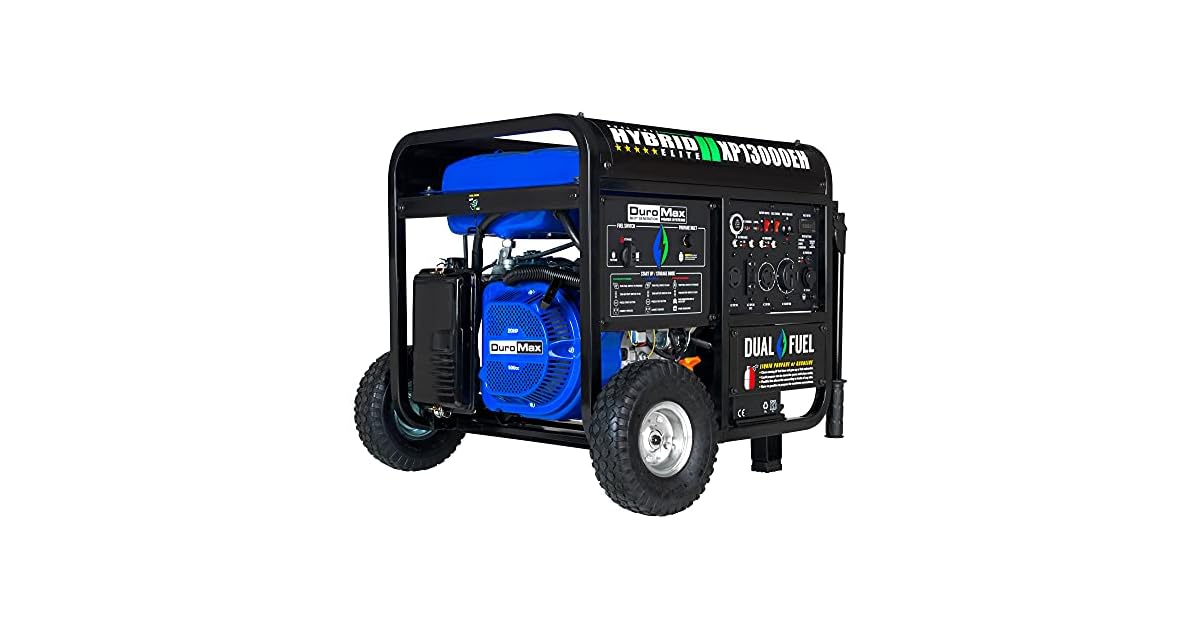
Best overall
DuroMax XP13000EH Dual Fuel
- 10,500 running watts output
- Dual Fuel: gasoline or propane
- 8 hours @ 50% load on gasoline
- 50A transfer-switch-ready outlet and push-button start
As an Amazon Associate, we earn from qualifying purchases.
DuroMax XP13000EH Dual Fuel — Best Overall
If your food truck menu leans on power-hungry equipment — a commercial fryer, a full-size flat-top, a refrigerator, a freezer and rooftop AC all running at once — the DuroMax XP13000EH is the unit to beat. With 10,500 running watts and 13,000 starting watts on gasoline, it is the highest-output dual-fuel generator in our roundup, which means it handles the brutal simultaneous start-up surge of compressor-driven appliances (fridges, freezers, AC units) without flinching. That surge capacity is exactly what kills smaller generators on food trucks.
The dual-fuel capability is genuinely useful on a truck. Gasoline gives you the full 10,500 running watts; propane burns cleaner, stores indefinitely without going stale, and lets you tap into the same propane supply your cooking equipment already uses — one less fuel to manage on event days. The 500cc engine, push-button start and a 50A transfer-switch-ready outlet round out a package built for serious loads. Runtime is rated at 8 hours at 50% load on gasoline, enough to cover a full service window.
The tradeoffs are the usual ones for this class: at 234 lbs it is not something you want to wrestle in and out of a truck by hand, so plan on a permanent mount or a ramp. And the spec sheet we verified did not include a published dBA figure, so treat it as a loud open-frame unit — park it behind the truck, point the exhaust away from the ordering window, and check local noise ordinances before you book a spot.
Pros
- Highest running watts in our roundup (10,500W)
- Dual fuel: gasoline or propane
- 50A transfer-switch-ready outlet
- Push-button start
Cons
- 234 lbs — plan for a fixed mount
- No published noise rating; expect loud open-frame operation
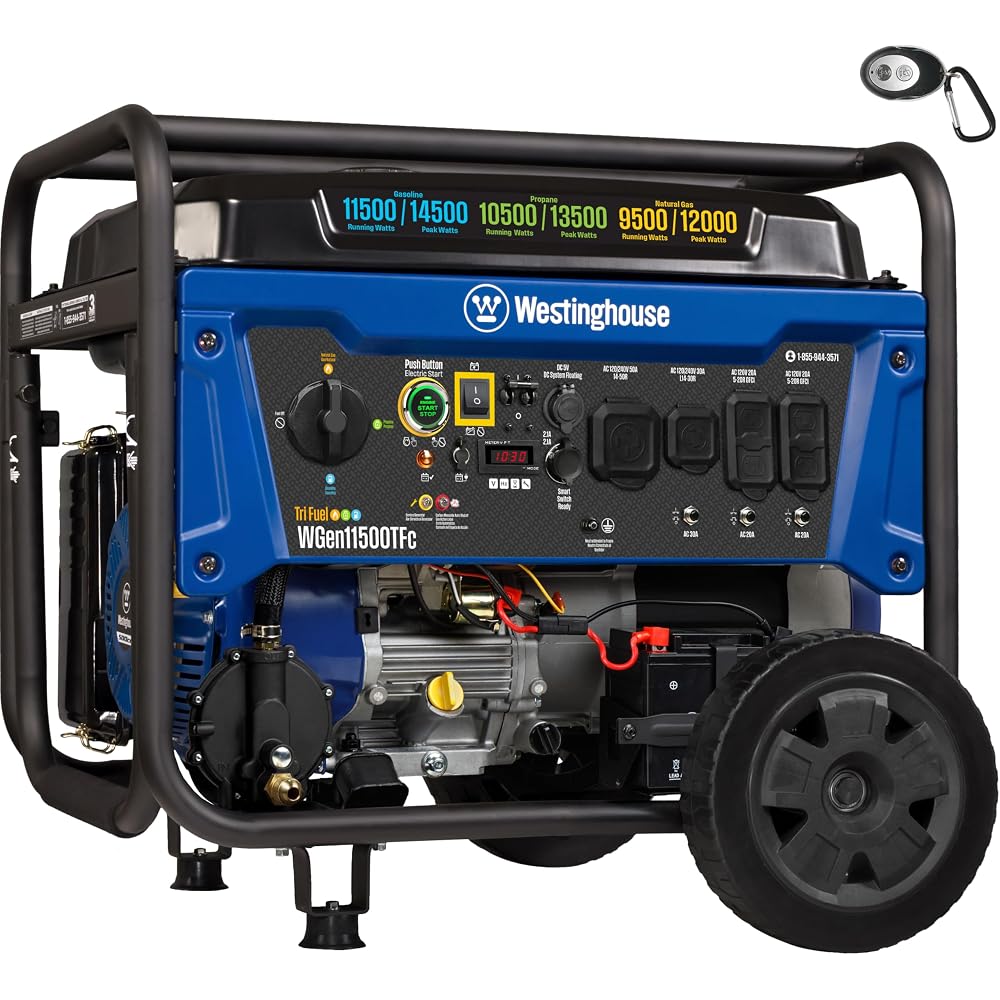
Best for big rigs
Westinghouse WGen11500TFc Tri-Fuel
- 11,500 running watts (gasoline) output
- Tri-Fuel: gasoline, propane, and natural gas
- 19 hours @ 25% load on a 9.5-gal tank
- 14-50R 50A outlet and remote electric start
As an Amazon Associate, we earn from qualifying purchases.
Westinghouse WGen11500TFc Tri-Fuel — Best for Big Rigs
Large food trucks and trailers with double fryers, multiple warmers and a full HVAC setup can push past what dual-fuel units comfortably sustain. The Westinghouse WGen11500TFc answers with 11,500 running watts and 14,500 peak watts on gasoline — the most headroom in this guide. Where it really stands apart is tri-fuel operation: gasoline, propane, and natural gas. If you ever set up at a commissary or a fixed venue with a natural gas hookup, you can run the generator off the same line (9,500 running watts on NG) and never carry fuel at all.
Runtime is excellent: up to 19 hours at 25% load on its 9.5-gallon gasoline tank, so even a double-shift event day is covered without a midday refuel. The 14-50R 50A outlet gives you a clean high-current connection for a truck wired with a 50-amp shore inlet, and remote electric start means the generator fires up from inside the truck — a small thing that feels huge when it is raining. Less than 5% THD means the output is clean enough for your POS terminal, card readers and any onboard electronics.
Honest caveats: it is rated at 74 dBA, which is typical loud open-frame territory — distance and barriers between the unit and your customers are mandatory. At 230 lbs it is also a permanent-mount proposition, not a grab-and-go unit.
Pros
- Massive 11,500 running watts on gasoline
- Tri-fuel incl. natural gas option
- 19-hour runtime at 25% load
- Remote electric start, 50A 14-50R outlet, <5% THD
Cons
- 74 dBA — loud; placement matters
- 230 lbs; needs a fixed mount
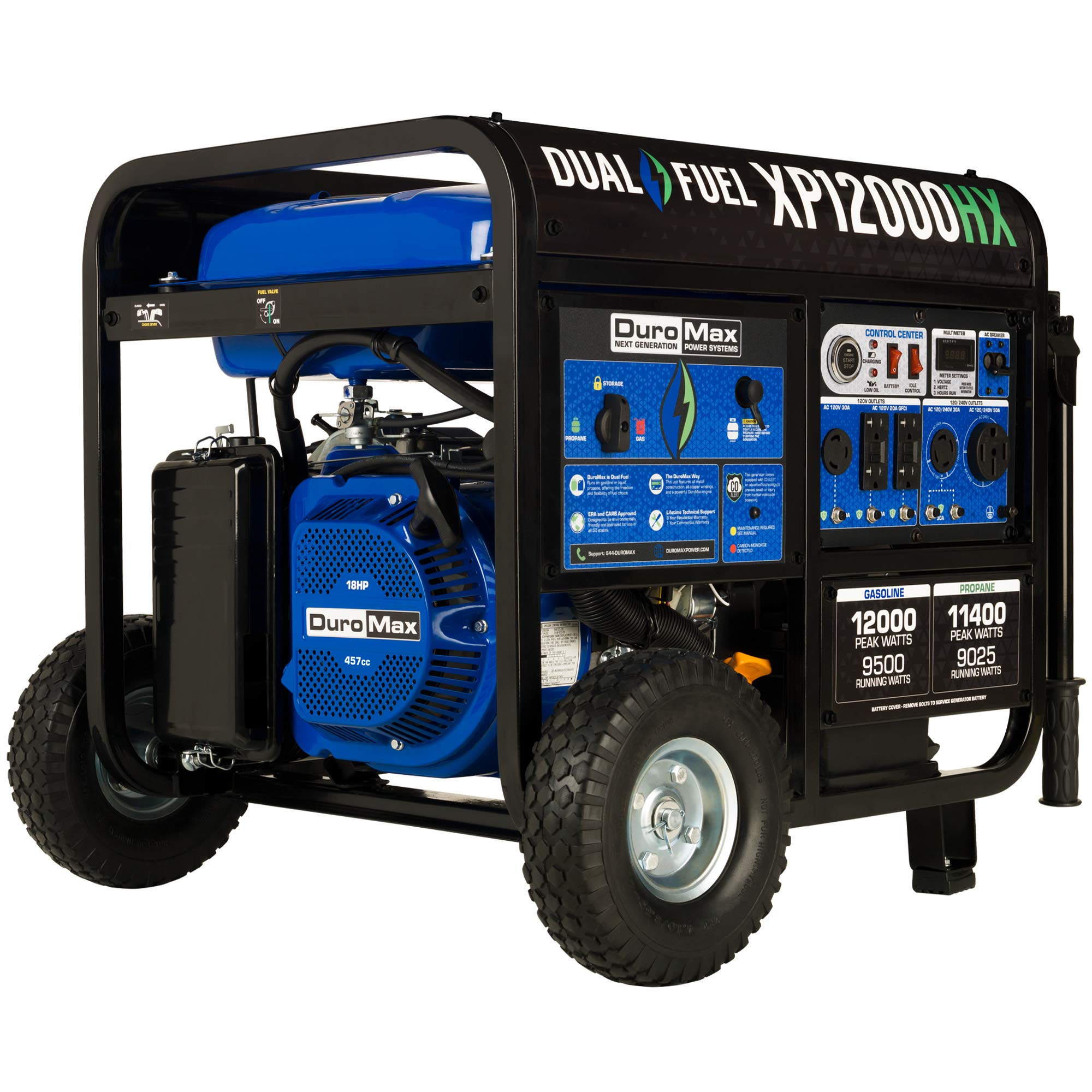
Best dual fuel
DuroMax XP12000HX Dual Fuel
- 9,500 running watts output
- Dual Fuel: gasoline / propane
- CO Alert shutdown protection
- 5-year warranty and 50A outlet
As an Amazon Associate, we earn from qualifying purchases.
DuroMax XP12000HX Dual Fuel — Best Dual Fuel
The XP12000HX is the slightly smaller sibling of our top overall pick, and for many food trucks it is actually the sweeter spot. With 9,500 running watts and 12,000 starting watts, it still covers a fryer plus refrigeration plus AC simultaneously, while the smaller footprint and 222-lb weight make mounting marginally easier. Dual-fuel operation again lets you choose between full gasoline output and cleaner-burning propane shared with your cooking fuel.
What pushed it into its own category slot is the combination of safety and warranty: CO Alert automatic shutdown protects your crew from carbon monoxide in tight commissary yards and crowded event rows, and the 5-year warranty is the longest we have seen on a dual-fuel unit in this class. The 50A transfer-switch-ready outlet and push-button electric start round out a genuinely food-truck-friendly feature set.
As with its bigger sibling, DuroMax does not publish a dBA figure, so assume loud open-frame sound levels and plan your placement accordingly. A published runtime figure was also not available, so size your fuel logistics conservatively for long event days.
Pros
- 9,500 running watts — plenty for most trucks
- CO Alert auto-shutdown
- 5-year warranty
- 50A outlet, push-button start
Cons
- 222 lbs — still needs mounting
- No published noise or runtime figures
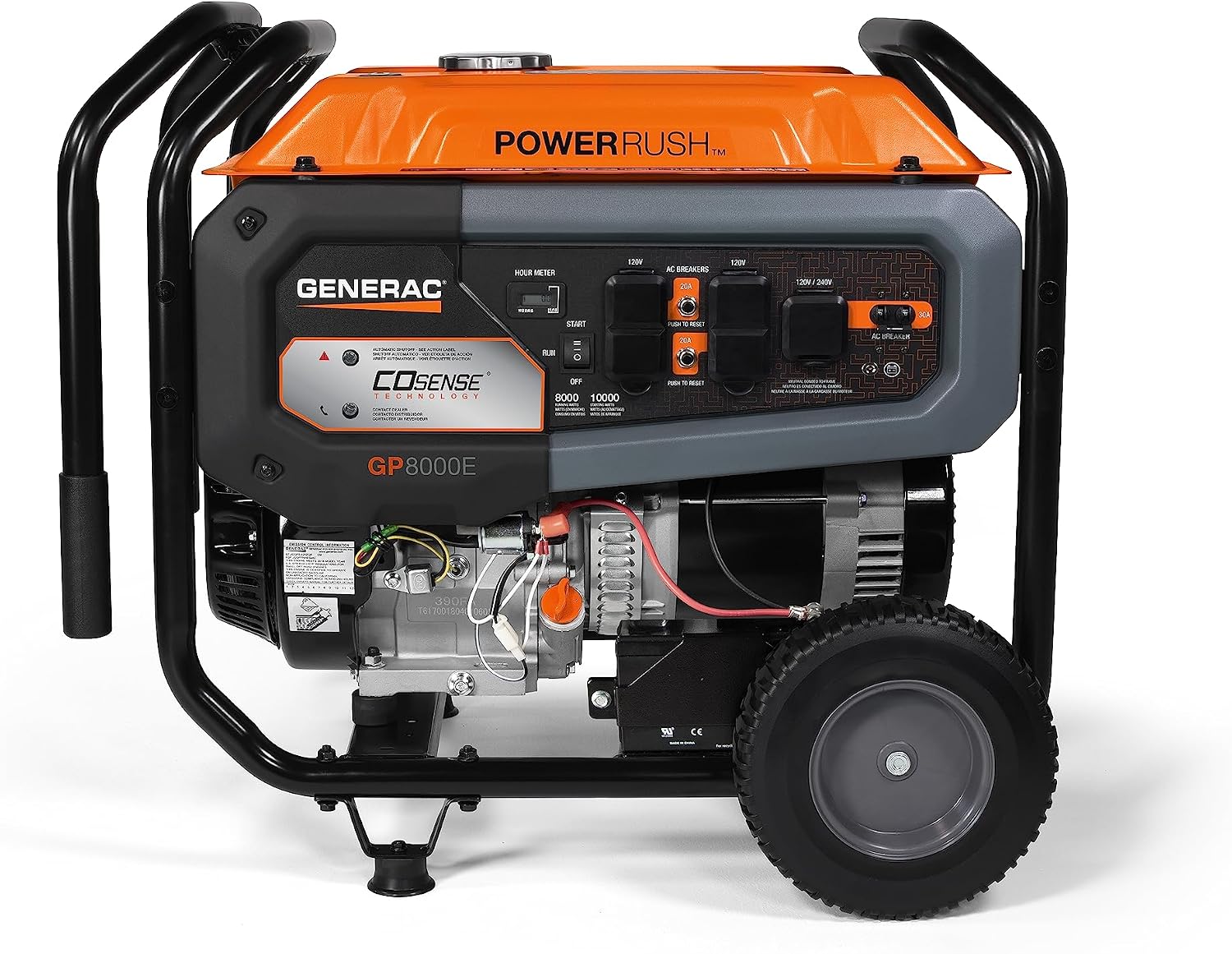
Best value
Generac GP8000E (model 7715, COsense)
- 8,000 running watts output
- Gasoline with electric start
- Up to 9.5 hours @ 50% load (7.9-gal tank)
- COsense carbon monoxide protection
As an Amazon Associate, we earn from qualifying purchases.
Generac GP8000E — Best Value
Not every food truck needs 10,000+ watts. A compact truck running a single fryer or flat-top, one fridge, lighting and a POS can live comfortably within 8,000 running watts — and the Generac GP8000E delivers that from one of the most trusted names in portable power, usually at a friendlier price than the 10kW-class dual-fuel units. With 10,000 starting watts on tap, compressor surges are still handled.
The 7.9-gallon tank stretches to 9.5 hours at 50% load, which covers most service windows without a refill, and electric start means one button instead of a rope pull when you are already juggling prep. COsense carbon-monoxide detection is built in, an important safety feature when the generator sits close to your service window and the crew inside the truck. Generac’s dealer and parts network is also the most established in the business, which matters when your livelihood depends on the unit starting every morning.
The tradeoff is fuel: this is gasoline only, so you cannot share propane with your cooking line. At 214 lbs it is no lightweight either, and being a conventional open-frame unit it will be loud — again, distance and exhaust direction are your friends.
Pros
- 8,000 running watts at a value price
- Electric start, COsense protection
- Up to 9.5-hour runtime at 50% load
- Huge dealer/parts network
Cons
- Gasoline only — no propane option
- 214 lbs; loud open-frame design
Best budget
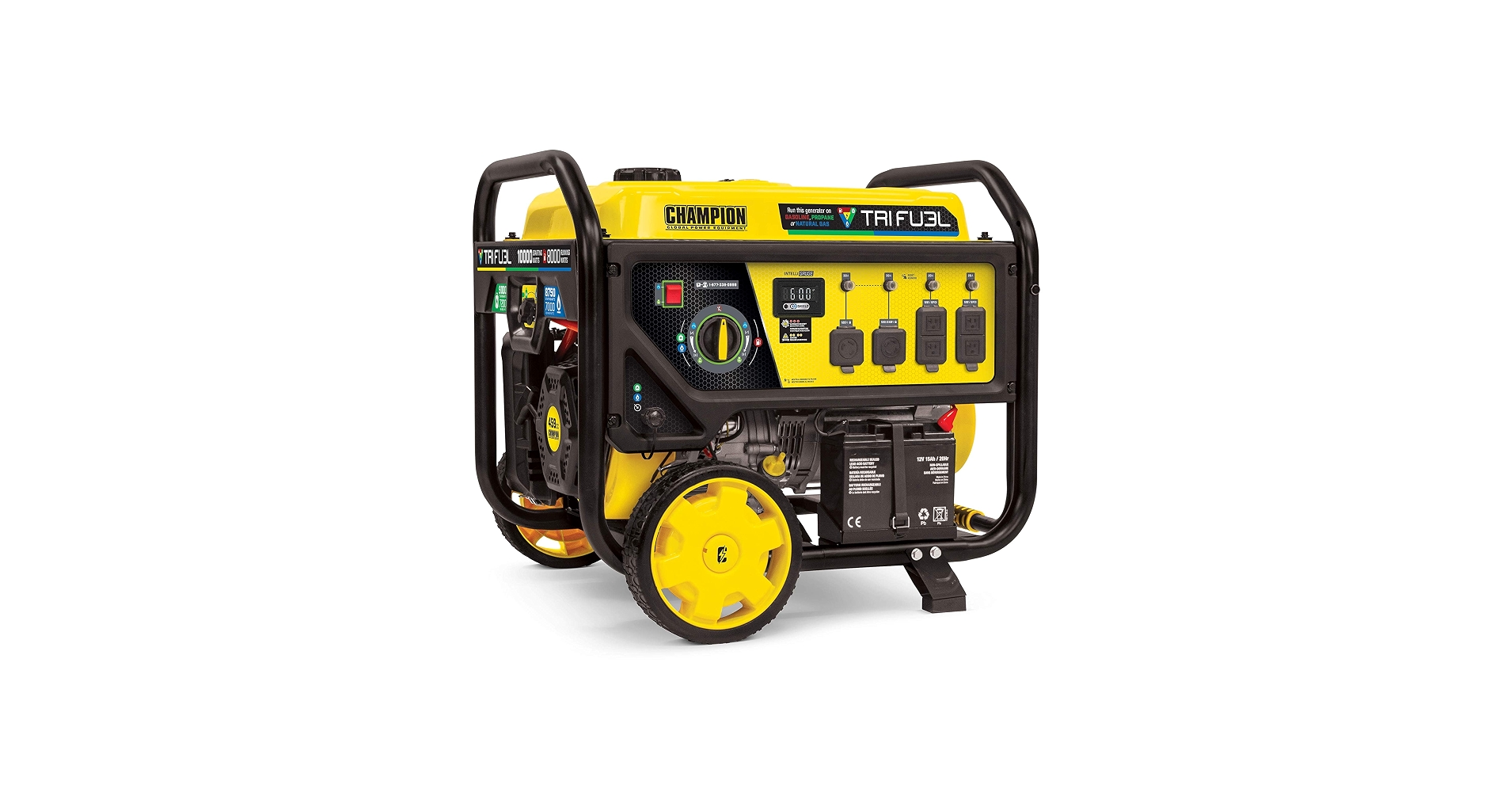
Champion 100416 Tri-Fuel
- 8,000 running watts (gasoline) output
- Tri-Fuel: gasoline, propane, natural gas
- 12.5 hours @ 50% load on 8.5 gal
- CO Shield + EPA/CARB compliant; NG hose kit included
As an Amazon Associate, we earn from qualifying purchases.
Champion 100416 Tri-Fuel — Best Budget
The Champion 100416 is proof that tri-fuel flexibility does not have to cost a fortune. At 8,000 running watts on gasoline (7,200 on propane, 7,000 on natural gas) with 10,000 peak watts, it sits in the same power class as the Generac above while adding fuel choice — including a natural gas hose kit in the box. For a budget-conscious startup truck, that is a remarkable amount of versatility per dollar.
Runtime is a genuine strength: 12.5 hours at 50% load on its 8.5-gallon tank means a full festival day without carrying extra cans. CO Shield carbon-monoxide auto-shutoff is standard, and the unit is EPA and CARB compliant, so it is legal to run in all 50 states — relevant if your truck tours across state lines. At 207 lbs it is one of the lighter 8kW-class units here.
The budget reality check: 74 dBA is firmly in loud open-frame territory, so you will need to manage noise with placement. And note the derating — you lose about 10% of your running watts on propane and more on natural gas, so do your sizing math against the fuel you will actually use most often.
Pros
- Tri-fuel at a budget-friendly price
- 12.5-hour runtime at 50% load
- CO Shield; EPA/CARB 50-state compliant
- Natural gas hose kit included
Cons
- 74 dBA — loud
- Wattage drops on propane (7,200W) and NG (7,000W)
Best quiet for customers
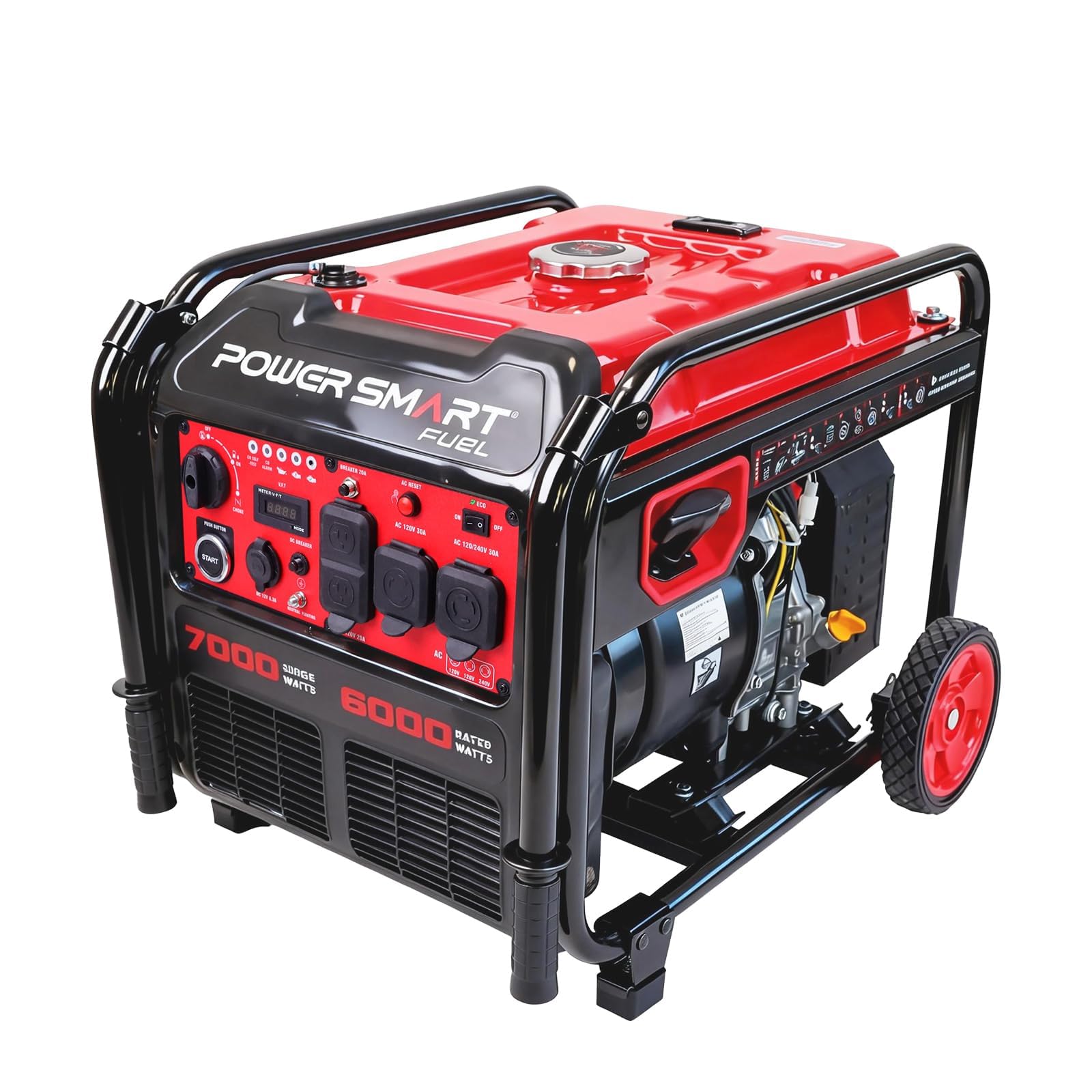
PowerSmart PS5055C Open-Frame Inverter
- 6,000 running watts inverter output
- Gasoline; 120/240V 30A output
- 70 dB @ 23 ft — quieter than conventional open-frame units
- Only 113.5 lbs — half the weight of 10kW-class units
As an Amazon Associate, we earn from qualifying purchases.
PowerSmart PS5055C Open-Frame Inverter — Best Quiet for Customers
Here is the niche the other five units cannot fill: a food truck where customer experience comes first — think dessert trucks, coffee trucks, or upscale catering setups at weddings where a roaring generator ruins the vibe. The PowerSmart PS5055C is an open-frame inverter rated at just 70 dB at 23 feet, noticeably calmer than the 74 dBA conventional units, and inverter output means clean power for espresso machines, blenders and electronics.
It is also astonishingly light for its class: 113.5 lbs versus 207+ for everything else here, and it still delivers 6,000 running watts with 7,000 starting watts in 120/240V configuration with a 30A outlet. For a truck whose biggest loads are a griddle, a warmer and a fridge — no fryer, no rooftop AC — that is enough, and you can move it without a forklift mentality.
Be honest with yourself about your loads before choosing this one: 6,000 running watts is the ceiling of the list, and a single commercial fryer can eat half of it. Runtime is also the shortest here at 6 hours at 50% load, so plan refuels on long days. And one quirk from the listing: Amazon appears to have the “rated” and “surge” wattage labels inverted, so treat the 6,000W figure as running power.
Pros
- 70 dB @ 23 ft — quietest in the roundup
- Inverter clean power for electronics
- Only 113.5 lbs — genuinely portable
- 120/240V 30A output
Cons
- Only 6,000 running watts — size your loads carefully
- 6-hour runtime at 50% load
Buying Guide: How to Size a Generator for a Food Truck
Do the wattage math. List every appliance you will run at the same time and add up the running watts. A commercial fryer alone can draw 3,000–5,000W; a refrigerator 600–800W running but triple that at start-up; a rooftop AC 1,500W+ running with a huge start-up surge; plus exhaust fans, lighting, warmers, POS and chargers. Then add 25% headroom. If your total lands near 7,000W, buy an 8,000–9,500W unit — running a generator flat-out at 100% load all day shortens its life and spikes fuel consumption.
Respect the start-up surge. Anything with a compressor or motor (fridges, freezers, AC, some blenders) draws 2–3x its running watts for a few seconds at start-up. Stagger your start-ups: fire up the AC first, let it settle, then the fridge, then cooking equipment. This is where the 12,000–14,500 peak watts of the big units above earn their keep.
Noise is a business problem, not just a comfort problem. Many cities enforce daytime noise ordinances around 65–75 dBA at a given distance, and event organizers increasingly require quiet power. Customers will not linger at an ordering window next to a screaming generator. Conventional open-frame units run around 74 dBA; an inverter like the PowerSmart PS5055C at 70 dB is meaningfully calmer. Whatever you buy, mount it as far from the service window as possible and point the exhaust away from people.
Choose your fuel. Gasoline gives the most watts and the cheapest refuels. Propane burns cleaner, stores forever, and — crucially — your truck probably already carries propane for cooking, so dual-fuel and tri-fuel units consolidate your fuel logistics. Natural gas is a bonus option for trucks that dock at fixed venues with a gas line. Note the derating: the Champion 100416 drops from 8,000 running watts on gasoline to 7,200 on propane and 7,000 on NG — size for the fuel you will actually use.
Match the outlets to your truck’s wiring. If your truck has a 50-amp shore-power inlet, you want a generator with a 50A outlet — the DuroMax units’ 50A transfer-switch-ready outlets and the Westinghouse’s 14-50R are built for this. For 30-amp panels, the L14-30R locking outlet (found on units like the Westinghouse WGen9500DF class) is the standard. Bring the right adapter cords; do not jury-rig connections.
Take CO safety seriously. Generators produce odorless carbon monoxide, and food trucks are tight spaces with people working right next to the unit. Every pick in this guide includes CO protection (CO Alert, CO Shield or COsense) that shuts the engine down if dangerous levels build up. Never run a generator inside the truck or a closed compartment — always in a ventilated exterior mount or on the ground with the exhaust pointed away.
One big unit vs. two paralleled units. A single large unit is simpler: one fuel tank, one engine to maintain, one exhaust stream. Two smaller inverters in parallel (for example via a 50A parallel kit) give redundancy — if one fails you still have half your power — and you can run just one on slow days. For most food trucks, one properly sized big unit plus careful load management is the simpler and cheaper path.
Food Truck Generator FAQs
What size generator do I need for a food truck?
Most food trucks need 7,000 to 11,500 running watts. Add up the running watts of all appliances you will use simultaneously (fryer, fridge, freezer, AC, fans, lighting, POS), then add about 25% headroom. A truck with a fryer, refrigeration and AC typically needs an 8,000–10,500W unit; bigger rigs with multiple fryers or full HVAC should look at 11,500W-class models like the Westinghouse WGen11500TFc.
How loud can a food truck generator be?
Conventional open-frame generators typically run around 74 dBA, which many customers find intrusive at the ordering window. Check your city’s noise ordinance before buying — limits commonly fall in the 65–75 dBA range during the day. Inverter generators like the PowerSmart PS5055C (70 dB at 23 ft) are noticeably quieter, and mounting the unit far from the service window with the exhaust pointed away helps regardless of model.
Is dual fuel or tri-fuel worth it for a food truck?
Usually yes. Your truck likely already carries propane for cooking, so a dual-fuel or tri-fuel generator lets you run both off one fuel supply — simpler logistics and no gasoline going stale. Propane also burns cleaner. Just remember output drops on alternative fuels (for example, the Champion 100416 gives 8,000W on gasoline but 7,200W on propane), so size your generator for the fuel you will actually run most.
Can I run my food truck generator on propane only?
Yes, with a dual-fuel or tri-fuel model — all of the multi-fuel picks in this guide run on propane. Propane is clean-burning and stores indefinitely, which suits trucks that sit between events. The tradeoff is slightly lower wattage on propane versus gasoline, so confirm the propane running-watts figure covers your total load before committing.
Where should I mount the generator on a food truck?
Mount it as far from the ordering window and customer areas as possible — typically a rear bumper platform or an exterior compartment — with the exhaust pointed away from people. Never run a generator inside the truck or in an enclosed compartment because of carbon monoxide. Units over 200 lbs (most of the high-wattage picks here) should be permanently mounted rather than lifted in and out daily.
How long will a food truck generator run on one tank?
It depends on load, but the models in this guide range from 6 hours at 50% load (PowerSmart PS5055C) to 19 hours at 25% load (Westinghouse WGen11500TFc on its 9.5-gallon tank). Mid-range picks like the Generac GP8000E (9.5 hours at 50%) and Champion 100416 (12.5 hours at 50%) comfortably cover a full service day. Plan refuels for long festival days and carry a little extra fuel.
Do I need clean inverter power for my food truck?
Your POS system, card readers and any onboard computers prefer clean power with low total harmonic distortion (THD). The Westinghouse WGen11500TFc (<5% THD) and the PowerSmart PS5055C (inverter output) both deliver clean power for sensitive electronics. Purely resistive loads like fryers and griddles do not care about THD, so a conventional generator is fine if electronics are minimal.
Our verdict
For most food trucks, the DuroMax XP13000EH is the safest bet — 10,500 running watts of dual-fuel power with a 50A outlet covers nearly any menu. If you run a big rig with multiple fryers and full HVAC, step up to the Westinghouse WGen11500TFc; and if customer ambiance matters more than raw watts, the quiet PowerSmart PS5055C inverter keeps the peace at the window.

Related Guides
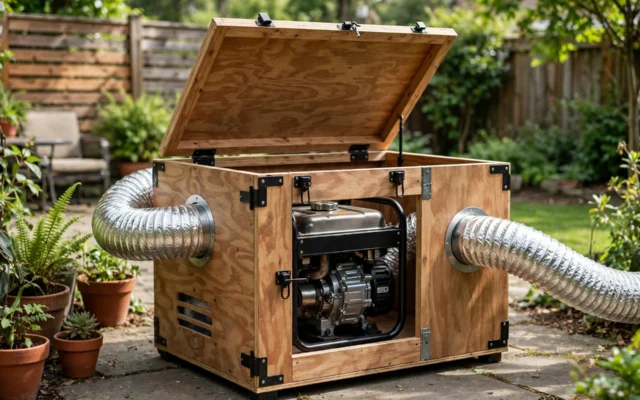
DIY Generator Quiet Box: How to Build a Noise-Reduction Enclosure
A DIY generator quiet box can cut noise 10–20 dB — but ventilation and CO safety are the whole project. Materials, baffle design, fan sizing, and the mistakes to avoid.

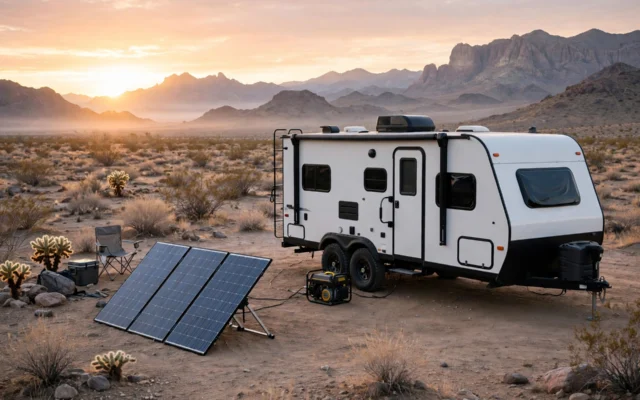
Boondocking Power Setup: Generator + Solar for Off-Grid Camping
The ideal boondocking power setup pairs solar with a generator and battery bank. Real daily load math, sizing tiers, and the generator run strategy that sips fuel.
RV Generator Quiet Hours & Campground Etiquette Guide
RV generator quiet hours are usually 10pm–8am, with limited daytime generator windows in national parks. The rules, the unwritten etiquette, and how to stay neighborly.