


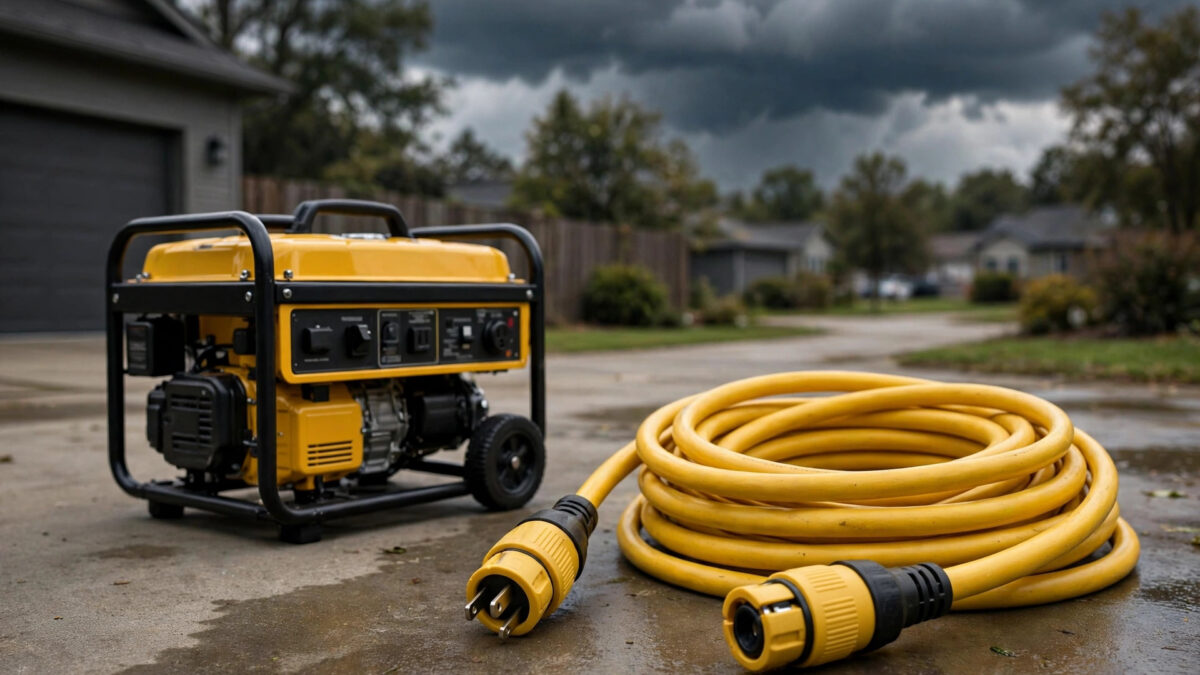
Here’s a mistake I see constantly: someone spends $1,200 on a generator, then connects it to the house with a $25 orange extension cord from the garage. That cord is probably 16-gauge, rated for 13 amps — and the generator’s 30-amp outlet will happily melt it. The cord between your generator and your home is a safety device, not an accessory.
The short answer for 2027: the PlugSaf 50-foot 30A cord is the best generator extension cord for most people. It’s true 10-gauge copper, ETL listed, and long enough to keep the generator a safe 20+ feet from the house. If your generator has a 50-amp outlet, step up to the VEVOR 50A cord — you need 6-gauge wire for that much current, and there’s no safe shortcut.
Key takeaways
- Match the cord to your generator’s outlet: 30A needs 10 AWG minimum, 50A needs 6 AWG. Undersized wire overheats.
- Every cord in this roundup is ETL or UL certified — never buy an uncertified high-amperage cord.
- 50 feet is the sweet spot for most homes: far enough for CO safety, short enough to limit voltage drop.
- Twist-lock connectors (L14-30, SS2-50) prevent accidental disconnection; verify your generator’s receptacle type first.
- For transfer-switch hookups, a straight L14-30P to L14-30R cord is what you want — not a fan-style multi-outlet cord.
Quick picks
- Best overall: PlugSaf 50FT 30A — true 10-gauge, ETL listed, 50 feet, cord organizer included.
- Best 50-amp: VEVOR 50A 50FT — 6/3+8/1 AWG copper, 14-50P to SS2-50R, handles 12,500W.
- Best for transfer switches: Champion 100395 25FT 30A — L14-30P to L14-30R, made for manual transfer switch hookup.
- Best multi-outlet: Champion 48033 25FT duplex — splits one L14-30 outlet into four household outlets.
- Best flat/under-door: Yodotek 25FT flat cord — flat cable slides under doors for indoor power without cracking a window.
- Best budget 25-footer: Vockjour 25FT 30A — STW 10-gauge, IP65, ETL listed at a wallet-friendly price.
Best overall
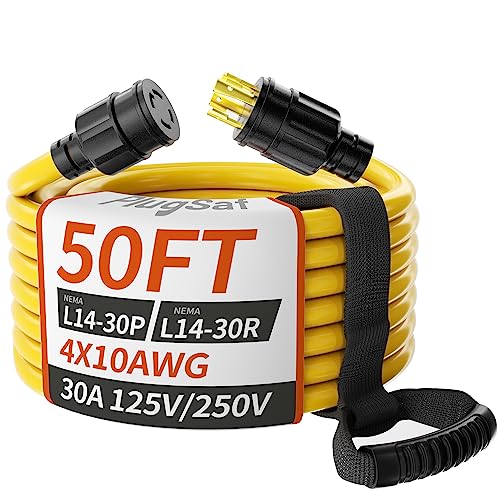
PlugSaf 50FT 30 Amp Generator Extension Cord
- Amperage: 30A (7,500W max)
- Wire Gauge: 10 AWG copper, STW jacket
- Connectors: NEMA L14-30P to L14-30R (twist-lock)
- Length: 50 ft
As an Amazon Associate, we earn from qualifying purchases.
This is the cord I recommend to friends, because it gets the three things that matter right: gauge, certification, and length. The conductors are genuine 10 AWG copper — the minimum safe size for a 30-amp circuit — in an STW jacket rated for 125/250V and up to 7,500 watts. The NEMA L14-30P to L14-30R twist-lock ends match the 30-amp outlet on most mid-size and large portable generators, and the twist-lock design means it won’t vibrate loose during a long outage run.
It’s ETL listed, which is the independent safety certification you should insist on for anything carrying this much current. The jacket is IP65-rated against dust and water jets and stays flexible down to -40°C — I run mine in winter storms and it coils without fighting me. Fifty feet is the right length for most properties: the generator sits 20+ feet from the house (per every manufacturer’s CO guidance) with slack to spare. The included adjustable cord organizer is a small touch that keeps a 50-foot 10-gauge cord — which is not light — manageable in storage.
Pros
- True 10-gauge copper — correct and safe for 30A circuits
- ETL listed with IP65 weatherproofing and -40°C flexibility
- 50 ft keeps the generator at a safe distance from the house
- Twist-lock ends won’t pull loose; includes cord organizer
Cons
- Heavy at 50 ft — about 14 lb
- Overkill if your generator only has 20A household outlets
- Bright yellow won’t suit everyone (black version available)
Best 50-amp
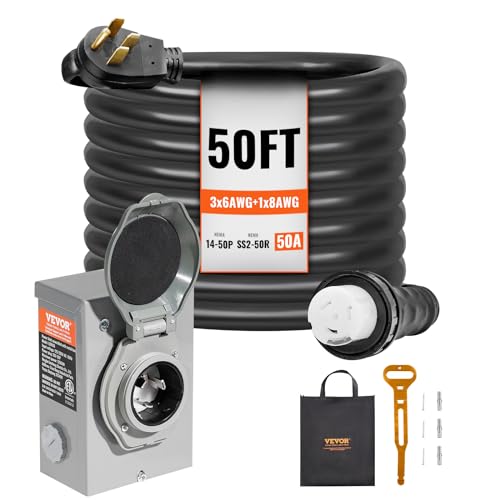
VEVOR 50 Amp Generator Extension Cord (50FT)
- Amperage: 50A (12,500W max)
- Wire Gauge: 6/3+8/1 AWG copper, STW jacket
- Connectors: NEMA 14-50P to SS2-50R (twist-lock)
- Length: 50 ft
As an Amazon Associate, we earn from qualifying purchases.
Big generators — 9,000 watts and up — increasingly ship with 50-amp outlets (14-50R), and a 30-amp cord on a 50-amp outlet is a fire waiting for an excuse. The VEVOR is built for the job: 6/3+8/1 AWG pure copper conductors, rated for 50 amps at 125/250V and up to 12,500 watts. The NEMA 14-50P male end plugs into the generator; the SS2-50R twist-lock female end connects to a 50-amp power inlet box (CS6364-compatible).
What I like beyond the specs: it’s ETL certified, the flame-retardant PVC jacket resists heat and UV, and it ships with a storage bag and tie — because a 50-foot 6-gauge cord is a beast to coil by hand. The temperature range (-104°F to 221°F per VEVOR) means it won’t turn into a rigid pipe in a January ice storm. If you’re backing up a whole house through a 50-amp inlet, this is the cord class you need, full stop.
Pros
- Proper 6-gauge copper for 50A — no dangerous undersizing
- ETL certified, weather-resistant jacket
- Storage bag and tie included
- Handles full 12,500W for large home-backup generators
Cons
- Very heavy — 6-gauge copper at 50 ft is a workout
- Overkill (and overpriced) for 30A generators
- SS2-50R end needs a matching 50A inlet box
Best for transfer switches
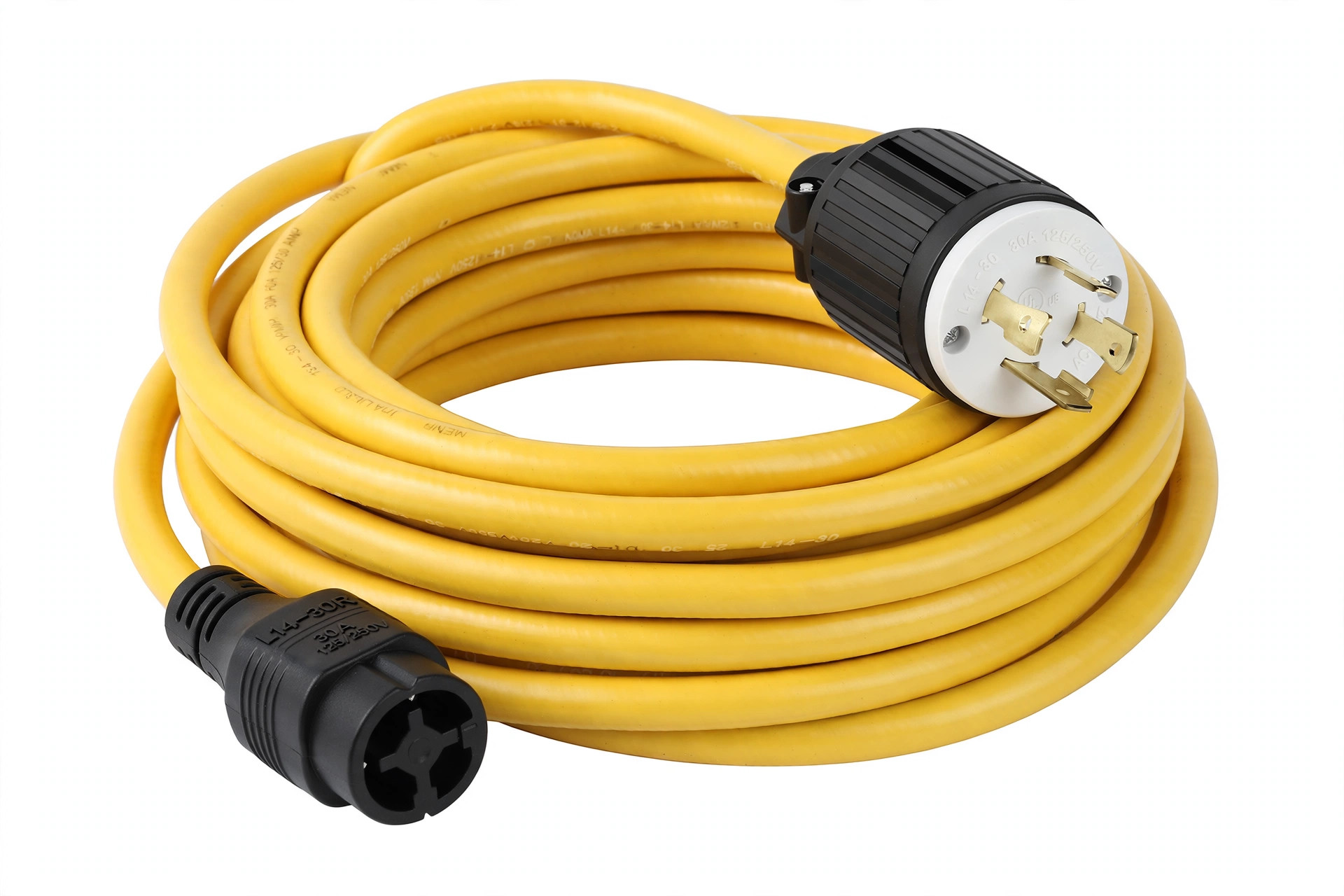
Champion 100395 25FT 30A Generator Power Cord
- Warranty: 1 year + free lifetime tech support
- Amperage: 30A
- Wire Gauge: 10 AWG copper, SJTW jacket
- Connectors: NEMA L14-30P to L14-30R
As an Amazon Associate, we earn from qualifying purchases.
If you have a manual transfer switch or an inlet box on the house — which is the right way to back up hardwired circuits — you don’t want a fan-style cord with household outlets. You want a straight L14-30P to L14-30R cable: generator on one end, inlet box on the other. Champion’s 100395 is exactly that, built by the same company that made your generator.
It’s 10-gauge copper in a cold- and heat-resistant thermoplastic jacket that stays flexible in extreme temperatures, which matters when you’re hooking up in a blizzard at midnight. Twenty-five feet is the standard inlet-box distance — the box is mounted on the house wall, the generator sits just outside. Backed by Champion’s 1-year warranty and their free lifetime technical support, and it’s consistently one of the best-selling generator cords on Amazon for a reason.
Pros
- Purpose-built for transfer switch / inlet box hookup
- Stays flexible in extreme heat and cold
- Champion support network behind it
- Proven bestseller with strong owner feedback
Cons
- 25 ft may be short for some property layouts
- No household outlets — inlet box required
- 30A only; 50A generators need a bigger cord
Best multi-outlet
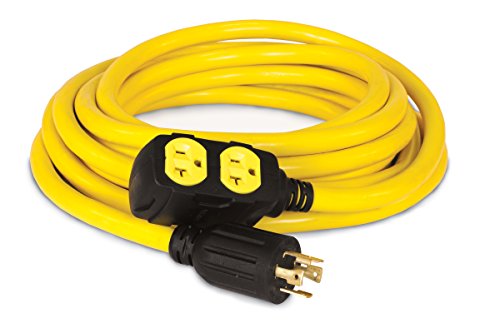
Champion 48033 25FT 30A Duplex Generator Cord
- Amperage: 30A (shared across outlets)
- Wire Gauge: 10 AWG copper, SJTW jacket
- Connectors: NEMA L14-30P to four 5-20R
- Length: 25 ft
As an Amazon Associate, we earn from qualifying purchases.
Not everyone has a transfer switch. If you’re running extension cords to the fridge, the freezer, a space heater, and a lamp, the Champion 48033 turns your generator’s single L14-30 locking outlet into four standard 5-20R household outlets. The duplex-style head keeps the plugs organized instead of dangling off a power strip.
Same story on construction as the 100395: 10-gauge copper, outdoor-rated SJTW insulation, thermoplastic jacket that stays flexible hot or cold. The dust covers on the outlets are a nice touch — they keep rain and debris out when an outlet isn’t in use. Just remember the math: four outlets share one 30-amp feed, so you’re still limited to 3,600 watts on the 120V legs combined. Don’t plug four space heaters into it and walk away.
Pros
- Four household outlets from one locking generator outlet
- 10-gauge copper with weather-resistant jacket
- Outlet dust covers included
- Ideal for no-transfer-switch setups
Cons
- Total draw still limited to one 30A feed
- 25 ft — shorter than ideal for some layouts
- Bulkier plug head to store
Best flat / under-door
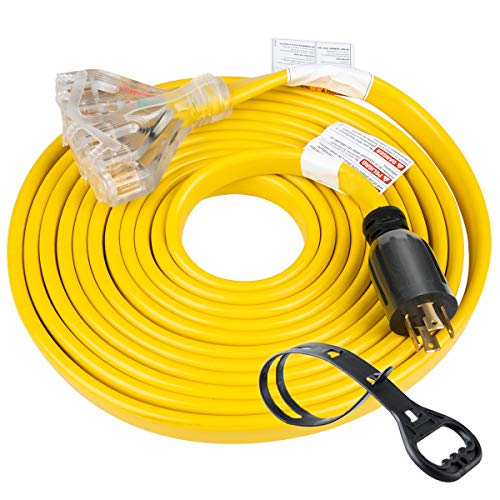
Yodotek 25FT Flat 30A Generator Cord
- Amperage: 30A (7,500W max)
- Wire Gauge: 10 AWG copper, flat SJTW
- Connectors: NEMA L14-30P to four 5-20R
- Length: 25 ft
As an Amazon Associate, we earn from qualifying purchases.
Here’s a scenario every outage veteran knows: it’s raining sideways, and you need power inside without leaving a window cracked open. The Yodotek’s flat 10-gauge cable slides under a closed door — no cracked window, no rain blowing in, no security worry. The L14-30P twist-lock end goes to the generator; the other end fans out to four 5-20R household outlets.
The cable is 10-gauge copper in a flat SJTW profile, UL-listed components, rated for the full 30A / 7,500W. The flat profile is also genuinely easier to coil and store than round cable of the same gauge. The tradeoff: flat cable shouldn’t be your only cord if you need serious length or a transfer-switch connection — it’s a specialty tool, and a good one.
Pros
- Flat cable runs under closed doors — no open windows in storms
- Full 10-gauge copper, 30A rated
- Four household outlets on the indoor end
- Easy to coil and store
Cons
- Specialty cord — not a transfer-switch replacement
- 25 ft only
- Flat profile can kink if coiled carelessly
Best budget 25-footer
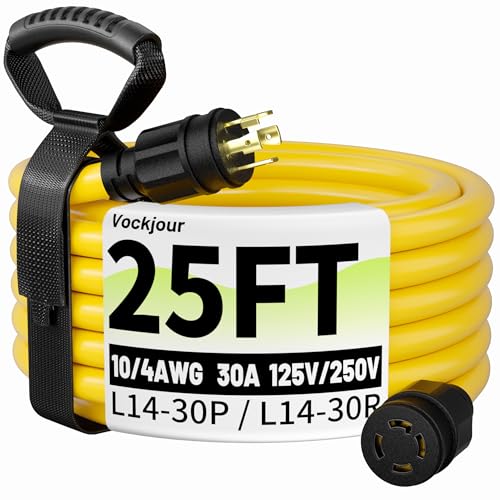
Vockjour 25FT 30A Generator Extension Cord
- Amperage: 30A (7,500W max)
- Wire Gauge: 10 AWG copper, STW jacket
- Connectors: NEMA L14-30P to L14-30R (twist-lock)
- Length: 25 ft
As an Amazon Associate, we earn from qualifying purchases.
If 25 feet reaches your setup, there’s no reason to pay for 50. The Vockjour is the cord that proves budget doesn’t have to mean sketchy: 10 AWG pure copper, STW jacket, ETL listed, IP65 waterproof, and rated for the full 30A / 7,500W with L14-30P to L14-30R twist-lock ends. It’s an Amazon’s Choice pick in the category with hundreds of recent buyers, which tells you the value proposition lands.
The PVC sheath is flame-retardant and rated from -40°C to 105°C, so it handles real winter. It even includes a cable organizer for storage. At roughly $50–$70, it’s the cheapest safe way to connect a 30-amp generator to an inlet box or transfer switch — just make sure 25 feet actually reaches with the generator parked 20 feet from the house.
Pros
- Proper 10-gauge copper and ETL listing at a budget price
- IP65 weatherproofing, wide temperature range
- Cable organizer included
- Strong buyer ratings
Cons
- 25 ft may not reach on larger properties
- Lesser-known brand than Champion or PlugSaf
- Thinner feature set (no LED indicators, etc.)
Generator extension cords compared
| Product | Amps | Gauge | Length | Best for |
|---|---|---|---|---|
| PlugSaf 50FT 30A | 30A | 10 AWG | 50 ft | Best overall |
| VEVOR 50A 50FT | 50A | 6/3+8/1 AWG | 50 ft | 50-amp generators |
| Champion 100395 | 30A | 10 AWG | 25 ft | Transfer switches |
| Champion 48033 duplex | 30A | 10 AWG | 25 ft | Multi-outlet, no transfer switch |
| Yodotek flat 25FT | 30A | 10 AWG flat | 25 ft | Under-door runs |
| Vockjour 25FT 30A | 30A | 10 AWG | 25 ft | Budget pick |
How to choose a generator extension cord
Match the amps first: 30A vs. 50A
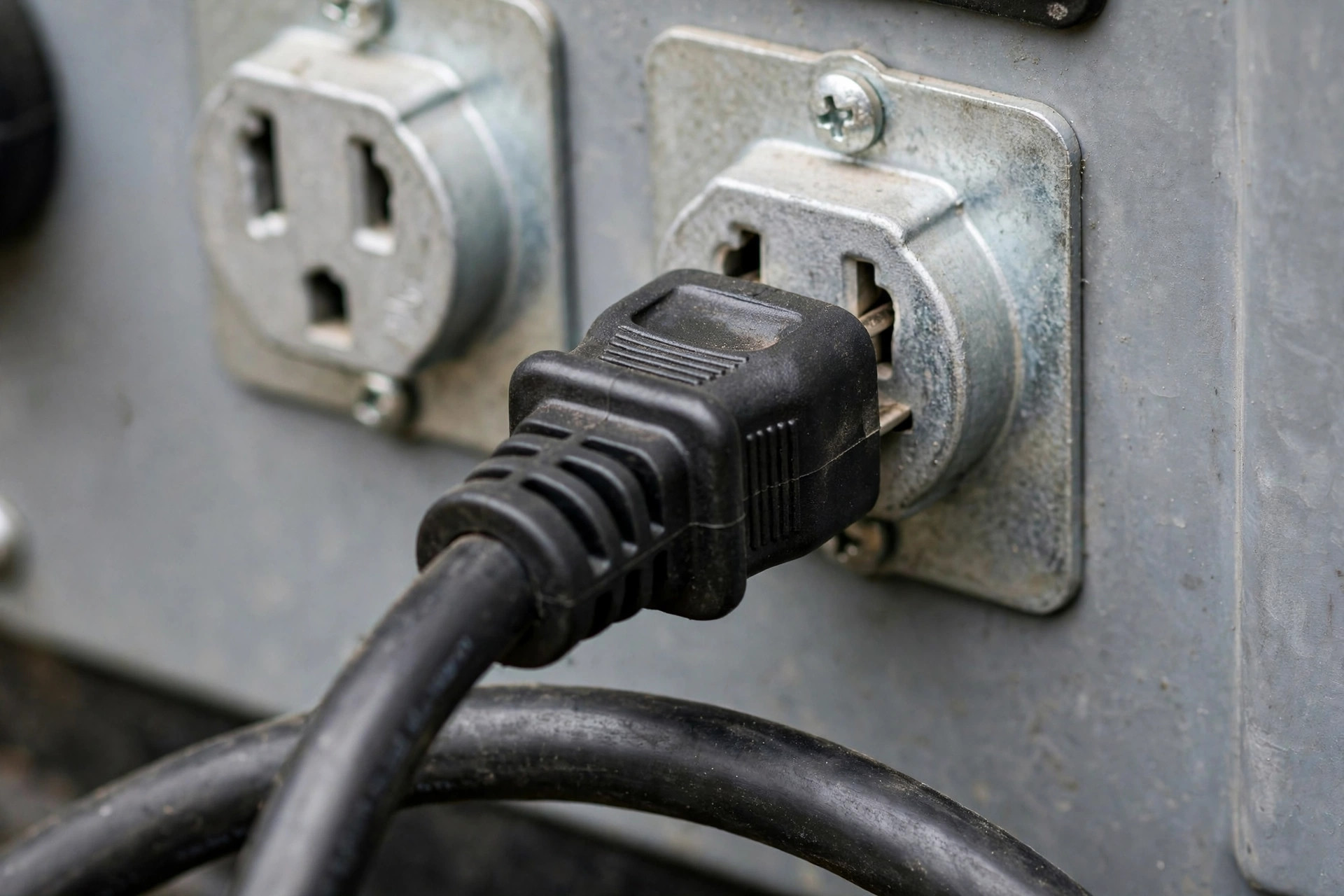
Look at your generator’s big locking outlet. If it says L14-30R, you need a 30-amp cord. If it says 14-50R, you need a 50-amp cord — and a 30-amp cord on that outlet is a genuine fire hazard, not a minor mismatch. When in doubt, check the manual. The outlet shape tells you everything: four-prong twist-lock is almost always 30A; the larger straight-blade 14-50 is 50A.
The gauge rule: 10 AWG for 30A, 6 AWG for 50A
Wire gauge is non-negotiable. A 30-amp circuit needs 10 AWG copper minimum; a 50-amp circuit needs 6 AWG. Thinner wire has higher resistance, which means heat — and at these currents, heat means melted insulation. The NEC’s 125% rule for continuous loads (Article 210.19) is the reason electricians oversize rather than undersize: if you’re running near the cord’s limit for hours, thicker wire is cheap insurance. Every cord in this roundup meets the correct gauge for its rating. If a listing doesn’t state the gauge, walk away.
Know your connector types
The common ones: L14-30 (30A twist-lock, 125/250V — the standard on most portable generators), TT-30 (30A RV plug, 120V only), 14-50 (50A, 125/250V — big home-backup units), and SS2-50/CS6364 (50A twist-lock inlet-box connectors). Twist-lock ends are worth preferring wherever your generator supports them — they can’t vibrate loose or get yanked out by a tripping foot.
Length and voltage drop
Longer cords lose more voltage. At 50 feet with proper 10-gauge wire on a 30A circuit, drop is small enough to ignore for most loads. Past 75–100 feet, it starts to matter — motors run hotter and dimmer. The practical rule: buy the shortest cord that still lets you park the generator at least 20 feet from the house with the exhaust pointed away. For most homes, that’s 25 or 50 feet.
Jacket and certification
Outdoor generator cords should have an STW or SJTW jacket (the “W” means weather-rated) and should be ETL or UL listed. That listing means an independent lab verified the gauge, insulation, and connectors. An unlisted 30-amp cord from a no-name seller is the one product category where I’d never gamble — the failure mode is a house fire.
The CO rule doesn’t change
A heavier cord doesn’t make the generator safer to place. It still runs outdoors, 20+ feet from the house, exhaust pointed away from windows and doors. The longer cord actually helps here — it’s what makes the safe distance practical. Put battery CO detectors on every floor regardless.
Frequently asked questions
What gauge extension cord do I need for a 30A generator?
Can I use a regular orange extension cord with my generator?
How long can a generator extension cord be?
Do I need a special cord for a transfer switch?
Is a 50A cord better than a 30A cord?
Our verdict
For most generator owners, the PlugSaf 50FT 30A is the right cord: correct gauge, certified, and long enough for safe placement. Big-generator owners with a 50A outlet need the VEVOR 50A — there’s no safe substitute for 6-gauge wire. Transfer-switch households should grab the Champion 100395, and anyone running appliances directly will love the Champion 48033 duplex or the flat Yodotek for under-door runs. Whichever you choose, pair it with a properly sized generator from our best portable generators guide — and if you’re still figuring out how much power you need, our generator sizing guide walks through the math.
How we researched this: We verified wire gauge, connector types, certifications, and length for each cord against manufacturer listings and Amazon product data, checked NEC ampacity guidance (including the 125% continuous-load rule), and reviewed owner feedback on flexibility, durability, and connector fit. No manufacturer provided test units.

Related Guides
Westinghouse iGen4500DF Review: The Dual-Fuel Inverter to Beat in 2027
Westinghouse iGen4500DF review: 4,500W dual-fuel inverter, 52 dBA, remote start, RV-ready. We test the specs, noise, and value against Honda in 2027.

Champion vs Generac Generators: Which Brand Is Better in 2027?
Champion vs Generac: Champion wins portable value, Generac wins standby. We compare lineups, reliability, safety tech, and support to pick the right brand.
Inverter vs Conventional Generators: Which Should You Buy in 2027?
Inverter vs conventional generators: inverters win on noise, fuel use and clean power; conventional wins on watts per dollar. Here's how to choose in 2027.