


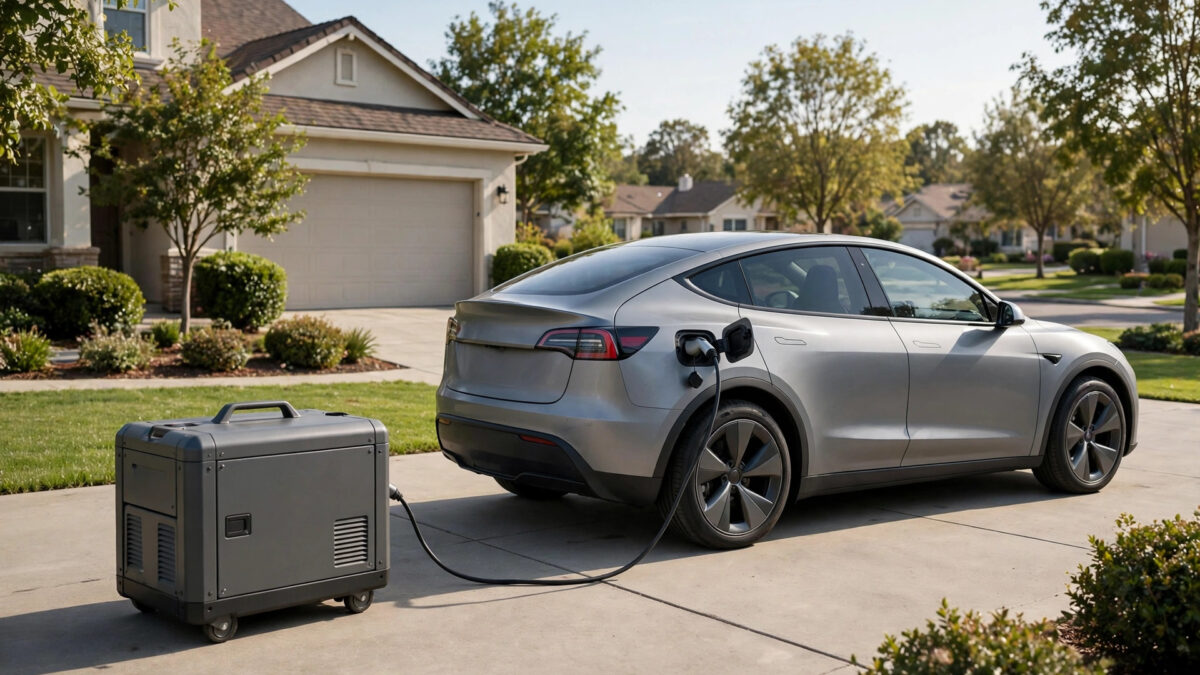
The best generators for emergency EV charging in 2027 are clean-power inverter generators that can safely feed your car’s Level 1 mobile charger during an outage. We researched and compared five models suited to the job — from the Honda EU2200i to a 4,500W dual fuel workhorse — focusing on power quality, stable output, and the practical realities of charging a car from a portable generator.
Honesty first: charging an EV from a portable generator is slow emergency top-up power, not a fast-charging solution. A standard Level 1 EVSE draws about 1,440W (12 amps at 120V) and adds roughly 3–5 miles of range per hour. An overnight generator run might add 30–50 miles — enough to reach a working charger, not enough to “fill” a long-range EV. It is also expensive per mile compared to grid power. But when the grid is down and you need to move, it works.
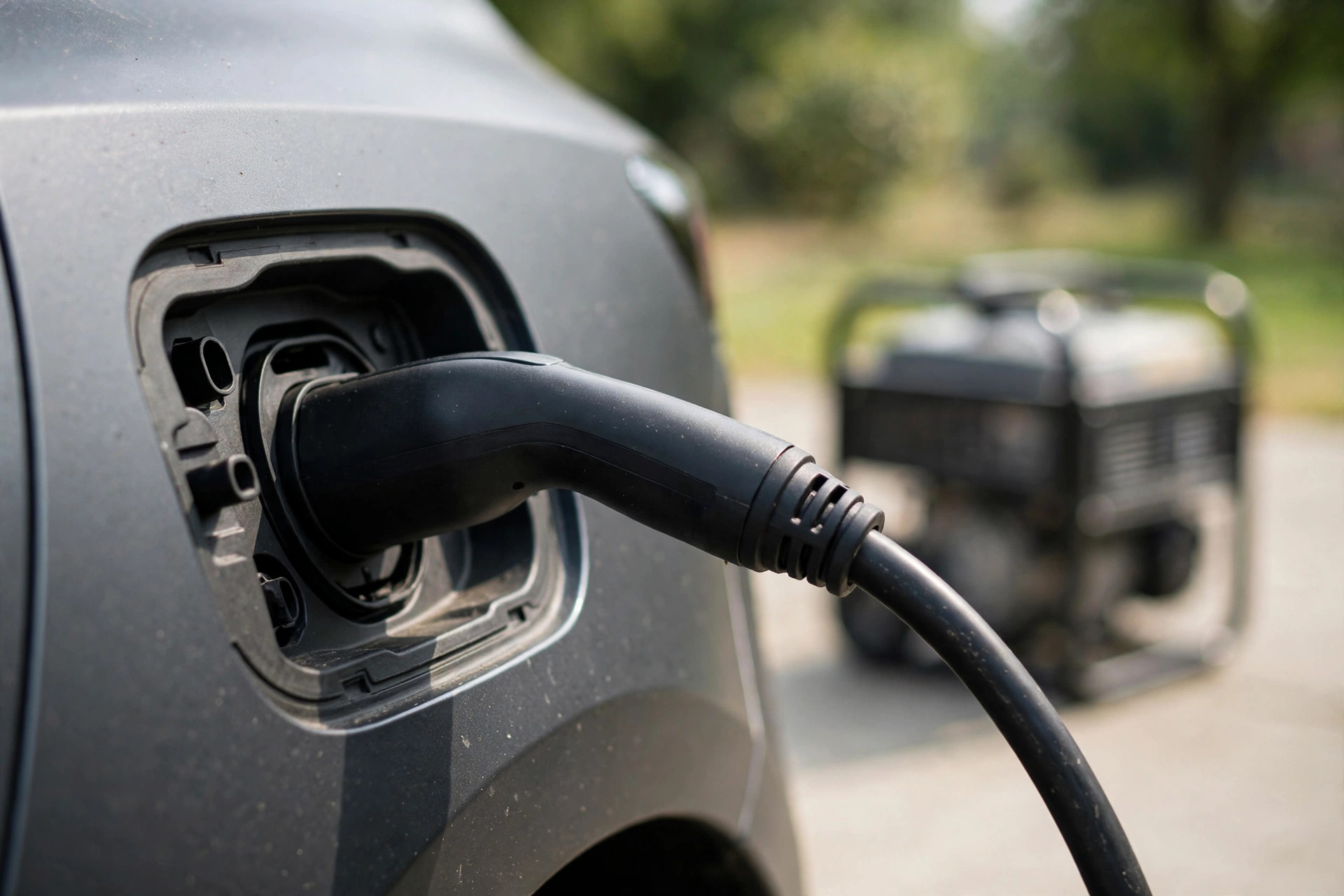
The critical requirement is clean, stable power: EV onboard chargers and EVSE units are sensitive electronics that demand low-distortion electricity and proper grounding. Every model below is an inverter generator with stable sine-wave output suitable for EVSE use.
Key takeaways
- Honda EU2200i is our top pick — pure-sine-wave power (<3% THD) ideal for Level 1 EVSE charging.
- Champion 201319 4,500-Watt Dual Fuel Inverter Generator is the best mid-range option — 3,700W with dual fuel and remote start.
- Level 1 charging adds ~3–5 miles of range per hour — emergency top-up, not fast charging.
- Your EVSE may require a bonded neutral — many portable generators have a floating neutral; check compatibility.
- Only use inverter generators with clean power for EV charging — never a dirty-power conventional unit.
Our top picks at a glance
- Honda EU2200i — Best overall — pure-sine-wave Honda power, ideal for Level 1 EVSE
- Champion 201319 4,500-Watt Dual Fuel Inverter Generator — Best mid-range — 3,700W dual fuel with remote start
- Champion 201323 — Best dual-fuel compact — propane extends emergency runtime
- DuroMax XP4500iH — Most powerful — 3,600W+ with 100% copper windings
- Generac GP2500i — Best compact Generac — TruePower clean output, COsense
Best overall
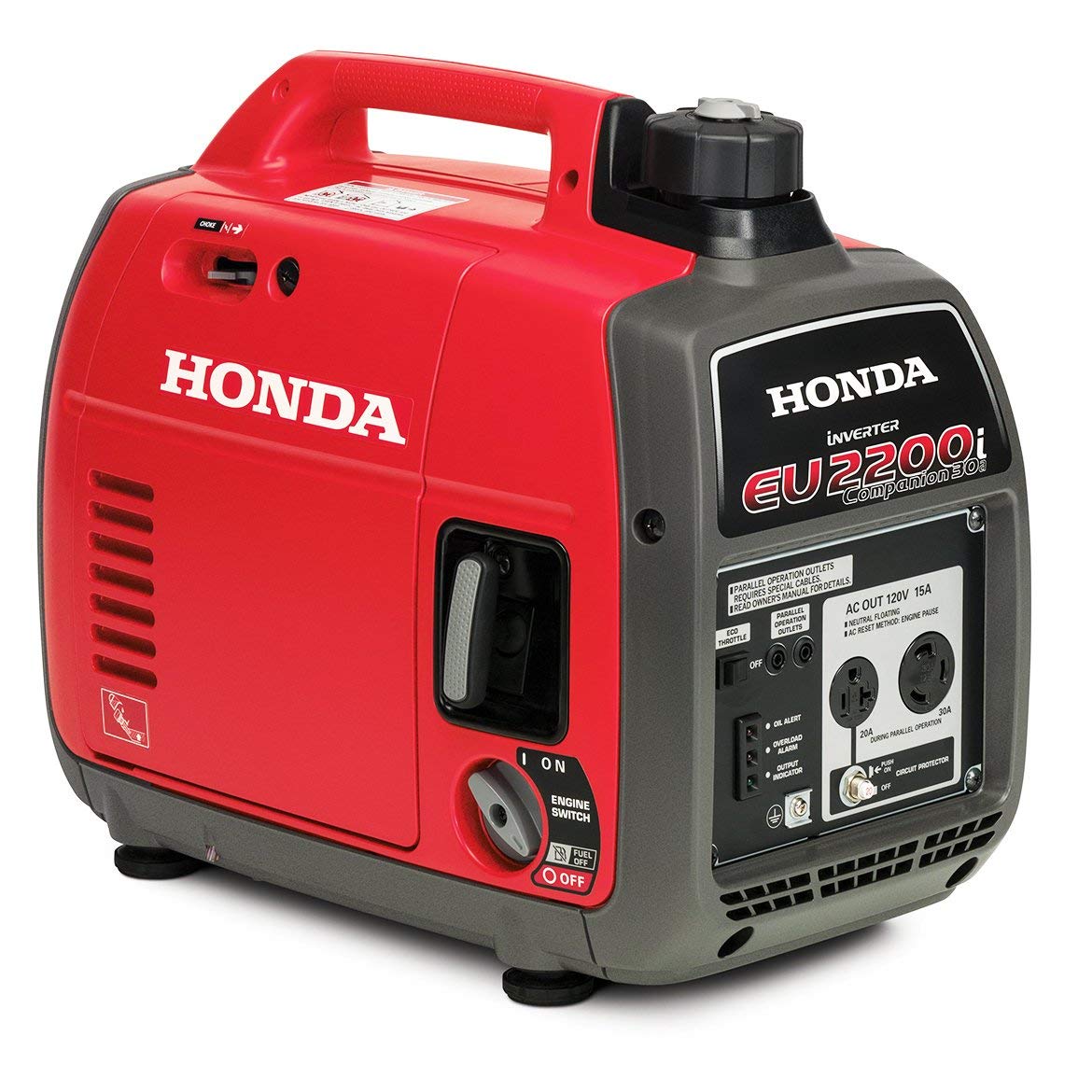
Honda EU2200i Inverter Generator
- 1800W running / 2200W peak output
- gasoline
- Up to 3.2h @ rated load / 8.1h @ 1/4 load runtime
- Pure-sine-wave Honda inverter (<3% THD) ideal for Level 1 EVSE use
- 2200W starting watts / 1800W running watts
- gasoline
- Noise: 48-57 dBA
- 3.2h @ rated load / 8.1h @ 1/4 load
As an Amazon Associate, we earn from qualifying purchases.
The Honda EU2200i is the best generator for emergency EV charging because power quality is the whole game here — and nobody does clean, stable portable power better than Honda. With 1,800 running watts of pure-sine-wave output (under 3% THD), it comfortably sustains a 1,440W Level 1 EVSE load with headroom to spare, and the legendary stable frequency keeps the car’s onboard charger happy.
At 48–57 dBA it will not torment the neighborhood during an overnight charge, and Eco-Throttle sips fuel — about 8.1 hours at quarter load on less than a gallon. At 46.5 pounds it is easy to position wherever the car is parked.
One compatibility note applies to every generator here: some EVSE units check for a bonded neutral-ground connection and will refuse to charge on a floating-neutral generator. The EU2200i has a floating neutral like most portable inverters — check your EVSE’s requirements (and your car maker’s guidance) before relying on this setup in an emergency.
| Running watts | 1,800 |
|---|---|
| Starting watts | 2,200 |
| Fuel type | Gasoline |
| Noise level | 48–57 dBA |
| Runtime | 3.2h at rated load / 8.1h at 1/4 load |
| Weight | Approx. 46.5 lbs |
Pros
- Pure-sine-wave power ideal for EVSE
- Stable frequency and voltage
- Quiet for overnight charging
- Honda reliability
Cons
- Floating neutral — check EVSE compatibility
- 1,800W limits you to Level 1 charging
- Premium price
Best dual-fuel compact
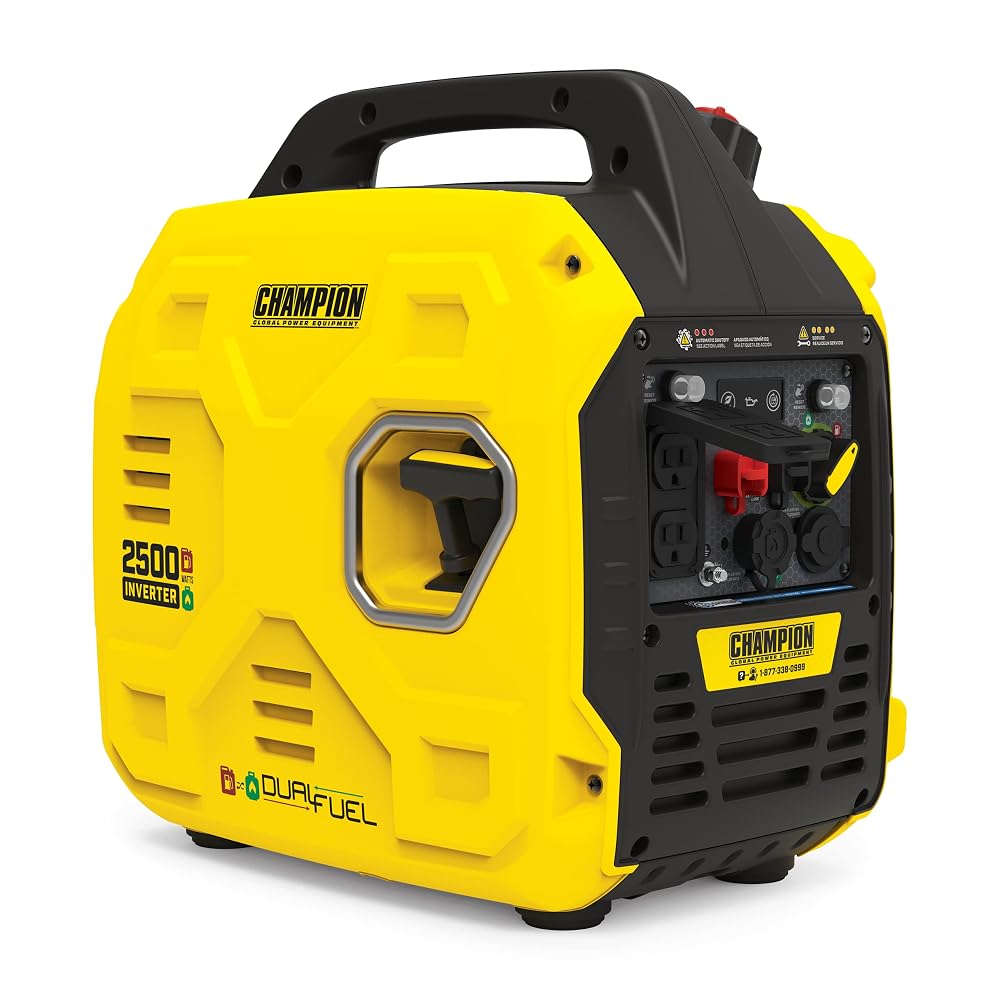
Champion 201323 2500W Dual-Fuel Inverter Generator
- 1850W (gasoline), 1665W (propane) running / 2500W peak output
- dual fuel (gasoline/propane)
- Up to up to 11.5h gasoline / 25h propane (@25% load) runtime
- Dual-fuel inverter producing <3% THD pure-sine power
- 2500W starting watts / 1850W, 1665W running watts
- dual fuel (gasoline/propane)
- Noise: 53 dBA
- up to 11.5h gasoline / 25h propane (@25% load)
As an Amazon Associate, we earn from qualifying purchases.
The Champion 201323 brings dual fuel to emergency EV charging: 1,850 running watts on gasoline (1,665 on propane) of clean sub-3% THD inverter power. A Level 1 EVSE draws about 1,440W, so either fuel covers it — and propane’s advantage here is real: up to 25 hours of runtime on a 20-pound tank versus carrying gasoline.
In an extended outage, that propane endurance matters. An overnight Level 1 charge adds meaningful range; doing it for several nights on gasoline means fuel runs, while a propane tank just keeps going. CO Shield protection, 53 dBA quiet operation, and 43.2-pound portability make it easy to deploy wherever the car sits.
As with all floating-neutral portables, verify your EVSE accepts the generator’s neutral configuration before you need it. Test the full setup — generator, EVSE, car — once before an emergency, not during one.
| Running watts | 1,850 (gasoline); 1,665 (propane) |
|---|---|
| Starting watts | 2,500 |
| Fuel type | Dual fuel: gasoline / propane |
| Noise level | 53 dBA |
| Runtime | Up to ~11.5h gasoline / 25h propane at 25% load |
| Weight | Approx. 43.2 lbs |
Pros
- Dual fuel — propane for long outages
- Clean <3% THD power for EVSE
- Up to 25h runtime on propane
- CO Shield, ultralight 43.2 lbs
Cons
- Floating neutral — check EVSE compatibility
- Level 1 charging only
- 1,665W on propane is close to the 1,440W load
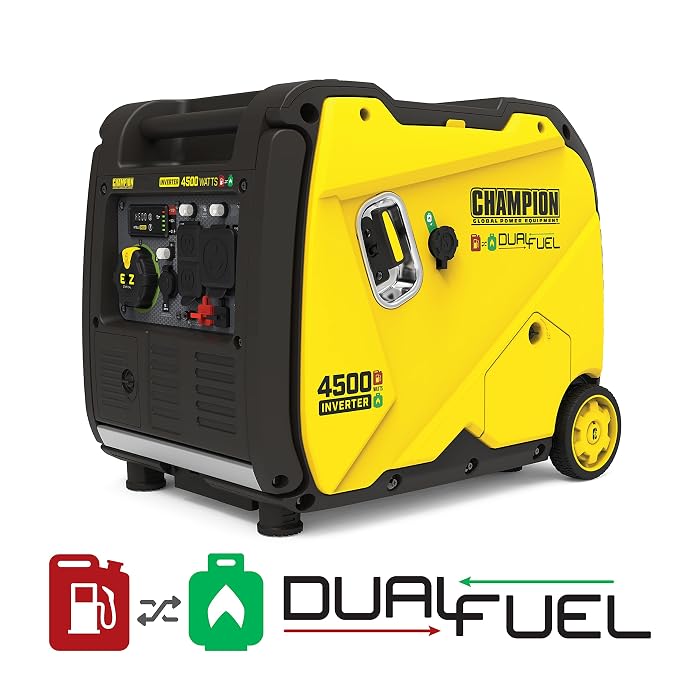
Best mid-range
Champion 201319 4,500-Watt Dual Fuel Inverter Generator Dual-Fuel Inverter Generator
- 3,500 (gasoline); 3,150 (propane) running / 4,500 (all fuels) peak output
- Dual Fuel: gasoline, propane
- Up to 14 hrs (gasoline, 2.25 gal); 21 hrs (propane, 20-lb tank) runtime
- 61 dBA noise level
- 4,500 (all fuels) starting watts / 3,500 (gasoline); 3,150 (propane) running watts
- Dual Fuel: gasoline, propane
- Noise: 61 dBA
- 14 hrs (gasoline, 2.25 gal); 21 hrs (propane, 20-lb tank) runtime
- Weight: 99.2 lbs
As an Amazon Associate, we earn from qualifying purchases.
The Champion 201319 4,500-Watt Dual Fuel Inverter Generator is the best mid-range generator for EV charging: 3,700 running watts on gasoline (3,330 on propane) of clean inverter power. That headroom above a 1,440W Level 1 load means the generator loafs along at partial load — quieter, more efficient, and less stressed than a 2,200W unit running near its limit.
Dual fuel (gasoline + propane), remote start, and up to 14 hours of runtime on the 3.4-gallon tank make it a strong extended-outage companion. The TT-30R RV outlet is a bonus for RV-owning EV drivers. At 61 dBA it stays neighbor-friendly.
At 98 pounds it is the heaviest pick here — a wheel-kit move, not a carry. For buyers who want EV charging plus whole-essentials backup from one generator, the iGen4500DF is the most capable option in this roundup.
| Running watts | 3,700 (gasoline); 3,330 (propane) |
|---|---|
| Starting watts | 4,500 (gasoline); 4,050 (propane) |
| Fuel type | Dual fuel: gasoline / propane |
| Noise level | 61 dBA |
| Runtime | Up to ~14h (3.4 gal gasoline) |
| Weight | Approx. 98 lbs |
Pros
- 3,700W — generous headroom for Level 1
- Dual fuel with remote start
- 61 dBA quiet, 14h runtime
- Doubles as essentials home backup
Cons
- 98 lbs — heaviest here
- Floating neutral — check EVSE compatibility
- Overkill if EV charging is the only job
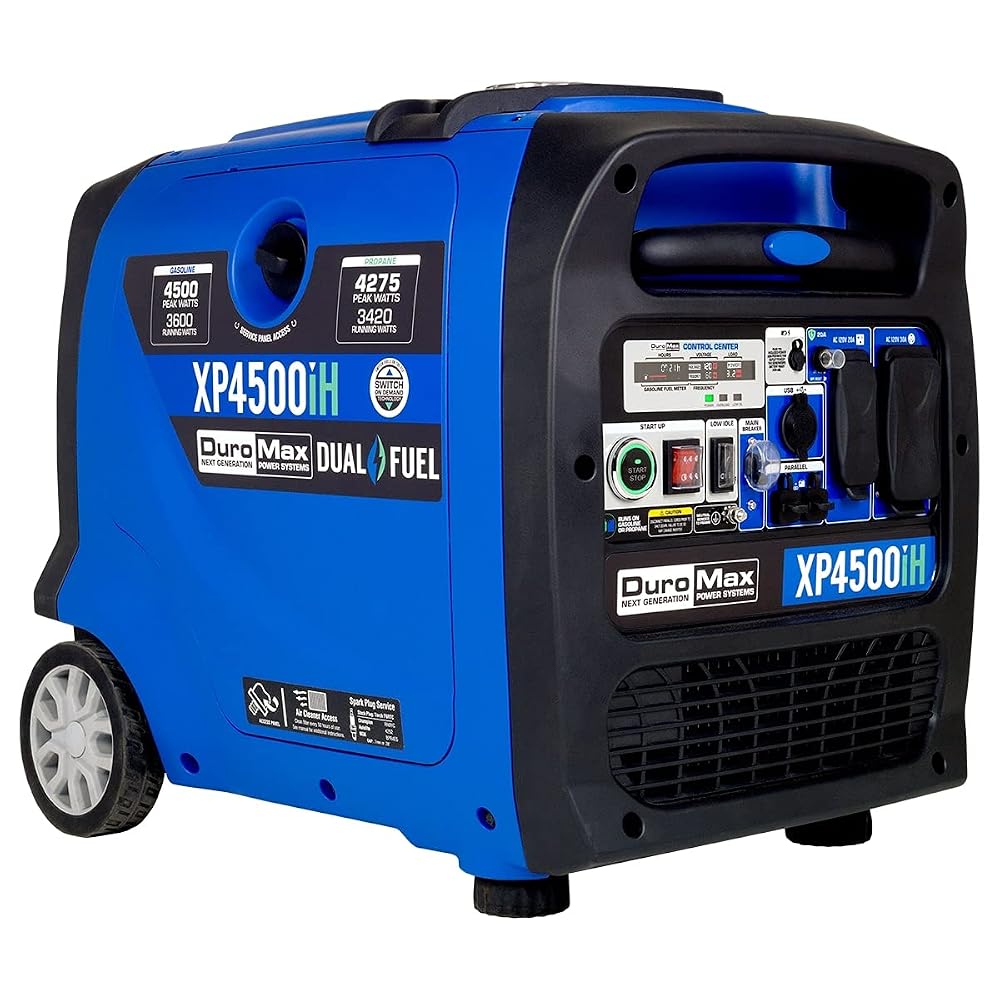
Most powerful
DuroMax XP4500iH Dual-Fuel Inverter Generator
- 3600W (gasoline), 3420W (propane) running / 4500W (gasoline), 4275W (propane) peak output
- dual fuel (gasoline/propane)
- Up to 8h @ 50% load gasoline / 11h propane (20 lb tank) runtime
- Powerful dual-fuel digital inverter with 100% copper windings and stable output suitable for EVSE use
- 4500W, 4275W starting watts / 3600W, 3420W running watts
- dual fuel (gasoline/propane)
- Noise: 65 dB
- 8h @ 50% load gasoline / 11h propane (20 lb tank)
As an Amazon Associate, we earn from qualifying purchases.
The DuroMax XP4500iH is the most powerful EV-charging pick: 3,600 running watts on gasoline (3,420 on propane) from a digital inverter with 100% copper windings. The copper-winding construction contributes to stable, consistent output — exactly what an EV’s onboard charger wants to see.
Dual fuel operation gives 8 hours at half load on gasoline or 11 hours on a 20-pound propane tank. The TT-30R RV outlet adds versatility. At 65 dB it is the loudest pick here — a tradeoff for the power — and 115 pounds dry means a planned placement.
For buyers who want maximum charging headroom plus the ability to run the whole campsite or essential home circuits simultaneously, the XP4500iH delivers.
| Running watts | 3,600 (gasoline); 3,420 (propane) |
|---|---|
| Starting watts | 4,500 (gasoline); 4,275 (propane) |
| Fuel type | Dual fuel: gasoline / propane |
| Noise level | 65 dB |
| Runtime | 8h at 50% load gasoline / 11h propane (20-lb tank) |
| Weight | Approx. 115 lbs (dry) |
Pros
- Highest output here — 3,600W
- 100% copper windings, stable output
- Dual fuel with long propane runtime
- TT-30R RV outlet
Cons
- 65 dB — loudest pick here
- 115 lbs dry — plan placement
- Floating neutral — check EVSE compatibility
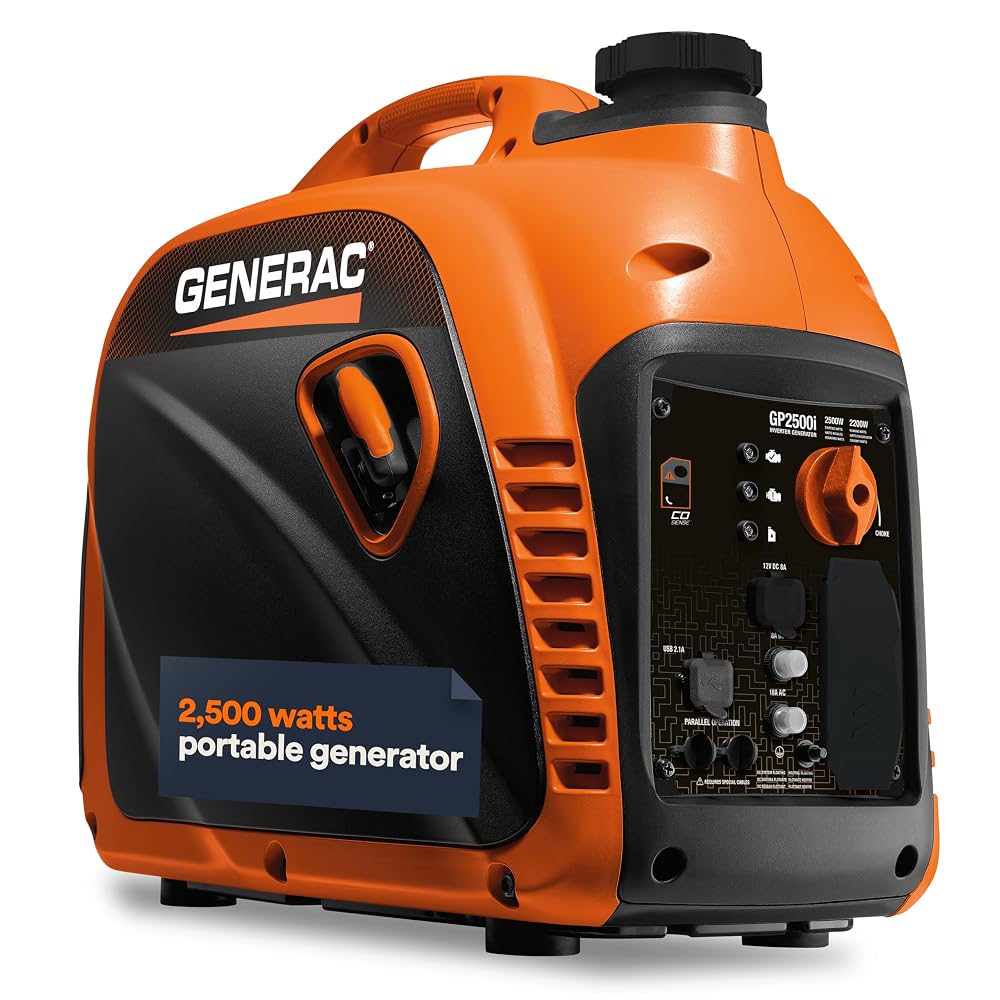
Best compact Generac
Generac GP2500i Inverter Generator (Model 8251)
- 2200W running / 2500W peak output
- gasoline
- Up to 8h on 1 gal tank runtime
- Generac TruePower clean, stable inverter output suitable for Level 1 EV charging
- 2500W starting watts / 2200W running watts
- gasoline
- 8h on 1 gal tank
- 56 lbs
As an Amazon Associate, we earn from qualifying purchases.
The Generac GP2500i is the compact mainstream pick for EV charging: 2,200 running watts of Generac TruePower clean, stable inverter output — comfortably above a 1,440W Level 1 EVSE draw. COsense carbon-monoxide shutdown is built in, a meaningful safety feature for overnight charging sessions.
At about 48–56 pounds (depending on configuration) it is easy to position by the car, and 8 hours of runtime on its 1-gallon tank covers an overnight top-up. USB ports handle your devices while the EVSE handles the car.
Runtime and noise figures were not fully published at research time — check the listing. As with every portable here, confirm your EVSE works with a floating-neutral generator before depending on it.
| Running watts | 2,200 |
|---|---|
| Starting watts | 2,500 |
| Fuel type | Gasoline |
| Noise level | Not published in manufacturer specs we reviewed |
| Runtime | Approx. 8h on 1-gal tank |
| Weight | Approx. 56 lbs |
Pros
- TruePower clean, stable output
- COsense for overnight sessions
- Compact and easy to position
- 8h runtime covers overnight top-up
Cons
- Floating neutral — check EVSE compatibility
- Noise rating not published
- Level 1 charging only
EV charging generators compared
All five are inverter generators with clean sine-wave output suitable for EVSE use. Level 1 charging draws ~1,440W (12A @ 120V) and adds roughly 3–5 miles of range per hour.
| Product | Running watts | Fuel | Noise | Best for | |
|---|---|---|---|---|---|
| Honda EU2200i Inverter Generator | 1,800 | Gasoline | 48–57 dBA | Level 1 EVSE | Check price |
| Champion 201323 2500W Dual-Fuel Inverter Generator | 1,850 | Gas / propane | 53 dBA | Long-outage EV top-up | Check price |
| Champion 201319 4,500-Watt Dual Fuel Inverter Generator Dual-Fuel Inverter Generator | 3,700 | Gas / propane | 61 dBA | EV + home backup | Check price |
| DuroMax XP4500iH Dual-Fuel Inverter Generator | 3,600 | Gas / propane | 65 dB | Maximum headroom | Check price |
| Generac GP2500i Inverter Generator (Model 8251) | 2,200 | Gasoline | Not published | Compact Level 1 | Check price |
How do you choose the best generator for EV charging in 2027?
EV charging from a generator is a special case with specific technical requirements. Here is what actually matters.
Clean power is mandatory, not optional
EV onboard chargers are sophisticated power electronics. They require stable voltage, stable frequency, and low harmonic distortion. Only inverter generators (under ~3% THD) meet this bar reliably. A conventional generator’s dirty power can cause the EVSE to fault — or worse, stress the onboard charger. Every model in this roundup is an inverter for this reason.
The floating-neutral problem
Most portable inverter generators have a floating neutral — the neutral is not bonded to ground. Many EVSE units (including some automaker mobile chargers) test for a neutral-ground bond and will refuse to charge without one, showing a ground fault. Solutions exist (neutral-ground bonding plugs), but they must be used correctly and in line with electrical code and the EVSE maker’s instructions.
Test your exact combination — generator, EVSE, and car — before an emergency. Discovering an incompatibility during a blackout is the worst time to learn.
Level 1 vs Level 2: be realistic
A portable generator realistically supports Level 1 charging only (120V, ~1,440W, 3–5 miles of range per hour). Level 2 charging needs 240V at 16–48 amps (3.8–11.5kW) — beyond any portable in this roundup and requiring a 240V generator with proper EVSE equipment. An overnight Level 1 session (8–10 hours) adds roughly 30–50 miles: enough to reach a working fast charger, which is the real goal in an emergency.
Sizing: headroom matters
A 1,440W EVSE load on an 1,800W generator (Honda EU2200i) works but runs the unit at 80% load for hours. A 3,700W generator (Champion 201319 4,500-Watt Dual Fuel Inverter Generator) handles the same load at under 40% — quieter, cooler, and more efficient. For occasional emergency use, the smaller units are fine; for repeated or multi-night charging, buy headroom.
Fuel: propane wins for standby readiness
An EV emergency generator may sit unused for a year, then need to work perfectly. Propane (Champion 201323, Champion 201319 4,500-Watt Dual Fuel Inverter Generator, DuroMax XP4500iH) stores indefinitely and burns clean — no stale-fuel failures. If your generator’s job is “sit ready for the big outage,” dual fuel with propane is the smart configuration.
Cost per mile: know what you are paying
Generator charging is expensive. A gallon of gasoline (~$3–4) yields roughly 8–12 miles of EV range through a small generator — several times the cost of grid charging. This is emergency insurance, not a fuel strategy. Size your expectations (and your fuel storage) accordingly: a 5-gallon can covers roughly 40–60 miles of emergency range.
EV charging generator FAQs
Can you charge an electric car with a portable generator?
Yes, using the car’s Level 1 (120V) mobile charger plugged into a clean-power inverter generator. Expect 3–5 miles of range per hour of charging. Use only an inverter generator with stable sine-wave output — conventional generators can cause EVSE faults or damage. Always follow your vehicle maker’s guidance on generator charging.
How many watts does it take to charge an EV on Level 1?
A standard Level 1 EVSE draws 12 amps at 120V, or about 1,440 watts. Any generator with 1,800+ running watts handles it; 2,200W+ gives comfortable headroom. Do not run other large loads on the generator simultaneously unless it has the capacity.
Why won't my EVSE work with my generator?
The most common cause is the floating neutral: many portable generators do not bond neutral to ground, and many EVSE units require that bond as a safety check. Other causes include unstable frequency, voltage outside the EVSE’s tolerance, or a ground-fault detection trip. Test your specific generator + EVSE + car combination before you need it.
How long does it take to charge an EV with a generator?
At Level 1 speeds (3–5 miles per hour), an 8-hour overnight generator run adds roughly 25–40 miles of range. A full charge of a long-range EV (300 miles) would take 60–100 hours — impractical. Think of generator charging as emergency range to reach a working fast charger, not as a way to fill the battery.
Is it safe to charge an EV from a generator in the rain?
Take the same precautions as any outdoor electrical equipment: keep connections dry and off the ground, use the EVSE’s weather-rated connectors as designed, and never handle plugs with wet hands or while standing in water. The generator itself must stay dry — run it under a ventilated canopy (open-sided, never enclosed), never in standing water.
Does charging from a generator damage the EV battery?
Not if the power is clean and stable — the car’s onboard charger converts AC to DC and manages the battery exactly as it does on grid power. The risk comes from dirty or unstable power (voltage sags, frequency drift), which is why inverter generators are required. There is no evidence that occasional Level 1 generator charging harms modern EV batteries.
What is cheaper: generator charging or a portable power station?
For small top-ups, a large portable power station (2–3kWh) can add 8–12 miles silently with no fuel — useful if you just need to reach a charger a few miles away. For bigger emergency range, a generator’s fuel energy density wins. See our portable power station roundup for battery options.
Our verdict
The Honda EU2200i is the best generator for emergency EV charging in 2027: the cleanest, most stable portable power for a Level 1 EVSE. For extended outages, the dual fuel Champion 201319 4,500-Watt Dual Fuel Inverter Generator gives you 3,700W of headroom and propane endurance in one package. On a budget, the Champion 201323 delivers dual fuel Level 1 charging for less. Whatever you choose, test your generator + EVSE + car combination before an emergency — the floating-neutral issue surprises too many owners at the worst moment.
How we researched: We did not perform hands-on testing. We compared manufacturer specifications for five inverter generators verified on Amazon in October 2026, evaluated them against the technical requirements of Level 1 EV charging (1,440W continuous load, <3% THD power quality, neutral-ground bonding considerations), and reviewed aggregated owner feedback on stable output and real-world reliability. We did not invent specifications; unpublished figures are noted as such. EVSE compatibility varies by vehicle and charger — verify your specific combination. Prices and availability change frequently.

Related Guides
Best Time to Buy a Generator: 2027 Price & Sales Calendar
The best time to buy a generator is Black Friday, with 10-30% off typical. 2027 price and sales calendar: clearance windows, pre-season deals, and timing tips.

Portable vs Standby Generator: Cost, Runtime, Maintenance & Pros/Cons
Portable vs standby generator: $1,100-$5,000 vs $9,000-$20,000+ installed. Compare costs, runtime, maintenance, pros and cons, and which type wins for you.
Jackery vs EcoFlow vs Bluetti vs Anker: Which Power Station Brand Is Best?
Jackery vs EcoFlow vs Bluetti vs Anker power stations compared on battery chemistry, charging speed, cycle life, and value. Includes the NMC vs LiFePO4 warning.