


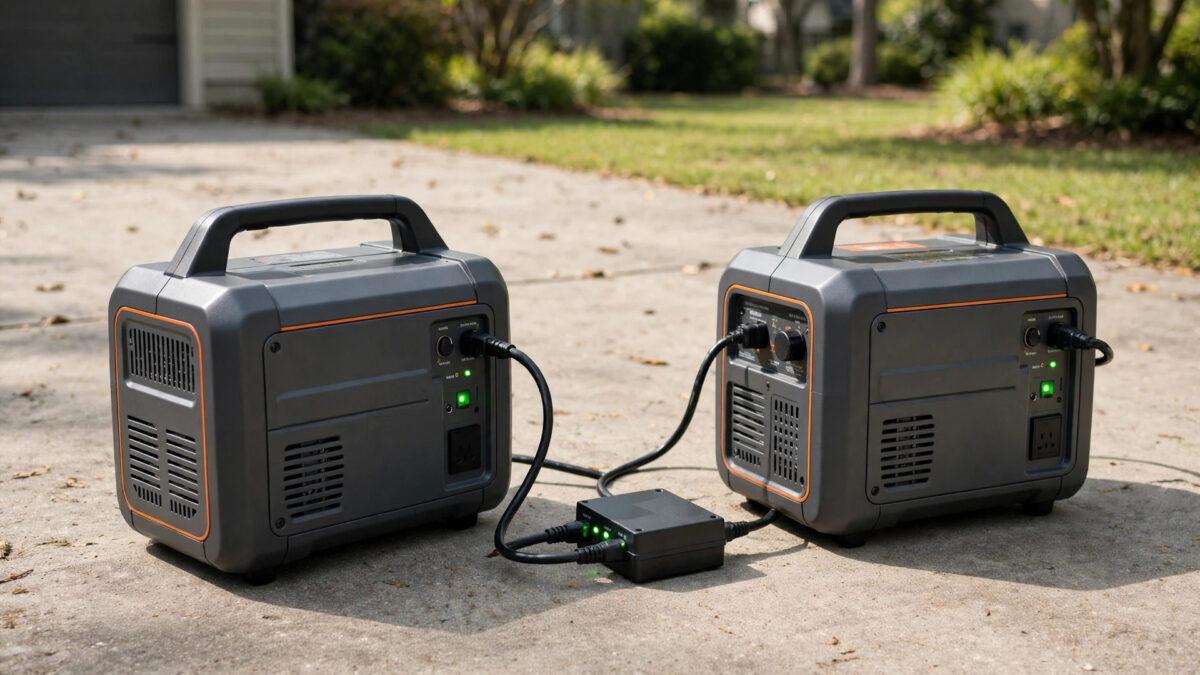
You need about 4,000 watts in 2027. You could buy one 4,500-watt generator — or two 2,200-watt inverters and a parallel kit. Both get you there. So which is the smarter buy? The short version: two paralleled inverters win on noise, fuel efficiency, portability, and redundancy; a single bigger generator wins on upfront cost, simplicity, and 240-volt power. I’ve run both setups, and the right answer depends on how you’ll actually use the thing.
This is one of the most common “which should I buy” questions I get, because the math looks like a tie on paper. It isn’t. The two setups behave very differently in real life — at 2 a.m. during an outage, the differences matter a lot.
Key takeaways
- Two paralleled 2,200W inverters give you roughly 4,000W combined — comparable to a single 4,500W unit — but you can run just one when loads are light, saving fuel and noise.
- Parallel setups cost more upfront: two small inverters plus a $50-100 parallel kit typically runs $200-400 more than one equivalent bigger generator.
- Redundancy is the killer feature of paralleling — if one unit fails, you still have half your power. A dead single generator leaves you with nothing.
- A single bigger generator is simpler (one engine to maintain, one fuel tank), usually cheaper per watt, and is the only option if you need 240V output.
- Parallel kits only work between compatible units — usually the same brand and family. You can’t parallel random generators together.
How paralleling actually works
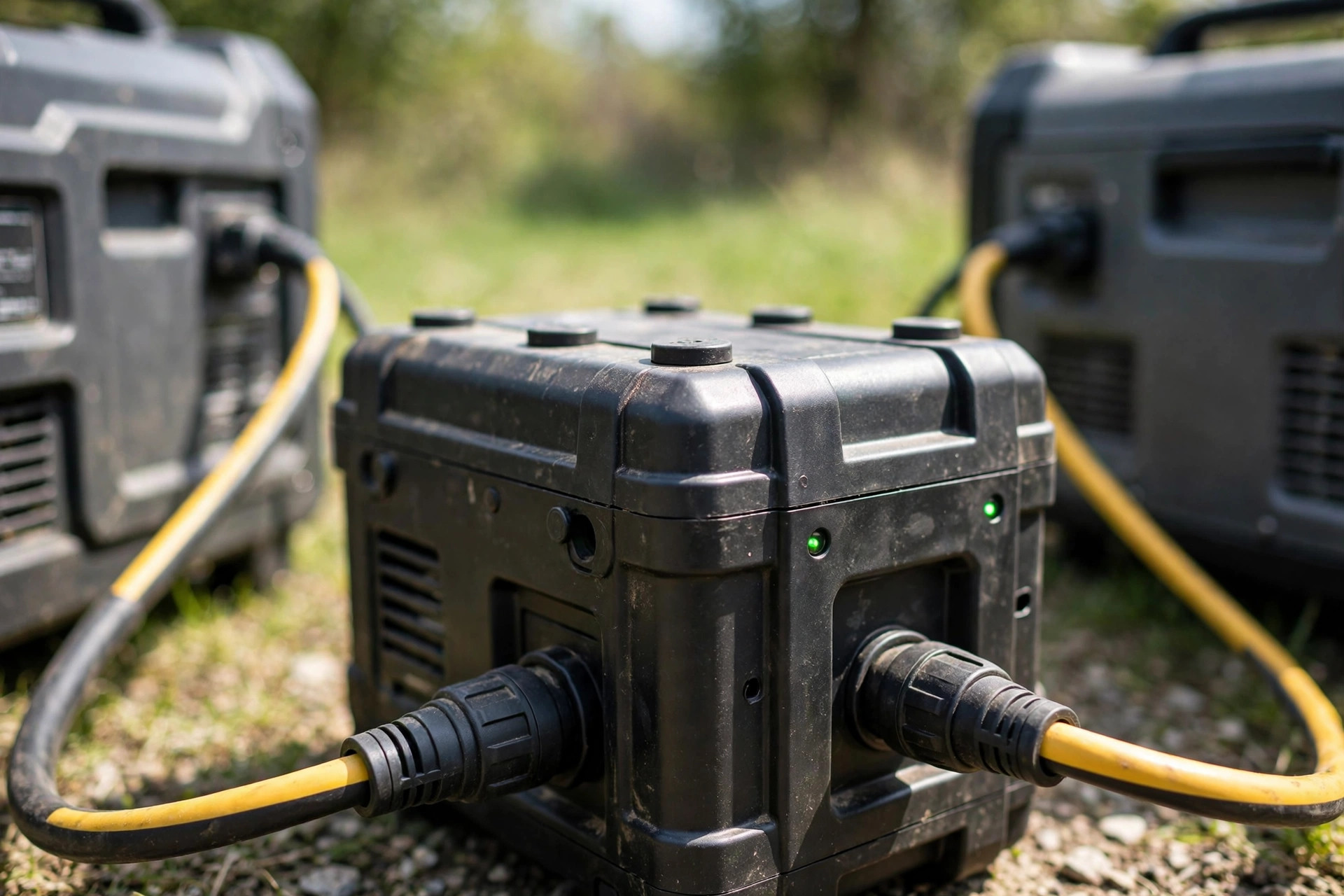
A parallel kit is a small box with cables that links two compatible inverter generators so their outputs sync — same voltage, same frequency, same phase — and combine into one larger feed. Two 2,200-watt inverters (2,000W running each) typically deliver around 3,600-4,000 running watts combined through the kit’s 30-amp outlet.
Note the key word: inverter generators. You can’t parallel conventional generators with a kit — their output can’t synchronize. (Utility-scale paralleling of big conventional units is a whole different engineering discipline.) If you’re shopping for a parallel setup, both units must be parallel-capable inverters, almost always from the same manufacturer and product family. Honda pairs with Honda, Champion with Champion, and so on. Some brands even restrict pairing to specific model pairs, so check the manual before buying the second unit.
Head-to-head comparison
| Factor | Two paralleled inverters | One bigger generator |
|---|---|---|
| Upfront cost (4,000W class) | Higher — two units + kit | Lower — one unit, better $/watt |
| Noise at light loads | Excellent — run one unit at low RPM | Louder — big engine idles even for small loads |
| Fuel efficiency (light loads) | Excellent — shut one down entirely | Poor — big engine sips nothing; it gulps |
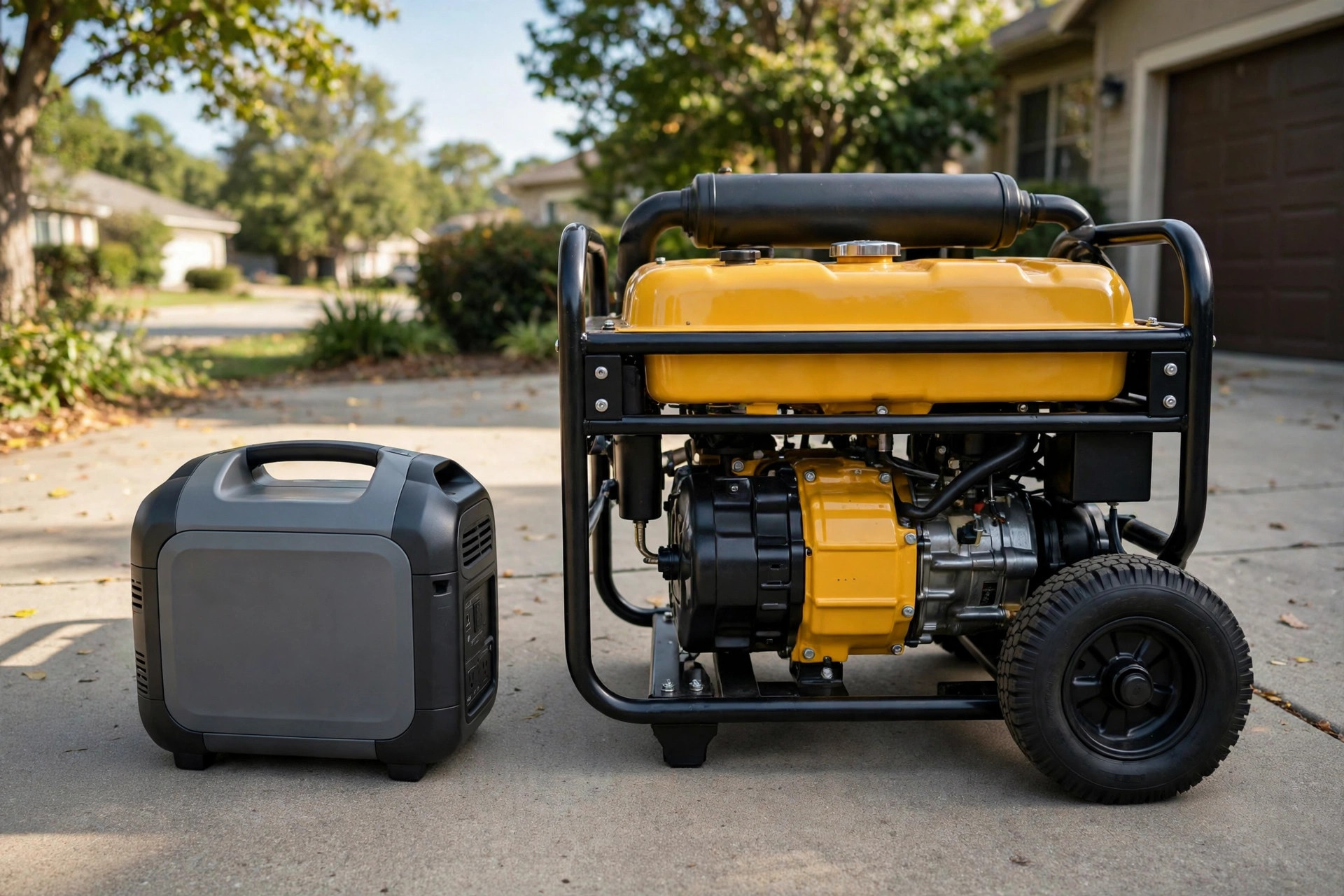
| Portability | Two ~50 lb units, easy to carry solo | One 100-130 lb unit, awkward alone |
| Redundancy | If one fails, you keep half power | Single point of failure |
| 240V output | Not available on most kits | Available on most 4,500W+ units |
| Maintenance | Two engines: double oil changes, plugs, filters | One engine, one maintenance schedule |
| Scalability | Start with one, add the second later | What you buy is what you get |
Where paralleled inverters win
Noise and fuel at real-world loads
This is the big one. Most of the time, you’re not pulling 4,000 watts. Overnight during an outage, you might be running a fridge (150W), some lights, and phone chargers — maybe 400 watts total. With a parallel setup, you run one small inverter loafing along at quarter throttle: quiet (often under 55 dBA) and sipping fuel. A 4,500W single generator handling that same 400W load is a big engine barely awake — louder, thirstier, and working inefficiently. When morning comes and you need the microwave plus the well pump, fire up the second unit.
Portability
Two 50-pound suitcases beat one 120-pound beast every time — loading into a truck, carrying to a campsite, or just moving it around the yard. I can carry one inverter in each hand. The big single unit needs a ramp, a dolly, or a second person. For anyone with a bad back (or no truck), this alone decides it.
Redundancy
Generators fail at the worst moments — usually from neglected maintenance discovered mid-outage. With two units, a dead machine costs you half your capacity, not all of it. Your fridge stays cold on the survivor while you troubleshoot the other. With a single generator, one failure means a warm fridge and a dark house.
Buy-as-you-grow
Start with one 2,200W inverter for camping and light backup. When the budget allows — or when you realize you need more — add the second unit and the kit. You can’t do that with a single big generator.
Where the single bigger generator wins
Upfront cost
No way around it: two quality 2,200W inverters plus a parallel kit costs noticeably more than one 4,500W generator of similar quality. The gap is typically a few hundred dollars. If the budget is fixed and the wattage is non-negotiable, the single unit wins on price.
Simplicity
One engine means one oil change schedule, one spark plug, one air filter, one fuel tank to stabilize, one pull cord to maintain. Two engines double every maintenance task. For someone who just wants backup power with minimal fuss, simpler is better.
240-volt power
This is the hard technical limit. Most parallel kits output 120V only. If you need to run a 240V well pump, a 240V pool pump, or feed a house panel through a 240V inlet, paralleled 120V inverters can’t do it. A single 4,500W+ generator with a 120/240V outlet handles those loads natively. Check what your must-run loads actually need before falling in love with the parallel idea — use our generator sizing calculator to add them up.
Surge capacity for motors
Bigger conventional and open-frame inverter generators tend to have beefier surge headroom relative to their running watts, which helps with hard-starting motors like well pumps and air compressors. Small inverters are more protective — their overload trips faster. If your main job is starting a big motor, the single bigger unit is usually the safer pick.
The cost math, honestly
Let’s put rough numbers on it. Two name-brand 2,200W inverters run roughly $500-600 each, plus $50-100 for the parallel kit — call it $1,100-1,300 all in for ~4,000W of clean inverter power. A single 4,500W portable (conventional or open-frame inverter) of decent quality runs roughly $700-1,000.
So the parallel route costs a few hundred more upfront. What you buy with that premium: quieter light-load operation, better fuel economy across a year of use, easier transport, and redundancy. Whether that’s worth it depends on your use pattern — a full-time RVer or frequent outage-prone homeowner will earn it back in fuel and sanity; someone who needs backup twice a decade probably won’t.
My recommendation
Here’s how I’d decide:
- Go parallel if your loads vary a lot (quiet nights, busy mornings), you camp or RV, you carry the generator by hand, you want redundancy, or you might expand later. The everyday experience is simply nicer.
- Go single and bigger if you need 240V, your main load is one big motor, the budget is tight, or you want the simplest possible maintenance routine. There’s real virtue in one engine and one fuel cap.
- Consider a single large inverter (4,500-7,000W enclosed or open-frame inverter) as the middle path — quieter than conventional, 240V capable, one engine. It costs more than a conventional unit but less than a parallel pair.
For a deeper dive on the technology differences, see our best portable generators roundup — and if you’re leaning parallel, confirm your chosen models are listed as parallel-compatible before you buy the second one.
Can you parallel any two generators?
How many watts do you get paralleling two 2000W generators?
Is it cheaper to parallel two small generators or buy one big one?
Can paralleled generators run 240V?
Do parallel generators need to be the same model?
I’ve run both setups through multi-day outages. The parallel pair is the one I reach for when I want a quiet night and options; the big single is the one I recommend to my brother-in-law who just wants to flip a switch and forget about it. Match the machine to the owner, not just the wattage.

Related Guides
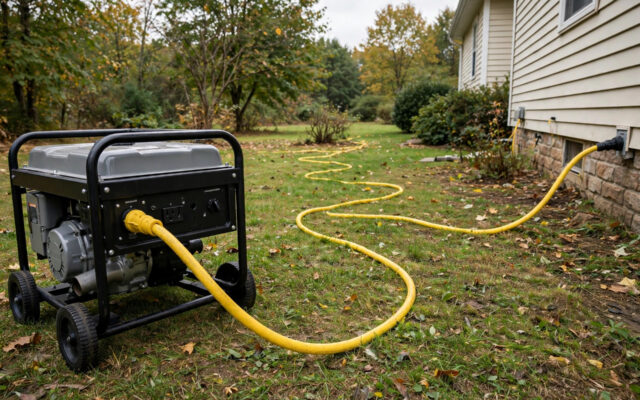
What Gauge Extension Cord Do You Need for a Generator?
Extension cord gauge depends on amps AND length: 12 AWG handles 20A to 50 ft, but you need 10 AWG at 100 ft. Chart, sizing steps, and fire-prevention rules inside.

Generator Carbon Monoxide Safety: The Complete 2027 Guide
Carbon monoxide from generators kills ~77 Americans a year. This complete guide covers symptoms, the CDC 20-foot rule, detector placement, and a pre-outage safety checklist.
Can You Run a Generator in a Garage? (Even With the Door Open?)
No — not even with the garage door wide open. Carbon monoxide builds fast in garages and drifts into the house. Here's the CDC's rule and what to do instead.