


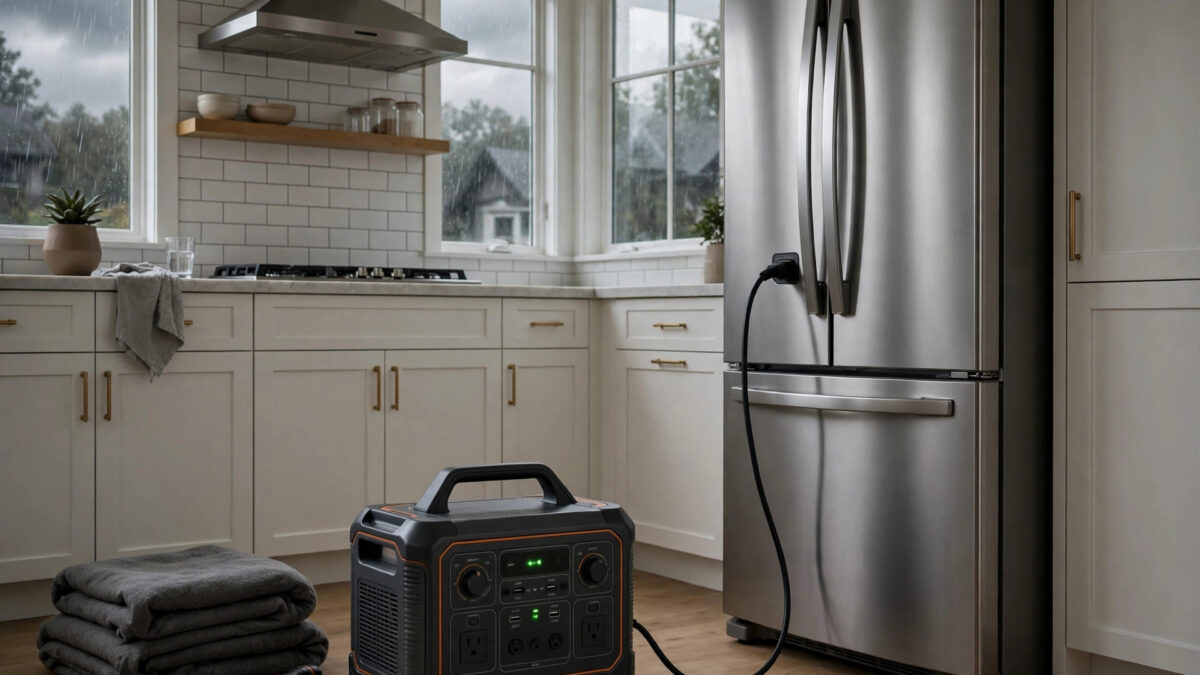
Yes — a solar generator can absolutely power a refrigerator. It is one of the most common reasons people buy one. But “can it” and “for how long” are very different questions, and fridges have a nasty trick called surge current that kills undersized setups. Here is the full picture: real fridge wattage, the surge problem, runtime math, and the minimum size that actually works.
How Much Power Does a Refrigerator Really Use?
Refrigerators are often quoted at scary wattages, but the reality is more manageable. Here are typical figures:
- Full-size fridge: 100–200W while the compressor is running
- Compressor startup surge: 800–1,200W+ for a fraction of a second
- Mini fridge: 50–100W running, 300–500W surge
- 12V camping fridge: 35–60W running, minimal surge
The critical detail is the duty cycle. A fridge compressor does not run constantly — it cycles on and off to maintain temperature, typically running about one-third of the time in a 70°F room. So a fridge rated at 150W running watts actually averages around 50W over a full day, consuming roughly 1.2kWh per 24 hours. Open the door frequently or park it in a hot garage and that duty cycle climbs.
The Surge Problem (and Why It Matters)
When a fridge compressor motor starts, it draws a brief spike of 2 to 4 times its running wattage. A 150W fridge can demand 900W for a split second. This is where cheap or undersized solar generators fail: the inverter sees the spike, decides it is an overload, and shuts down — even though the running load would have been easy.
Two specs solve this:
- Continuous inverter rating must exceed your total simultaneous running watts.
- Surge rating must exceed the compressor’s startup spike.
Quality inverters typically surge to double their continuous rating. The EcoFlow DELTA 3 Plus is a good illustration: 1,800W continuous with 3,600W of surge headroom from a 1,024Wh battery — its surge capacity swallows a fridge compressor startup without breaking a sweat, which is exactly why it works as a fridge-backup unit despite its mid-size battery.
Runtime Math: A Worked Example
Let us run the numbers for a typical full-size fridge on a 1,024Wh solar generator.
Step 1: Usable energy = 1,024Wh × 0.85 (inverter efficiency) ≈ 870Wh.
Step 2: Fridge daily consumption = 150W × 24h × ⅓ duty cycle ≈ 1,200Wh per day.
Step 3: Runtime = 870 ÷ 1,200 ≈ 0.7 days, or about 17 hours.
So a 1,024Wh unit keeps a full-size fridge cold for roughly two-thirds of a day. That covers most short outages and gets you through the night — but it will not carry you through a multi-day blackout alone. Scale up for longer coverage:
- 1,000Wh: 12–18 hours for a full-size fridge
- 2,000Wh: a full 24 hours, plus phones and lights
- 3,000Wh+: multi-day coverage, especially with solar panels connected
For a detailed sizing walkthrough covering every appliance, see our guide on what size solar generator you need.
What Size Solar Generator for a Fridge?
Practical minimum: 1,000Wh with an 1,800W inverter. The watt-hour figure sets your runtime; the 1,800W inverter (with ~3,600W surge) guarantees the compressor actually starts. Anything smaller risks nuisance shutdowns at every compressor cycle.
Comfortable: 1,500–2,000Wh. Covers a full day for the fridge plus lights, phones, and a router — the realistic “one-day outage” kit.
Multi-day outages: 2,000Wh+ with solar panels. Connect 400W of panels and incoming solar offsets the fridge’s draw during daylight, stretching a 2,000Wh unit across several days. This is the setup serious preppers use.
Mini fridges and 12V camping fridges are far easier: a 500Wh unit runs a 12V camping fridge for a full day, making them a favorite pairing for camping setups.
Tips to Stretch Fridge Runtime
- Pre-cool before the outage. Turn the fridge to its coldest setting while grid power is still available. A cold fridge coasts longer.
- Keep the door closed. Every opening dumps cold air and forces a compressor cycle. Plan what you need before opening.
- Keep it full. A full fridge holds temperature better than an empty one — add water jugs if you have space.
- Move it to shade. Every degree of ambient heat raises the duty cycle. A fridge in a cool basement sips power compared to one in a hot garage.
- Connect solar panels while running. Even 200W of panels meaningfully offsets a cycling fridge during the day.
- Use eco mode. Many stations offer an efficiency mode that reduces idle inverter draw — small savings that add up over 24 hours.
- Skip the ice maker and water dispenser. They add surprising load; disable them during outages.
What About Freezers and Fridge-Freezer Combos?
Chest freezers are actually efficient — typically 100–150W running with similar surge behavior to fridges, and their thick insulation means long off-cycles. A 1,000Wh unit handles a chest freezer about as well as a fridge. Upright freezer-fridge combos and French-door models with ice makers draw more; size up to 1,500Wh+ for those.
Running a fridge and a freezer simultaneously? Add their running watts together for the inverter requirement (usually 300–400W combined — no problem for an 1,800W inverter) and roughly double the daily watt-hours. A 2,000Wh unit is the sensible starting point. Compare capable models in our best portable power stations roundup.
Will a solar generator damage my refrigerator?
No — provided it has a pure sine wave inverter, which all quality solar generators do. Pure sine wave power is as clean as grid power. Avoid cheap modified-sine-wave inverters, which can make compressor motors run hot and noisy.
How long will a 1000Wh solar generator run a fridge?
Roughly 12 to 18 hours for a typical full-size fridge, depending on ambient temperature and how often the door opens. In a cool room with the door kept shut, expect the higher end of that range.
Can a solar generator run a fridge and freezer at the same time?
Yes. Combined running draw is usually 300 to 400W — easy for any 1,800W inverter — but daily energy roughly doubles. Plan on 2,000Wh or more for a full day of both, and keep solar panels connected to extend runtime.
Do I need a pure sine wave inverter for a refrigerator?
Yes, strongly recommended. Fridge compressors are induction motors that run hotter, louder, and less efficiently on modified sine wave power. Every reputable solar generator brand uses pure sine wave inverters as standard.
Can solar panels keep up with a fridge in real time?
Often, yes. A cycling fridge averages 40 to 60W, so 200 to 400W of panels in good sun covers the fridge’s draw and trickle-charges the battery simultaneously. On cloudy days the battery makes up the difference.
Our verdict
A solar generator can absolutely run a refrigerator — the minimum viable setup is 1,000Wh with an 1,800W pure sine wave inverter to clear the compressor surge, and 2,000Wh plus panels is the comfortable multi-day answer. Size it with our sizing guide, then pick a unit from our best solar generators of 2027 roundup.

Related Guides
Best Solar Generator Bundles with Panels for 2027
Save money with the best solar generator bundles of 2027 — power station plus solar panel kits ready to use out of the box.

Best Solar Generators for RVs in 2027
Power your RV adventures with the best solar generators for RVs in 2027, featuring TT-30 outlets and fast solar charging.
Best Solar Generators for Camping in 2027
The best solar generators for camping in 2027: lightweight, quiet power stations that keep your gear charged off-grid.