



Gas vs solar generator: which costs less per kWh? A portable gas generator produces electricity for roughly $0.40 to $1.00+ per kWh once you count fuel, oil, and maintenance — while a solar generator (portable power station + panels) produces each kWh for nearly $0 after you buy the equipment, since sunlight is free. But the solar setup costs much more upfront and stores only a finite amount of energy. In this guide, we researched the real math: upfront costs, cost per kWh, 10-year total cost of ownership, runtime limits, and long-term value — so you can see which one actually wins for your situation.
Cost comparisons in backup power are full of cherry-picked numbers, so we will show our work. Every figure below is an estimate based on typical 2027 prices and published efficiency data — your fuel prices, usage hours, and equipment choices will shift the results. The framework matters more than any single number.
Key Takeaways
- Gas generator electricity costs roughly $0.40–$1.00+ per kWh (fuel + maintenance); solar generator marginal cost per kWh is near $0 after purchase.
- Upfront, gas wins: $500–$2,000 for a quality inverter generator vs. $1,500–$4,000+ for a comparable solar generator + panels setup.
- Over 10 years of frequent use, the solar setup’s total cost of ownership can beat gas — over 10 years of rare use, gas usually wins.
- Gas offers unlimited runtime with refueling; solar is limited by battery capacity and sunshine.
- Gas needs ongoing maintenance (oil, filters, fuel rotation); solar needs almost none.
- Usage pattern decides the winner: hours per year is the single most important variable.
Gas vs. Solar Generator Cost per kWh: The Short Answer
For infrequent backup use — a few dozen hours per year — a gas generator is almost always cheaper overall, because its low upfront cost dominates the math and fuel costs stay small. For frequent use — hundreds of hours per year, off-grid living, or daily cycling — a solar generator’s near-zero operating cost compounds into major savings that can overtake gas within a few years. The breakeven point depends on your fuel price and usage hours; the worked example later in this guide shows how to calculate yours. Runtime needs can override cost entirely: if you need unlimited multi-day runtime or 240V power, gas wins regardless of price.
Gas vs. Solar Generator Upfront Costs Compared
| Setup | Typical upfront cost (2027, approx.) | What you get |
|---|---|---|
| Gas: 3,500W inverter generator | $800–$1,500 | 3,500W continuous, 120V (+240V on some), unlimited runtime on fuel |
| Gas: 7,500W dual-fuel generator | $1,200–$2,000 | 7,500W, 120/240V, runs gas or propane |
| Solar: 1,000Wh station + 200W panel | $900–$1,500 | ~1,000–1,800W output, ~1 kWh storage, silent, indoor-safe |
| Solar: 2,000Wh station + 400W panels | $1,800–$3,000 | ~2,200–3,600W output, ~2 kWh storage, expandable |
| Solar: 4,000Wh+ expandable + 800W panels | $3,500–$6,000+ | Whole-essentials backup, multi-day with sun |
These are approximate street-price ranges, not quotes — prices move with sales and seasons. Note the structural difference: with gas, more power costs a little more; with solar, more stored energy costs a lot more, because batteries are the expensive part.

Cost per kWh: Showing the Math
Gas generator cost per kWh
An efficient inverter generator converts roughly one gallon of gasoline into 3,000 to 4,000 watt-hours (3–4 kWh) of electricity at moderate load — less efficient at very light loads, where fuel consumption per kWh climbs. The math:
Fuel cost per kWh = price per gallon ÷ kWh per gallon
At $3.50/gallon and 3.5 kWh/gallon: $3.50 ÷ 3.5 = $1.00/kWh. At light loads where efficiency drops to ~2.5 kWh/gallon, the same fuel costs $1.40/kWh. Add oil changes, air filters, spark plugs, and fuel stabilizer — roughly $0.05–$0.15/kWh amortized — and real-world gas electricity lands around $0.50–$1.50/kWh depending on load and fuel price. For comparison, grid electricity averages roughly $0.15–$0.20/kWh in the US — generator power is 3 to 8 times more expensive than the grid.
Solar generator cost per kWh
Once purchased, a solar generator’s marginal cost per kWh is just the amortized equipment cost spread over its lifetime energy throughput. A 2,000Wh LiFePO4 station rated for 3,000 cycles delivers about 6,000 kWh over its life (2 kWh × 3,000 cycles, roughly — real usable throughput is somewhat less). At a $2,000 purchase price: $2,000 ÷ 6,000 kWh ≈ $0.33/kWh lifetime amortized — and every kWh beyond that is nearly free. If the sun does the charging, the “fuel” cost is literally zero.
10-Year Total Cost of Ownership: A Worked Example
Let us compare two comparable setups — a 3,500W-class inverter generator vs. a 2,000Wh solar station with panels — at two usage levels. All figures are estimates to illustrate the method; plug in your own numbers.
| Cost over 10 years | Gas: 3,500W inverter (~$1,000) | Solar: 2,000Wh + panels (~$2,200) |
|---|---|---|
| Light use: 50 hrs/yr at ~1.5 kW avg (75 kWh/yr) | $1,000 + ~$750 fuel/maint. = ~$1,750 | $2,200 + ~$0 = ~$2,200 |
| Heavy use: 500 hrs/yr at ~1.5 kW avg (750 kWh/yr) | $1,000 + ~$7,500 fuel/maint. = ~$8,500 | $2,200 + ~$0 = ~$2,200 |
| Replacement in 10 yrs? | Likely (5,000 hrs exceeds engine life) | Unlikely (500 cycles of 3,000) |
The pattern is stark: at light backup use, gas wins by a few hundred dollars. At heavy use, solar wins by thousands — and the gas generator likely needs replacing mid-decade while the solar station keeps going. Your breakeven sits where your usage falls between these poles.
Beyond Cost: Runtime, Power, and Practical Limits
Cost is not the whole decision. Each technology has hard limits money cannot fix.
Runtime
Gas runs as long as you have fuel — days or weeks with resupply. Solar runs until the battery empties, then needs hours of sun to recharge. A week-long cloudy outage defeats solar; a fuel shortage defeats gas. For true multi-day resilience, gas (or a hybrid of both) is the safer bet.
Power output
Gas generators reach 12,000W+ with 240V output for well pumps, central AC, and welders. Portable solar stations top out around 3,600W at 120V in most consumer models — enough for essentials, not for heavy 240V loads. If your must-run list includes 240V equipment, gas is the answer regardless of cost math.
Noise, emissions, and location
Solar is silent and emission-free — usable indoors, in apartments, and where generators are banned. Gas is noisy and must run outdoors 20+ feet from buildings. If you cannot run a generator where you live, the cost comparison is moot.
Maintenance and readiness
Gas demands ongoing care: oil changes, fuel rotation, monthly exercise runs, stale-fuel vigilance. Neglected gas generators are the ones that fail when needed. Solar needs almost nothing — keep it charged to 50–80 percent in storage and it is ready. For owners who will not maintain equipment, solar’s readiness advantage is real value.
Long-Term Value: Lifespan and Resale
A LiFePO4 solar station degrades slowly — after 3,000+ cycles it still holds ~80 percent capacity, and for occasional outage use it can serve 10+ years. A gas generator’s engine wears with every hour; 2,000–3,000 hours is a typical service life, and resale value drops with hours and age. Solar equipment also benefits from improving technology and, in some regions, clean-energy incentives — check current federal, state, and utility programs before buying, as credits can shift the math significantly (we do not quote specific incentives here because they change frequently).
FAQs
What is the cost per kWh of a gas generator vs. a solar generator?
Is a solar generator cheaper than a gas generator long term?
How long do solar generators last compared to gas generators?
Can a solar generator run a whole house?
Do solar generators work on cloudy days?
Are there tax credits for solar generators?
Conclusion
The gas vs. solar generator decision comes down to usage: light, infrequent backup favors gas on cost; heavy, frequent use favors solar — dramatically. But cost is only half the story. Gas gives you unlimited runtime and 240V power at the price of noise, fumes, and maintenance; solar gives you silent, indoor-safe, maintenance-free power limited by battery and sunshine. Size the decision to your loads, your outage history, and your willingness to maintain equipment — and many households will find the hybrid approach (both) is the true long-term winner.

Related Guides

Best Time to Buy a Generator: 2027 Price & Sales Calendar
The best time to buy a generator is Black Friday, with 10-30% off typical. 2027 price and sales calendar: clearance windows, pre-season deals, and timing tips.

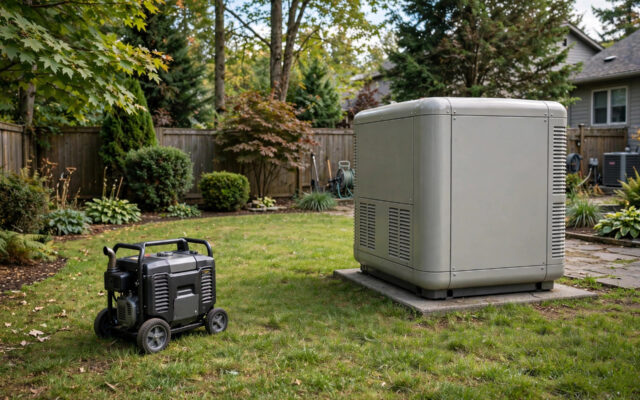
Portable vs Standby Generator: Cost, Runtime, Maintenance & Pros/Cons
Portable vs standby generator: $1,100-$5,000 vs $9,000-$20,000+ installed. Compare costs, runtime, maintenance, pros and cons, and which type wins for you.

Jackery vs EcoFlow vs Bluetti vs Anker: Which Power Station Brand Is Best?
Jackery vs EcoFlow vs Bluetti vs Anker power stations compared on battery chemistry, charging speed, cycle life, and value. Includes the NMC vs LiFePO4 warning.