


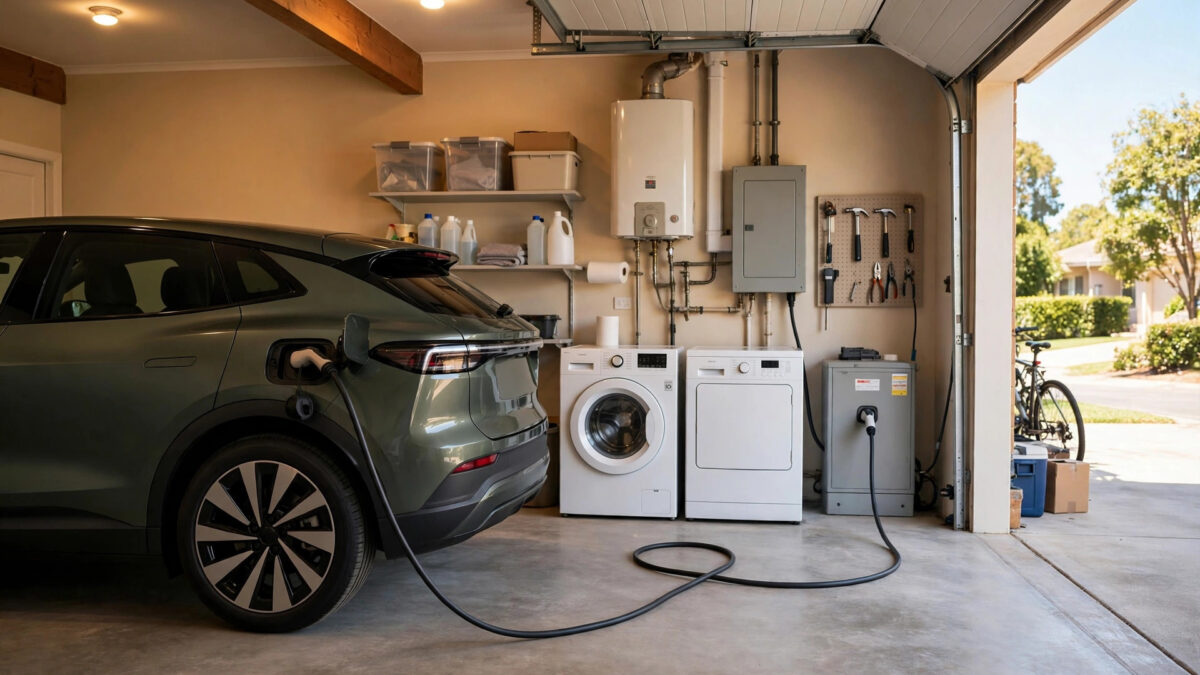
Wondering how to power your house with an EV? Your electric vehicle’s giant battery can absolutely run your home during an outage — there are two very different ways to do it. V2L (vehicle-to-load) gives you built-in power outlets on the car for running appliances through extension cords: simple, no electrician needed. V2H (vehicle-to-home) feeds power into your home’s electrical panel through a transfer switch, running whole circuits like a standby generator: powerful, but it requires special bidirectional hardware and professional installation. In this guide, we explain how each works, what equipment and vehicle support you need, how long an EV battery lasts powering a house, and the critical safety rules.
The core insight: a typical EV battery holds 60 to 100 kilowatt-hours of energy. The average American home uses about 25 to 30 kWh per day — and far less if you stick to essentials during an outage. That means a fully charged EV can theoretically back up essential home loads for two to four days. It is one of the most underused emergency power resources sitting in driveways in 2027.
Key Takeaways
- V2L = AC outlets on the vehicle powering appliances via extension cords (typically 1.5–3.6 kW). Simple and DIY-friendly.
- V2H = the EV powers home circuits through a transfer switch and bidirectional charger (often ~9.6 kW). Requires professional installation.
- Not all EVs support V2L or V2H — check your owner’s manual; V2H additionally needs compatible bidirectional charging hardware.
- A 60–100 kWh EV battery can run essential home loads for roughly 2–4 days.
- Never connect an EV (or any power source) to house wiring without a transfer switch — backfeeding kills utility workers.
- V2L needs no permits; V2H is electrical work requiring a licensed electrician, permits, and code compliance.
What Is V2L (Vehicle-to-Load)?
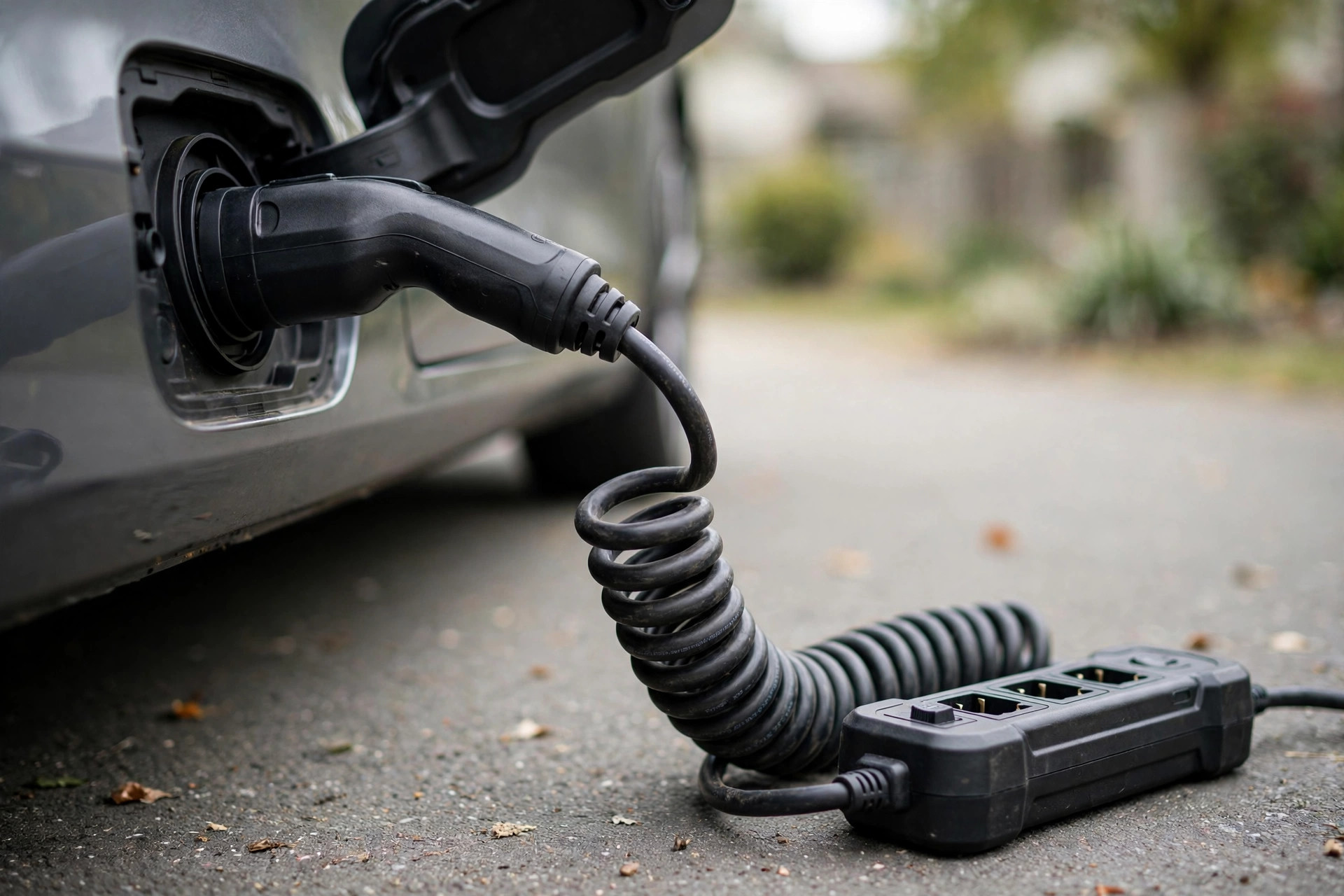
V2L, or vehicle-to-load, is the simpler of the two technologies: the EV has built-in 120V AC outlets (sometimes in the cabin, frunk, or via an adapter on the charge port) that you power directly from the car’s battery through its onboard inverter. You plug appliances in with ordinary extension cords, exactly as you would with a portable generator — except the “generator” is silent, emission-free, and already sitting in your driveway. Typical V2L output ranges from about 1.5 kW to 3.6 kW depending on the vehicle and market, which covers a refrigerator, lights, chargers, a fan or small heater, and even a microwave one at a time.
What can you run on V2L?
At 1.8 to 3.6 kW, V2L handles the classic outage essentials comfortably: full-size fridge (200W), freezer (150W), LED lights (50W), phones and laptops (150W), Wi-Fi router (15W), TV (100W), and a box fan (75W) total well under 1,000 watts. Add a microwave (1,200W) or a portable induction cooktop (1,500W) one at a time and you are still within limits. What V2L cannot do: run 240V hardwired loads like central AC, electric water heaters, or well pumps.
Which EVs have V2L?
V2L availability varies by make, model, model year, and region — it is a feature you must confirm in your specific vehicle’s owner’s manual or spec sheet, not something to assume. Some vehicles include interior outlets only; others support higher-power external discharge through the charge port with a manufacturer adapter. If your EV lacks V2L, this entire option is off the table until your next vehicle.
What Is V2H (Vehicle-to-Home)?
V2H, or vehicle-to-home, goes much further: the EV connects through a bidirectional charger to your home’s electrical panel via a transfer switch, powering entire household circuits — lights, outlets, fridge, furnace blower, even a well pump — much like a standby generator would. V2H systems typically deliver around 9.6 kW of continuous power, enough for most of a home’s essential loads simultaneously, and they switch over automatically when the grid fails if set up that way.
What equipment does V2H require?
V2H is not a cable — it is a system. You need a vehicle with bidirectional charging capability, a compatible bidirectional charger (wall unit), and a transfer switch or gateway panel that safely isolates your home from the grid. The charger alone typically costs several thousand dollars before installation, and the whole project is comparable in scope to installing a standby generator.
Which EVs support V2H?
Far fewer than support V2L. Bidirectional capability depends on the vehicle’s power electronics and the manufacturer’s software support, and the compatible charger ecosystem is still maturing. Before planning a V2H project, verify three things: your vehicle supports bidirectional discharge, a charger exists that is certified compatible with your vehicle, and your utility allows the interconnection. All three must be true.
V2L vs. V2H: Which Is the Better Way to Power Your House With an EV?
| Feature | V2L (Vehicle-to-Load) | V2H (Vehicle-to-Home) |
|---|---|---|
| How it connects | Extension cords to car outlets | Bidirectional charger + transfer switch to panel |
| Typical power | 1.5–3.6 kW | ~9.6 kW |
| Voltage | 120V only | 120/240V split-phase |
| Can run hardwired loads (well pump, furnace)? | No | Yes |
| Installation | None — use built-in outlets | Licensed electrician, permits |
| Equipment cost | $0 (built into car) | Several thousand $ + install |
| Automatic during outage? | No — manual plug-in | Can be automatic |
| Best for | Essentials via cords; apartments; short outages | Whole-home backup; long outages |
How Long Can an EV Power a House?
The math is straightforward: divide the battery’s usable kilowatt-hours by your home’s average power draw. A 77 kWh EV battery running essential loads averaging 1 kW (fridge cycling, lights, chargers, fan) lasts roughly 70+ hours — about three days. Bump consumption to 2 kW average (add a microwave, TV, small heater cycling) and you get about a day and a half. Run a 4 kW central AC and the battery drains in under 20 hours.
| Scenario | Avg. draw | 77 kWh battery lasts (approx.) |
|---|---|---|
| True essentials (fridge, lights, chargers, fan) | ~0.7 kW | ~4 days |
| Comfortable (add TV, microwave, router) | ~1.5 kW | ~2 days |
| Heavy (add space heater or window AC) | ~3 kW | ~1 day |
| Central AC + normal house | ~5 kW | ~15 hours |
These are approximate — real runtime depends on the battery’s state of charge when the outage starts (a car at 40 percent gives you 40 percent of these numbers), conversion losses, and temperature. The practical lesson: keep the EV reasonably charged during storm season, and be disciplined about loads.
What About V2G (Vehicle-to-Grid)?
V2G extends the V2H idea one step further: instead of just powering your home, the EV exports power to the utility grid, typically to earn credits or payments during peak-demand events. V2G requires utility program participation, additional metering and approvals, and the same bidirectional hardware as V2H. For most homeowners in 2027, V2G is a future possibility rather than a practical outage tool — V2H is the technology that keeps your lights on.
Safety and Code Requirements
V2L through extension cords avoids all of this — it is electrically the same as using a portable generator’s outlets, with the same common-sense rules: outdoor-rated cords, no daisy-chaining, keep connections dry, and never plug a cord into house wiring. One EV-specific caution: the car must be parked where its cooling systems can operate normally, and you should follow the manufacturer’s guidance on extended stationary discharge.
FAQs
How can I power my house with my EV during an outage?
What is the difference between V2L and V2H?
How long will an EV battery power a house?
Can any EV do V2H?
Is V2H cheaper than a standby generator?
Do I need a permit to set up V2H?
Conclusion
Powering your house with an EV is no longer theoretical — V2L gives any supported EV owner a silent, fuel-free way to run essentials through extension cords today, and V2H offers genuine whole-home backup for those willing to invest in bidirectional hardware and professional installation. Match the approach to your vehicle, your loads, and your budget — and for V2H, get the electrical work done right by a licensed electrician.

Related Guides
Can You Charge an EV With a Generator? Power & Charging Guide
Can you charge an EV with a generator? Yes — with clean inverter power and proper grounding. Level 1 vs. Level 2 sizing, THD needs, and real costs explained.
