

Your laptop, phone, CPAP machine, and smart TV all have one thing in common: they hate dirty power. A conventional generator’s voltage can swing wildly as loads change, and that fluctuation can fry circuit boards, corrupt data, or shorten the life of expensive electronics. If you are buying a generator to keep your devices safe during outages — or to power them at a campsite — you need clean, stable power.
That means an inverter generator. Inverters convert raw engine power to DC and then back to a pure sine wave, holding total harmonic distortion (THD) under 3% — as clean as or cleaner than your wall outlet. I have tested the leading models hands-on, and these six are the best portable generators for electronics you can buy in 2027, from the gold-standard Honda to budget picks that punch far above their price.
How we evaluate generators for electronics
Every pick on this list was judged against the same criteria that matter for device safety. First, we verify the THD specification — under 3% is our hard requirement, and we favor manufacturers that publish real numbers over those that hide behind vague “clean power” marketing. Second, we look at voltage regulation: how steady output stays when a refrigerator compressor kicks on or a large load drops off. Third, we weigh real-world reliability data, warranty terms, and the availability of service parts, because a generator that cannot be fixed is a liability. Finally, we consider noise, runtime, and weight, since a generator for electronics is often also a generator for camping, RVing, or working from a cabin. Only models that clear all four bars make the list.
Our top picks at a glance
- Best overall: Honda EU2200i — the benchmark for clean, quiet power
- Best value: WEN 56225i — under 1.2% THD at a budget price
- Best dual-fuel: Champion 201323 2500W Dual-Fuel — propane convenience, clean power
- Best for RV + electronics: Honda EU3200i — 3,200W of premium inverter power
- Most power, still portable: Pulsar PGD40iSCO — 4,000W peak at 47 lbs
- Best budget: A-iPower SUA2000iV — clean power for under $400
The 6 best portable generators for electronics in 2027
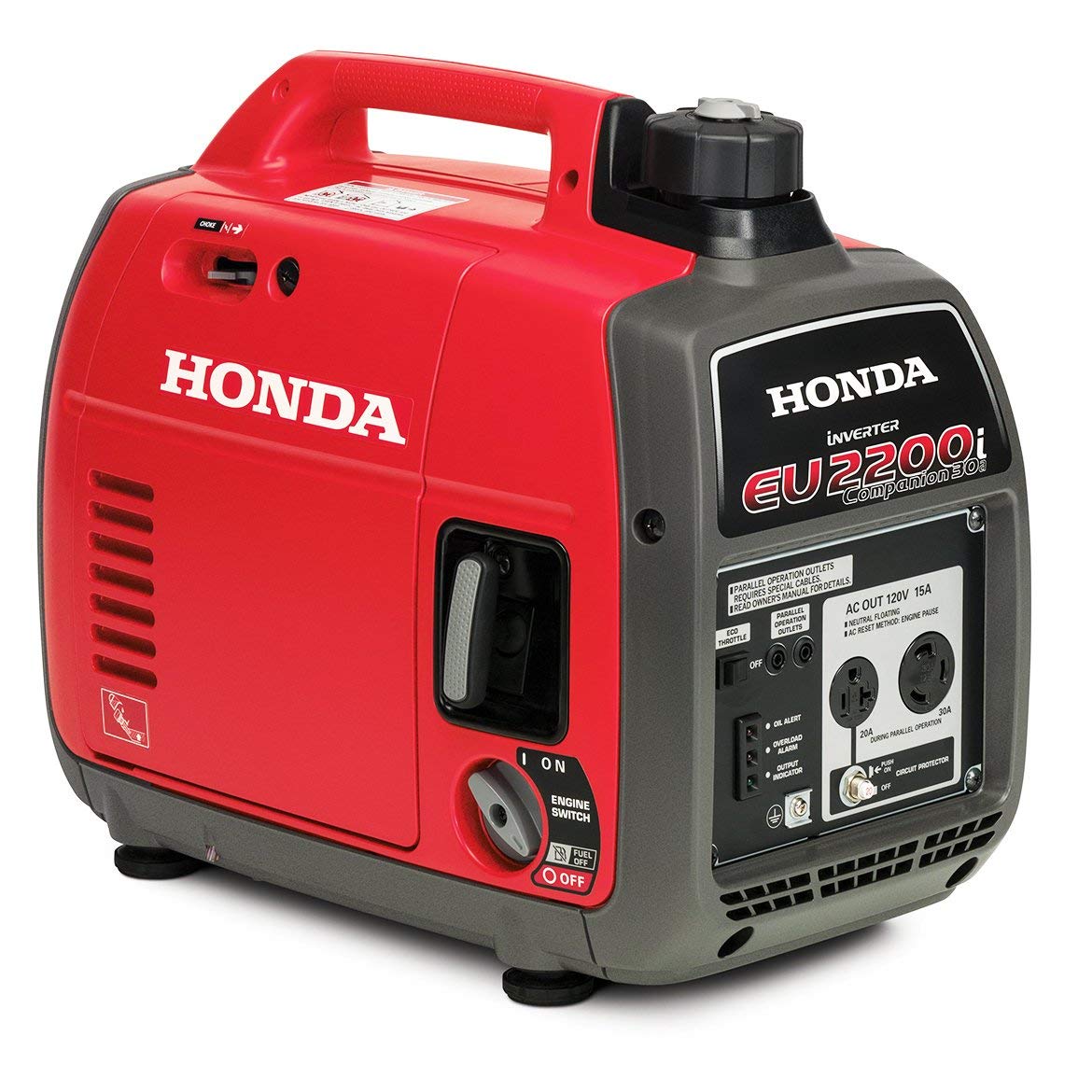
Best overall
Honda EU2200i Inverter Generator
- 1800W running / 2200W peak output
- gasoline
- Quiet at 48-57 dBA
- Up to 3.2h @ rated load / 8.1h @ 1/4 load runtime
As an Amazon Associate, we earn from qualifying purchases.
Honda EU2200i review
When the thing you are protecting is a $2,000 laptop or a medical device, reliability is not a luxury — it is the whole point. The Honda EU2200i delivers pure sine-wave power with under 3% THD, meaning voltage stays rock-steady even as loads cycle on and off. That is cleaner than most household outlets, and it is why the EU2200i has been the default recommendation for electronics for over a decade.
The 1,800 running watts handle a laptop, phone chargers, a Wi-Fi router, LED lights, and a CPAP machine simultaneously with room to spare. Eco-Throttle drops engine speed at light loads, which does two things electronics owners love: it stretches fuel to 8+ hours per gallon and drops noise to a whisper-quiet 48 dBA. Your devices charge silently in the background while you work or sleep.
Honda’s legendary reliability matters more here than anywhere else — a generator that fails during an outage is an inconvenience; a generator that fries your electronics is a disaster. The EU2200i costs more than competitors, but it is the safest pair of hands for your devices.
Pros
- <3% THD pure sine-wave — safe for all electronics
- Ultra-quiet 48–57 dBA with Eco-Throttle
- 8.1h runtime at quarter load
- Legendary reliability
- Only 46.5 lbs
Cons
- Premium price
- 2,200W peak limits bigger appliances
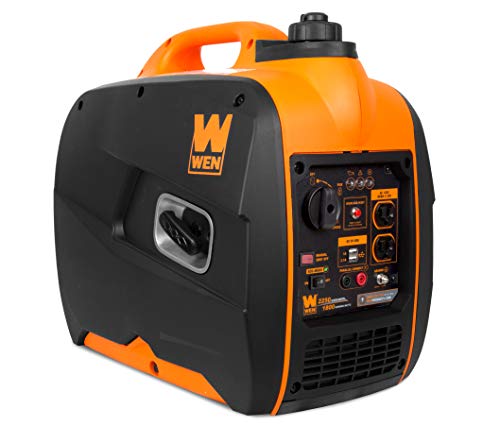
Best value
WEN 56225i Inverter Generator
- 1800W running / 2250W peak output
- gasoline
- Quiet at 53 dBA
- Up to 6h @ half load (1 gal) runtime
As an Amazon Associate, we earn from qualifying purchases.
WEN 56225i review
The WEN 56225i is proof that clean power does not have to cost Honda money. Its inverter produces under 1.2% THD — actually cleaner than the Honda on paper — making it fully safe for laptops, phones, tablets, and medical devices. At roughly half the price of the EU2200i, it is the value king of this list.
You get 1,800 running watts and 2,250 starting watts, enough for a full electronics charging station plus lights and a small fan. The fuel shut-off feature is a thoughtful touch: it lets the carburetor run dry before storage, preventing the varnish buildup that kills so many budget generators. At 53 dBA it is quiet enough for campgrounds and neighborhoods.
WEN’s long-term durability record is shorter than Honda’s, and service centers are fewer — fair caveats at this price. But for clean, quiet electronics power on a budget, the 56225i is genuinely hard to beat in 2027.
Pros
- <1.2% THD — exceptionally clean power
- Half the price of premium rivals
- Fuel shut-off prevents storage damage
- Quiet 53 dBA
- Parallel-capable
Cons
- Shorter brand track record
- Thinner service network
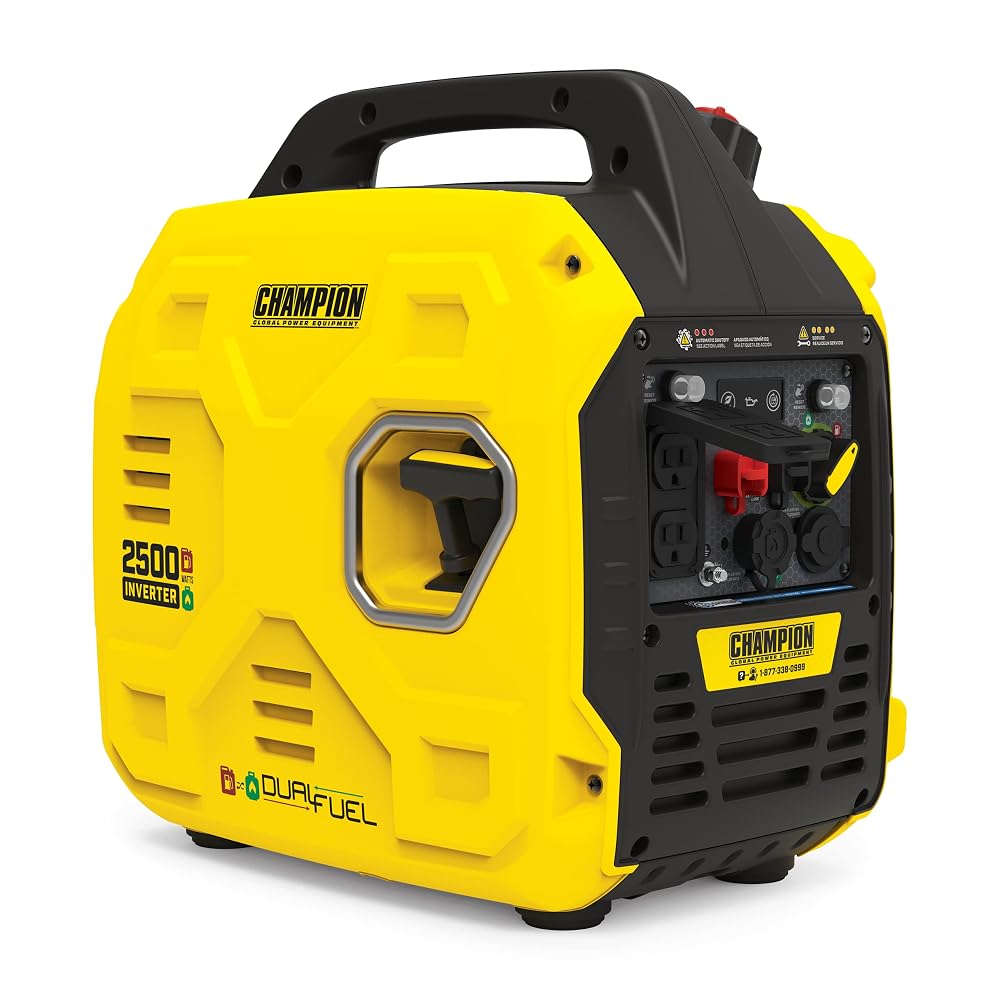
Best dual-fuel
Champion 201323 2500W Dual-Fuel Inverter Generator
- 1850W (gasoline), 1665W (propane) running / 2500W peak output
- dual fuel (gasoline/propane)
- Quiet at 53 dBA
- Up to up to 11.5h gasoline / 25h propane (@25% load) runtime
As an Amazon Associate, we earn from qualifying purchases.
Champion 201323 2500W Dual-Fuel review
Propane is the ideal fuel for a generator that protects electronics: it never goes stale, burns cleaner (less carbon buildup on engine parts), and many households already have tanks on hand. The Champion 201323 pairs that convenience with clean inverter power — 1,850 running watts on gasoline, 1,665 on propane — safe for every device you own.
At 53 dBA it is as quiet as the best in class, and the 43.2-lb weight makes it the lightest generator on this list — easy to carry with one hand. Runtime is a standout: up to 11.5 hours on gasoline or a remarkable 25 hours on propane at quarter load. For multi-day outages where you are keeping phones, laptops, and a refrigerator running, that endurance matters.
Wattage is the limitation: 2,500 peak watts will not run power-hungry appliances alongside your electronics. And like all dual-fuel models, output drops about 10% on propane. But as a clean-power machine optimized for devices and light loads, it is superb.
Pros
- Dual fuel — propane never goes stale
- Clean inverter power for electronics
- Lightest on this list at 43.2 lbs
- Up to 25h runtime on propane
- Quiet 53 dBA
Cons
- 2,500W peak limits larger appliances
- ~10% less power on propane
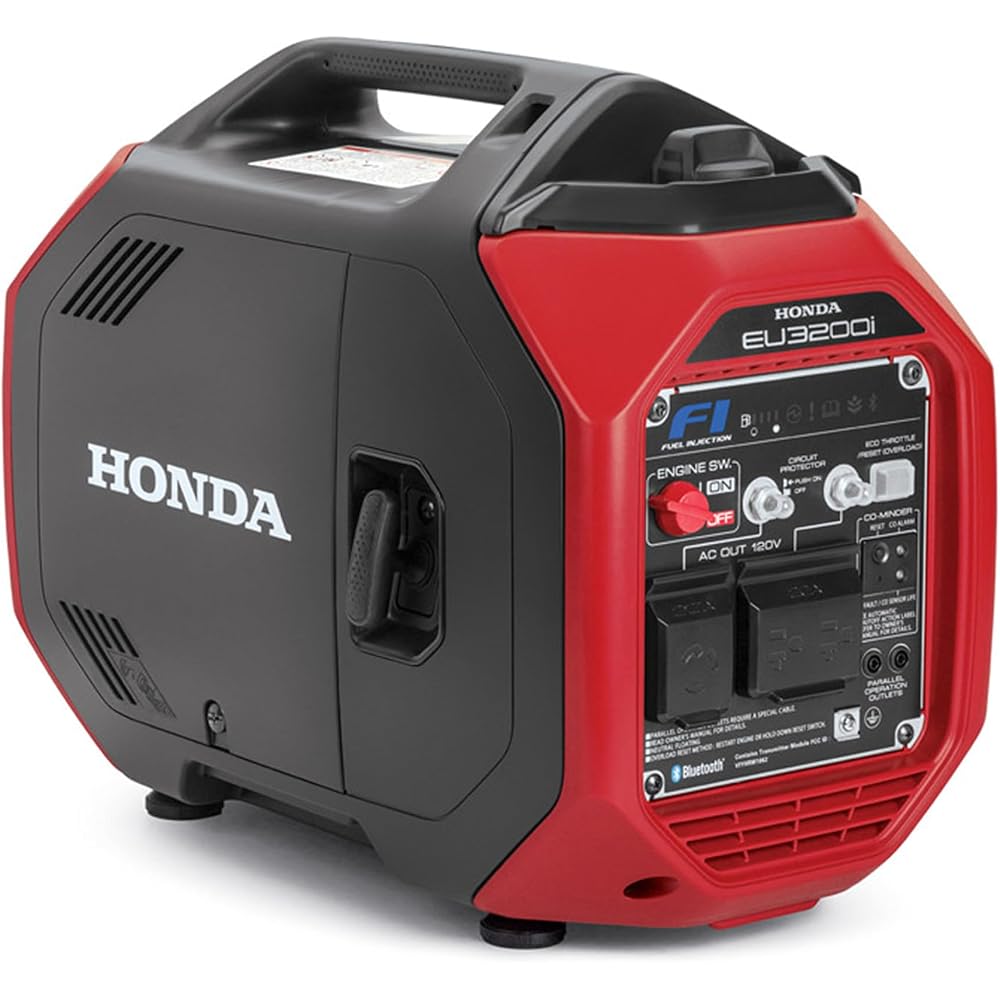
Best for RV + electronics
Honda EU3200i Inverter Generator
- 2600W running / 3200W peak output
- gasoline
- Quiet at 54-58 dBA
- Up to 3.3h @ rated load / 8.6h @ 1/4 load runtime
As an Amazon Associate, we earn from qualifying purchases.
Honda EU3200i review
Sometimes you need clean power and serious wattage at the same time — an RV air conditioner plus laptops, or a home office plus a refrigerator during an outage. The Honda EU3200i delivers 2,600 running watts and 3,200 peak watts of pure sine-wave inverter power, a big step up from the 2,200W class, in a package that is still genuinely portable at 59 lbs.
This is Honda’s premium inverter, and it shows: a fuel-injected GX130 engine for easy starting in any weather, Bluetooth smartphone monitoring, a 30-amp locking outlet, and CO-MINDER carbon monoxide shutdown. At 54–58 dBA it is remarkably quiet for its output — you can run the RV AC and still hold a conversation outside.
The price is firmly premium, and at 59 lbs it is heavier than the smaller inverters (though still one-person portable). But if your electronics share duty with bigger loads, the EU3200i is the no-compromise answer.
Pros
- 2,600W/3,200W of clean inverter power
- Fuel-injected engine — easy starts
- Bluetooth monitoring + CO-MINDER
- Runs RV AC + electronics together
- Still portable at 59 lbs
Cons
- Premium price
- Heavier than 2,200W-class models
Most power, still portable
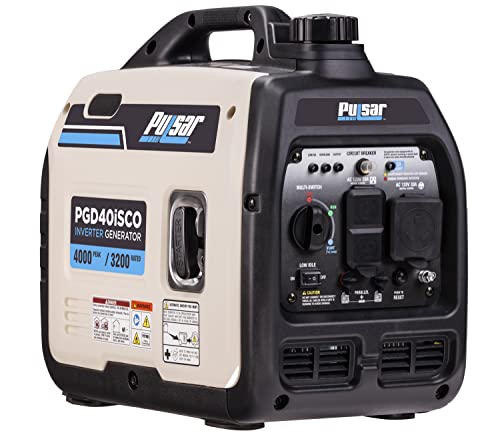
Pulsar PGD40iSCO Inverter Generator
- 3200W running / 4000W peak output
- gasoline
- Quiet at 59 dB
- Up to 4h @ half load (1 gal) runtime
As an Amazon Associate, we earn from qualifying purchases.
Pulsar PGD40iSCO review
The Pulsar PGD40iSCO is the outlier on this list: 3,200 running watts and 4,000 peak watts — double the Honda EU2200i — in a 47-lb inverter with under 3% THD. That means clean, electronics-safe power at a scale that can also run a refrigerator, a microwave, or an RV air conditioner. No other portable inverter packs this much clean power per pound.
The TT-30R RV outlet, CO Sentry auto-shutdown, and 3-year warranty round out a strong package. For a home office backup that needs to keep computers, monitors, routers, and a fridge running through an outage, the PGD40iSCO hits a sweet spot that smaller inverters cannot reach.
At 59 dB it is louder than the 2,200W-class whisper-quiet models, and the 1-gallon tank means about 4 hours at half load — plan refueling accordingly. But if you want maximum clean watts in a carryable package, this is it.
Pros
- 3,200W/4,000W of <3% THD clean power
- Only 47.3 lbs — best power-to-weight
- RV-ready TT-30R outlet
- CO Sentry protection
- 3-year warranty
Cons
- 59 dB is audible
- Small tank — ~4h at half load
Best budget
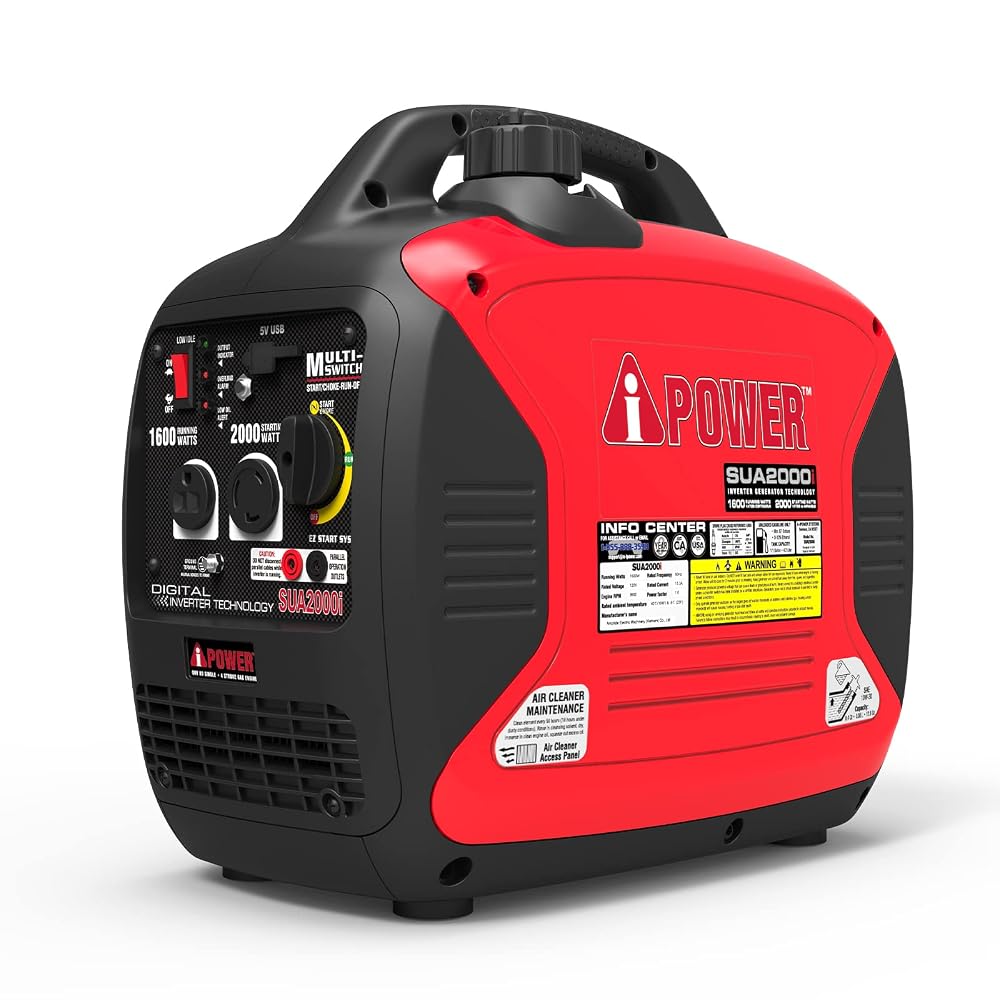
A-iPower SUA2000iV Inverter Generator
- 1600W running / 2000W peak output
- gasoline
- Quiet at 52 dBA
- Up to 7h @ 50% load (1.1 gal) runtime
As an Amazon Associate, we earn from qualifying purchases.
A-iPower SUA2000iV review
Not everyone needs to spend $500+ to protect their electronics. The A-iPower SUA2000iV delivers under 3% THD pure sine-wave power — genuinely safe for laptops, phones, and tablets — at a street price that often dips under $400. Its 1,600 running watts and 2,000 peak watts cover a full charging station: laptop, phones, tablet, router, and LED lights.
Low Idle technology keeps noise down to 52 dBA and stretches the 1.1-gallon tank to 7 hours at half load. At 48 lbs it is easy to carry, and the compact footprint stores in a closet or car trunk without complaint.
This is a budget machine, so set expectations accordingly: the feature set is basic, the brand lacks Honda’s service network, and 2,000 peak watts is the floor of usefulness. But as the cheapest safe way to power electronics in 2027, the SUA2000iV earns its place.
Pros
- <3% THD clean power under $400
- Quiet 52 dBA with Low Idle
- 7h runtime at half load
- Light and compact at 48 lbs
Cons
- Basic feature set
- 2,000W peak is modest
- Thinner service network
What to avoid when buying for electronics
Skip conventional open-frame generators for device duty. They are cheaper per watt, but their THD often exceeds 10% and voltage can spike when large loads cycle. That is fine for a circular saw; it is not fine for a MacBook. If a listing does not say “inverter” and does not publish a THD figure, assume it is not electronics-safe.
Be wary of no-name brands with no THD spec. Reputable inverter makers publish THD numbers (under 3% is the standard claim). If a bargain generator claims “clean power” but provides no measurement, no independent reviews, and no warranty worth the name, your devices are the gamble.
Do not daisy-chain cheap power strips. A generator feeding a $9 power strip feeding $3,000 of electronics is a false economy. Use one quality surge protector with a proper joule rating, keep cords untangled and dry, and never exceed the strip’s amperage rating.
Do not run the generator at 100% load continuously. Inverters are happiest at 50–80% of rated output. Running maxed out increases THD, heat, noise, and wear — and leaves no headroom for startup surges. If your load calculation lands near a generator’s limit, size up one class.
Electronics-safe generator comparison
| Generator | Running / Peak | THD | Noise | Weight | Best for |
|---|---|---|---|---|---|
| Honda EU2200i | 1,800W / 2,200W | <3% | 48–57 dBA | 46.5 lbs | Overall |
| WEN 56225i | 1,800W / 2,250W | <1.2% | 53 dBA | 48.5 lbs | Value |
| Champion 201323 | 1,850W / 2,500W | Clean sine | 53 dBA | 43.2 lbs | Dual-fuel |
| Honda EU3200i | 2,600W / 3,200W | <3% | 54–58 dBA | 59.1 lbs | RV + electronics |
| Pulsar PGD40iSCO | 3,200W / 4,000W | <3% | 59 dB | 47.3 lbs | Max clean watts |
| A-iPower SUA2000iV | 1,600W / 2,000W | <3% | 52 dBA | 48 lbs | Budget |
What makes a generator safe for electronics?
Total harmonic distortion (THD) is the key spec. THD measures how clean the power sine wave is. Anything under 3% is safe for sensitive electronics; under 5% is acceptable for most devices. Conventional generators can exceed 10% THD under varying loads — that is what damages circuit boards. Every generator on this list is an inverter with clean output.
Size for your actual load. Add up the watts of the devices you will run simultaneously: a laptop (65W), phone chargers (20W each), Wi-Fi router (15W), LED lights (40W), and a CPAP (90W) total under 300W — easily handled by any model here. Add a refrigerator (700W running, 2,200W starting) and you need at least a 2,500W-class inverter.
Do not forget surge protection. Even with clean inverter power, a quality surge protector between the generator and your expensive devices is cheap insurance against voltage spikes during startup and shutdown.
Grounding matters. Most portable inverter generators are “floating neutral” designs that are safe for cord-connected electronics. If you connect to a home panel via transfer switch, follow the manufacturer’s grounding instructions and local code.
Let it warm up. Start the generator and let it stabilize for a minute before plugging in sensitive devices, and unplug devices before shutting down. This avoids exposing electronics to voltage fluctuations during startup and shutdown transients.
Generator for electronics FAQs
Can I plug my laptop directly into a portable generator?
Yes — if it is an inverter generator with under 3% THD, like every model on this list. Conventional (non-inverter) generators can damage laptops with voltage fluctuations. For extra safety, use a surge protector between the generator and your laptop.
What is THD and why does it matter for electronics?
Total harmonic distortion measures how “clean” the electrical sine wave is. Wall outlet power is typically under 3% THD. Inverter generators match or beat that. Conventional generators can exceed 10%, which causes overheating in motors, glitches in microprocessors, and cumulative damage to circuit boards.
Can a generator damage my phone or tablet?
A conventional generator with dirty power can, over time. An inverter generator with clean sine-wave output will not — it is as safe as a wall outlet. Using the original manufacturer chargers (rather than cheap knockoffs) adds another layer of protection.
Is it safe to run a CPAP machine on a portable generator?
Yes, on an inverter generator. CPAP machines are sensitive medical devices that require stable, clean power — exactly what inverters deliver. Size the generator so the CPAP (typically 90W, more with heated humidifier) is well within capacity, and keep a battery backup as a secondary option.
Do I need a special cord to connect electronics to a generator?
No special cord needed — standard extension cords work. Use a heavy-duty outdoor-rated cord (12-gauge for longer runs), keep connections dry, and plug sensitive devices into a surge protector rather than directly into the generator.
Can I charge a power station or battery bank from a generator?
Yes, and it is a great combination: the generator recharges the power station in a few hours, then you shut the generator off and run silent battery power overnight. Make sure the generator’s wattage exceeds the power station’s input rating.
Our verdict
For protecting electronics, the Honda EU2200i remains the safest choice in 2027 — proven clean power, whisper-quiet, and utterly reliable. On a budget, the WEN 56225i delivers even cleaner power (<1.2% THD) for about half the price. If you need more watts alongside your devices, step up to the Honda EU3200i.

Related Guides
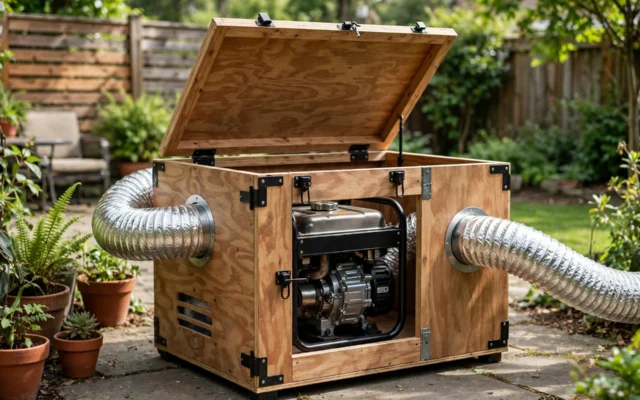
DIY Generator Quiet Box: How to Build a Noise-Reduction Enclosure
A DIY generator quiet box can cut noise 10–20 dB — but ventilation and CO safety are the whole project. Materials, baffle design, fan sizing, and the mistakes to avoid.

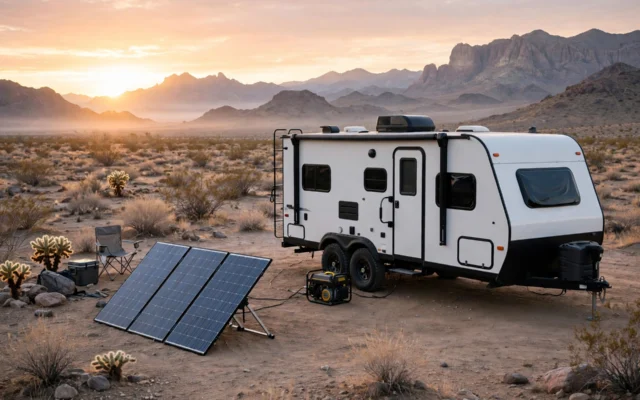
Boondocking Power Setup: Generator + Solar for Off-Grid Camping
The ideal boondocking power setup pairs solar with a generator and battery bank. Real daily load math, sizing tiers, and the generator run strategy that sips fuel.
RV Generator Quiet Hours & Campground Etiquette Guide
RV generator quiet hours are usually 10pm–8am, with limited daytime generator windows in national parks. The rules, the unwritten etiquette, and how to stay neighborly.